Repository navigation
ISO 13855 separation distance
Standards tour · stop 10 of 20 · ← ISO 13857 · ISO/TS 15066 →
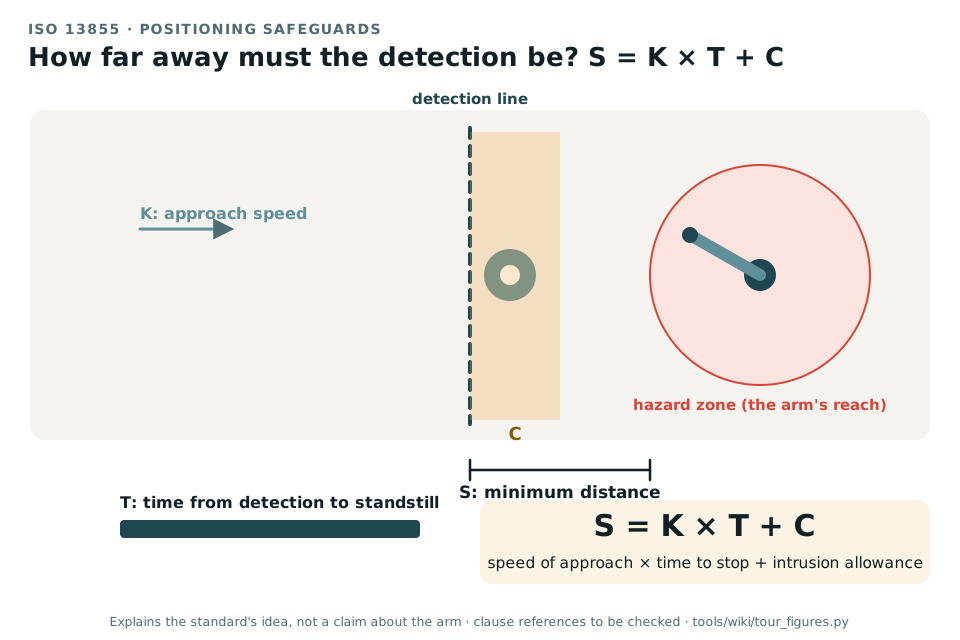
A person approaches at speed K and crosses a detection line; the time T from detection to standstill runs while they keep moving. The minimum distance S from the detection line to the hazard zone is K × T plus an intrusion allowance C. Generated by tour_figures.py; it explains the standard's idea and claims nothing about the arm.
In one sentence. ISO 13855 says how far from a hazard a detecting safeguard must be: far enough that a person moving at a standard speed cannot arrive before the machine has stopped.
ISO 13855:2024, Safety of machinery: positioning of safeguards with respect to the approach of the human body. A type-B standard that turns a measured stopping time into a minimum distance:
S = K × T + C
- K, the approach speed of a person or a body part, a value the standard gives.
- T, the overall time from detection to standstill: the detection device's response, the control system's reaction and the machine's stopping time.
- C, an intrusion allowance: how far a hand or body reaches past the detection zone before it is detected, which depends on what the device can detect.
The faster a person can approach and the longer the machine takes to stop, the further out the detection must be. A safeguard placed closer than S is too late, however reliable it is.
The record's recommended position for the first safety case is separation: no contact with a person is claimed, so keeping people out of reach while the arm moves is what makes it safe (DQ-005, answered). Where a person may stand follows from this formula, and the formula needs the arm's measured stopping time, which nobody has measured yet. No separation plan exists (GAP-06).
| What the record takes | Where |
|---|---|
| The approach speeds and intrusion allowance, and the form of the derivation | Human-robot interaction, WP-C-06 |
| The response-time and stopping budget that gives T | WP-S-04 |
| Measuring the stopping performance | WP-V-02 |
| Validating the separation | WP-V-03 |
Any separation distance. The arm has no detection device today, and T is unknown until the stopping tests run.
- Detection zone: the zone in which a protective device detects a person.
- Approach speed (K): the speed the standard assumes for a walking body or a reaching hand.
- Overall system stopping performance (T): the time from detection to standstill.
- Intrusion distance (C): how far a body part reaches past the detection zone before it is detected.
No standard is held by the project, so every clause number on this page is to be checked against a licensed copy. The lead decided to buy them only when an assessor is engaged (DQ-011).
| Clause | What it covers |
|---|---|
| §5 | The general formula and its terms |
| §6 | Approach speeds, stopping performance and the minimum distance for the kinds of safeguard, as the record cites it |
Standards tour · stop 10 of 20 · ← ISO 13857 · ISO/TS 15066 →