Repository navigation
IEC 61508 functional safety
Standards tour · stop 5 of 20 · ← IEC 62061 · EN 60204-1 →
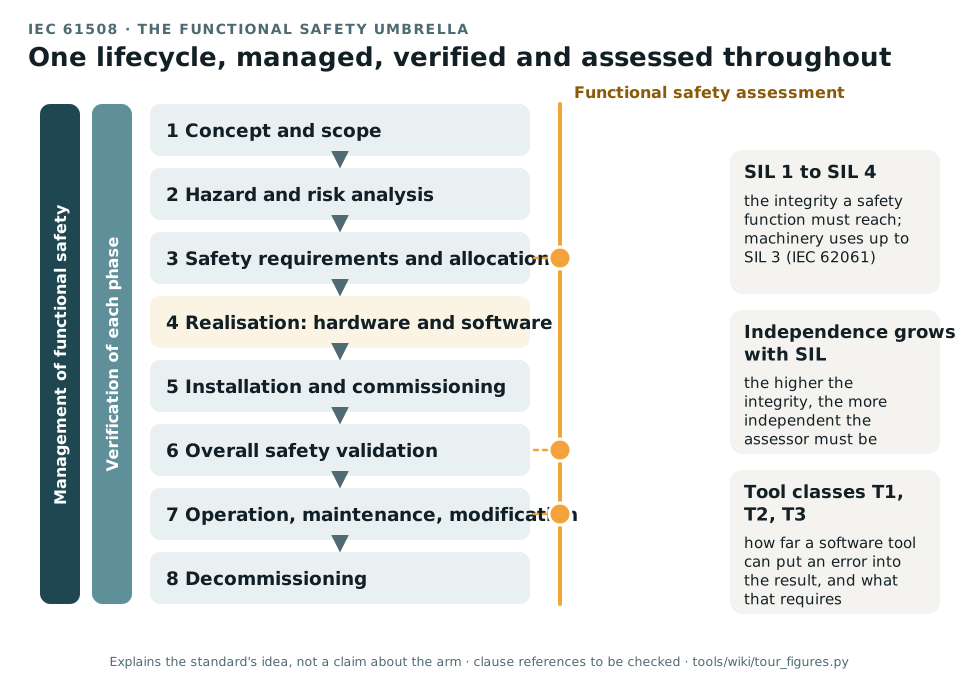
The overall safety lifecycle of IEC 61508 as eight phases, with management of functional safety and verification running beside every phase and a functional safety assessment checking the key points. Generated by tour_figures.py; it explains the standard's idea and claims nothing about the arm.
In one sentence. IEC 61508 is the parent of the functional safety standards: one lifecycle for electrical, electronic and programmable safety systems, managed, verified and independently assessed from concept to scrapping.
IEC 61508:2010, Functional safety of electrical/electronic/programmable electronic safety-related systems, seven parts. It is a basic safety publication: sector standards are written from it, IEC 62061 for machinery among them. Part 1 holds the lifecycle, management and assessment; Part 2 the hardware; Part 3 the software; Part 4 the definitions.
Safety is built through a lifecycle: concept and scope, hazard and risk analysis, safety requirements and their allocation to systems, realisation in hardware and software, installation and commissioning, validation, operation and modification, decommissioning. Three things run beside every phase:
- Management of functional safety: who is responsible, competent and independent for what.
- Verification: each phase checks that its outputs meet its inputs.
- Functional safety assessment: an independent judgement that functional safety has been achieved; the more integrity the function needs, the more independent the assessor must be.
Integrity is rated as a SIL, 1 to 4. Software tools are classified T1 to T3 by how far they can put an error into the result, from a text editor (T1) to a compiler or code generator (T3).
The machinery standards say little about how the work is managed and assessed. IEC 61508 fills that gap, and it would govern the software of the controller safety layer if that layer ever carried a safety function.
| What the record takes | Where |
|---|---|
| Management of functional safety: roles, competence, independence | Safety plan, WP-M-02 |
| Confirmation measures and their independence | Confirmation measures plan, WP-M-06 |
| The functional safety assessment | WP-K-04; the question on engaging an independent assessor (DQ-009, answered) |
| Software tool classification T1 to T3 | WP-P-07 |
Any SIL. IEC 61508 supplies the management and assessment structure; the measure of a safety function stays the PL.
- E/E/PE: electrical, electronic and programmable electronic.
- Systematic capability: how well a component's design process guards against systematic faults, on the SIL scale.
- Functional safety assessment: an investigation, by someone independent, of whether functional safety has been achieved.
- T1, T2, T3: software tool classes; a T3 tool can put an error into the executable code.
No standard is held by the project, so every clause number on this page is to be checked against a licensed copy. The lead decided to buy them only when an assessor is engaged (DQ-011).
| Clause | What it covers |
|---|---|
| 61508-1 §6 | Management of functional safety |
| 61508-1 §7 | The overall safety lifecycle |
| 61508-1 §8 | Functional safety assessment |
| 61508-3 §7.4.4 | Requirements for support tools, including the classes T1 to T3 |
| 61508-4 | Definitions and abbreviations |
Standards tour · stop 5 of 20 · ← IEC 62061 · EN 60204-1 →