Repository navigation
Process maps
The integrated process model (WP-P-11) records every phase as activities in
discipline lanes, linked by the work products they consume and produce, with the cross-domain interfaces where one
discipline's analysis depends on another's and the confirmation measures of the gate. Everything on this page is
drawn from that model by process_figures.py and checked by CI,
so the swimlanes cannot disagree with the register, the safety plan or the confirmation plan. The same model also
generates a Mermaid map and an activity table per phase under maps/, linked from
each section below.
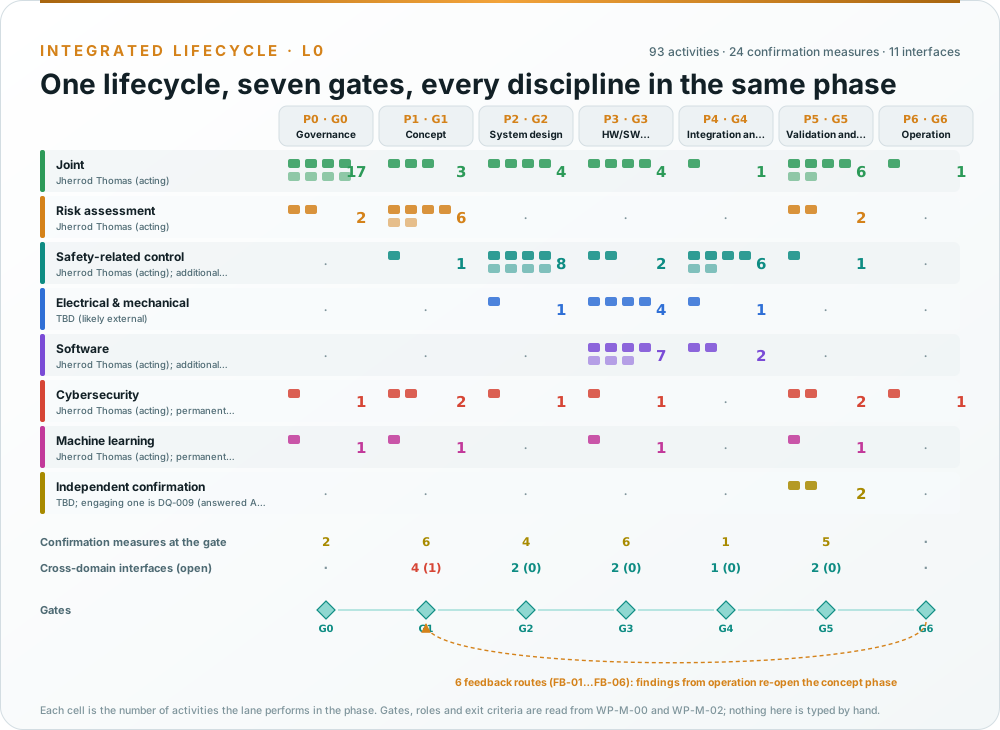
Read it row by row: the joint lane carries the governance phase almost alone, risk assessment peaks in the concept
phase, the safety-related control lane dominates design and verification, electrical and software work sits in
development, cybersecurity runs through every phase, and the independent confirmation lane acts at every gate. The
Mermaid version with the exit criteria is maps/lifecycle.md.
- One column per discipline present in the phase, with the role that owns it and who holds that role today, read from the safety plan.
- Top to bottom is dependency order. An arrow is a work-product input: the activity at its head cannot finish before the one at its tail. Arrows implied by a longer path are left out; the activity table in the Mermaid map lists every input.
- Chips name the work products produced, coloured by their register status: grey skeleton, amber draft, green approved. The colour comes from WP-M-00.
- Dotted links are cross-domain interfaces, anchored to text that occurs verbatim in both work products. Red means a recorded open item still has to settle it.
- The yellow band lists the confirmation measures the gate needs and whether a record exists; the teal bar is the gate and its exit criterion.
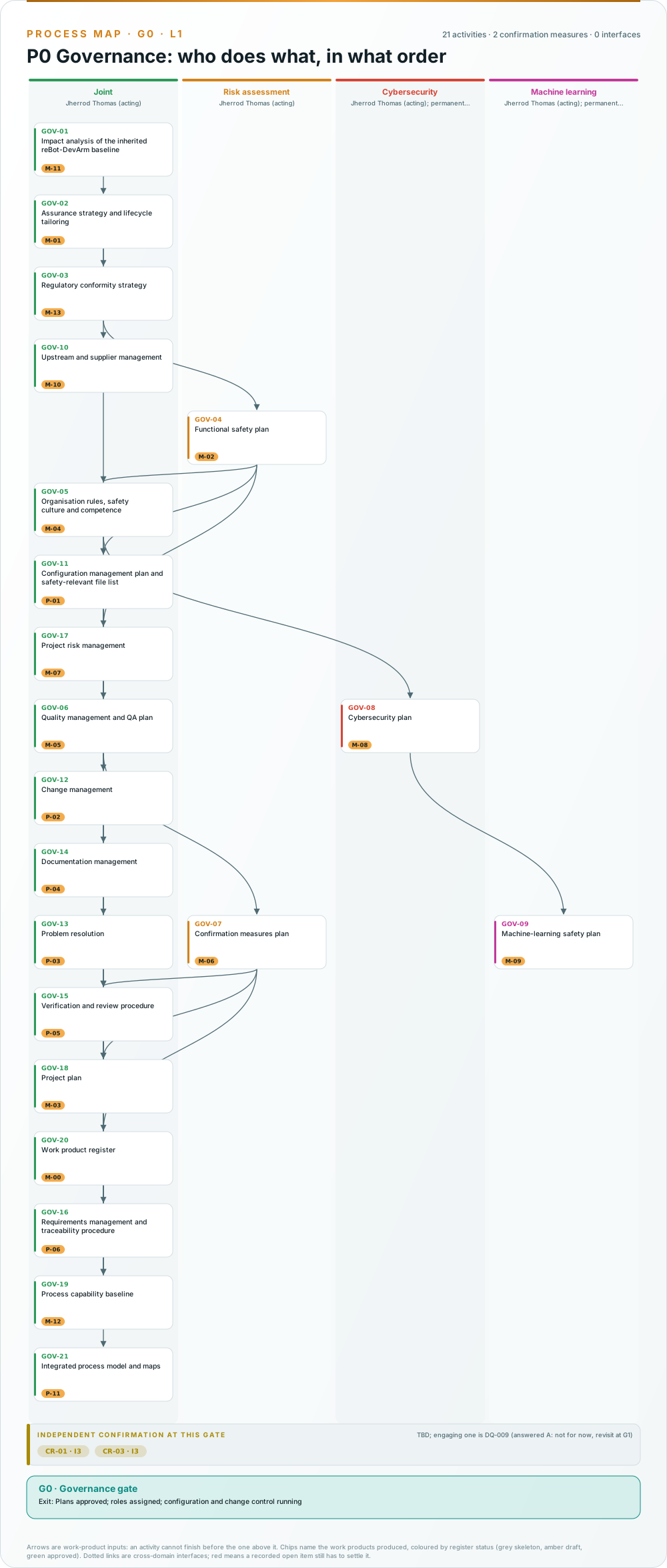
What to look for: the plans and procedures every later phase reads from; the roles still unassigned; whether the discipline plans and the safety plan agree on who holds each role. Mermaid map and tables: g0-governance.md · skeleton: G0.
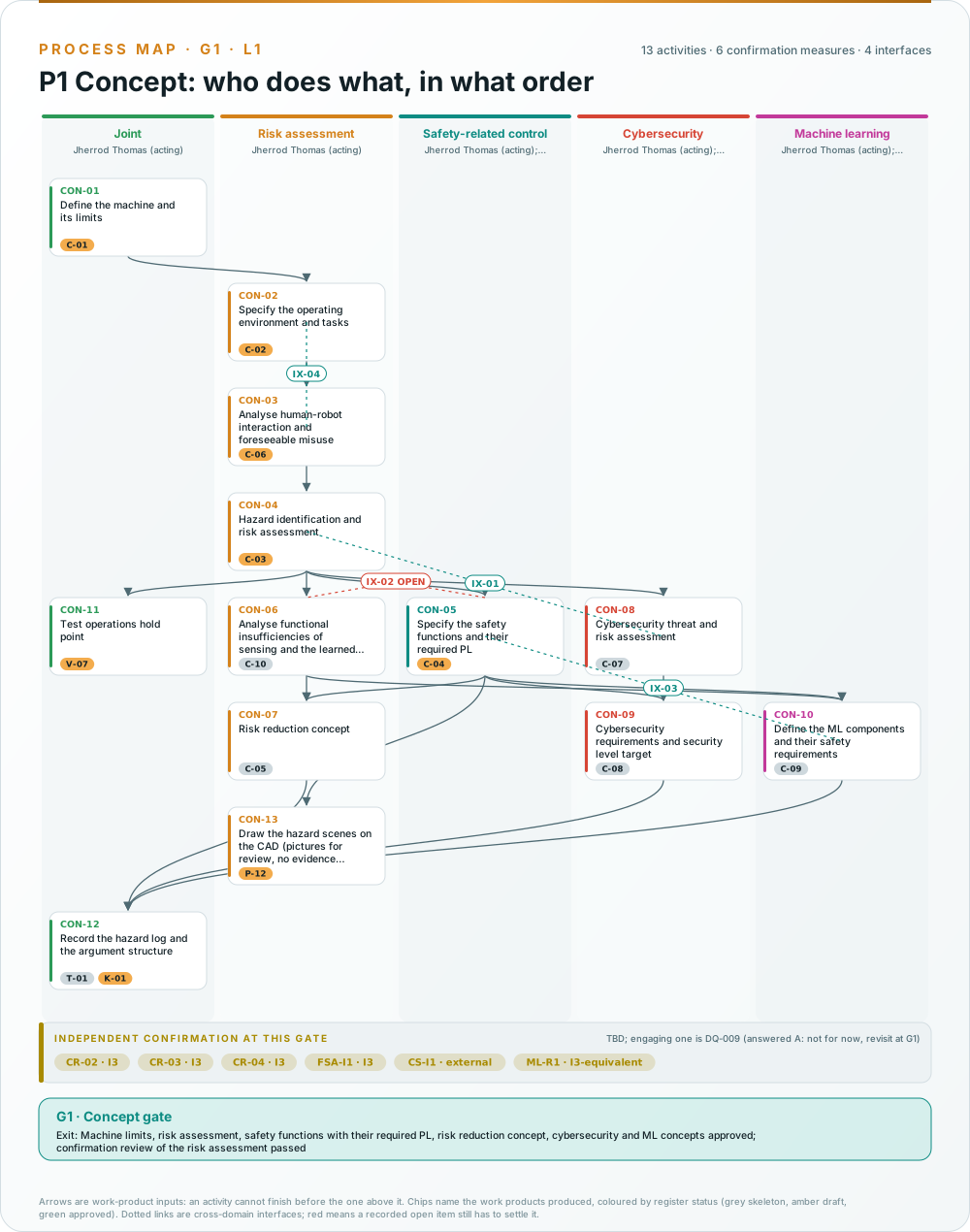
What to look for: the risk-assessment lane feeding the control-system lane; the one open interface, the sensing limit of the contact-detection functions, which waits on the collaborative-claim decision (DQ-005); six confirmation measures, none performed. Mermaid map and tables: g1-concept.md · skeleton: G1.
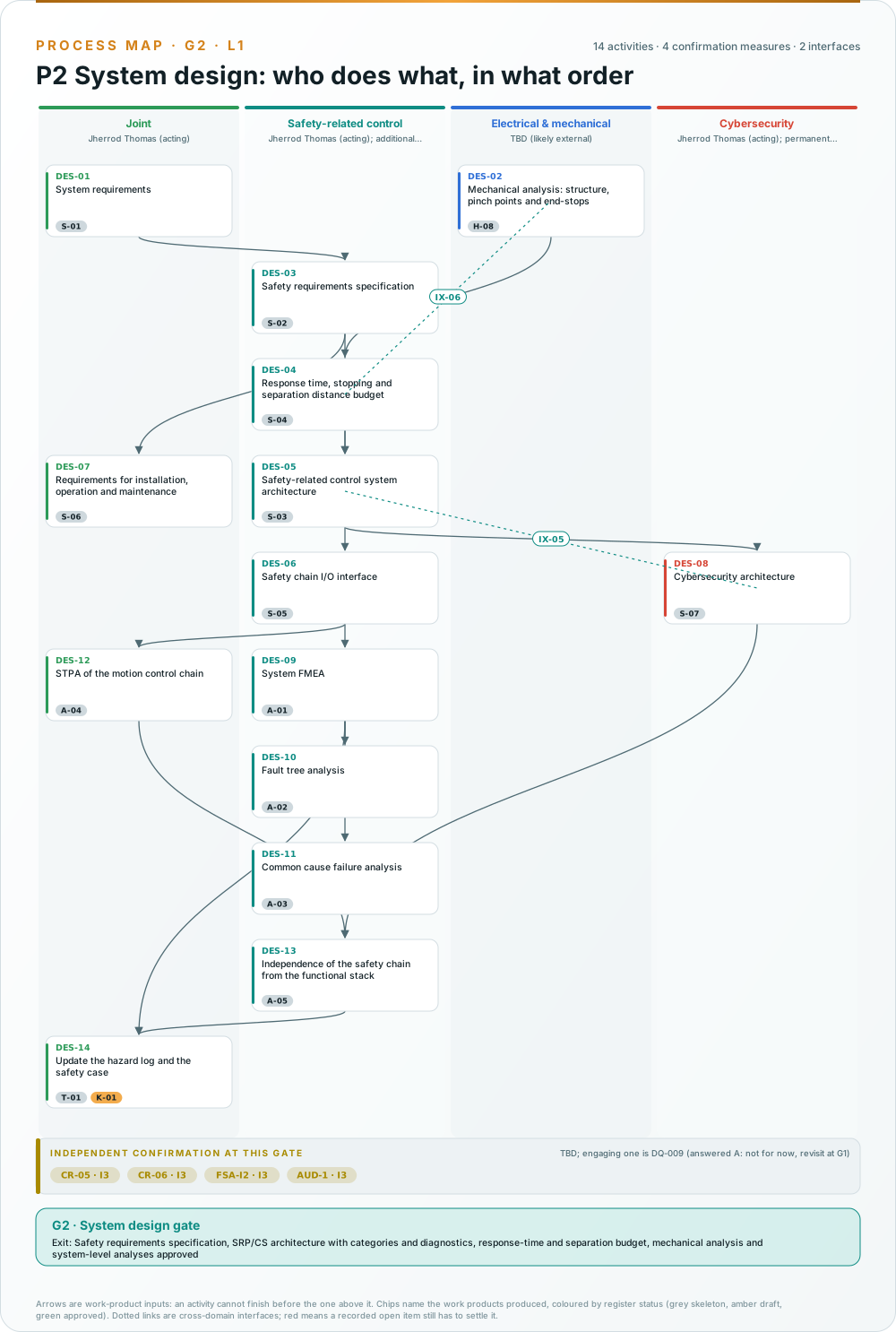
What to look for: the serial chain from the requirements specification to the independence analysis; the mechanical analysis (end-stops, pinch points, fixing) the stopping budget depends on; the safety and security interface in the architecture. Mermaid map and tables: g2-system-design.md · skeleton: G2.
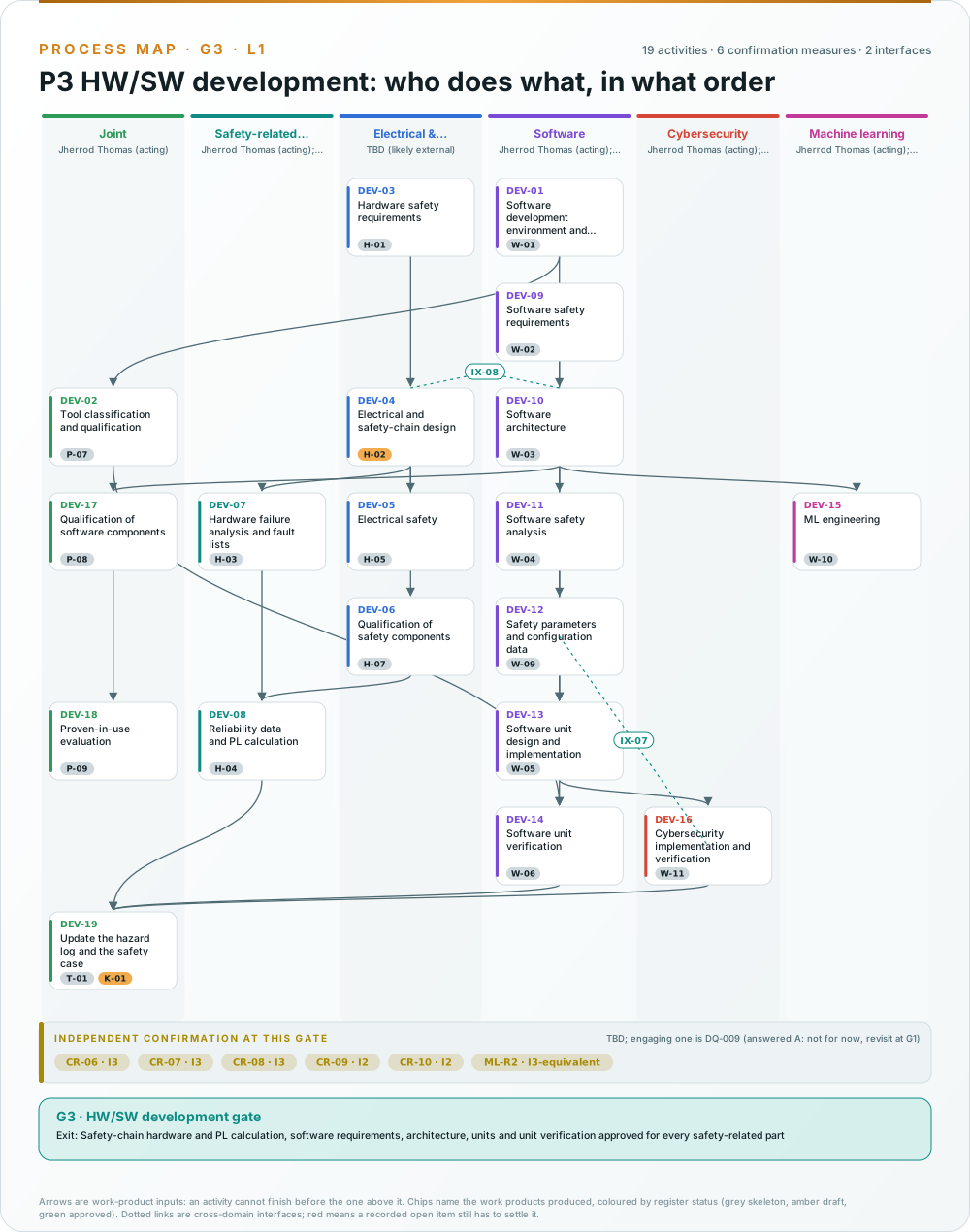
What to look for: the PL calculation waiting on fault lists, certificates, the actuator reliability data nobody has published yet and the common-cause score; the controller safety layer starting from a pinned build; the safety-parameter integrity interface between software and cybersecurity. Mermaid map and tables: g3-hw-sw-development.md · skeleton: G3.
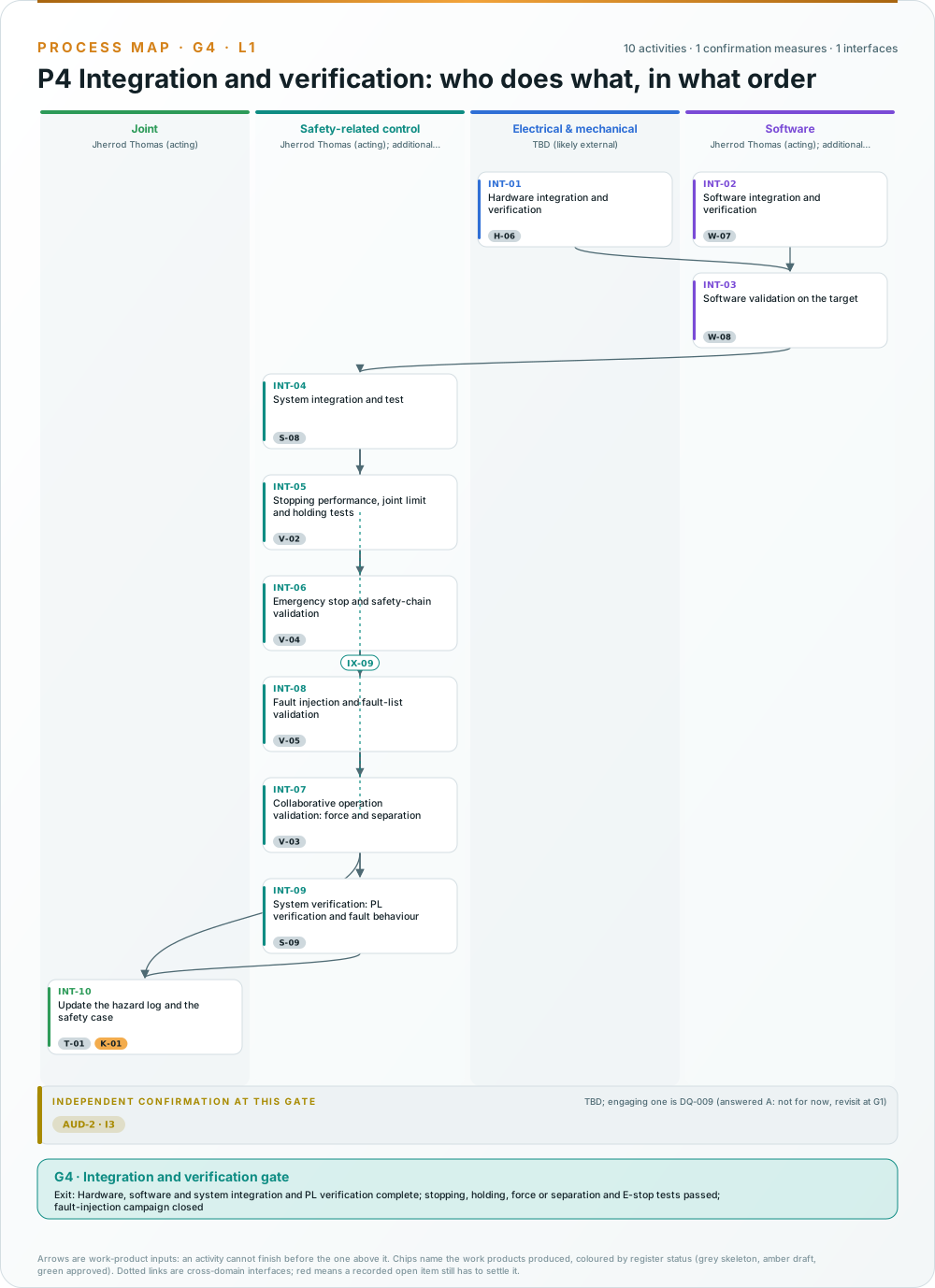
What to look for: every powered test under the hold point of WP-V-07; the stopping time and angle per joint measured before the separation distances are validated. Mermaid map and tables: g4-integration-and-verification.md · skeleton: G4.
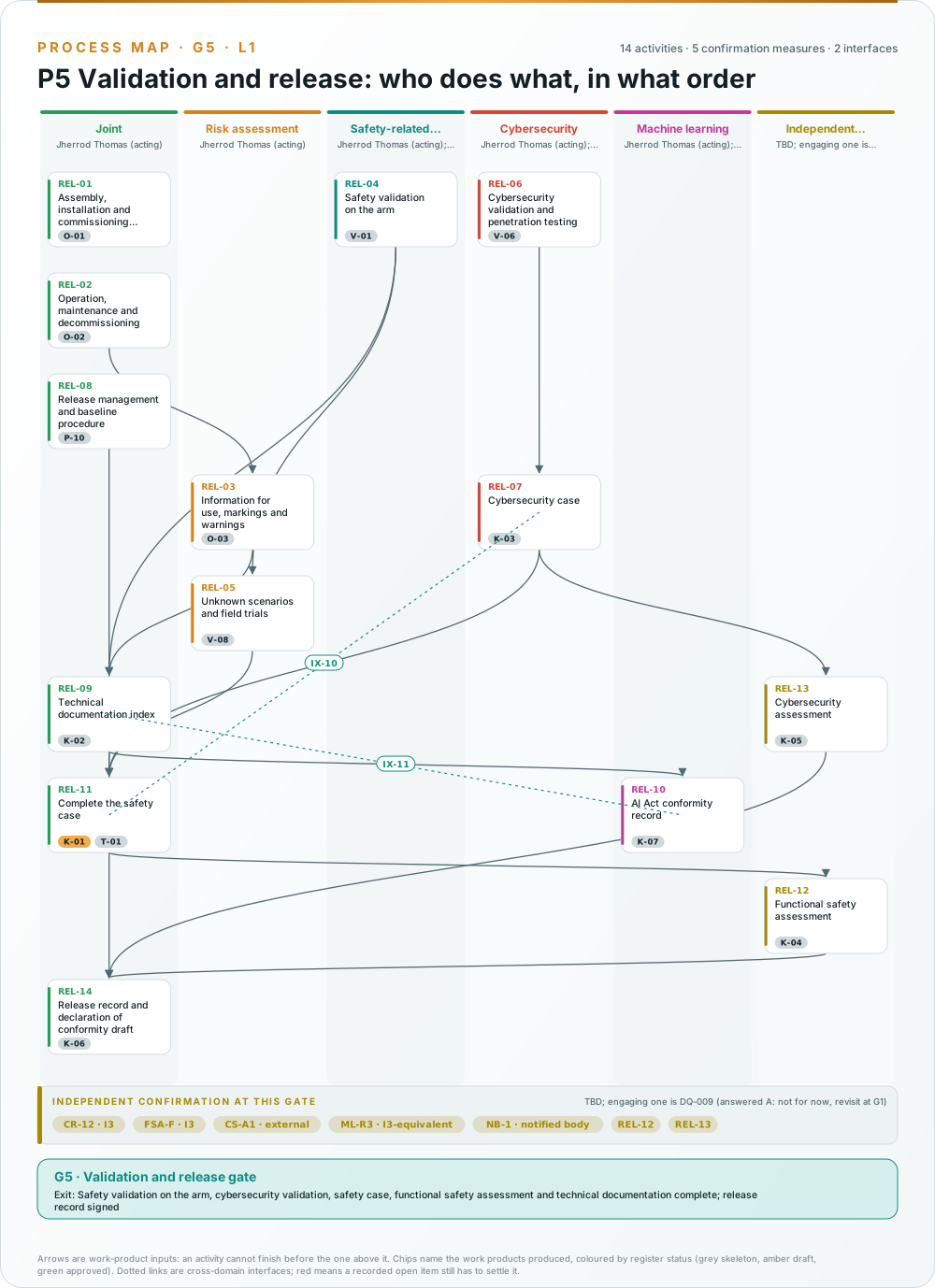
What to look for: the arguments meeting in the safety case; the assessments in the independent lane; the technical documentation shared between the Machinery Regulation and, if ever needed, the AI Act. Mermaid map and tables: g5-validation-and-release.md · skeleton: G5.
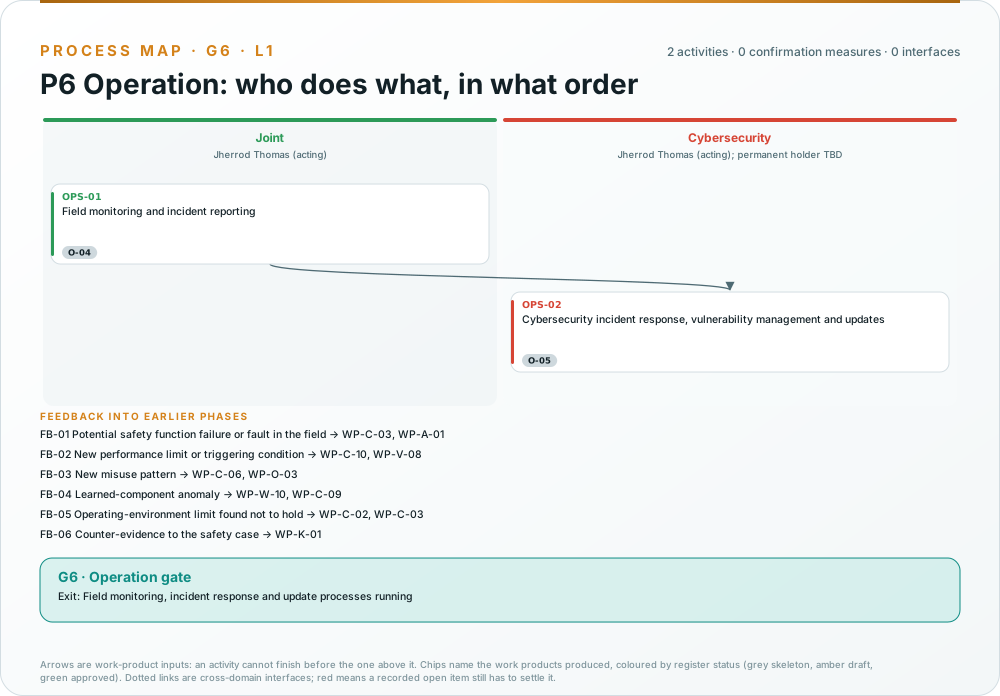
What to look for: the six feedback routes back into the concept phase, each anchored to the routing table of field monitoring. Mermaid map and tables: g6-operation.md · skeleton: G6.
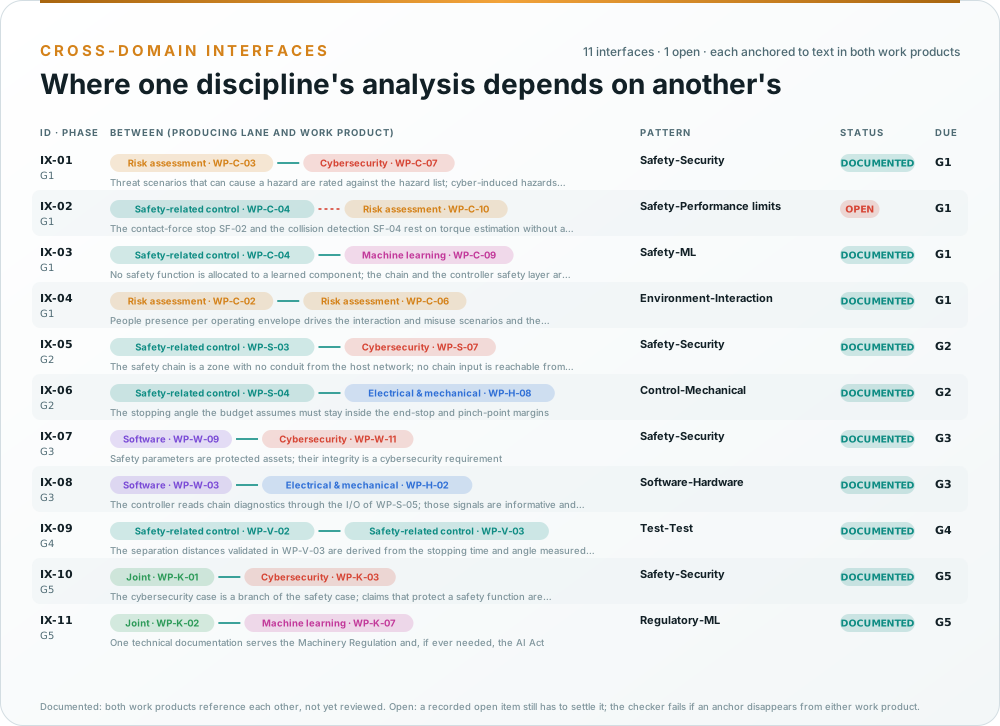
An interface is a point where one discipline's analysis depends on another's: safety and security, safety and performance limits, control and mechanical, software and hardware, regulatory and machine learning. Each is anchored to a sentence that occurs verbatim in both work products; the checker fails if either sentence disappears. Documented means the documents reference each other but nobody has reviewed the agreement yet.
For each gate the model also generates a pre-filled gate review skeleton in
10-safety-case/gates/skeletons/: the gate's work products with their
status and open-item counts, the confirmation measures and whether their records exist, the open interfaces, the
unassigned roles and the exit criteria as rows to fill. A skeleton is not a gate review; holding one means copying it
to a dated file and re-checking every value at the review baseline (gates README).
The model is data in assurance/process/model/: phases, lanes, activities, reviews,
interfaces and feedback routes in a flat YAML subset. Edit the records, run
python3 assurance/process/tools/process_model.py and python3 assurance/process/tools/process_figures.py, and
commit the records with the regenerated maps, skeletons and figures. The checkers (--check) fail in CI when a map
or figure is stale, an anchor disappears from a work product, a work product the register gates in a phase has no
producing activity, or the gate's confirmation measures differ from
WP-M-06 §9.