Repository navigation
ISO 13850 emergency stop
Standards tour · stop 7 of 20 · ← EN 60204-1 · ISO 13854 →
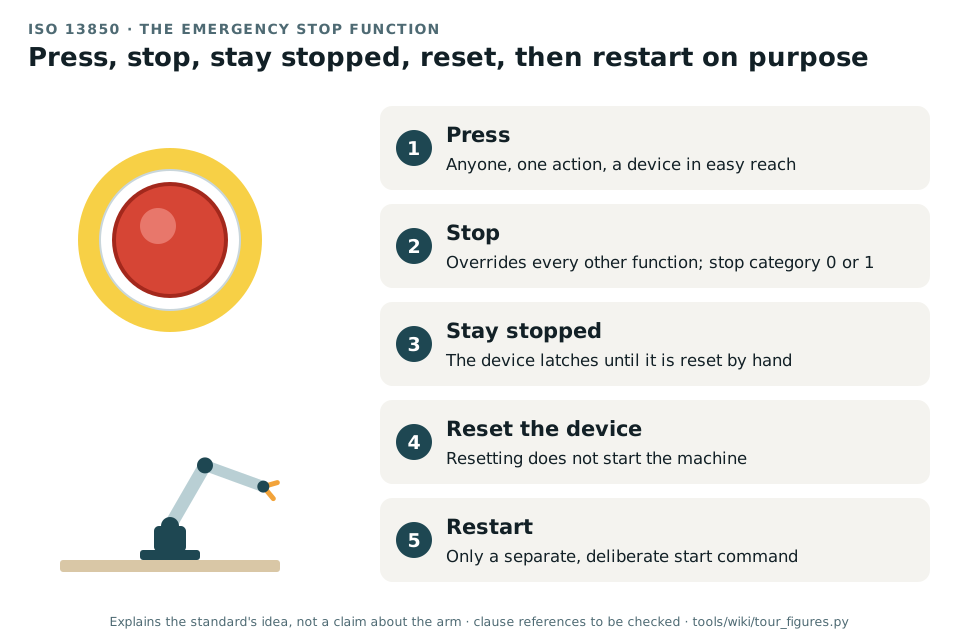
Press, stop, stay stopped, reset, restart on purpose: the five steps of an emergency stop. The arm keeps still through the reset and moves again only after a separate start command. Generated by tour_figures.py; it explains the standard's idea and claims nothing about the arm.
In one sentence. ISO 13850 says what an emergency stop must do: one action by anyone stops the machine, overriding everything else, and it stays stopped until a person resets it on purpose, without the reset starting anything.
ISO 13850:2015, Safety of machinery: emergency stop function, principles for design. A type-B standard. The emergency stop is a complementary protective measure: it backs up the safeguards, it does not replace them.
- Press. Anyone can trigger it with one action, on a device in easy reach: a red actuator on a yellow background.
- Stop. It overrides every other function and stops as a category 0 or category 1 stop (EN 60204-1), chosen from the risk assessment.
- Stay stopped. The device latches; the command stays until it is reset.
- Reset the device. Resetting is a deliberate manual act, and it must not start the machine.
- Restart. Only a separate start command moves the machine again.
How dependable the function must be is set by the risk assessment, as a PL under ISO 13849-1.
No emergency stop exists in upstream's documented design (GAP-08). The only stop is a software command, which a stalled program or a dropped connection can defeat. Until a real stop exists, the record's hold point allows no powered test with anyone in reach of the arm (WP-V-07).
| What the record takes | Where |
|---|---|
| The emergency stop as a safety function: motor supply removed by the contactor, latched until a deliberate reset | SF-32 in Safety functions and PLr, WP-C-04 |
| The manual reset that does not restart | SF-24 in the same work product |
| Its validation | WP-V-04 |
| The hardware on the bench before any powered test | The bench stop question (DQ-006, answered: a wired two-channel stop with a safety relay and contactor) |
That any arm has an emergency stop today, or that upstream's wireless stop meets the standard; that is one option of the open bench stop question.
- Emergency stop function: the function; emergency stop device: the button or pull-cord that triggers it.
- Latching: the device stays in its pressed state until reset.
- Reset: the deliberate act that releases the latch; it permits a restart, never causes one.
- Complementary protective measure: a measure that supports the safeguards, such as the emergency stop.
No standard is held by the project, so every clause number on this page is to be checked against a licensed copy. The lead decided to buy them only when an assessor is engaged (DQ-011).
| Clause | What it covers |
|---|---|
| §4 | Safety requirements: the function's priority, its stop category, latching and reset, and the device |
Standards tour · stop 7 of 20 · ← EN 60204-1 · ISO 13854 →