Repository navigation
ISO 12100 risk assessment
Standards tour · stop 1 of 20 · ← the tour · ISO 10218-1 and -2 →
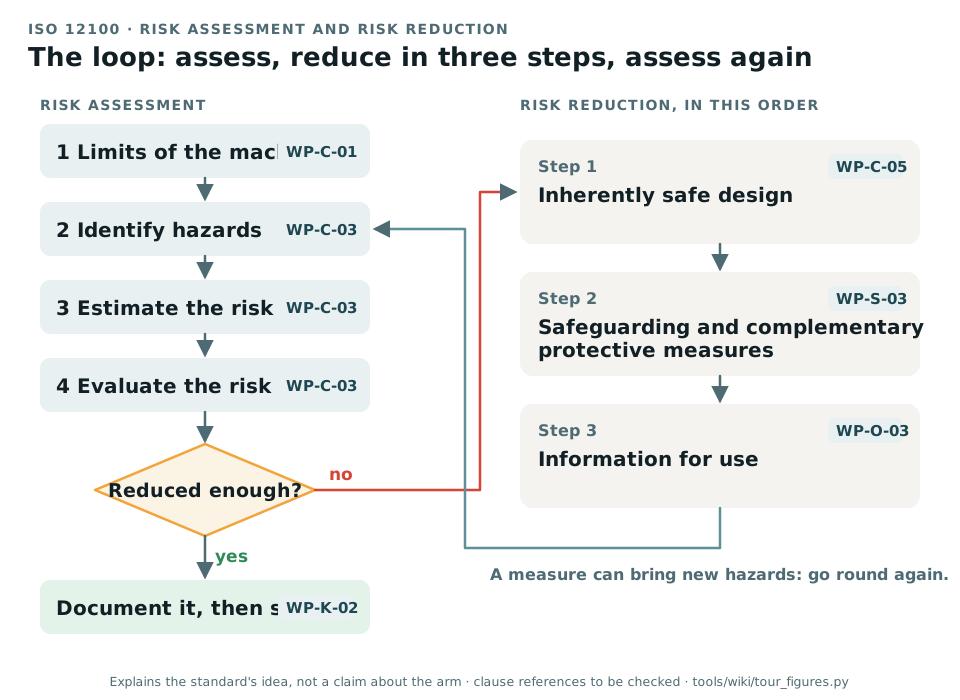
The loop of ISO 12100: four steps of risk assessment on the left, the three steps of risk reduction in their fixed order on the right, and round again until the risk is reduced enough. The chips name the work product of the record that does each step. Generated by tour_figures.py; it explains the standard's idea and claims nothing about the arm.
In one sentence. ISO 12100 is the method every machine starts with: decide what the machine is for and where its limits are, find what could hurt someone, judge how bad it is, and reduce it in a fixed order of preference.
ISO 12100:2010, Safety of machinery: general principles for design, risk assessment and risk reduction. It is the only type-A standard of the machinery set: it applies to every machine and gives the vocabulary and the method that every other machinery standard builds on (how the standards stack).
- Limits of the machine. What it is for and what people will predictably do with it anyway, the space it needs and sweeps, its life from transport to scrapping, and who is around it.
- Identify hazards in every phase of that life: transport, assembly, setting, use, cleaning, maintenance, decommissioning. The standard's annex lists the kinds: mechanical, electrical, thermal, noise, vibration, radiation, materials, ergonomics and the environment.
- Estimate the risk from how bad the harm could be and how likely it is: how often and how long people are exposed, how likely the hazardous event is, and whether they could avoid it.
- Evaluate whether the risk needs reducing.
- If it does, reduce it in order. First change the design so the hazard goes away or shrinks. Then add safeguarding: guards, protective devices, safety functions, complementary measures such as the emergency stop. Only then rely on information for use: warnings, instructions, training. A later step may not replace an earlier one that was reasonably practicable.
- Every measure is checked for new hazards it brings, so the loop runs again. The whole result is documented.
The arm is small, sold as a kit, runs on 24 V and looks harmless. That impression is what a structured method corrects: a pinch point at every joint, a payload that can drop, a policy that can move fast, and an assembler who is also the user. The method makes each of them be named, rated and given a measure from the right step.
| What the record takes | Where |
|---|---|
| Limits: intended use, foreseeable misuse, space and time limits | Item definition, WP-C-01 |
| The one hazard log of the project: the package's hazards HZ-M01 to HZ-D01, rated per operating envelope | Risk assessment, WP-C-03 |
| The three-step allocation for every hazard | Risk reduction concept, WP-C-05; GAP-27 records that the package left it undone for 18 hazards |
| The documentation the standard asks for | Technical documentation index, WP-K-02 |
| Fifteen of the hazards drawn on upstream's CAD for review | Hazard scenes |
That the risk assessment is complete or accepted. The ratings are the package's and are not yet re-rated for the bench envelope (WP-C-03, open item OI-1), and a reviewer who has run the arm has yet to confirm the severities (OI-2). A limitation that is only written down is not counted as a control for a hazard that can injure.
- Hazard: a potential source of harm. Hazardous situation: a person exposed to it. Hazardous event: what turns the situation into harm.
- Risk: the combination of how severe the harm is and how likely it is to happen.
- Reasonably foreseeable misuse: use the designer did not intend but people predictably make.
- Protective measure: anything that reduces risk, from a design change to an instruction.
- Residual risk: what is left after the protective measures.
No standard is held by the project, so every clause number on this page is to be checked against a licensed copy. The lead decided to buy them only when an assessor is engaged (DQ-011).
| Clause | What it covers |
|---|---|
| §4 | The strategy for risk assessment and risk reduction |
| §5.3 | Determining the limits of the machine |
| §5.4 | Hazard identification |
| §5.5, §5.6 | Risk estimation, risk evaluation |
| §6.2, §6.3, §6.4 | Inherently safe design, safeguarding and complementary protective measures, information for use |
| §7 | Documentation of risk assessment and risk reduction |
| Annex B | Examples of hazards, hazardous situations and hazardous events |
Standards tour · stop 1 of 20 · ← the tour · ISO 10218-1 and -2 →