Repository navigation
ISO 21448 performance limits
Standards tour · stop 14 of 20 · ← IEC 61025 · IEC 62443 →
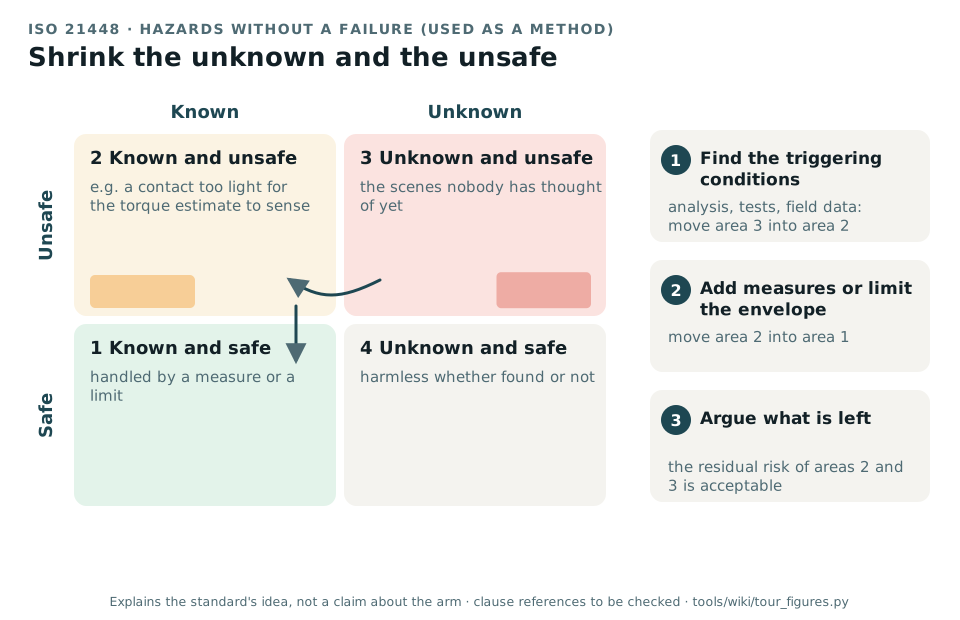
Known or unknown, safe or unsafe. Exploring shrinks the unknown and unsafe area by turning it into known cases; measures and limits then shrink the known and unsafe area; what is left is argued as acceptable. Generated by tour_figures.py; it explains the standard's idea and claims nothing about the arm.
In one sentence. ISO 21448 deals with harm that happens when nothing has failed, because a function's design or sensing is not good enough for the situation; the record borrows its method, not its scope.
ISO 21448:2022, Road vehicles: safety of the intended functionality, known as SOTIF. It is an automotive standard. The record uses it as a method only, because no machinery standard covers hazards that arise without a fault: what a current-based torque estimate cannot sense, or what a learned policy does on a scene it was not trained on.
Every situation the function meets falls into one of four areas:
- Known and safe: handled by a measure or a limit.
- Known and unsafe: a triggering condition that leads to harm, identified but not yet handled.
- Unknown and unsafe: the situations nobody has thought of yet.
- Unknown and safe: harmless whether found or not.
Analysis, tests and field data move situations out of area 3 into area 2; measures, or limits on the operating envelope, move them from area 2 into area 1; what remains is argued as acceptable residual risk.
Two of the arm's safeguards are estimates, not sensors: contact is detected from motor currents, and learned policies propose motions from camera images. Both can fail to do their job with every part working.
| What the record takes | Where |
|---|---|
| The functional insufficiencies and triggering conditions of sensing and the learned policy | Insufficiency analysis, WP-C-10 |
| Unknown scenarios and field trials | WP-V-08 |
Every limit found is closed by a safety function or an operating-envelope limit, or stays open as a defeater in the safety case.
Any SOTIF conformance; the standard is written for road vehicles and is cited as informative.
- Functional insufficiency: a shortfall in the specification or the performance of a function.
- Triggering condition: a situation that, with an insufficiency, leads to a hazardous behaviour.
- Known and unknown scenarios: situations already identified, and those not yet.
No standard is held by the project, so every clause number on this page is to be checked against a licensed copy. The lead decided to buy them only when an assessor is engaged (DQ-011).
| Clause | What it covers |
|---|---|
| §6, §7 | Identifying hazards, functional insufficiencies and triggering conditions, as the record cites them |
Standards tour · stop 14 of 20 · ← IEC 61025 · IEC 62443 →