Repository navigation
How we use each standard
reBot-DevArm is a machine, an industrial robot in the sense of ISO 10218, not a road vehicle and not a driverless truck. The standards are the machinery set, applied with one method: one hazard log, one requirements database, generated figures, a safety case with its defeaters published. This page says, for each standard, what the fork takes from it, what it does not claim, and where it lands in the record. The authoritative version is WP-M-01 §4 and §5. The standards tour gives each standard its own page with an animated figure. No compliance is claimed with any of them, because no assessment has been performed and the drafting environment has no licensed copy; every clause reference is marked to be checked.
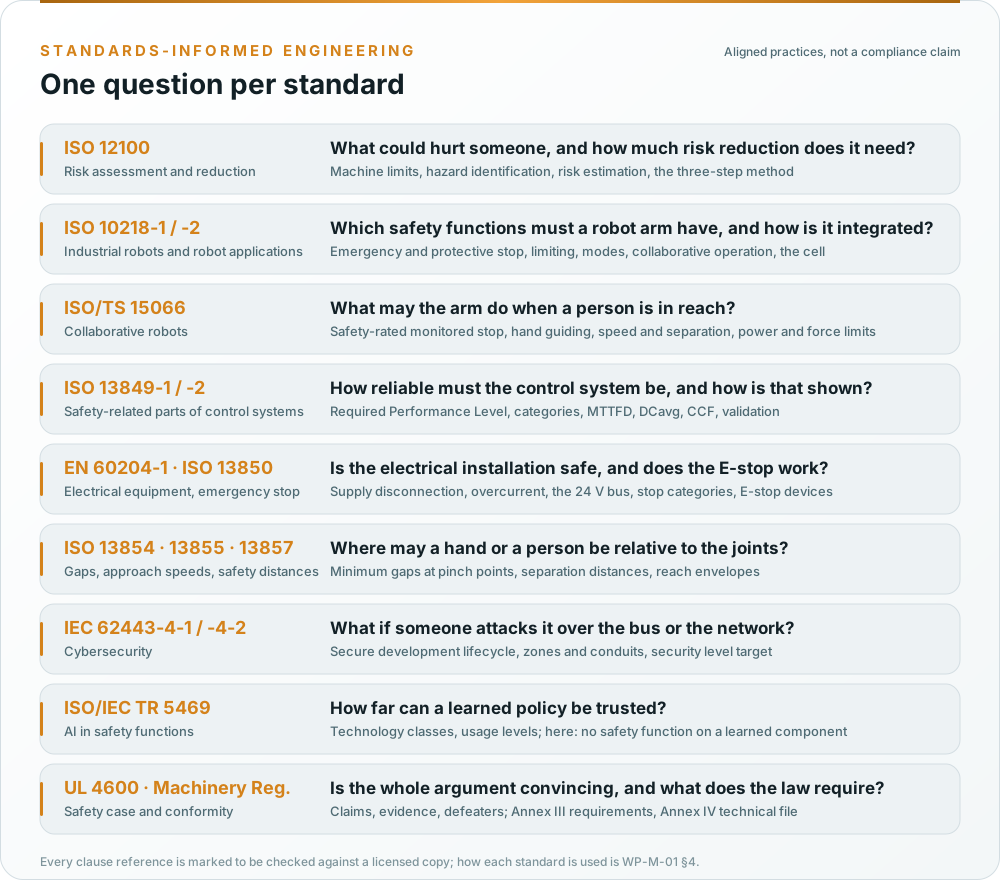
Which gate needs the work products that cite each standard is the standards map.
Full page on the tour: ISO 12100.
- What we take: the whole method. Machine limits (use, space, time), hazard identification per life phase, risk estimation and evaluation, then the three-step method in order: inherently safe design, safeguarding and complementary protective measures, information for use. The documentation of §7 becomes the heart of the technical file.
- How: WP-C-01 defines the arm and its limits, WP-C-03 is the one hazard log of the project (the package's hazards, HZ-M01 to HZ-D01, re-rated per operating envelope), and WP-C-05 allocates every row to the three steps, which the package left undone for 18 of them (GAP-27).
- Position taken: a limitation that is only documented is not a control for a hazard that can injure; the gap assessment's worst findings (no emergency stop, a lost connection that holds the last torque command) are closed by design or safeguarding, not by a warning.
Full page on the tour: ISO 10218-1 and -2.
- What we take: Part 1 for the arm: the safety functions a robot must provide (emergency stop, protective stop, safely limited speed and the axis, torque and space limits, enabling control in manual mode, prevention of unexpected start-up, the operational modes), the performance requirement on its safety-related control (PL d, category 3, as the default to be checked), and the 2025 editions' collaborative-operation text. Part 2 for what the application around the arm must provide: the workspace, the safeguarding, the integrator's duties.
- How: WP-C-04 specifies SF-32 emergency stop, SF-08 safe stop on watchdog, SF-24 manual reset, SF-03 joint torque and speed limiting, SF-29 joint limits and the rest with their required PL; WP-C-02 defines the operating envelopes; WP-S-06 carries the Part 2 duties of whoever installs the arm; the validation work products test the functions.
- Position taken: ISO 10218-1 expects PL d for the stop functions. The lead set it as the target (decision DQ-004), and it drives the chain hardware the fork must add. The 2011 editions and ISO/TS 15066 are what the package cited; the 2025 text is the target and is marked to be checked (DQ-011).
Full page on the tour: ISO/TS 15066.
- What we take: the four collaborative modes (safety-rated monitored stop, hand guiding, speed and separation monitoring, power and force limiting), the body-region force and pressure thresholds of Annex A, and the measurement method that turns them into joint torque and speed caps.
- How: WP-C-06 analyses every scene in which a person is in reach; WP-V-03 validates whatever claim is made.
- Position taken: the first safety case makes no power-and-force-limiting claim (DQ-005, answered): the arm has no joint torque sensors, no force measurement exists (GAP-28), and the recommended envelope (OE-1) keeps everyone but the operator out of reach. Contact detection by torque estimation (SF-02, SF-04) is defence in depth, bounded by what the estimator can sense (WP-C-10).
Full page on the tour: ISO 13849-1 and -2.
- What we take: the Performance Level as the measure of a safety function, the risk graph for the required PL, the designated architectures (categories B to 4), MTTFD, DCavg and CCF, the software requirements of §7, the verification of §8, validation with the fault lists of 13849-2, and the documentation and information-for-use requirements.
- How: WP-S-02 (SRS), WP-S-03 (architecture and categories), WP-H-04 (the PL calculation, with a SISTEMA project as the record), WP-H-07 (certified and well-tried components), WP-V-01 and WP-V-05 (validation and fault lists).
- Position taken: the stop functions are allocated to a hardwired safety chain (two-channel E-stop and enabling inputs, a safety relay, a contactor with mirror contact on the 24 V motor supply). The controller safety layer and the host stack are functional layers that are hardened but carry no PL claim in the first safety case. That keeps the PL d argument inside components with certificates and known reliability data, which the actuators do not have (GAP-14).
Full pages on the tour: IEC 62061, IEC 61508.
- What we take: management of functional safety (61508-1 §6), the functional safety assessment and its independence (61508-1 §8), software requirements beyond §7 of 13849-1 (61508-3) if the controller safety layer is ever promoted into the chain, and the tool classification T1 to T3.
- How: WP-M-02, WP-M-06, WP-P-07, the software work products.
- Position taken: no SIL claim is made. The target measure is the Performance Level; IEC 61508 supplies the management and assessment structure the machinery standards leave thin.
Full pages on the tour: EN 60204-1, ISO 13850.
- What we take: the supply disconnecting device, overcurrent protection, protection against electric shock, protective bonding, control circuits and stop categories 0 and 1, the verification tests of §18; the emergency stop function and its devices.
- How: WP-H-05, WP-H-02, WP-V-04.
- Position taken: the first engineering act of the fork is a lockable disconnect, a fuse and a dual-channel E-stop through a safety relay and contactor on any arm it tests with, as bench equipment before it is a product design (WP-V-07, decision DQ-006). The open-frame mains supply in upstream's BOM gets an enclosure (GAP-11, DQ-018).
Full pages on the tour: ISO 13854, ISO 13857, ISO 13855.
- What we take: the minimum gaps that avoid crushing a finger or a hand at a joint; the reach distances that keep a person out of a hazard zone; the approach-speed formula that turns a measured stopping time into a separation distance.
- How: WP-H-08 measures every joint gap and end-stop, WP-S-04 owns the budget, WP-V-02 measures the stopping performance, WP-V-03 validates the separation.
- Position taken: no joint gap has been measured (GAP-01) and no separation plan exists (GAP-06); until they do, nobody is inside the reach envelope while the arm can move.
Full page on the tour: IEC 62443.
- What we take: the secure product development lifecycle practices (management, requirements, design, implementation, verification, defect management, update management, guidelines) and the component requirements with a security level target, plus the zone and conduit model of 62443-3-2/-3-3.
- How: WP-M-08, the threat and risk assessment WP-C-07, the requirements and security level target WP-C-08, the architecture WP-S-07, implementation and penetration testing, the cybersecurity case WP-K-03.
- Position taken: threats that can cause a hazard are rated against the hazard list; the safety chain is a zone with no conduit from the host network, so no attack on the software can hold the contactor closed. Today any process with the CAN-USB adapter open can command every joint (GAP-22) and tele-operation is unauthenticated (GAP-23); the security level target is a decision for the lead (DQ-013).
Full pages on the tour: ISO/IEC TR 5469, AI Act.
- What we take: the classification of learned components by technology class and usage level, and the properties that would have to be shown if one ever implemented a safety function.
- How: WP-M-09, WP-C-09, WP-W-10, WP-K-07.
- Position taken: no safety function is allocated to a learned component; every LeRobot policy output passes the same clamp as any other command (DQ-008, answered). That keeps the fork out of the Machinery Regulation's Annex I Part A (mandatory third-party assessment for self-evolving safety behaviour) and out of the AI Act's high-risk obligations; the threshold is monitored.
Full page on the tour: ISO 21448.
- What we take: the vocabulary and method for hazards that happen without any fault: functional insufficiencies, triggering conditions, known and unknown scenarios. No machinery standard covers what a current-based torque estimator cannot sense or what a policy does on a scene outside its training set.
- How: WP-C-10 and WP-V-08; every limit is closed by a safety function, an operating-envelope limit, or stays as an open defeater.
- Position taken: cited as informative. No SOTIF conformance is claimed or meaningful for a machine.
Full page on the tour: UL 4600.
- What we take: the structure: claims, arguments, evidence with review state, defeaters published rather than hidden, assumptions stated, feedback from the field.
-
How: WP-K-01 and the machine-readable records,
validator and dashboard in
case/. GAP-01…GAP-36 are the first defeaters, all open. - Position taken: no UL 4600 conformance claim; guidance only.
Full pages on the tour: Machinery Regulation, AI Act.
- What we take: the essential health and safety requirements (Annex III), the technical documentation (Annex IV), the conformity assessment procedures (Art. 25 and the modules), the manufacturer's obligations (Art. 10), the declaration of conformity (Annex V); and the AI Act's threshold for a high-risk AI system.
- How: WP-M-13 is the strategy, WP-K-02 maps the register onto Annex IV, WP-K-06 holds the unsigned declaration draft.
- Position taken: the lead chose the EU frame (DQ-002) with internal control (Module A) as the planned route (DQ-012); the US frame (ANSI/A3 R15.06) would be a cross-reference, not a second file. The fork places nothing on the market, and upstream's CC BY-NC-SA licence forbids commercial use, so the obligations are planned for, not incurred (GAP-35).
Full page on the tour: Automotive SPICE.
- What we take: the process reference model for a self-assessment of process capability, because no machinery-specific process model exists and the package already found the ISO 9001 subset (design review, nonconformance, corrective action) missing.
- How: WP-M-12, and the ASPICE column of the register.
- Position taken: a self-assessment, not an assessment; target CL2 for management, support, system and software processes, CL1 for hardware and ML.