Repository navigation
ISO 13857 reach distances
Standards tour · stop 9 of 20 · ← ISO 13854 · ISO 13855 →
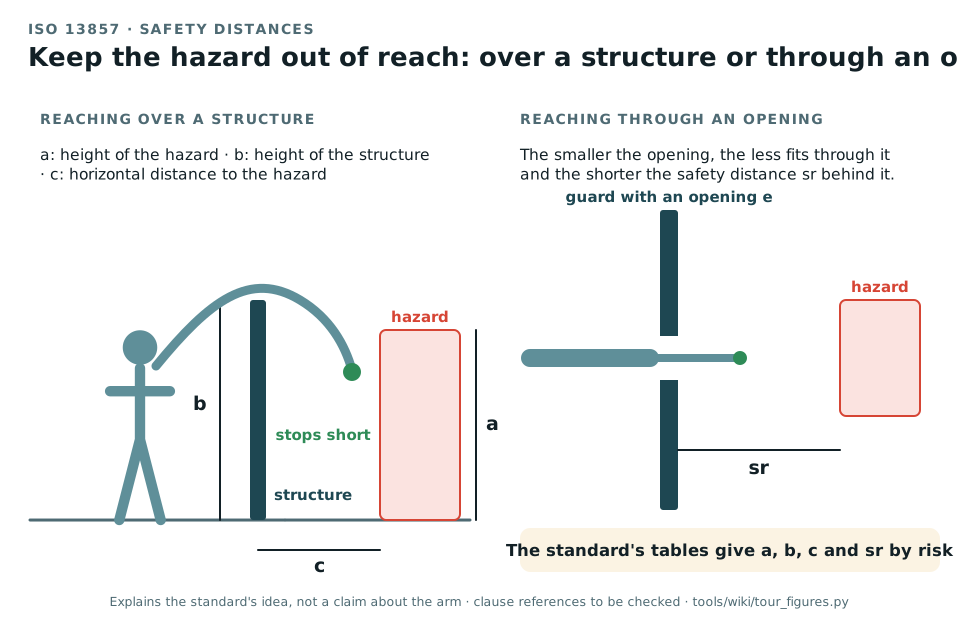
Left, a person reaching over a protective structure: the hazard's height a, the structure's height b and the horizontal distance c decide whether the hand gets there. Right, a hand reaching through an opening: the smaller the opening e, the shorter the safety distance sr behind it. Generated by tour_figures.py; it explains the standard's idea and claims nothing about the arm.
In one sentence. ISO 13857 gives how far a hazard must be from a fence, an edge or an opening so that a hand, an arm or a foot cannot reach it, over, around or through.
ISO 13857:2019, Safety of machinery: safety distances to prevent hazard zones being reached by upper and lower limbs. A type-B standard of tables: reaching upwards, over a protective structure, around an edge, and through openings of a given shape and size, for low and high risk.
- Over a structure. Given the height of the hazard (a) and of the structure (b), the table gives the horizontal distance (c) the hazard must keep from the structure.
- Through an opening. Given the shape and size of the opening (e), the table gives the safety distance (sr) behind it: a slot a fingertip fits through needs only a short distance; an opening an arm fits through needs a long one.
On the supervised bench, nobody but the operator is meant to be near the arm, and the boundary is a marked area, not a guard. If the arm is ever used where others pass, a classroom for example, a fence or enclosure would be sized with this standard, and so would any guard over a joint.
| What the record takes | Where |
|---|---|
| Reach distances in the analysis of who can be where | Human-robot interaction, WP-C-06 |
| Guards over joints and openings, if they are added | Mechanical analysis, WP-H-08 |
| Which envelope the first safety case covers, bench only or classroom too | The envelope question (DQ-003, answered) |
Any guard or distance. None is designed; the record's position is that nobody is inside the reach envelope while the arm can move (GAP-06).
- Hazard zone: the space where a person can be harmed.
- Protective structure: a fence, guard or edge between a person and a hazard zone.
- Safety distance (sr): the distance a protective structure or opening must keep from the hazard zone.
No standard is held by the project, so every clause number on this page is to be checked against a licensed copy. The lead decided to buy them only when an assessor is engaged (DQ-011).
| Clause | What it covers |
|---|---|
| §4.2 | Upper limbs: reaching upwards, over protective structures, around and through openings |
| §4.3 | Lower limbs |
Standards tour · stop 9 of 20 · ← ISO 13854 · ISO 13855 →