Repository navigation
Standards at a glance
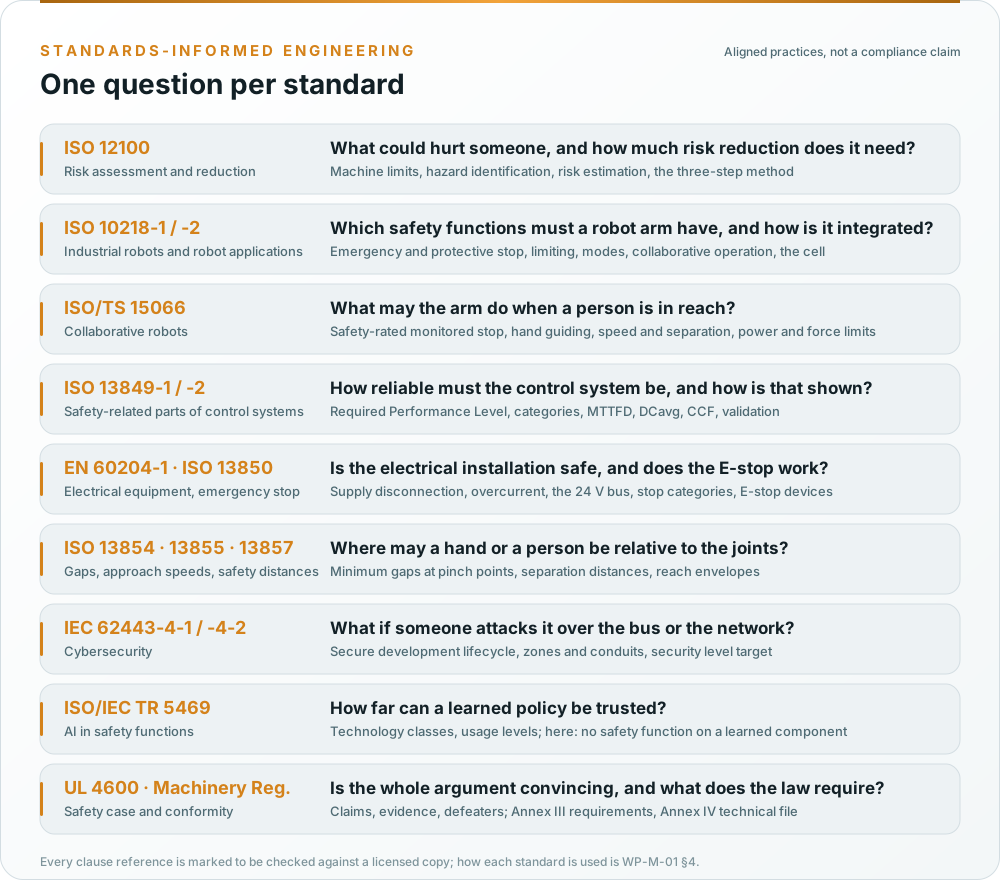
The fork follows standards-informed development: its work products are structured after these standards and cite their clauses. No compliance is claimed, because no assessment has been performed and no standard is held; every clause reference is marked to be checked against a licensed copy. The assurance strategy, WP-M-01 explains how each standard is tailored to an open-source assurance record for a desktop arm built by someone else; How we use each standard is the page-length version of this table, and the standards tour gives each standard its own page with an animated figure.
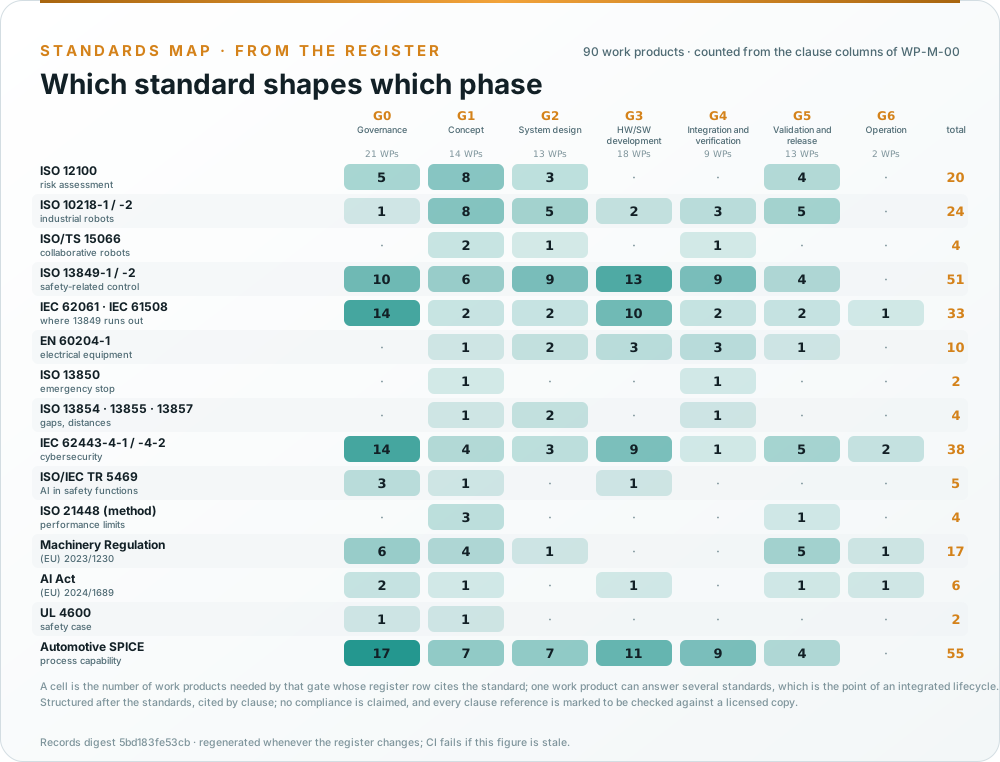
Counted from the clause columns of WP-M-00 by
make_assets.py; one work product can answer several standards, which
is the point of an integrated lifecycle. The process maps show the same work as activities in
discipline lanes.
| Standard | The question | Main work products |
|---|---|---|
| ISO 12100, risk assessment and reduction | What could hurt someone, and how much risk reduction does it need? | Item definition, WP-C-01 · Risk assessment, WP-C-03 · Risk reduction concept, WP-C-05 |
| ISO 10218-1/-2:2025, industrial robots and robot applications | Which safety functions must a robot arm have, and what must the application around it provide? | Safety functions and PLr, WP-C-04 · Operating environment, WP-C-02 · Installation and operation, WP-S-06 |
| ISO/TS 15066, collaborative robots | When may a person be in reach, and how much force or pressure is too much? | Human-robot interaction, WP-C-06 · Collaborative validation, WP-V-03 |
| ISO 13849-1/-2, safety-related parts of control systems | How reliable must the control system be, and how is that shown? | SRS, WP-S-02 · Architecture, WP-S-03 · PL calculation, WP-H-04 · Validation, WP-V-01 |
| EN 60204-1, ISO 13850, electrical equipment and emergency stop | Is the electrical installation safe, and does the E-stop work? | Electrical safety, WP-H-05 · Chain design, WP-H-02 · E-stop validation, WP-V-04 |
| ISO 13854, ISO 13857, ISO 13855, gaps, safety distances, safeguard positioning | Can a finger get into a joint, and where may a person stand? | Mechanical analysis, WP-H-08 · Stopping and separation budget, WP-S-04 |
| IEC 62443-4-1/-4-2, cybersecurity | What if someone attacks it? | Threat and risk assessment, WP-C-07 · Cybersecurity architecture, WP-S-07 · Cybersecurity case, WP-K-03 |
| ISO/IEC TR 5469, AI in safety functions | How far can a learned policy be trusted? | ML component definition, WP-C-09 · ML engineering, WP-W-10 |
| UL 4600, safety case | Is the whole argument convincing? | Safety case, WP-K-01 |
| Machinery Regulation (EU) 2023/1230, AI Act | What does the law require? | Regulatory strategy, WP-M-13 · Technical documentation index, WP-K-02 |
ISO 3691-4 (driverless industrial trucks) is not used: the arm does not drive. If it is ever mounted on a mobile base, that base is a second item with its own record.
| Practice | Where it is applied |
|---|---|
| IEC 62061 and IEC 61508 | Management, assessment and software where ISO 13849 runs out: WP-M-06, WP-W-02 |
| ISO 21448 as a method | Insufficiency analysis, WP-C-10 · Field trials, WP-V-08 |
| Automotive SPICE | Capability baseline, WP-M-12: a self-assessment, not a formal assessment |
| Safety analysis (IEC 60812, IEC 61025) | FMEA · FTA · CCF · STPA · Independence of the chain |
| Integrated process model | WP-P-11 and the process maps |
| Independent review | Confirmation measures plan, WP-M-06 · Verification and review procedure, WP-P-05 |
One shared hazard log (the risk assessment, with cybersecurity, insufficiency and misuse cross-references) and
one requirements database (in assurance/trace/, hazards, safety functions and
assumptions first) hold the standards together:
| Topic | Primary standard | Interface |
|---|---|---|
| Hazards of the machine | ISO 12100, ISO 10218-1 | Every other analysis rates its findings against this hazard list |
| Safety functions and their PL | ISO 10218-1, ISO 13849-1 | The required PL comes from the risk graph on the hazard; the achieved PL from the chain's calculation |
| Contact with a person | ISO/TS 15066, ISO 13855 | Whether contact is permitted at all is a decision for the lead (DQ-005); without it, separation is the only mode |
| Performance limits of sensing | ISO 21448 method | What the torque estimator cannot sense bounds the contact-detection functions |
| Attacks that cause hazards | IEC 62443 | Threat scenarios link to hazards; the chain is a zone with no network conduit |
| Learned components | ISO/IEC TR 5469 | None carries a safety function; the chain and the safety layer are the independent safeguard |
| Conformity | Machinery Regulation | The technical file indexes the register |
The host stack proposes, the controller safety layer checks, and a hardwired safety chain is the checker of last resort that nothing in software can override. Only the chain carries a Performance Level target.
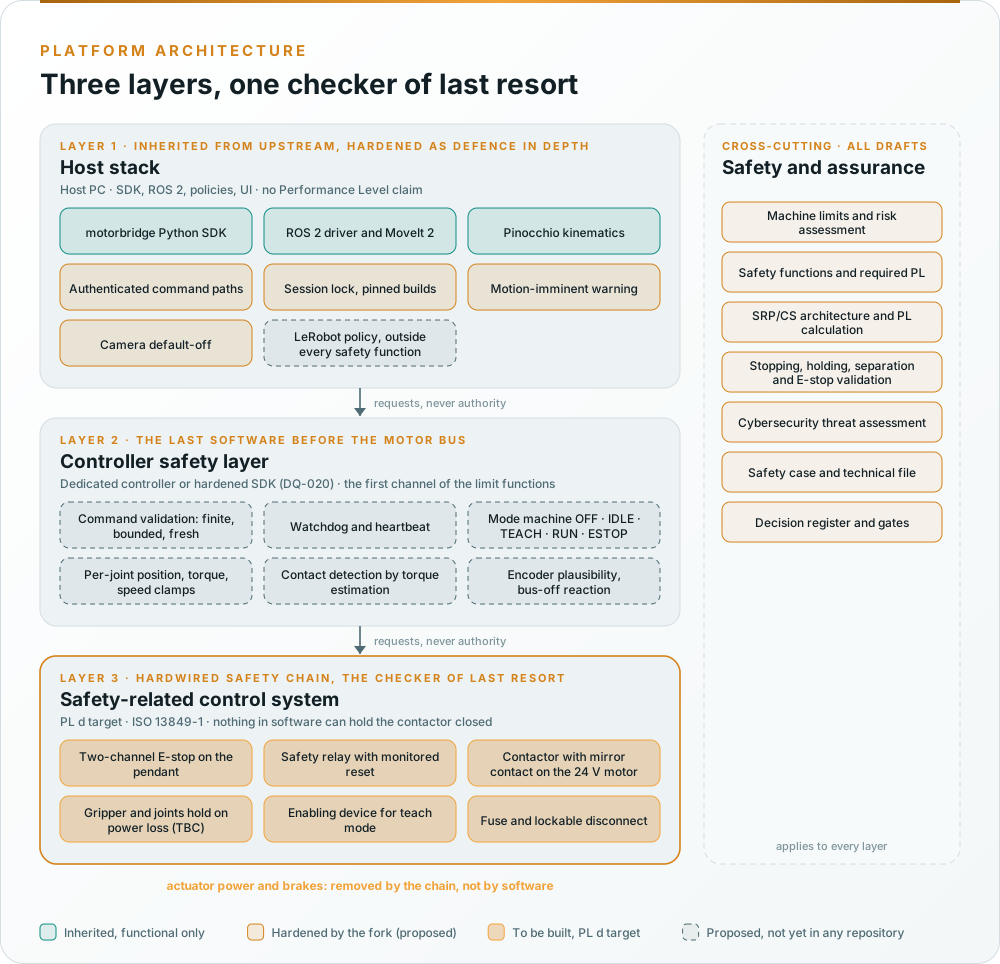
The README architecture figure, generated by make_assets.py. The strategy is WP-M-01 §6.
The machinery standards assume a manufacturer placing a finished machine on the market. The fork is an open-source assurance record for a kit arm designed by someone else, sold under a non-commercial licence, and assembled by its user. The strategy records its tailoring decisions, each needing confirmation by an independent assessor. The ones that shape the project most:
- Modification of existing machinery. Nothing is reused from upstream as a safety work product, because none exists; the concept-phase package the fork published is an input, not a work product; the fork does a full concept phase.
- Safety functions on a hardwired chain. The host software and the controller safety layer are hardened as defence in depth; only the chain carries the PL claim in the first safety case.
- Certified components. The safety relay, the contactor and the E-stop devices are bought with certificates; the actuators are not safety components, and no claim rests on their closed firmware.
- Proven in use is not claimed. Upstream's thermal test and the community's run history are supporting evidence only.
- Independence. The author never reviews their own work. With a single maintainer, confirmation reviews and the functional safety assessment need an external assessor.
- Regulatory. The frame (EU recommended) and the conformity route are decisions for the lead.
The full table is in WP-M-01 §5. Which
clauses each assurance folder answers to is in assurance/README.md.