Repository navigation
ISO 13854 minimum gaps
Standards tour · stop 8 of 20 · ← ISO 13850 · ISO 13857 →
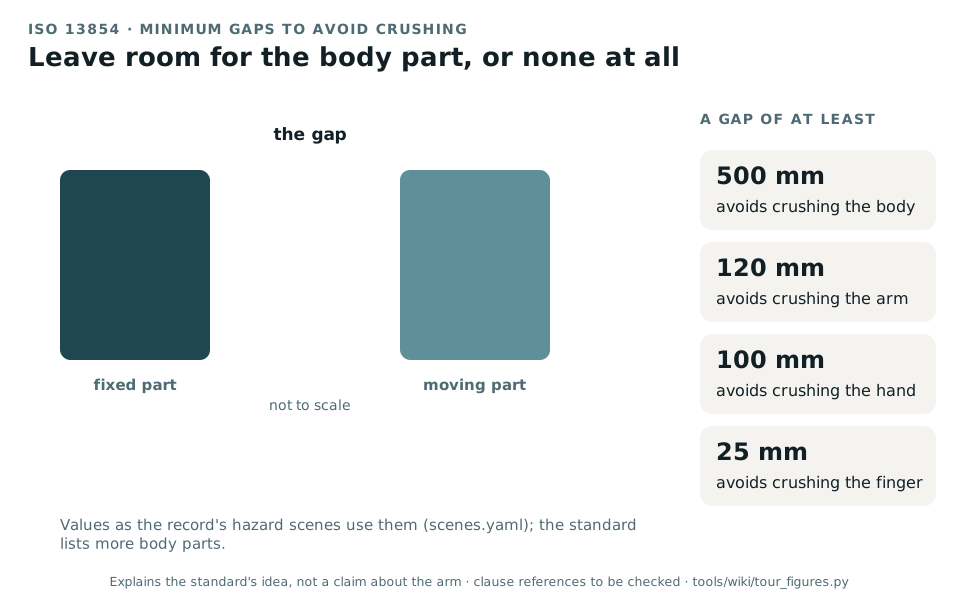
Two parts close the gap between them; as it narrows past each minimum gap, the body part it protected can be crushed. The values are the ones the record's hazard scenes use, read from scenes.yaml when the figure is generated. Generated by tour_figures.py; it explains the standard's idea and claims nothing about the arm.
In one sentence. ISO 13854 gives the smallest gap that lets a body part sit between two closing surfaces without being crushed; a gap must be at least that wide, or too narrow for the part to get in at all.
ISO 13854:2019, Safety of machinery: minimum gaps to avoid crushing of parts of the human body. A type-B standard with one central table: for each body part, the gap that keeps it from being crushed.
Wherever two surfaces move towards each other, check the gap they leave at the closest point. If it is at least the minimum for a body part that can get there, that part fits without being crushed. If it is smaller, there are two other ways out: make the opening too small for the part to enter at all (ISO 13857), or keep the part out with a guard or a stop. The standard lists more parts than the figure shows, the head, leg, foot and toes among them.
Every joint of the arm is a closing gap: between adjacent links, between the covers and the links, and between the gripper jaws. None of them has been measured against the minimum gaps (GAP-01). In the record's hazard scenes, the elbow and wrist covers as modelled close through the finger gap well before the end-stop (Hazard scenes).
| What the record takes | Where |
|---|---|
| Measuring every joint gap and the gripper jaws | Mechanical analysis, WP-H-08 |
| A design measure for joint gaps (DM-02) | Risk assessment, WP-C-03 |
| The pinch scenes, with the gap plotted against these values | Hazard scenes, WP-P-12 |
That any gap on the arm meets the standard; none has been measured. The scene gaps come from upstream's CAD in assumed poses, as pictures for review.
- Minimum gap: the smallest gap that avoids crushing a given body part.
- Crushing hazard: two surfaces closing on a body part; shearing: two edges passing each other.
No standard is held by the project, so every clause number on this page is to be checked against a licensed copy. The lead decided to buy them only when an assessor is engaged (DQ-011).
| Clause | What it covers |
|---|---|
| §4 | Minimum gaps, with the table of body parts |
Standards tour · stop 8 of 20 · ← ISO 13850 · ISO 13857 →