Repository navigation
For the assessor
This page is for the person asked to look at the fork independently: a confirmation reviewer, a functional safety auditor or assessor, a cybersecurity or ML reviewer, a notified body's examiner, or someone deciding whether to take that role on. It says what state to expect, where the plans are, what you would be asked to do, what to assess against, how independence is recorded, and how to send findings. Every line points at the record that owns it; this page decides nothing and claims nothing.
Note
No confirmation measure has been performed, and no assessor has been engaged. The project has one maintainer, so every review at independence level I2 or I3 is planned as external. The lead decided not to engage an assessor for now and to revisit it at G1 (decision register DQ-009).
| Fact | Where it is recorded |
|---|---|
| No confirmation review, audit or assessment has taken place | Confirmation records folder, WP-M-06 §1 |
| No gate review has been held | Gate records folder |
| The assessor role is open until G1 |
WP-M-02 §3.1; decision register entry DQ-009 in register.yaml
|
| Every role in the safety plan resolves to the maintainer; roles needing independence are TBD | WP-M-02 §3.1 |
| Much of the record is AI-assisted drafting, which counts at I0 and gives no review credit | WP-M-02 §3.3 |
| Clause citations are marked "check against the licensed copy"; no standard is held | WP-M-06 OI-1; decision register DQ-011 |
| The concept-phase package (safety case, DFMEA, requirements, test plan) is an input the author wrote; nobody has reviewed it | Gap assessment §1 |
| No work product is approved or baselined; the rest are drafts and skeletons | WP-M-00 §3 |
| Nothing has been tested: the fork has powered no arm | WP-V-07, test sites |
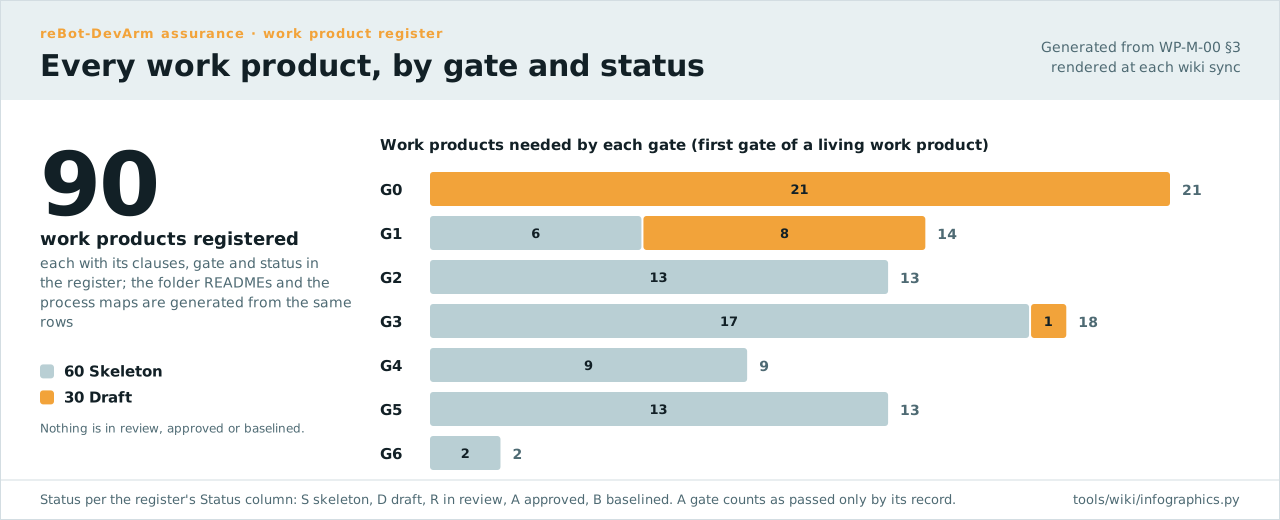
Rendered from the register at every wiki sync.
| Step | Work product | What to take from it |
|---|---|---|
| 1 | WP-M-01 assurance strategy | The one configuration claims apply to (§3.1), the three-layer argument the whole case rests on (§6), how each standard is used (§4), the tailoring decisions (§5), the strategic decisions and their status (§8), the top risks (§9) |
| 2 | WP-M-02 functional safety plan | Roles and who holds them (§3), the activities per phase (§4), the early-implementation rule for the bench safety hardware (§4.1), gate reviews (§10) |
| 3 | WP-M-06 confirmation measures plan | What you would be asked to do (below), the independence scheme and its mapping onto IEC 61508-1 §8 (§3), the assessor qualification (§6.1), the schedule (§9), the records (§10) |
| 4 | WP-M-13 regulatory conformity strategy | The Machinery Regulation route, the Annex I Part A threshold, the technical documentation mapping, the non-commercial licence |
| 5 | WP-M-00 work product register | The gates and their exit criteria (§2), every work product with its clauses, gate and status (§3) |
| 6 | Process model and maps | How the disciplines' work fits together per phase, the cross-domain interfaces, the confirmation measures each gate needs and whether they have been performed, the readiness of each gate |
| 7 | Baseline gap assessment | What the project itself found wanting in the inherited arm, the package and the process, finding by finding, with the standard each bears on |
| 8 | WP-K-04 functional safety assessment | The report template you would fill in, including the independence declaration |
Standards at a glance lists which standard each work product answers to. How the repository is organized maps the folders.
WP-M-06 plans every measure by gate; the summary table is WP-M-06 §9.
- Confirmation reviews CR-01 to CR-12, each naming the work products, the planned independence level and the gate (§4.1). The risk assessment (CR-02), the safety functions and their required PL (CR-04), the PL calculation (CR-07) and the safety case (CR-12) are the ones that carry the argument.
- Functional safety audits AUD-1 and AUD-2, checking that the plans are carried out as written (§5).
- Functional safety assessments FSA-I1 and FSA-I2 at the concept and system-design gates, and the final FSA-F before any release record (§6), in the sense of IEC 61508-1 §8 and the validation of the achieved PL against the required PL.
- Cybersecurity review and assessment CS-I1 and CS-A1 under IEC 62443 (§7).
- ML reviews ML-R1 to ML-R3 of the position that no learned policy carries a safety function (§7).
- Conformity assessment NB-1 by a notified body, if the route the lead chooses needs one (§8, DQ-012).
Who may do each is in §6.1: no authorship of or contribution to the assessed work, no reporting line to the maintainer, no financial interest beyond the fee, no involvement in upstream reBot-DevArm development at Seeed Studio, competence in machinery functional safety with evidence, declared in writing in each report.
A review is against a named state of the record, never against the moving branch.
| Thing | Where |
|---|---|
| The commit of this record and of the software forks, once they exist | The Baseline field of every work product; the gap assessment header |
| The reference configuration the claims apply to | WP-M-01 §3.1 and the reference arm page |
| Which files count as safety-relevant, and in which class | Safety-relevant paths, owned by WP-P-01 |
| Baselines, snapshots and controlled copies | Baselines in case/baselines/ (BL-001); snapshots and controlled copies to come with WP-P-04 |
Everything is public. Read access is a clone of the repository at the baseline commit.
- The levels I0 to I3 and who can reach each one today are in WP-M-06 §3.
- A confirmation record is written by the named reviewer at the required level, states that independence in
writing, and is stored under
10-safety-case/confirmation/using the WP-P-05 record template. - What does not count. A passing CI run. An AI-generated pre-review. A self-assessment such as the ASPICE capability baseline. The trace memo of the concept-phase package, which the author wrote about their own workbooks.
The project publishes its own counter-evidence. Start with these rather than hunting for it.
| List | Where |
|---|---|
| Findings against the inherited arm, the package and the process, GAP-nn | Gap assessment |
| Open items of each work product | The last section of every work product, counted per gate in the gate skeletons |
| Open cross-domain interfaces | The readiness section of each process map |
| Project risks | WP-M-07 (skeleton; the top risks are in WP-M-01 §9) |
| Questions the lead has decided, and the ones still open | Decision register; see How decisions are made |
-
A finding from a confirmation measure becomes a GitHub issue labelled
confirmation-finding, handled under WP-P-03, and is listed with its ID in your record. - A comment on a work product short of a formal review goes to the pull request that changes it, or to an issue naming the work product and section.
- A vulnerability goes through SECURITY.md, never a public issue. See Reporting a safety concern.
Engaging an assessor is a decision of the project lead, recorded in the decision register (DQ-009 for functional safety; the cybersecurity assessor and the notified body are open items of WP-M-06 and WP-M-13). If you are considering it, the shortest route is an issue saying so, with the competence evidence WP-M-04 asks for.
Assurance status represents recorded engineering evidence and review state. It does not constitute certification or approval for operation with a person in reach.