Repository navigation
IEC 61025 fault tree analysis
Standards tour · stop 13 of 20 · ← IEC 60812 · ISO 21448 →
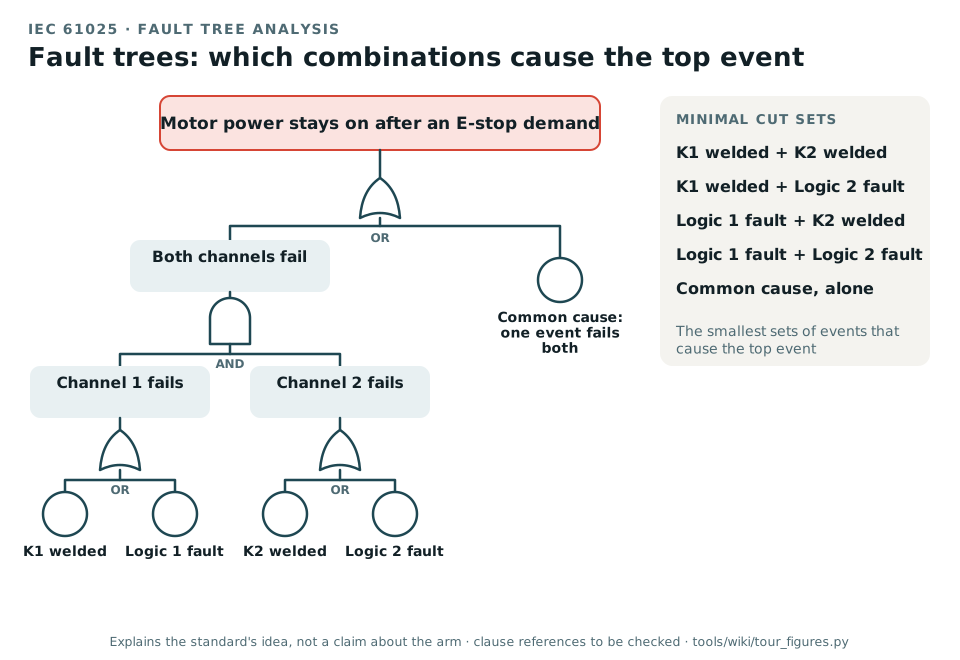
A fault tree for 'motor power stays on after an E-stop demand', as an illustration of the method: one failed channel does not cause it, both do, and a common cause skips the redundancy. The minimal cut sets list the smallest combinations. Generated by tour_figures.py; it explains the standard's idea and claims nothing about the arm.
In one sentence. IEC 61025 is the method for working backwards from one unwanted event to every combination of failures that can cause it, through AND and OR gates.
IEC 61025:2006, Fault tree analysis (FTA). A method standard: the symbols, the steps, and the qualitative and quantitative evaluation of a tree.
Start from the top event, the outcome you must avoid. Ask what could cause it: if any one of several causes is enough, join them with an OR gate; if all must happen together, with an AND gate. Go down until each branch ends in a basic event, a failure you can put data on. The minimal cut sets are the smallest combinations of basic events that cause the top event: a cut set of one is a single point of failure.
The record's argument for the stop functions is redundancy: two channels, two contactors in series. A fault tree shows whether that holds: that no single failure defeats the stop, and where a common cause, one supply or one welded part, could defeat both channels at once.
| What the record takes | Where |
|---|---|
| A fault tree per safety function | Fault tree analysis, WP-A-02 |
| The common cause failure analysis | WP-A-03 |
| Independence of the chain from the host stack | WP-A-05 |
Any fault tree yet: the analyses are skeletons until the chain is designed. The tree in the figure illustrates the method.
- Top event: the undesired outcome at the top of the tree.
- Gate: AND (all inputs needed) or OR (any input is enough).
- Basic event: a failure at the bottom of a branch, with its own probability.
- Minimal cut set: a smallest set of basic events that together cause the top event.
- Common cause failure: one event that causes several basic events at once.
No standard is held by the project, so every clause number on this page is to be checked against a licensed copy. The lead decided to buy them only when an assessor is engaged (DQ-011). The record cites the standard for the method as a whole rather than by clause.
Standards tour · stop 13 of 20 · ← IEC 60812 · ISO 21448 →