Repository navigation
Contributor guide
Contributions are welcome in machinery safety, safety-related control systems, electrical and mechanical engineering, embedded and ROS 2 software, robot learning, cybersecurity, verification, documentation and review. This page is the short version of contributing, which is the rule book.
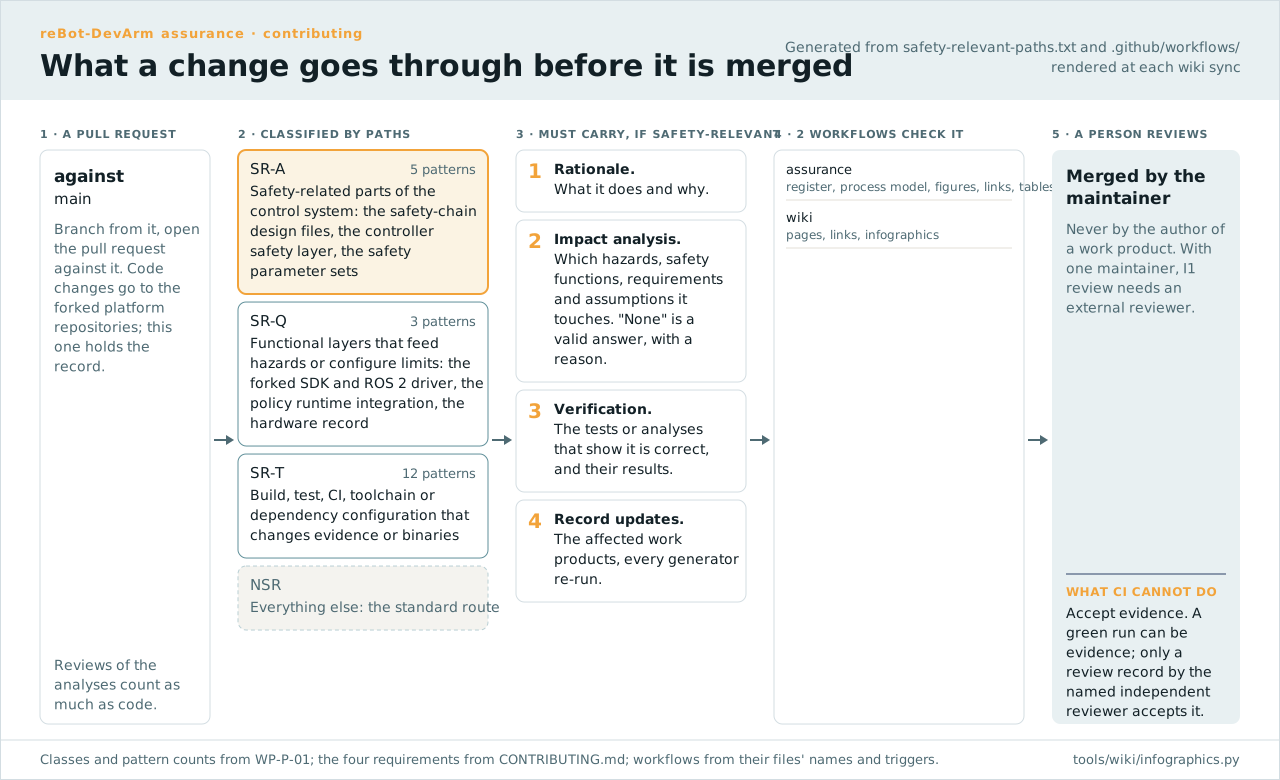
Rendered from the safety-relevant file list and the workflow files by infographics.py at every wiki sync.
This repository is the record; only Python 3 is needed (PyYAML for the decision register).
git clone https://github.com/jherrodthomas/reBot-DevArm.git
cd reBot-DevArm
python3 assurance/01-management/decisions/check_decisions.py     # the questions for the lead
python3 assurance/tools/folder_index.py --check                  # folder indexes match the register
python3 assurance/process/tools/process_model.py --check         # process maps and gate skeletons current
python3 docs/assets/rebot/make_assets.py --check                 # README figures match their generator
python3 assurance/tools/check_links.py                           # every relative link resolves
python3 assurance/tools/check_tables.py                          # every table row matches its header
python3 tools/wiki/build_wiki.py                                 # these pages check clean
Changes to the software that moves the arm go to the forked SDK and driver repositories once they exist (DQ-007); the tests they need are described in WP-W-01. Until then the software is upstream's and is not changed here.
- Branch from
mainand open the pull request againstmain. The pull request template asks for a safety-impact statement; "none" is a valid answer with a reason. - Questions and bugs go to the issues with the problem report or safety concern template. A review of an analysis is as valuable as code.
- Decisions for the project lead are not issues; they go into the decision register.
A change is safety-relevant if it touches a path on the safety-relevant file list or changes an assurance work product. The list has three classes:
| Class | What it covers | Examples |
|---|---|---|
SR-A |
Safety-related parts of the control system | The chain design files, the controller safety layer, the safety parameter sets (joint limits, torque and speed caps, watchdog timings) |
SR-Q |
Functional layers that feed hazards or configure limits | The forked SDK and ROS 2 driver, the policy runtime integration, upstream's hardware record under hardware/
|
SR-T |
Build, test, CI, toolchain or dependency configuration that changes evidence or binaries | Workflows, package pins, the generators and checkers |
Anything not matched is not safety-relevant and takes the standard route. The list is owned by WP-P-01 and changes only through a change request.
- Rationale. What the change does and why.
-
Impact analysis. Which hazards, safety functions, requirements and assumptions it affects, following
WP-M-11 and
WP-P-02, recorded under
07-supporting/impact/. "No assurance object affected" is a valid result, with a reason. - Verification. The tests or analyses that show the change is correct, and their results.
- Record updates. The affected work products, with every generator re-run.
- A work product leaves
Draftonly through a verification review by someone other than its author (WP-P-05); a claim is accepted only through a confirmation measure at the independence WP-M-06 requires. - A passing CI run, a passing test or an existing file does not accept anything. It can be evidence that a reviewer accepts.
- An AI-generated review is not a substitute for the required independent confirmation.
- Never edit generated files (process maps, gate skeletons, folder READMEs, README figures) by hand. Change the source and regenerate.
hardware/ is Seeed Studio's record and is never edited here; it changes only by merging from upstream, with an
impact analysis under WP-M-10. The
concept-phase package files at the repository root (reBot_DevArm_*) are an input to the record and are not
edited either. Upstream's licence is CC BY-NC-SA 4.0: contributions stay non-commercial, keep the notices, and must
not imply Seeed Studio's endorsement.
Much of the drafting is done in Claude Code sessions under the project lead's direction. The rules those sessions follow are in CLAUDE.md: sort questions before asking, keep every question self-contained, ask in batches of ten, and record decisions in the register. A session's pull request is reviewed like any other. The session log lists what has been merged.
- Issues for anything about the project.
- Security problems go through SECURITY.md, never a public issue. See reporting a safety concern.