Split screen
Local co-op: two to four players on one screen, each with their own HUD, their own menus and their own focus. Player two's stick never moves player one's cursor.
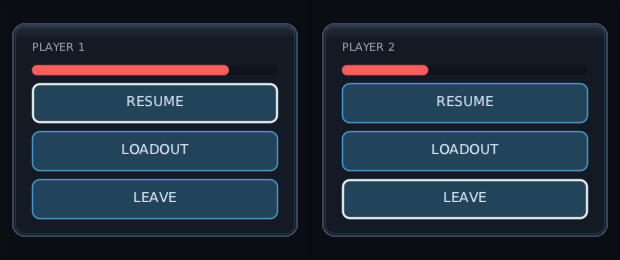
It takes three things, and you already know two of them:
-
A
UiHostper player. Each host has its own tree, clocks and recomposer, so two of them are two completely separate interfaces. -
A
Viewportper player, fromViewport.splitScreen. It says which part of the window is theirs. -
One
InputRouter, which hands each pad, the keyboard and the mouse to the right player.
val viewports = Viewport.splitScreen(
    design = Size(960f, 1080f),      // one player's interface
    physical = window.framebuffer,   // the whole window, in real pixels
    players = 2,
)| Players | Layout |
|---|---|
| 1 | the whole window |
| 2 | side by side, or one above the other with stacked = true
|
| 3 | a quarter each; the bottom-right quarter is left for the game (a map, a scoreboard) |
| 4 | a quarter each, left to right, then down |
Every player is laid out at the same design size and fitted into their own area
with the usual Layout scale policy. So one HUD, written once, is right in every
quarter. Pick a design the same shape as one player's area and nothing is
letterboxed.
A viewport's area is where on the window it goes. Its origin is still measured from
the window's corner, so a canvas draws into the right place with nothing else told
about the split. The safe area is measured from the window's edges too: a notch on
the left only pushes in the player on the left.
One UiRenderer per player, all on the same canvas, one after another:
val hosts = List(2) { UiHost() }
val renderers = hosts.map { UiRenderer(it, canvas) }

// each frame, after the game has drawn every player's view of the world:
renderers.forEachIndexed { i, ui -> ui.render(viewports[i], System.nanoTime()) }
Each player's drawing is cut off at the edge of their own area, so nothing one player
draws lands in the other's half. That holds even with ScalePolicy.Fill, where a
design a different shape from its area is scaled past the area's edges.
A backend knows nothing about players. It pushes every pad, the keyboard and the
mouse into one sink. Make that sink an InputRouter:
// Each player's sink is what a one-player game already has: routers and
// navigators behind a SourceAware (see Input).
val router = InputRouter(unclaimed = lobby)     // pads nobody owns yet go here

router.assignGamepad(GamepadId(0), playerOne)
router.assignGamepad(GamepadId(1), playerTwo)
router.assignKeyboard(playerOne)
router.assignPointer(viewports[0], playerOne)
router.assignPointer(viewports[1], playerTwo)

GdxGamepadInput(router).start()
Gdx.input.inputProcessor = InputMultiplexer(
    GdxPointerInput(router, { Viewport.oneToOne(windowSize) }),   // the router wants window pixels
    GdxKeyboardInput(router),
)
The rules:
- Pads go by number. Every gamepad event says which pad it came from. When a pad changes hands, its old owner is told it was unplugged first, so a stick held while pads were being handed out does not keep scrolling the menu it left. A pad that is really unplugged keeps its owner, so plugging it back in gives it back.
- The keyboard goes to one player, because there is only one. Text goes with it.
- The pointer goes by where it is. A click in the right half reaches player two, in player two's own coordinates. A press keeps the pointer until release, so a slider dragged past the middle stays with whoever grabbed it. Moving from one half into the other ends the hover in the first.
-
Whatever belongs to nobody (an unassigned pad, a click outside every area) goes to
unclaimed, in window coordinates. Leave it null to ignore those.
Give each player their own InputSourceTracker and their prompts follow their own
device: the player on the keyboard reads E, the one on the pad reads A.
A pad nobody owns goes to unclaimed. Make that the lobby:
val lobby = object : InputSink {
    override fun onGamepad(event: GamepadEvent): Boolean {
        if (event !is GamepadEvent.ButtonDown || event.button != GamepadButton.Start) return false
        if (router.ownerOf(event.gamepadId) != null) return false
        router.assignGamepad(event.gamepadId, nextFreePlayer())
        return true
    }
    override fun onPointer(event: PointerEvent) = false
    override fun onKey(event: KeyEvent) = false
    override fun onText(event: TextEvent) = false
}
When a player leaves, router.unassign(player) gives back every device they held and
lets go of anything they had pressed.
When the window is resized, make new viewports and call assignPointer again for
each player. That replaces their old area, and cancels a press still held in it.
uiTest takes a viewport, and UiTest.input is the player's sink, so a test wires
two screens behind a router exactly as a game does:
val halves = Viewport.splitScreen(Size(400f, 300f), Size(800f, 300f), players = 2)
val one = uiTest(Size(400f, 300f), viewport = halves[0]) { Menu() }
val two = uiTest(Size(400f, 300f), viewport = halves[1]) { Menu() }
val router = InputRouter().apply {
    assignGamepad(GamepadId(0), one.input)
    assignGamepad(GamepadId(1), two.input)
}

router.onGamepad(GamepadEvent.ButtonDown(GamepadId(1), GamepadButton.DpadDown))
one.settle(); two.settle()

two.assertFocused("options")
one.assertFocused("play")
Events sent to a router do not settle anything, so call settle() on each player after.
SplitScreenUiTest in composegl-ui is the worked example, and GdxSplitScreenTest in
composegl-gdx checks both halves in real pixels.