Repository navigation
collection_browser
This page covers the Elements panel itself — organizing folders, moving and deleting elements, what "writable" actually means day to day, and how to build yourself a shortcut to the devices you actually reach for instead of hunting through the shared collection every time (§4). Separate pages cover the file format (Elements XML) and drawing one element (Using the element editor).
Source: sources/ElementsCollection/ — elementscollectionwidget.cpp (the
panel), elementstreeview.cpp / elementscollectionmodel.cpp (the tree),
elementslocation.cpp (identity and writability).
The Elements panel has two tabs:
| Tab | Shows |
|---|---|
| Collections | the element tree — common, custom, company, and anything embedded in the current project |
| Modèles (Templates) | reusable diagram fragments ("macros"), separate from single elements — see Templates |
A macro is a saved chunk of diagram content — elements, conductors, whatever was selected — placed back as a group. It is a distinct mechanism from an element and is covered on its own page, Templates; the browsing and folder-management rules on this page apply equally to both tabs.
There are two ways to put a symbol or a template on the sheet:
- Drag it onto the sheet.
- Double-click it, or select it and press Enter. A preview appears at the mouse pointer if the pointer is over the sheet, otherwise in the middle of the view, and follows the pointer until you click. Escape or a right-click cancels. A then places the same symbol again — see Drawing faster.
Before 27 September 2026 a double-click opened the symbol in the element editor instead. To get that back, tick Double-cliquer dans la collection ouvre l'éditeur d'élément au lieu de l'insérer (Double-clicking in the collection opens the element editor instead of inserting) in Configurer QElectroTech > Général, tab Apparence. Either way, Éditer l'élément in the right-click menu always opens the editor.
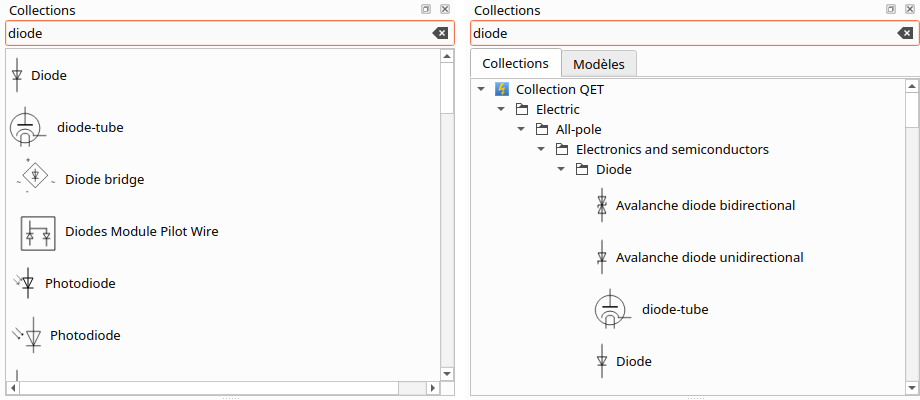
The search box at the top filters the current tab as you type.
A search shows one flat list, best match first, instead of the filtered tree. Down moves from the search box into the list; double-click or Enter on a result places it, as above.
Prefer the filtered tree? Untick Afficher les résultats de recherche sous forme de liste triée (Show search results as a ranked list) in Configurer QElectroTech > Général (PR #1083). The search then filters the tree as it did before, with the tree's own keyboard navigation.
| Collection | Location | Writable? |
|---|---|---|
| Common | ships with QET | No — always read-only, regardless of file permissions on disk |
| Custom | yours | yes |
| Company | shared within an organisation | yes |
| Embedded | inside the open project | follows the project — read-only if the project itself is read-only |
The common collection's read-only status is not a permissions check —
ElementsLocation::isWritable() refuses it unconditionally, by path. That's
why New folder, New element, rename and delete are always greyed out there,
even running as an administrator.
All three top-level paths (plus the two title-block-template paths and the macros path) can be relocated from Preferences → General.
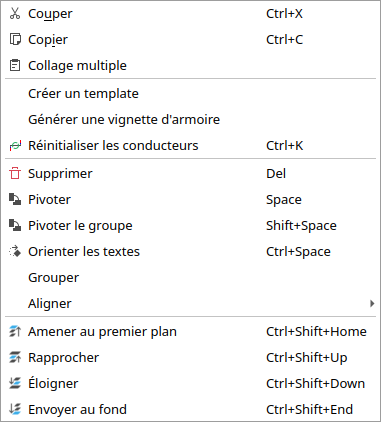
Right-click in the tree for:
| Action | Does |
|---|---|
| Nouveau dossier (New folder) | creates a sub-folder — only where the collection is writable |
| Nouvel élément (New element) | starts the new-element wizard in that folder |
| Importer une pièce EPLAN (.edz)… | imports an EPLAN part into that folder — see EDZ import |
| Éditer l'élément (Edit the element) | opens it in the element editor (not offered for a template) |
| Éditer le dossier (Edit the folder) | rename it |
| Supprimer l'élément (Delete the element) | asks for confirmation, then removes the file — not undoable |
| Supprimer le dossier (Delete the folder) | asks for confirmation, then removes the folder and everything in it — not undoable |
| Ouvrir le dossier correspondant (Open the corresponding folder) | reveals the location in your OS file manager |
| Recharger les collections (Reload collections) | re-reads the collection tree from disk — useful after editing files outside QET |
| Afficher uniquement ce dossier / Afficher tous les dossiers (Show only this folder / Show all folders) | a "solo" filter, to focus the tree on one branch |
| Propriété du dossier (Folder properties) | filesystem path, plus a count of elements and sub-folders it holds |
Drag and drop always copies, never moves. Checked directly:
ElementCollectionHandler has a copy() method and no move() at all, and
the model's dropMimeData() ignores the drop action it's given and calls
copy() unconditionally. Drag an element from the common collection, your
own custom folder, or anywhere else onto a writable folder, and the
original stays exactly where it was — you get a second copy, not a
relocation. You can't drop onto the common collection at all (it refuses
any write, per §2). If the destination already has a file or folder with
the same name, you're asked — erase the existing one, or give the new copy
a different name — rather than either side losing data silently.
Deletion is real deletion, not a QET-level undo/trash. If a folder or element might still be needed, keep a copy elsewhere rather than delete it — there's no "move" to rely on for that, only copy-then-manually-delete.
The shipped common collection is organized by device category across the whole trade — thousands of elements, deep folders, and no way to mark one as a favourite. If you keep reaching for the same twenty or thirty devices across every project, the tools above already combine into a real solution, without waiting on a "favourites" feature that doesn't exist yet:
- Right-click "Collection utilisateur" (your custom collection) → New folder. Build whatever structure actually matches how you think about your own work — by project type, by panel, alphabetically by name, flat with no subfolders at all. It's yours; the common collection's structure has no say in it.
- Find each device once, however you normally would — browsing, or the search box (§1; it matches display names, not filenames).
- Drag it onto your new folder. This copies it in, per §3 above — the original in the common collection is untouched, so you're never at risk of breaking the shared library while building your own shortcut to it.
- Repeat for every device you reach for often. From then on, they're one level deep under Collection utilisateur, in an order you chose.
This user collection is also the palette of the Insert element picker, which shows it as a grid at the cursor — see Drawing faster.
"Show only this folder" (§3) is the other half of this: once your shortlist folder exists, right-click it and solo it to hide the entire common collection tree while you work, then "Show all folders" when you need to find something new. That combination — a small hand-picked folder, solo-filtered — is the closest thing QET currently has to a favourites list, built entirely from the copy-and-organize primitives above rather than a dedicated feature.
This is a snapshot, not a live link. A copied element doesn't track its common-collection original — if the shipped version of a device is later fixed or improved, your copy doesn't pick that up automatically. Redo the copy if you want the update. That trade-off is the same one embedded elements make (§5), just deliberate here instead of automatic.
A project can carry its own copy of elements it uses, independent of any
collection on disk — that's the Embedded row above. This is what makes a
.qet file self-contained: send someone the file, and elements you pulled
from your custom collection travel with it, correctly rendered, even though
the recipient has no such collection.
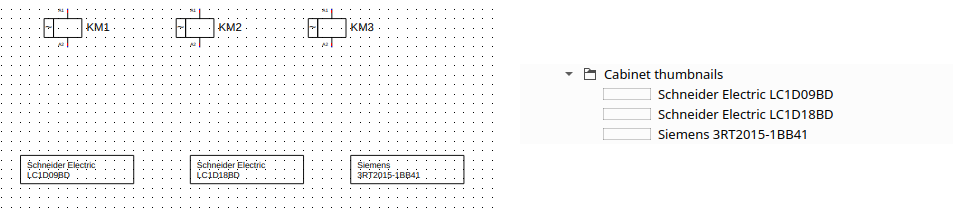
To lay out a cabinet you need a block for each device that says what it is. Select symbols on a sheet, right-click, and choose Générer une vignette d'armoire (Generate cabinet thumbnail). Every selected symbol that has both a manufacturer and a manufacturer reference in its information gets a thumbnail: a 120 × 30 frame showing those two values. The thumbnails go into a Cabinet thumbnails folder of the project's embedded collection, ready to drag onto a cabinet layout sheet.
- A device already in the folder is skipped, so running it again, or on several copies of one device, adds nothing.
- The entry is hidden when no selected symbol has both values.
- Like anything embedded, the thumbnails travel inside the
.qetfile.
Since PR #1170 (merged 2026-09-29); discussion #602.
See also: Elements XML · Using the element editor · Preferences reference · Importing EPLAN parts (.edz)
Looking for how to select items already placed on a diagram (Tab-cycling, select all, invert selection) rather than finding one to place? That's Keyboard-only control, a different meaning of "select" from everything on this page.
A project accumulates embedded copies: every element you place is stored inside
the .qet file, and deleting the element from a sheet does not remove the
stored definition. Over a long project that adds up.
Project → Nettoyer le projet offers three checkboxes, all ticked by default:
| Option | Removes |
|---|---|
| Unused title block templates | embedded title block templates no sheet uses |
| Unused elements | embedded element definitions that no sheet places |
| Empty categories | embedded folders left with nothing in them |
"Unused" is decided by looking at what the sheets actually place, so an element you deleted from the drawing yesterday counts as unused today.
This cannot be undone. Cleaning does not go through the undo stack — there is no undo command to reverse, and Ctrl+Z will not bring the definitions back. The only way out is to close the project without saving. Save first if you are not certain.
It only touches the collection embedded in the project. Your own element library on disk is not affected, and neither is the common collection. The practical consequence is the reverse of what people fear: cleaning does not lose you an element you still have installed — but it does mean a project carried to a machine that lacks that element in its library no longer brings its own copy.
