-
Notifications
You must be signed in to change notification settings - Fork 0
20242 February 2024
Article Type: Release Notes Release Version: 2024.2.0 Release Date: February 2024 Applies to Versions: 2024.2+
The February 2024 release (2024.2) delivers significant platform capabilities focused on streamlining data analysis, improving developer productivity, and strengthening enterprise security. This release introduces the highly anticipated Aggregate Query system for the GraphQL API, Screen Designer auto-save functionality, and a new external user access request system to enhance support workflows.
Additionally, this release expands integration capabilities with a new Google API connector and PCCC PLC driver, while implementing important security clarifications around tenant type API restrictions to encourage best practices in enterprise deployments.
Important: Support for the legacy Electron-based Edge Gateway ends with this release on 2/20/2024. Please migrate to the service-based Edge Gateway before this date.
- Aggregate Queries: Dramatically streamline the creation of business reports, summary screens, and dashboards by aggregating data directly through the GraphQL API without needing transforms, data flows, or manual calculations.
- Screen Designer Auto Save: Automatically saves and syncs screen changes after periods of inactivity, protecting developers from losing work due to browser or PC crashes.
- User Access Request System: Enables Fuuz support staff to request site access through a formal approval workflow, enhancing security transparency and audit capabilities.
- Google API Connector: New integration connector supporting connections to Google APIs including Google Drive, with flexibility to support additional Google services.
- PCCC Edge Gateway Driver: Expanded industrial connectivity with support for PCCC PLC communications.
- Tenant Type API Restrictions: Enhanced security by restricting administrative activities to the Enterprise Administration tenant.
The 2024.2 release introduces a major API feature that enables data aggregation directly through the GraphQL API. This capability dramatically streamlines the process of creating business reports, summary screens, dashboards, and other data analysis workloads without requiring transforms, data flows, or manual mathematical calculations.
A new _aggregate field now appears in GraphQL queries and field pickers. By selecting a field and operator from an object, the API automatically groups by every selected field not inside _aggregate and returns the computed value for the selected field and operator.
Example: By selecting the table template in the Screen Designer and selecting inventory status and quantity unit to group by, plus aggregate operators on the quantity value, you can generate an inventory report in seconds.


- Availability: All App Admin and Developer access types
- Learn more: Aggregate-Query-API
The Screen Designer now includes auto-save functionality to protect designers from losing changes due to PC or browser crashes. The designer automatically saves and syncs with any open screen runners after a period of inactivity.

If there is a reason to turn off auto-save temporarily—for example, when testing changes without saving them—the feature can be disabled using the toggle in the subheader.

Note: Future releases will enhance this system with automatic versioning and will extend auto-save functionality to the Data Model Designer, Data Flow Designer, and Application Configuration.
- Availability: All App Admin and Developer access types
A new external user access request system enables the Fuuz support team to offer quicker and more streamlined support while maintaining full security transparency. When a Fuuz support team member requests access to a customer site, enterprise administrators receive an email with the subject "Fuuz Site Access Request" containing:
- Which site and tenants/applications access is requested for
- Who is requesting the access
- Duration of the requested access
- Reason for the access request

The email includes a "Review Request in Fuuz" link that opens the request directly in your Fuuz site. From there, you can review the request in detail, including whether the user currently has an account, their current access level, and what actions approving the request will perform. You can then approve or reject the request with an optional rejection reason.
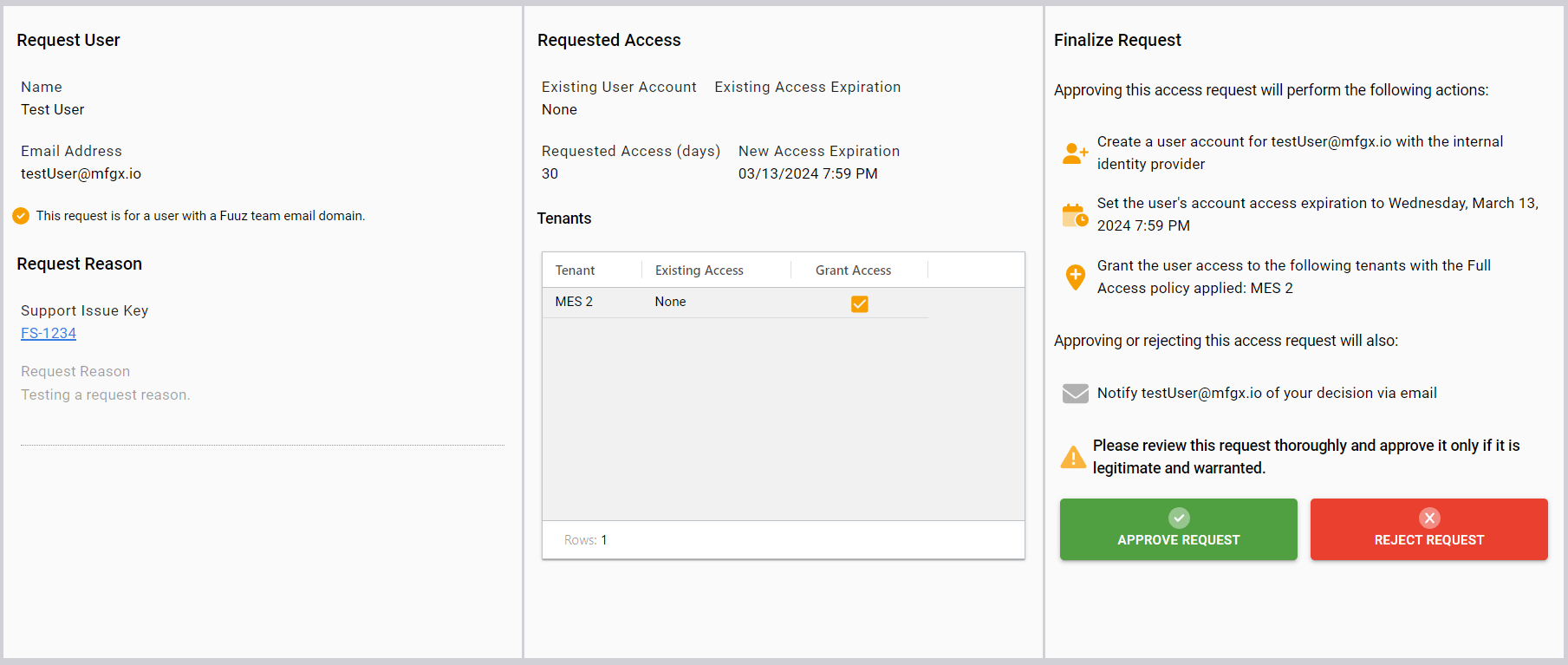
Note: A similar feature for internal access requests (when existing users need to request access to another application) is planned for a future release.
- Availability: Enterprise Administrators
A new integration connector supporting connections to Google APIs has been added. Initially developed to support Google Drive connections, this connector has been designed with flexibility to support all Google APIs. The current release includes a specific data flow node for Google Drive, while other Google APIs can be accessed through the generic Integrate node. Additional specific nodes for common APIs such as Gmail, Docs, and Search are planned for future releases.
- Availability: All App Admin and Developer access types
The Edge Gateway now includes a PCCC (Programmable Controller Communication Commands) PLC driver, expanding industrial connectivity options for legacy Allen-Bradley PLC communications.
- Availability: Edge Gateway deployments
A new data flow node has been added to support integration with SAP SuccessFactors, enabling streamlined HR data synchronization workflows.
- Availability: All App Admin and Developer access types
A new JSONata binding $isNotNilOrEmpty has been added, which returns true when the provided value is not null, undefined, 0, or an empty array, object, or string.
- Availability: All JSONata expression contexts (screens, data flows, transforms)
- Date and Time Field Defaults: Added support for default values and triggers for Date and Time field types in the Data Model Designer
- Enterprise Users UI: Updated Enterprise Users table and form to improve the user interface around deactivating and reactivating users
- API Key Deactivation: Added middleware to automatically deactivate user API keys when tenant access is deactivated
- Authentication Error Handling: Improved handling of certain authentication errors to prevent users from getting "stuck" in error states
- XML Content Handling: Implemented better handling of XML content types for webhook and data flow requests and responses
- Infrastructure Update: Updated infrastructure to latest service mesh version
- Health Check Optimization: Updated health check routes on some services to no longer try to load unused access model from cache
- Notification User Roles: Updated notification service to correctly capture changes to user roles when updating internal email lists
- Notification Recipients: Added a list of recipients to communication records to capture the list of email addresses a notification was sent to
- Gateway Error Handling: Updated Gateway UI error handling to better handle long-running requests to the Gateway server
- Data Flow Validation: Implemented data flow validation system to encourage best practices in flow development
- Walkthrough Improvement: Updated walkthrough to no longer close when clicking off the walkthrough dialog
- Schedules Display: Updated data flow schedules screen to correctly display frequencies as inactive when their schedule is inactive
- Log Capture: Added a new system to asynchronously persist log-type records to improve durability and reduce write workload
- Routes Tab Fix: Updated the Routes tab on the Screen form to correctly apply an exact match based on screen ID
- Console Deep Expand: Added CTRL+Click shortcut to deeply expand nested properties in console components
- Console Text Truncation: Added truncation of long text values in console components
-
Tenant Type Metadata: Added
tenantTypeIdto$metadata.tenantcontext in frontend transforms - Help Mode Info: Added screen version number and deployment date to the footer when help mode is enabled
- Screen Import: Added the ability to import screens from the splash screen in Screen Designer
- Module Field: Added a Module field to screens directly, copying modules from routes where available
- Save Dialogs: Updated save dialogs to provide default values for required Active and Full Screen fields
- Application Designer: Updated application designer actions to retain fullscreen state when creating new objects
- Icon Picker: Added new features for the icon picker component, including support for custom colors, configuration around which properties are available, and support for disabling the input
- Array Input Component: Added an Array Input component type to handle input of lists of scalar values (text, numbers, etc.)
- Scan Beep: Added "Beep on Scan" option to the Scan element to play a simple success/error beep on scan
- Select Dialog Mode: Added "Dialog Mode" option to the Select element to allow more flexibility around dialog behavior; added "Advanced Search" mode to open the advanced search dialog on request
- Table Cell Checkbox: Updated table cell styles for editable checkboxes to correct alignment and remove indeterminate state
- SVG Element: Added several new configuration options to the SVG element
- Fixed a bug causing nullable one-to-one relationships to throw unexpected errors
- Fixed a bug which could cause the incorrect field to be deleted when deleting a relationship between two models which have multiple relationships between them
- Fixed a potential crash caused by the Modbus driver reconnecting
- Fixed an issue which could cause the IBM DB2 driver to fail to load
- Removed unused Data Flow Library option from help menu and corrected Knowledge Base URLs
Important: Review these changes carefully as they may require updates to your implementation.
The 2024.2 release implements API restrictions that clarify the different tenant types and their intended purposes:
- Application Tenants: API restrictions have been added to prevent use of designers in installed application environments
- Custom Tenants: API restrictions now require user, tenant, enterprise, and other security administration activities to be performed in the Enterprise Administration tenant
When attempting administrative activities in non-administrative tenants, you will encounter errors such as:
The createAccessControlPolicy mutation is not permitted in custom tenants.
These errors indicate you need to switch to the Enterprise Administration tenant and repeat the action.
As announced in the 2024.1 release, the service-based Edge Gateway now fully supports all features of the legacy Gateway application. Support for the legacy Electron-based Edge Gateway ends on 2/20/2024.
Note: To identify which Gateway version you are running: if the Gateway opens in a desktop application window rather than a browser window, you are running the legacy Electron application and should migrate to the service-based Gateway.
If you are currently running the legacy Electron-based Edge Gateway:
- Contact Fuuz Support to schedule your migration to the service-based Gateway
- Complete the migration before 2/20/2024 to avoid service interruptions
- Review the service-based Gateway documentation for any configuration differences
If you have previously performed security or user administration activities in custom tenants:
- Update your workflows to perform administrative activities in the Enterprise Administration tenant
- Review any automation scripts or integrations that create or modify access control policies, users, or permissions
- Update any documentation or training materials to reflect the new administrative workflow
Note: Access types and roles do not automatically update across tenants or environments (Build, QA, Production). Administrators must ensure continuity between all tenants and environments as desired.
| Version | Date | Editor | Description |
|---|---|---|---|
| 1.0 | 2024-02-20 | Fuuz Documentation Team | Initial Release |
Source: support.fuuz.com
Getting Started (14)
- Access Field Level Help within the Fuuz Platform
- Field-Level Help
- Fuuz Platform 101: Low/No-Code Technology in Manufacturing
- Fuuz Platform Architecture
- Getting to Know the Fuuz Platform
- Logging into Fuuz – Cloud Access
- Manage what displays in Field Level Help throughout Fuuz
- Recovering Your Fuuz Account
- Sharing A Page
- Switching Between Apps in Fuuz
- Switching between Fuuz Environments (Build, QA, Production)
- Trouble Logging Into Fuuz
- Unique Email Plus Addressing
- Welcome To Industry Accelerators!
Training Guides (52)
Applications
- Brand and Configure Your Application
- Create an Application
- Deactivate (Retire) an Application
- Find Pages Beyond the Left Menu
- Install a Fuuz Package
- Navigate the Application Designer
- Retire an Application
Access & Users
- Approve Access Requests
- Approve Application Access Requests
- Configure the Internal Password Policy
- Create a Role
- Create an API Key
- Deactivate and Reactivate a User
- Grant Permissions with Policies
- Investigate Login Activity
- Invite a User to an Application
- Manage App Users
- Request Access to an Application
- Switch Applications, Roles, and Environments
- Understand Developer Access
- Understand Web Access
- Use the User Menu (Profile, Theme, and More)
Data Models & Schema
- Add a Custom Field
- Create a Data Model
- Create a Sequence
- Design Model Fields in the Schema Designer
- Relate Two Data Models
Screens
Weather Lookup Series — guided 3-part build
- Part 1 · Build the Screen (Beginner)
- Part 2 · Store the Readings (Intermediate)
- Part 3 · Watched Locations & Scheduled Capture (Advanced)
Data Flows & Integrations
- Call an External API with a Flow
- Connect to External Systems
- Create a Data Flow
- Create a Notification Channel
- Create a Webhook
- Save Queries, Scripts, and Data Mappings
- Schedule a Data Flow
- Use the Script Editor
Data, Reporting & Monitoring
- Browse Data with Data Explorer
- Build a Document (Report or Label)
- Check Component References
- Create Configuration Records (Modules, Units, Calendars, and More)
- Explore the GraphQL API
- Export Data
- Import Data into an Application
- Investigate Application Logs
- Save an Export Configuration
- Trace a Data Change
Enterprise & Organizations
Platform Concepts & Architecture (10)
- Bridging the Red and Blue Data Divide - How Fuuz Became the First Industrial Platform to Merge Operational and Business Intelligence
- Claude AI Skills for the Fuuz Platform
- Cool Things we built with Fuuz Episode 1 12.5.2025 (Public)
- Differences between MES and ERP from an ERP Consultant Eric Kimberling
- Fuuz can be your "Connected Worker Platform"
- Listen and Learn what MES is and what makes it unique
- Manufacturers struggle with Build versus Buy for their MES and what are the Core 4 Elements
- Stock Price Application
- Why All Manufacturers Build their MES System Part 1
- Why All Manufacturers Build their MES System Part 2
Screens & Application Design (17)
- Application Designer Guide
- Array Input
- Combobox
- Dynamic Field Configurations
- Fuuz Deployment Methodologies
- Fuuz Form Detail Screen Specification
- Historical Data Table Screen Design Standard
- JSON
- JSON Form Fields in Action Steps
- JSON Schema Inputs
- Master Data Table Screen Design Standard
- Mobile Screen Design Standard
- Screen Context Container
- Screen Generation (AI) Flow Template V1.5.1
- Setup Data Table Screen Design Standard
- Table Column Conditional Formatting
- Transform Data in a Column
Data Models & Schema (8)
Data Flows & Scripting (51)
Designing Flows
- Data Flow Design Standards
- Data Flow Logs
- Debugging and Testing our Fuuz Data Flows
- Flow Schedules
- Fuuz Data Flows enable DataOps at Scale, ETL, iPaaS and more
- How to Create APIs Using Data Flows in Fuuz
- How To General E-Commerce Integrations using Data Flows in Fuuz iPaaS
- How to Setup a daily file import using Fuuz Data Flows
- Managing Large Datasets in Fuuz: Data Flow Engine Performance Optimization
- The Power of Data Flows - Unlocking Industrial Intelligence with Fuuz
- Using Fuuz with FTP integrations and Data Flows iPaaS
Data Flow Nodes
- Data Flow Nodes Reference
- Debugging & Context Nodes
- Flow Control Nodes
- Fuuz Platform Nodes
- IIoT & Gateway Nodes
- Integration Nodes
- Notification Nodes
- Source & Trigger Nodes
- Transform Nodes
JSONata Reference
- Aggregation Functions
- Array Functions
- Boolean Functions
- Boolean Operators
- Comparison Operators
- Composition
- Construction
- Constructs
- Custom Fuuz Only JSONata Library
- Date Time Functions
- Date Time Processing
- Expressions
- Fuuz Bindings: $predicateFilter
- Higher Order Functions
- Jsonata Tutorial
- Numeric Functions
- Numeric Operators
- Object Functions
- Other Operators
- Path Operators
- Predicate Expressions
- Processing Model
- Regex
- Simple Queries
- Slow Transform Performance: JSONata vs JavaScript Optimization Guide
- Sorting Grouping and Aggregation
- String Functions
Scripting
Integrations & Connectors (30)
General & iPaaS
- API Keys
- Cloud Connectors - Complete Reference Guide
- Connecting a CRM with your ERP using Fuuz
- Connecting a Vending Machine to your ERP system using Fuuz
- Creating a Scheduled Integration & Sending a CSV File in an Email
- Debug a NetSuite SOAP API integration
- Fuuz Connections help you integrate your Systems and Devices
- Fuuz has lists of Connectors and Drivers you can use
- Fuuz has pre-built integration Connectors
- How to create a check an ODBC connection with another system
- How to Create a RESTful API Using the Fuuz Platform
- How to create a simple Integration and Store data in Fuuz
- How To Design or Configure Policies and Policy Groups for my App in Fuuz
- How to Integrate Fuuz with another product or another API
- How to Integrate with an HR system like ADP using Fuuz iPaaS
- How to use API Explorer and GraphQL to Query Data in Fuuz for Beginners
- How you Integrate your ERP with your MES
- Industry 3 and Industry 4 differences in ERP and MES Integrations
- Integrated Carrier Package
- Make REST-Based Calls With An API Key
- Policy Groups
- System connectivity validation - testing a connection when your 3rd party moves its hosting
- Using Fuuz as an iPaaS to Connect - to an API, Collect - Data from the API, Store - that data in Fuuz tables
Plex
- How to connect using Plex UX datasources from Fuuz iPaaS
- How to integrate with Plex Classic using Fuuz iPaaS
- How to Setup and Connect to Plex APIs
EDI
IIoT & Edge Gateway (18)
- Edge Connections: Complete Industrial Integration Reference
- Edge Gateway Flows
- Edge Gateway Installation Step-by-Step
- Edge to Cloud Infrastructure
- Gateway Deployment & Architecture
- Gateway System Requirements
- How IIoT fits into the Industrial Data "Stack"
Physical Device Connectors
- Connecting To Kepware OPCUA Server
- Fanuc Robot Connectivity using Edge Gateway
- HMI Template Standard - ISA-101 Compliant
- How to connect OPC/UA simulator to the Edge Gateway
- Modbus TCP
- MQTT
- Omron PLC/HMI NX102 Connectivity with Edge Gateway
Edge Data Connectors
Reporting, Documents & Dashboards (8)
- Building a Non-Conformance Report (NCR) Application in Fuuz
- Create responsive structured dashboard layouts using the Grid Container and Grid Cell components
- How to add visualizations (charts and graphs) to reports in Fuuz for Beginners
- How to build real-time reports in Fuuz from scratch for Beginners
- How to modify existing reports in Fuuz for Beginners
- Non-Conformance Report Accelerator
- Printing Documents
- Printing Documents From Fuuz
Administration & Access Control (27)
- Access Control
- Access Requests
- Access Requests: Overview
- Access Type Overview
- Access Types
- Add Users to Fuuz Apps
- App Admin Access
- App Management
- App Users
- Applications (Tenants)
- Authentication Events
- Change a User's Access Type
- Configurations
- Create Users and Set Access Type
- Enterprise Admin Overview
- Enterprise Users
- Enterprise Users vs Access Requests
- How To Login to your Fuuz Enterprise - Non Single Sign On
- How To Login to your Fuuz Enterprise - Single Sign On
- Identity Providers
- Notifications
- Notifications
- Organizations
- Roles
- Settings
- Switching my active Role within Fuuz
- Troubleshooting User Login Errors Due to Identity Provider Misconfiguration
Data Management (8)
Accelerators, Templates & Packages (8)
- Create a Quality Batch Golden Record Analysis Tool in Fuuz
- Fuuz Developer 101 Bootcamp - 2026 Schedule & Enrollment
- Fuuz Developer 101 Bootcamp - Program Overview
- Fuuz Industry Accelerators - Installation & Best Practices
- Fuuz Industry Accelerators - Overview
- How-To: Managing Green/Blue Deployments with Fuuz Package Management Zero-Downtime
- Model Agnostic Scheduling System APS
- Setting up In-House Fuuz
Design Standards (1)
How-To Guides (8)
- Connecting to Fuuz from a remote system to execute a Fuuz API
- Connecting to Fuuz from a remote system to execute a Fuuz API - Extended Features Part 2
- Data Mapping
- Document your Application using Atlassian Confluence and our Pre-Built App
- Fuuz Platform Capabilities
- How to add multiple data records to the Fuuz database with a single API call
- How to on Best Practices for Designing Flows in Fuuz
- Using the Transformation Explorer
FAQ & Troubleshooting (1)
Release Notes (117)
2026
- 2026.1 (January 2026)
- 2026.2 (February 2026)
- 2026.3 (March 2026)
- 2026.4 (April 2026)
- 2026.5 (May 2026)
- 2026.6 (June 2026)
2025
- 2025.1 (January 2025)
- 2025.10 (October 2025)
- 2025.11 (November 2025)
- 2025.12 (December 2025)
- 2025.2 (February 2025)
- 2025.4 (April 2025)
- 2025.5 (May 2025)
- 2025.6 (June 2025)
- 2025.7 (July 2025)
- 2025.8 (August 2025)
- 2025.9 (September 2025)
2024
- 2024.1 (January 2024)
- 2024.10 (October 2024)
- 2024.11 (November 2024)
- 2024.12 (December 2024)
- 2024.2 (February 2024)
- 2024.3 (March 2024)
- 2024.4 (April 2024)
- 2024.5 (May 2024)
- 2024.6 (June 2024)
- 2024.7 (July 2024)
- 2024.8 (August 2024)
- 2024.9 (September 2024)
2023
- 2023.5 (May 2023)
- 2023.1 (January 2023)
- 2023.10 (October 2023)
- 2023.11 (November 2023)
- 2023.12 (December 2023)
- 2023.2 (February 2023)
- 2023.3 (March 2023)
- 2023.4 (April 2023)
- 2023.6 (June 2023)
- 2023.7 (July 2023)
- 2023.8 (August 2023)
- 2023.9 (September 2023)
2022
- 2022 Q1 Fuuz Package Updates (03/11/2022)
- 2022 Q1 Fuuz Release Notes v3.87.0 (03/17/2022)
- 2022 Q1 MFGx Release Notes v3.78.0 (01/06/2022)
- 2022 Q1 MFGx Release Notes v3.79.0 (01/13/2022)
- 2022 Q1 MFGx Release Notes v3.80.0 (01/20/2022)
- 2022 Q1 MFGx Release Notes v3.81.0 (01/27/2022)
- 2022 Q1 MFGx Release Notes v3.82.0 (02/03/2022)
- 2022 Q1 MFGx Release Notes v3.83.0 (02/10/2022)
- 2022 Q1 MFGx Release Notes v3.85.0 (02/28/2022)
- 2022 Q2 Fuuz Release Notes v3.90.0 (04/14/2022)
- 2022 Q2 Fuuz Release Notes v3.91.0 (04/21/2022)
- 2022 Q2 Fuuz Release Notes v3.92.0 (04/28/2022)
- 2022 Q2 Fuuz Release Notes v3.93.0 (05/06/2022)
- 2022 Q2 Fuuz Release Notes v3.94.0 - v3.97.0 (June 13, 2022)
- 2022 Q2 Fuuz Release Notes v3.98.0 (06/16/2022)
- 2022 Q2 Fuuz Release Notes v3.99.0 (06/30/2022)
- 2022 Q3 Fuuz Release Notes v3.100.0 🎉 (07/06/2022)
- 2022 Q3 Fuuz Release Notes v3.101.0 (07/21/2022)
- 2022 Q3 Fuuz Release Notes v3.102.0 (08/11/2022)
- 2022 Q3 Fuuz Release Notes v3.103.0 (08/18/2022)
- 2022 Q4 Fuuz Release Notes v3.107.0 - v3.109.0 (10/27/2022)
2021
- 2021 Q1 MFGx Release Notes v3.29.0 (1/7/2021)
- 2021 Q1 MFGx Release Notes v3.30.0 (1/14/2021)
- 2021 Q1 MFGx Release Notes v3.34.0 (2/4/2021)
- 2021 Q1 MFGx Release Notes v3.37.0 (2/26/2021)
- 2021 Q1 MFGx Release Notes v3.38.0 (3/5/2021)
- 2021 Q1 MFGx Release Notes v3.40.0 (3/25/2021)
- 2021 Q1 MFGx.io Release Notes v3.32.0 (1/21/2021)
- 2021 Q1 MFGx.io Release Notes v3.33.0 (1/28/2021)
- 2021 Q2 MFGx Release Notes v3.41.0 (4/1/2021)
- 2021 Q2 MFGx Release Notes v3.42.0 (4/8/2021)
- 2021 Q2 MFGx Release Notes v3.43.0 (4/16/2021)
- 2021 Q2 MFGx Release Notes v3.44.0 (4/22/2021)
- 2021 Q2 MFGx Release Notes v3.45.0 (4/29/2021)
- 2021 Q2 MFGx Release Notes v3.47.0 (5/13/2021)
- 2021 Q2 MFGx Release Notes v3.48.0 (5/20/2021)
- 2021 Q2 MFGx Release Notes v3.48.0 (5/27/2021)
- 2021 Q2 MFGx Release Notes v3.50.0 (6/03/2021)
- 2021 Q2 MFGx Release Notes v3.51.0 (6/10/2021)
- 2021 Q2 MFGx Release Notes v3.52.0 (6/17/2021)
- 2021 Q2 MFGx Release Notes v3.54.0 (6/28/2021)
- 2021 Q3 Fuuz Release Notes v3.58.0 (7/22/2021)
- 2021 Q3 MFGx Release Notes v3.55.0 (7/1/2021)
- 2021 Q3 MFGx Release Notes v3.60.0 (8/5/2021)
- 2021 Q3 MFGx Release Notes v3.61.0 (8/17/2021)
- 2021 Q3 MFGx Release Notes v3.62.0 (8/19/2021)
- 2021 Q4 MFGx Release Notes v3.68.0 (10/8/2021)
- 2021 Q4 MFGx Release Notes v3.69.0 (10/14/2021)
- 2021 Q4 MFGx Release Notes v3.70.0 (10/21/2021)
- 2021 Q4 MFGx Release Notes v3.71.0 (10/28/2021)
- 2021 Q4 MFGx Release Notes v3.72.0 (11/04/2021)
- 2021 Q4 MFGx Release Notes v3.73.0 (11/11/2021)
- 2021 Q4 MFGx Release Notes v3.74.0 (11/19/2021)
- 2021 Q4 MFGx Release Notes v3.75.0 (12/02/2021)
- 2021 Q4 MFGx Release Notes v3.76.0 (12/09/2021)
- 2021 Q4 MFGx Release Notes v3.77.0: The Holiday Update (12/16/2021)
2020
- 2020 Q2 MFGx Release Notes v2.32.0 (4/9/2020)
- 2020 Q2 MFGx Release Notes v2.33.0 (4/16/2020)
- 2020 Q2 MFGx Release Notes v2.35.0 (4/30/2020)
- 2020 Q2 MFGx Release Notes v3.5.0 (6/18/2020)
- 2020 Q2 MFGx Release Notes v3.6.0 (6/25/2020)
- 2020 Q2 MFGx.io Release Notes v2.32.0 (4/9/2020)
- 2020 Q3 MFGx Release Notes v3.10.0 (7/23/2020)
- 2020 Q3 MFGx Release Notes v3.11.0 (7/30/2020)
- 2020 Q3 MFGx Release Notes v3.13.0 (8/13/2020)
- 2020 Q3 MFGx Release Notes v3.17.0 (9/21/2020)
- 2020 Q3 MFGx Release Notes v3.7.0 (7/6/2020)
- 2020 Q3 MFGx Release Notes v3.8.0 (7/9/2020)
- 2020 Q4 MFGx Release Notes v3.20.0 (10/13/2020)
- 2020 Q4 MFGx Release Notes v3.21.0 (10/15/2020)
- 2020 Q4 MFGx Release Notes v3.22.1 (10/22/2020)
- 2020 Q4 MFGx Release Notes v3.23.0 (11/5/2020)
- 2020 Q4 MFGx Release Notes v3.24.0 (11/12/2020)
- 2020 Q4 MFGx Release Notes v3.26.0 (12/3/2020)
- 2020 Q4 MFGx Release Notes v3.27.0 (12/10/2020)
- 2020 Q4 MFGx Release Notes v3.28.0 (12/17/2020)