-
Notifications
You must be signed in to change notification settings - Fork 0
20247 July 2024
Article Type: Release Notes Audience: All Users Module: Platform Releases
The July release includes a range of features designed to streamline app development and administration in Fuuz. Read on to learn more!
The July 2024 release includes an exciting new feature for the Application Designer which brings together the various app components in the platform. With this release, users can now drag screens, data models, and data flows from the Navigator panel into a screen design to create screen elements! Each of those component types will create a different element:
- Dragging and dropping a screen into another screen will create an action button which navigates to the dropped screen.
- Dragging and dropping a data flow into a screen will create a flow button which executes that data flow.
- Dragging and dropping a data model into a screen will ask the user whether they wish to create a table or form, then allow them to pick the fields and sections they want to include before generating a table with filters and actions or a form with actions.

This feature is just the first step down the path of more fluidly integrating app components together in the app designer; future releases will add support for dragging and dropping into flows, as well as the ability to drag and drop specific fields from a data model to create just a single column or input.
This month's release also includes a new system screen we're very excited about: a global Data Change History!
First, some background: as an event-driven system, Fuuz has always had a very comprehensive change capture system, useful as an edit history or audit tool; if data change capture is enabled on a data model (and it is by default), metadata about any change to any record is captured separately from the model and stored for a specified retention period - even if the record itself is deleted. However, before this change, there was no consistent way to view that change history; some screens had a "Data Changes" tab available on the form, but not all, and even then the user experience left much to be desired.
This new Data Change History screen, accessible via the Administration menu or search bar, solves those problems. This split-screen view allows administrators to select what type of record to view changes for and then filter based on a specific record, change date, user, or other criteria.

The table on the left will display the change history - who changed what when - allowing admins to understand how a record may have changed over time.

To dive into the details of a specific change, administrators can select a change from the table. This will load the change into the form on the right, highlighting which fields changed and allowing administrators to view the entire record if desired.
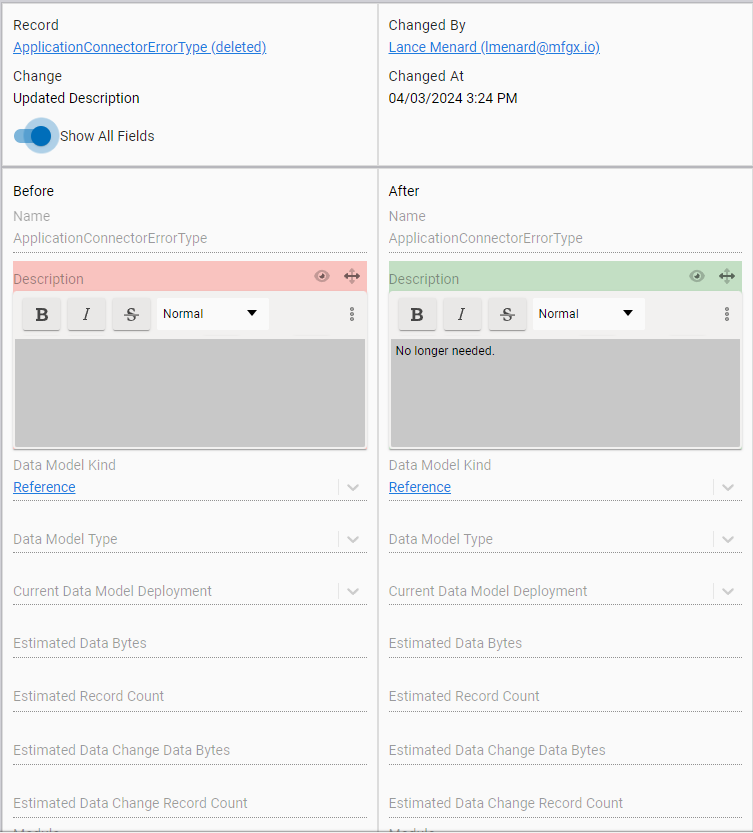
In a future release, we'll add a link to this page to the system subheader, so users can quickly view the relevant data changes for the context of the screen they're viewing - keep an eye out for that feature!
The 2024.7 release features a new screen element with the ability to embed an external webpage inside a Fuuz screen. This Embedded Webpage element allows app builders to set up a URL or transform to load, and to select the permissions required for the embedded page to run. Most sites will require at least the navigation and script permissions, but others may be required depending on how the embedded site operates and what it should be allowed to do. End users can then interact with the embedded page within the context of a Fuuz screen!
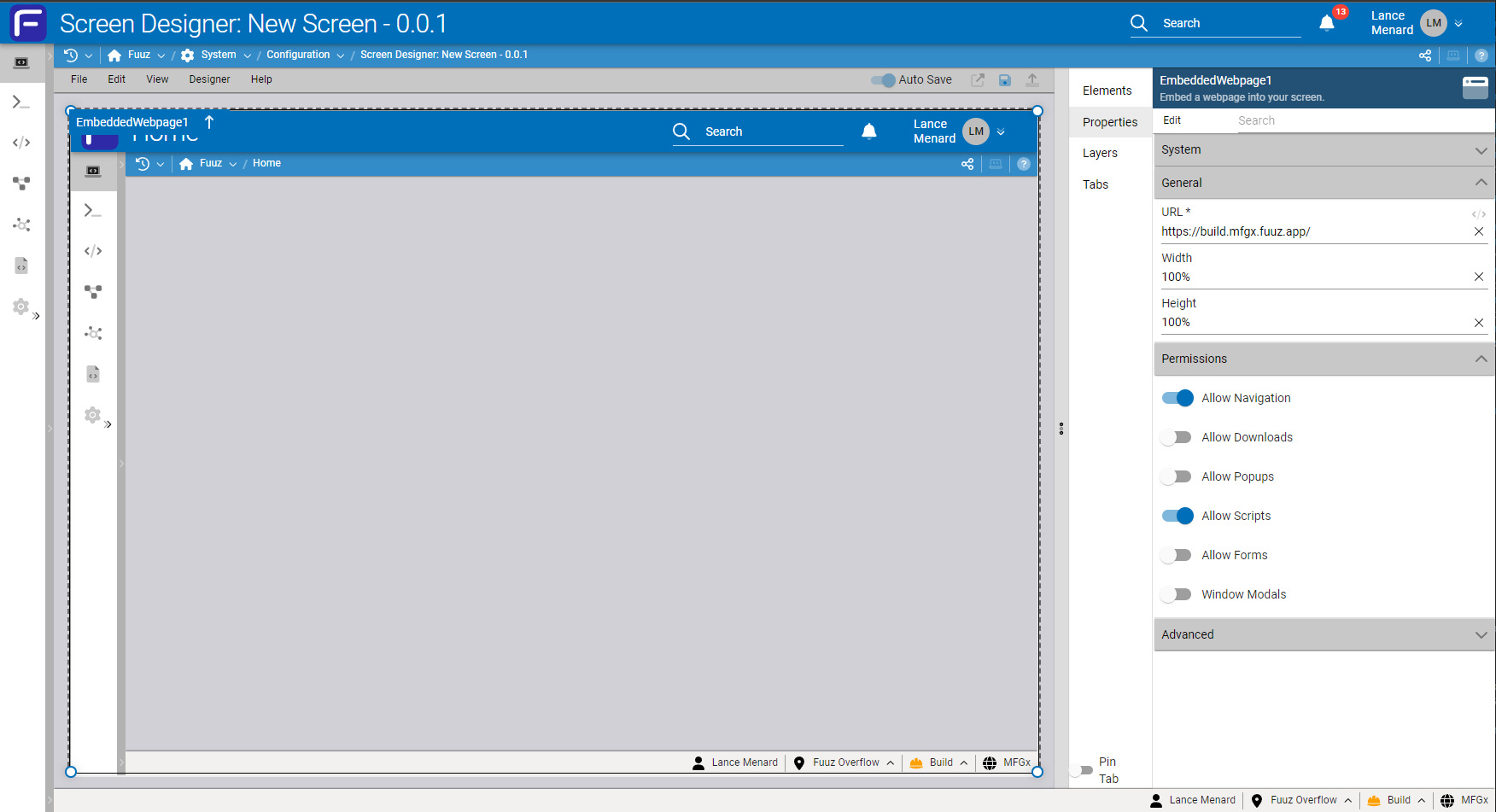
This element is most helpful for displaying information from an external page, or to streamline a manual process which would normally require multiple browser tabs. It will allow app builders to create more seamless integrations with external systems such as ERP or TMS.
Important: Not every webpage permits itself to be embedded, and how those embedded pages work can change with browser updates as permissions and standards evolve over time. As such, it's recommended to restrict use of this element to non-mission-critical processes where a backup or alternative process exists, and to test a specific site with the element before assuming it will work.
The July release adds a new Type field to data models which will streamline the process of developing applications. This field is available while creating a model, or in the Properties panel for existing models.
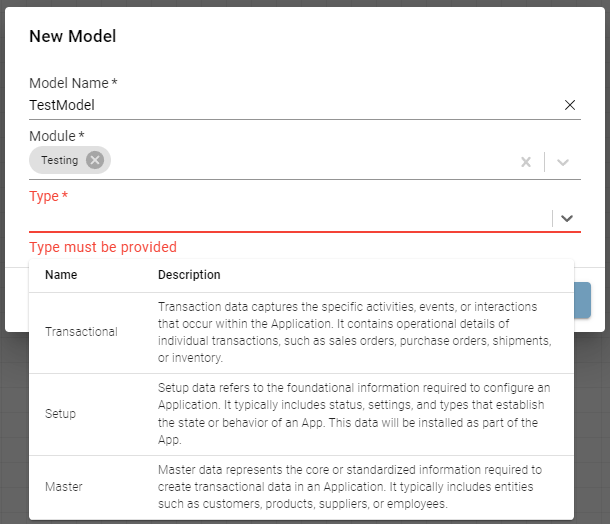
These types define broad categories of the type of data stored in the model, and will eventually be used to drive default model properties and fields, as well as to automate the process of including setup data as part of an app during publishing. There are three types available:
- Master: Master data represents the core or standardized information required to create transactional data in an Application. It typically includes entities such as customers, products, suppliers, or employees.
- Setup: Setup data refers to the foundational information required to configure an Application. It typically includes status, settings, and types that establish the state or behavior of an App. This data will be installed as part of the App.
- Transactional: Transactional data captures the specific activities, events, or interactions that occur within the Application. It contains operational details of individual transactions, such as sales orders, purchase orders, shipments, or inventory.
For the moment, this data model type is largely informational, but it's important to select the type that best aligns with the model to get the most benefit from future enhancements.
Note: Models that were already deployed prior to this release won't have a type, but a data model type must be selected during model creation or before deploying a new version of an existing model.
This month's release simplifies the process of using web flows in screens. Prior to this release, web flows either needed to be used with a Flow Button element, or they needed to be selected in the "Additional Screen Flows" field on the screen itself. With this release, web flows will now be automatically loaded when executed, which means "Additional Screen Flows" is no longer required when using a web flow with the $executeFlow binding or Flow action button step.
Additionally, we've improved the compatibility between web flows and backend flows with the various methods of running them: you can now use the $executeFlow binding, Flow action step, or Flow Button screen element to run either a web flow or backend flow. This should help streamline app development, with less time spent worrying about using the right element with the right flow type.
The 2024.7 release includes a significant set of optimizations to data model deployments to reduce deployment times and improve reliability when installing large packages of data models. Single models now generally deploy in a few seconds where they took 15-20 seconds before, which speeds up iteration during the early stages of app development.
Additionally, large batches of data models deploy much more quickly and reliably; our flagship MES app, which has 242 data models at last count, deploys in around three minutes, which speeds up the process of installing apps and gets those apps into your user's hands faster!
User access management is one of the points of friction that has developed over the past year as we've invested in our app platform. The existing approach was developed early on in the life of the platform, and as the system as grown and evolved over the years, it's become clear that a number of aspects of user management don't nicely align with how customers are using the platform now. To address that, we're rolling out a range of changes in the July release which will collectively have a significant impact on how user access is managed in Fuuz.
These changes were described in detail in a preview in the release notes for the 2024.6 release; rather than repeat them here, please refer to those notes for details!
- Added a Type field to data models to streamline application packaging and master data import/export
- Updated schema designer to not prompt for a description or data mapping when deploying many models at once
- Improved schema deployment to reduce deployment times for single models and increase reliability when installing packages with large numbers of data models
- Added validation to ensure the "Set Null" deletion reference behavior can't be used with non-nullable fields
- Changed Deletion Reference Behavior input to a Select field so descriptions are also displayed
- Updated the model "Edit Definition" action to "View Definition" and disallow changes
- Updated deployment status snackbars to use data change notifications instead of full events
- Added a global Data Change History screen to display data changes from any model in the system
- Refactored scalar map and document conversions to ensure scalar type consistency between APIs
- Added support for deprecation reasons on queries and mutations
- Added a specific error message when trying to change the password of a user configured with a single sign-on identity provider
- Implemented a wide array of changes aimed at making user access management simpler and more intuitive
- Access control policies and groups are now managed per-tenant/app, rather than in the enterprise admin tenant
- Policy groups can now be applied to users by linking them to roles
- Added an Access Type field to users to indicate the basic level of permissions/access the user should have
- Added a streamlined "Invite User" action to the App Users screen in app tenants
- Converted replication service to Typescript in preparation for upcoming enhancements
- Updated core services to RabbitMQ 13 and MongoDB 7
- Updated AJV validator library
- Updated SMTP connector to use the latest version of
nodemailerand to disallow certain attachment options
- Added handling for an edge case that could cause the Edge Gateway to crash
- Corrected a bug with the Recipients list dialog on the notification channel table
- Corrected an edge case that could leave lingering queue consumers after subscription queue errors
- Applied styling and functionality tweaks to the console component to improve usability with large objects
- Updated input tab navigation to improve usability of keyboard-only input with text and select inputs
- Added icon picker to module group form
- Updated web flow system to load web flows on demand, rather than requiring them to be specifically loaded into a screen, and to add more interoperability between web and backend flows with flow buttons and the
$executeFlowbinding - Updated
markedlibrary used in Markdown components and conversions
- Updated field group inputs to start collapsed by default
- Updated the array input to better handle values of various types
- Added a 300px maximum width to columns in the Select input's popper to force long text to wrap
- Updated Cron, Date Time Range, Measure, and Ratio Measure inputs to use Select inputs instead of Comboboxes
- Updated Select Input element Additional Filter to a transform input
- Corrected a bug causing the screen designer not to update the screen route during deployment
- Corrected a bug causing an error if a default tab is set on a Tab element when tabs have no names
- Added an
iconformat option for table columns - Added an Embedded Webpage element
- Updated screen designer to allow pasting nested cards/forms
- Added functionality to create tables, forms, and buttons by dragging data models, flows, or screens from the Navigator panel into a screen
Source: support.fuuz.com
Getting Started (14)
- Access Field Level Help within the Fuuz Platform
- Field-Level Help
- Fuuz Platform 101: Low/No-Code Technology in Manufacturing
- Fuuz Platform Architecture
- Getting to Know the Fuuz Platform
- Logging into Fuuz – Cloud Access
- Manage what displays in Field Level Help throughout Fuuz
- Recovering Your Fuuz Account
- Sharing A Page
- Switching Between Apps in Fuuz
- Switching between Fuuz Environments (Build, QA, Production)
- Trouble Logging Into Fuuz
- Unique Email Plus Addressing
- Welcome To Industry Accelerators!
Training Guides (52)
Applications
- Brand and Configure Your Application
- Create an Application
- Deactivate (Retire) an Application
- Find Pages Beyond the Left Menu
- Install a Fuuz Package
- Navigate the Application Designer
- Retire an Application
Access & Users
- Approve Access Requests
- Approve Application Access Requests
- Configure the Internal Password Policy
- Create a Role
- Create an API Key
- Deactivate and Reactivate a User
- Grant Permissions with Policies
- Investigate Login Activity
- Invite a User to an Application
- Manage App Users
- Request Access to an Application
- Switch Applications, Roles, and Environments
- Understand Developer Access
- Understand Web Access
- Use the User Menu (Profile, Theme, and More)
Data Models & Schema
- Add a Custom Field
- Create a Data Model
- Create a Sequence
- Design Model Fields in the Schema Designer
- Relate Two Data Models
Screens
Weather Lookup Series — guided 3-part build
- Part 1 · Build the Screen (Beginner)
- Part 2 · Store the Readings (Intermediate)
- Part 3 · Watched Locations & Scheduled Capture (Advanced)
Data Flows & Integrations
- Call an External API with a Flow
- Connect to External Systems
- Create a Data Flow
- Create a Notification Channel
- Create a Webhook
- Save Queries, Scripts, and Data Mappings
- Schedule a Data Flow
- Use the Script Editor
Data, Reporting & Monitoring
- Browse Data with Data Explorer
- Build a Document (Report or Label)
- Check Component References
- Create Configuration Records (Modules, Units, Calendars, and More)
- Explore the GraphQL API
- Export Data
- Import Data into an Application
- Investigate Application Logs
- Save an Export Configuration
- Trace a Data Change
Enterprise & Organizations
Platform Concepts & Architecture (10)
- Bridging the Red and Blue Data Divide - How Fuuz Became the First Industrial Platform to Merge Operational and Business Intelligence
- Claude AI Skills for the Fuuz Platform
- Cool Things we built with Fuuz Episode 1 12.5.2025 (Public)
- Differences between MES and ERP from an ERP Consultant Eric Kimberling
- Fuuz can be your "Connected Worker Platform"
- Listen and Learn what MES is and what makes it unique
- Manufacturers struggle with Build versus Buy for their MES and what are the Core 4 Elements
- Stock Price Application
- Why All Manufacturers Build their MES System Part 1
- Why All Manufacturers Build their MES System Part 2
Screens & Application Design (17)
- Application Designer Guide
- Array Input
- Combobox
- Dynamic Field Configurations
- Fuuz Deployment Methodologies
- Fuuz Form Detail Screen Specification
- Historical Data Table Screen Design Standard
- JSON
- JSON Form Fields in Action Steps
- JSON Schema Inputs
- Master Data Table Screen Design Standard
- Mobile Screen Design Standard
- Screen Context Container
- Screen Generation (AI) Flow Template V1.5.1
- Setup Data Table Screen Design Standard
- Table Column Conditional Formatting
- Transform Data in a Column
Data Models & Schema (8)
Data Flows & Scripting (51)
Designing Flows
- Data Flow Design Standards
- Data Flow Logs
- Debugging and Testing our Fuuz Data Flows
- Flow Schedules
- Fuuz Data Flows enable DataOps at Scale, ETL, iPaaS and more
- How to Create APIs Using Data Flows in Fuuz
- How To General E-Commerce Integrations using Data Flows in Fuuz iPaaS
- How to Setup a daily file import using Fuuz Data Flows
- Managing Large Datasets in Fuuz: Data Flow Engine Performance Optimization
- The Power of Data Flows - Unlocking Industrial Intelligence with Fuuz
- Using Fuuz with FTP integrations and Data Flows iPaaS
Data Flow Nodes
- Data Flow Nodes Reference
- Debugging & Context Nodes
- Flow Control Nodes
- Fuuz Platform Nodes
- IIoT & Gateway Nodes
- Integration Nodes
- Notification Nodes
- Source & Trigger Nodes
- Transform Nodes
JSONata Reference
- Aggregation Functions
- Array Functions
- Boolean Functions
- Boolean Operators
- Comparison Operators
- Composition
- Construction
- Constructs
- Custom Fuuz Only JSONata Library
- Date Time Functions
- Date Time Processing
- Expressions
- Fuuz Bindings: $predicateFilter
- Higher Order Functions
- Jsonata Tutorial
- Numeric Functions
- Numeric Operators
- Object Functions
- Other Operators
- Path Operators
- Predicate Expressions
- Processing Model
- Regex
- Simple Queries
- Slow Transform Performance: JSONata vs JavaScript Optimization Guide
- Sorting Grouping and Aggregation
- String Functions
Scripting
Integrations & Connectors (30)
General & iPaaS
- API Keys
- Cloud Connectors - Complete Reference Guide
- Connecting a CRM with your ERP using Fuuz
- Connecting a Vending Machine to your ERP system using Fuuz
- Creating a Scheduled Integration & Sending a CSV File in an Email
- Debug a NetSuite SOAP API integration
- Fuuz Connections help you integrate your Systems and Devices
- Fuuz has lists of Connectors and Drivers you can use
- Fuuz has pre-built integration Connectors
- How to create a check an ODBC connection with another system
- How to Create a RESTful API Using the Fuuz Platform
- How to create a simple Integration and Store data in Fuuz
- How To Design or Configure Policies and Policy Groups for my App in Fuuz
- How to Integrate Fuuz with another product or another API
- How to Integrate with an HR system like ADP using Fuuz iPaaS
- How to use API Explorer and GraphQL to Query Data in Fuuz for Beginners
- How you Integrate your ERP with your MES
- Industry 3 and Industry 4 differences in ERP and MES Integrations
- Integrated Carrier Package
- Make REST-Based Calls With An API Key
- Policy Groups
- System connectivity validation - testing a connection when your 3rd party moves its hosting
- Using Fuuz as an iPaaS to Connect - to an API, Collect - Data from the API, Store - that data in Fuuz tables
Plex
- How to connect using Plex UX datasources from Fuuz iPaaS
- How to integrate with Plex Classic using Fuuz iPaaS
- How to Setup and Connect to Plex APIs
EDI
IIoT & Edge Gateway (18)
- Edge Connections: Complete Industrial Integration Reference
- Edge Gateway Flows
- Edge Gateway Installation Step-by-Step
- Edge to Cloud Infrastructure
- Gateway Deployment & Architecture
- Gateway System Requirements
- How IIoT fits into the Industrial Data "Stack"
Physical Device Connectors
- Connecting To Kepware OPCUA Server
- Fanuc Robot Connectivity using Edge Gateway
- HMI Template Standard - ISA-101 Compliant
- How to connect OPC/UA simulator to the Edge Gateway
- Modbus TCP
- MQTT
- Omron PLC/HMI NX102 Connectivity with Edge Gateway
Edge Data Connectors
Reporting, Documents & Dashboards (8)
- Building a Non-Conformance Report (NCR) Application in Fuuz
- Create responsive structured dashboard layouts using the Grid Container and Grid Cell components
- How to add visualizations (charts and graphs) to reports in Fuuz for Beginners
- How to build real-time reports in Fuuz from scratch for Beginners
- How to modify existing reports in Fuuz for Beginners
- Non-Conformance Report Accelerator
- Printing Documents
- Printing Documents From Fuuz
Administration & Access Control (27)
- Access Control
- Access Requests
- Access Requests: Overview
- Access Type Overview
- Access Types
- Add Users to Fuuz Apps
- App Admin Access
- App Management
- App Users
- Applications (Tenants)
- Authentication Events
- Change a User's Access Type
- Configurations
- Create Users and Set Access Type
- Enterprise Admin Overview
- Enterprise Users
- Enterprise Users vs Access Requests
- How To Login to your Fuuz Enterprise - Non Single Sign On
- How To Login to your Fuuz Enterprise - Single Sign On
- Identity Providers
- Notifications
- Notifications
- Organizations
- Roles
- Settings
- Switching my active Role within Fuuz
- Troubleshooting User Login Errors Due to Identity Provider Misconfiguration
Data Management (8)
Accelerators, Templates & Packages (8)
- Create a Quality Batch Golden Record Analysis Tool in Fuuz
- Fuuz Developer 101 Bootcamp - 2026 Schedule & Enrollment
- Fuuz Developer 101 Bootcamp - Program Overview
- Fuuz Industry Accelerators - Installation & Best Practices
- Fuuz Industry Accelerators - Overview
- How-To: Managing Green/Blue Deployments with Fuuz Package Management Zero-Downtime
- Model Agnostic Scheduling System APS
- Setting up In-House Fuuz
Design Standards (1)
How-To Guides (8)
- Connecting to Fuuz from a remote system to execute a Fuuz API
- Connecting to Fuuz from a remote system to execute a Fuuz API - Extended Features Part 2
- Data Mapping
- Document your Application using Atlassian Confluence and our Pre-Built App
- Fuuz Platform Capabilities
- How to add multiple data records to the Fuuz database with a single API call
- How to on Best Practices for Designing Flows in Fuuz
- Using the Transformation Explorer
FAQ & Troubleshooting (1)
Release Notes (117)
2026
- 2026.1 (January 2026)
- 2026.2 (February 2026)
- 2026.3 (March 2026)
- 2026.4 (April 2026)
- 2026.5 (May 2026)
- 2026.6 (June 2026)
2025
- 2025.1 (January 2025)
- 2025.10 (October 2025)
- 2025.11 (November 2025)
- 2025.12 (December 2025)
- 2025.2 (February 2025)
- 2025.4 (April 2025)
- 2025.5 (May 2025)
- 2025.6 (June 2025)
- 2025.7 (July 2025)
- 2025.8 (August 2025)
- 2025.9 (September 2025)
2024
- 2024.1 (January 2024)
- 2024.10 (October 2024)
- 2024.11 (November 2024)
- 2024.12 (December 2024)
- 2024.2 (February 2024)
- 2024.3 (March 2024)
- 2024.4 (April 2024)
- 2024.5 (May 2024)
- 2024.6 (June 2024)
- 2024.7 (July 2024)
- 2024.8 (August 2024)
- 2024.9 (September 2024)
2023
- 2023.5 (May 2023)
- 2023.1 (January 2023)
- 2023.10 (October 2023)
- 2023.11 (November 2023)
- 2023.12 (December 2023)
- 2023.2 (February 2023)
- 2023.3 (March 2023)
- 2023.4 (April 2023)
- 2023.6 (June 2023)
- 2023.7 (July 2023)
- 2023.8 (August 2023)
- 2023.9 (September 2023)
2022
- 2022 Q1 Fuuz Package Updates (03/11/2022)
- 2022 Q1 Fuuz Release Notes v3.87.0 (03/17/2022)
- 2022 Q1 MFGx Release Notes v3.78.0 (01/06/2022)
- 2022 Q1 MFGx Release Notes v3.79.0 (01/13/2022)
- 2022 Q1 MFGx Release Notes v3.80.0 (01/20/2022)
- 2022 Q1 MFGx Release Notes v3.81.0 (01/27/2022)
- 2022 Q1 MFGx Release Notes v3.82.0 (02/03/2022)
- 2022 Q1 MFGx Release Notes v3.83.0 (02/10/2022)
- 2022 Q1 MFGx Release Notes v3.85.0 (02/28/2022)
- 2022 Q2 Fuuz Release Notes v3.90.0 (04/14/2022)
- 2022 Q2 Fuuz Release Notes v3.91.0 (04/21/2022)
- 2022 Q2 Fuuz Release Notes v3.92.0 (04/28/2022)
- 2022 Q2 Fuuz Release Notes v3.93.0 (05/06/2022)
- 2022 Q2 Fuuz Release Notes v3.94.0 - v3.97.0 (June 13, 2022)
- 2022 Q2 Fuuz Release Notes v3.98.0 (06/16/2022)
- 2022 Q2 Fuuz Release Notes v3.99.0 (06/30/2022)
- 2022 Q3 Fuuz Release Notes v3.100.0 🎉 (07/06/2022)
- 2022 Q3 Fuuz Release Notes v3.101.0 (07/21/2022)
- 2022 Q3 Fuuz Release Notes v3.102.0 (08/11/2022)
- 2022 Q3 Fuuz Release Notes v3.103.0 (08/18/2022)
- 2022 Q4 Fuuz Release Notes v3.107.0 - v3.109.0 (10/27/2022)
2021
- 2021 Q1 MFGx Release Notes v3.29.0 (1/7/2021)
- 2021 Q1 MFGx Release Notes v3.30.0 (1/14/2021)
- 2021 Q1 MFGx Release Notes v3.34.0 (2/4/2021)
- 2021 Q1 MFGx Release Notes v3.37.0 (2/26/2021)
- 2021 Q1 MFGx Release Notes v3.38.0 (3/5/2021)
- 2021 Q1 MFGx Release Notes v3.40.0 (3/25/2021)
- 2021 Q1 MFGx.io Release Notes v3.32.0 (1/21/2021)
- 2021 Q1 MFGx.io Release Notes v3.33.0 (1/28/2021)
- 2021 Q2 MFGx Release Notes v3.41.0 (4/1/2021)
- 2021 Q2 MFGx Release Notes v3.42.0 (4/8/2021)
- 2021 Q2 MFGx Release Notes v3.43.0 (4/16/2021)
- 2021 Q2 MFGx Release Notes v3.44.0 (4/22/2021)
- 2021 Q2 MFGx Release Notes v3.45.0 (4/29/2021)
- 2021 Q2 MFGx Release Notes v3.47.0 (5/13/2021)
- 2021 Q2 MFGx Release Notes v3.48.0 (5/20/2021)
- 2021 Q2 MFGx Release Notes v3.48.0 (5/27/2021)
- 2021 Q2 MFGx Release Notes v3.50.0 (6/03/2021)
- 2021 Q2 MFGx Release Notes v3.51.0 (6/10/2021)
- 2021 Q2 MFGx Release Notes v3.52.0 (6/17/2021)
- 2021 Q2 MFGx Release Notes v3.54.0 (6/28/2021)
- 2021 Q3 Fuuz Release Notes v3.58.0 (7/22/2021)
- 2021 Q3 MFGx Release Notes v3.55.0 (7/1/2021)
- 2021 Q3 MFGx Release Notes v3.60.0 (8/5/2021)
- 2021 Q3 MFGx Release Notes v3.61.0 (8/17/2021)
- 2021 Q3 MFGx Release Notes v3.62.0 (8/19/2021)
- 2021 Q4 MFGx Release Notes v3.68.0 (10/8/2021)
- 2021 Q4 MFGx Release Notes v3.69.0 (10/14/2021)
- 2021 Q4 MFGx Release Notes v3.70.0 (10/21/2021)
- 2021 Q4 MFGx Release Notes v3.71.0 (10/28/2021)
- 2021 Q4 MFGx Release Notes v3.72.0 (11/04/2021)
- 2021 Q4 MFGx Release Notes v3.73.0 (11/11/2021)
- 2021 Q4 MFGx Release Notes v3.74.0 (11/19/2021)
- 2021 Q4 MFGx Release Notes v3.75.0 (12/02/2021)
- 2021 Q4 MFGx Release Notes v3.76.0 (12/09/2021)
- 2021 Q4 MFGx Release Notes v3.77.0: The Holiday Update (12/16/2021)
2020
- 2020 Q2 MFGx Release Notes v2.32.0 (4/9/2020)
- 2020 Q2 MFGx Release Notes v2.33.0 (4/16/2020)
- 2020 Q2 MFGx Release Notes v2.35.0 (4/30/2020)
- 2020 Q2 MFGx Release Notes v3.5.0 (6/18/2020)
- 2020 Q2 MFGx Release Notes v3.6.0 (6/25/2020)
- 2020 Q2 MFGx.io Release Notes v2.32.0 (4/9/2020)
- 2020 Q3 MFGx Release Notes v3.10.0 (7/23/2020)
- 2020 Q3 MFGx Release Notes v3.11.0 (7/30/2020)
- 2020 Q3 MFGx Release Notes v3.13.0 (8/13/2020)
- 2020 Q3 MFGx Release Notes v3.17.0 (9/21/2020)
- 2020 Q3 MFGx Release Notes v3.7.0 (7/6/2020)
- 2020 Q3 MFGx Release Notes v3.8.0 (7/9/2020)
- 2020 Q4 MFGx Release Notes v3.20.0 (10/13/2020)
- 2020 Q4 MFGx Release Notes v3.21.0 (10/15/2020)
- 2020 Q4 MFGx Release Notes v3.22.1 (10/22/2020)
- 2020 Q4 MFGx Release Notes v3.23.0 (11/5/2020)
- 2020 Q4 MFGx Release Notes v3.24.0 (11/12/2020)
- 2020 Q4 MFGx Release Notes v3.26.0 (12/3/2020)
- 2020 Q4 MFGx Release Notes v3.27.0 (12/10/2020)
- 2020 Q4 MFGx Release Notes v3.28.0 (12/17/2020)