Repository navigation
ACIDE
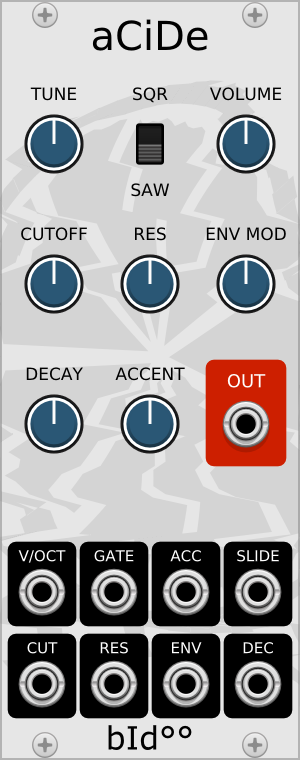
Synth voice · Oscillator · Filter · 10 HP
aCiDe is an acid bass voice in the style of the classic silver acid box: one oscillator, a diode ladder filter, a filter envelope, a volume envelope, accent, slide and a VCA. It has no sequencer: a sequencer plays it through V/OCT, GATE, ACCENT and SLIDE. The filter follows published analyses of the original circuit. It has not been compared with a real unit, so judge it by ear.
- Patch zOù MAï's track 1 GATE to GATE and V/O to V/OCT.
- Patch CV1 to ACCENT and CV2 to SLIDE. On a trig, CV1 at 10 V makes an accent, and CV2 at 10 V ties the note to the next one.
- Patch OUT to your mixer or Audio module.
- Set a pattern of 16th notes around A1 to A2 at about 130 BPM.
- Turn CUTOFF and ENV MOD while it plays, then raise RES.
- Turn DECAY for longer or shorter sweeps, and ACCENT for how far accented notes jump.
- Repeated accents: with RES high, several accented notes in a row each sweep the filter higher than the last, as a capacitor in the accent circuit charges up. Turn RES down and each accent is a short, equal jump.
- Slides: raise SLIDE before the gate falls, or keep the gate high into the next note (a trig longer than its step on zOù MAï). The pitch glides, and neither envelope restarts.
- Accent sets the decay: on an accented note the filter envelope is always short, whatever DECAY says.
- Polyphonic cables (since version 2.7.4): one voice per channel of V/OCT or GATE, up to 16, each with its own accent, slide and CVs (a mono cable acts on every voice); OUT has one channel per voice. With mono cables it is the mono voice it always was, slide included: slides glide within each voice.
| Control | Range | Description |
|---|---|---|
| TUNE | -12..+12 semitones | Pitch of the oscillator. It does not move the filter. |
| SAW / SQUARE | 2 positions | The waveform. Lit is square. The square is made from the saw, so it is not a plain 50 % square: its two halves stay slightly unequal (about 48 % and 52 %) over the whole range. |
| VOLUME | 0-100 % | Output level. |
| CUTOFF | 200 Hz-2.5 kHz | Frequency of the filter's resonance with the envelope at rest. |
| RES | 0-100 % | Resonance. It also thins the sound above about 100 Hz, and it shapes the accent sweep. Above about 96 % the filter can self-oscillate when the cutoff is high: see Notes. |
| ENV MOD | 0-100 % | How far the filter envelope sweeps the cutoff. It never reaches zero, and turning it up also lowers the cutoff at rest. |
| DECAY | 200 ms-2 s | Length of the filter envelope on normal notes. |
| ACCENT | 0-100 % | How much an accented note adds to the filter sweep and to the level. |
Hover over or turn a knob to see its value in place of its name.
| Input | Description |
|---|---|
| V/OCT | Pitch, 1 V/oct, 0 V = C4. |
| GATE | A rising edge starts a note, unless it is tied. Read at every sample. |
| ACCENT | High (above 1 V) at the start of a note makes it an accented note. |
| SLIDE | High (above 1 V) when the gate falls ties the note to the next gate, for up to 1 s. High at a new gate while the last note is still sounding also ties. |
| CUTOFF | Added to the knob, 1 V/oct. |
| RES, ENV, DECAY | Added to the knob: 10 V = the full range. |
| Output | Description |
|---|---|
| OUT | Audio. About ±5 V at the default VOLUME, more on accents. Softly limited above 8 V, so it stays under 10 V. |
- Note timing: as on the original, the sound starts about 4 ms after the gate, with a 3 ms attack. A note ends 16 ms after the gate falls: 8 ms at full level, then 8 ms fading to nothing. That quick end gives it its short click. Accented notes have a soft tail on top, from the accent's path to the VCA.
- Self-oscillation: at RES 100 % the filter starts to whistle by itself once its frequency, with the envelope and CV added, is above about 2 kHz. From 5 kHz up it does so from RES 97 %, and it does not at all below 1.5 kHz. The whistle is about 2-3 V at the default VOLUME, runs about 10-20 cents off the cutoff and is not tuned to the note, and it can lock to a harmonic on some notes. It goes on as long as the settings stay, but you only hear it while the VCA is open: between notes the output is silent. To stay clear of it, keep RES under 95 %.
- Bass: there is less low bass than on most synth voices. At RES 0, 32 Hz is about 4 dB under the level at 100 Hz.
- Knobs and CV are read every 16 samples, and the voice glides between readings, so they do not make zipper noise.
- CPU: about 0.6 % of a core per playing voice at 44.1, 48 or 96 kHz. Since version 2.7.5 a silent voice (its VCA closed) skips its oscillator and filter, so only the voices playing cost CPU. A note after a silence starts at another point of the oscillator's cycle, at the same level and without a click.
- Sample rates: the oscillator and filter run at twice the rate up to 50 kHz, and at the engine's rate above that.
- Only the knob positions are saved.