Repository navigation
ziNC
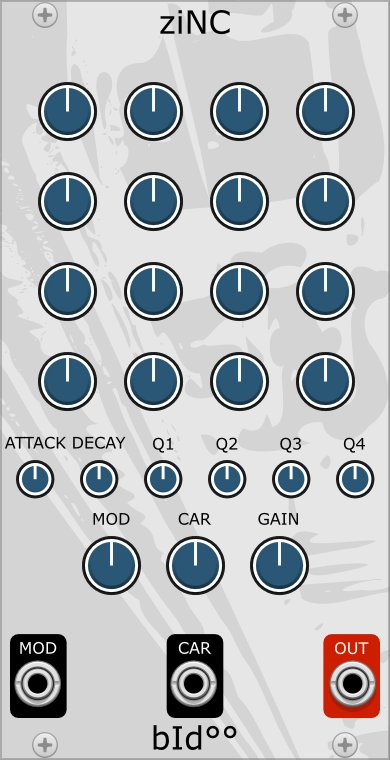
Effect · Vocoder · 13 HP
ziNC is a 16-band vocoder. It measures the level of the modulator (usually a voice or a drum loop) in 16 frequency bands and applies those levels to the same bands of the carrier (usually a rich synth sound). The result is the carrier "speaking" with the modulator's articulation.
- Patch a voice, a speech sample or a drum loop into MOD.
- Patch a bright, sustained sound into CAR, for example a VCV VCO saw or a chord of several saws mixed together.
- Patch OUT to your mixer or Audio module.
- Play both at once: you hear the carrier shaped by the modulator.
- If it is too quiet, raise MOD, CAR or GAIN (each 0 to +20 dB).
- Robot voice: a speech or vocal sample (for example from OAI or POUPRE) into MOD, a VCV VCO saw playing a note or chord into CAR. Keep ATTACK and DECAY low so the words stay intelligible.
- Rhythmic pad: a drum loop into MOD and a pad or chord into CAR. The pad pulses with the drums. Raise DECAY for smoother, longer swells.
- Whisper effect: VCV Noise (white) into CAR and a voice into MOD gives a whispered, unpitched voice.
- Band EQ on the result: the 16 knobs set the level of each band in the output. Turn down the lowest row to remove rumble, or boost the top bands for more intelligibility. The knobs light up as the modulator hits their band, which helps you see which bands are busy.
- Narrow, ringing bands: raise Q1-Q4 for a more resonant, metallic vocoder; lower them for a smoother, more blended sound.
| Control | Range | Description |
|---|---|---|
| 16 band knobs | -inf..+6 dB | Output level of each band, default 0 dB. The number above each knob is its centre frequency, from top left to bottom right: 100, 139, 193, 268, 373, 518, 720 Hz, 1.0k, 1.4k, 1.9k, 2.7k, 3.7k, 5.2k, 7.2k, 10.0k, 13.9k. The first 15 are spaced evenly on a log scale (about half an octave apart); the 16th adds the air above. |
| ATTACK | 1.5-600 ms | How fast a band's envelope rises when the modulator gets louder in that band. |
| DECAY (decay time) | 1.5-600 ms | How fast a band's envelope falls when the modulator gets quieter. |
| Q1 (modulator filter 1 Q) | Q 0.6-6.1 | Q of the first band-pass filter on the modulator. Default (knob in the middle) Q 3: the bands just meet. Lower is wider, higher narrower. |
| Q2 (modulator filter 2 Q) | Q 0.6-6.1 | Q of the second band-pass filter on the modulator (the two are in series), default Q 3. |
| Q3 (carrier filter 1 Q) | Q 0.6-6.1 | Q of the first band-pass filter on the carrier, default Q 3. |
| Q4 (carrier filter 2 Q) | Q 0.6-6.1 | Q of the second band-pass filter on the carrier, default Q 3. |
| MOD (modulator gain) | 0..+20 dB | Gain on the modulator before analysis. |
| CAR (carrier gain) | 0..+20 dB | Gain on the carrier. |
| GAIN (output gain) | 0..+20 dB | Output level. |
| Input | Description |
|---|---|
| MOD | Modulator, the sound whose spectrum is followed. A polyphonic cable is summed to one signal first (the mix you would hear), so every carrier channel follows the same analysis. |
| CAR | Carrier, the sound that is filtered. Polyphonic: each channel goes through its own filter bank, shaped by the same modulator. |
| Output | Description |
|---|---|
| OUT | Vocoded signal, as many channels as CAR. Softly limited above 8 V so it stays under 10 V. |
- The band knobs change colour with the modulator level in their band: blue when quiet, towards red when loud.
- Bypass: Rack's bypass passes the carrier to OUT.
- Polyphony: a polyphonic carrier (for example a chord from a poly VCO) gives a polyphonic output, one vocoded voice per channel, all following the one modulator. Each extra carrier channel costs about as much CPU as the carrier half of a mono ziNC.
- The carrier must have energy in the bands you want to hear: a saw, a square or noise works well; a sine gives almost nothing.
- Each band uses two band-pass filters in series on each side. The level is corrected for the Q, so narrow or wide bands sound about as loud.
- Bands above 0.45 x the sample rate are moved down to that limit.