Repository navigation
BanCau
Envelope generator · Function generator · Oscillator · LFO · Waveshaper · 15 HP
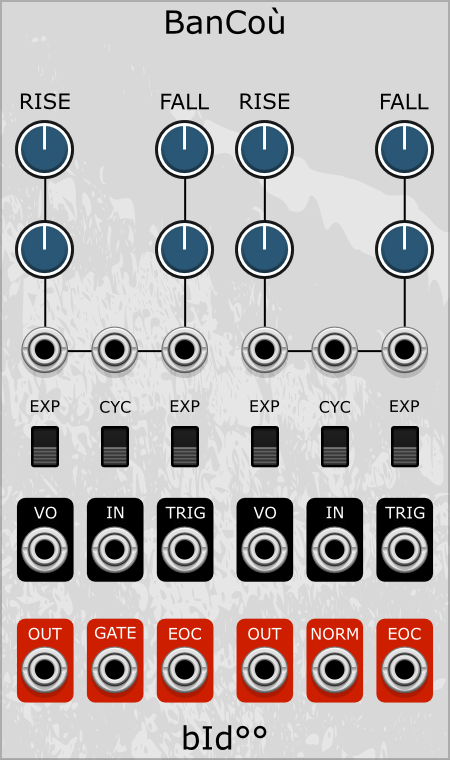
BanCoù is a dual slope generator modelled on the Serge Dual Universal Slope Generator. Each of the two sides makes a rise-then-fall shape from 0 to 10 V. Trigger it and it is an attack-decay envelope; switch on cycle and it is an LFO or, with fast times and V/oct, a VCO; feed a signal into IN and it is a slew limiter (lag processor). Both sides are identical except for their middle output.
- On the left side, patch a clock or gate into TRIG.
- Patch OUT into the CV input of a VCA (VCV VCA) that your audio goes through.
- Turn the top RISE and FALL knobs: each trigger now makes an attack-decay envelope.
- To get an LFO instead, set the middle switch CYC up (cycle on) and leave TRIG unpatched.
- AD envelope: clock into TRIG, OUT into a VCA or filter cutoff. RISE is the attack, FALL the decay. Set the EXP switches up for a more natural, curved (exponential) shape.
- Slew / portamento: patch a sequencer's pitch CV into IN and take OUT to a VCO. With TRIG unpatched and cycle off, OUT glides towards IN at the RISE time going up and the FALL time going down. Keep times short for portamento, long for a slow lag.
- Voltage-controlled LFO or VCO: cycle on. The frequency is about 1 / (rise time + fall time). Patch a 1V/oct pitch into VO to play it: +1 V halves both times, so the pitch goes up an octave. With rise near zero you get a saw, with equal times a triangle. Use the right side's NORM output for a centred ±5 V wave.
- Clock divider / delay: patch a trigger into TRIG and use EOC: it goes high when the cycle ends. Triggers that arrive while the slope is rising are ignored, so a long RISE skips beats. Patch EOC of the left side into TRIG of the right side to chain two envelopes.
- Square wave or gate from the slope: the left side's GATE output is high (10 V) while OUT is above 5 V. In cycle mode it is a square wave. With linear slopes it stays high for half the cycle whatever the times; with exponential shapes the width changes with the RISE/FALL balance.
Each side has the same set (left = side 1, right = side 2).
| Control | Range | Description |
|---|---|---|
| RISE (top knob) | 0.2 ms - 20 s (63 ms default) | Time for a full 0-10 V rise. |
| FALL (top knob) | 0.2 ms - 20 s (63 ms default) | Time for a full 10-0 V fall. |
| RISE CV amount (knob under RISE) | -100..+100 % | How much the RISE CV input and the middle (both) input change the rise time. At 100 %, +1 V halves the time; negative values make it longer. |
| FALL CV amount (knob under FALL) | -100..+100 % | Same for the fall time. |
| EXP (left switch) | down: Linear / up: Exponential | Shape of the rise. Exponential is a curve like a charging capacitor. |
| CYC (middle switch) | down: Off / up: On | Cycle: the slope restarts at the end of each fall, so it runs as an LFO/VCO. |
| EXP (right switch) | down: Linear / up: Exponential | Shape of the fall. |
| Input | Description |
|---|---|
| Rise CV (left port of the CV row) | Changes the rise time, scaled by the RISE CV amount knob. |
| Middle port of the CV row (both) | Changes both rise and fall, each scaled by its own amount knob. |
| Fall CV (right port of the CV row) | Changes the fall time, scaled by the FALL CV amount knob. |
| VO | 1V/oct on both times: +1 V halves them. Not scaled by the knobs. |
| IN | At rest, OUT slews to this voltage. After a trigger, the fall ends at this voltage instead of 0 V. |
| TRIG | A rising edge starts a rise from the current level, then the fall. Ignored while rising; while falling it restarts the rise from where the slope is. |
Times are limited to 200 s at the long end.
| Output | Description |
|---|---|
| OUT | The slope, 0 to 10 V (or following IN at rest). |
| GATE (left side only) | 10 V while OUT is above 5 V, else 0 V. |
| NORM (right side only) | OUT minus 5 V: a bipolar -5 to +5 V version. |
| EOC | End of cycle: 10 V while the slope rests, plus a 1 ms pulse at the end of each fall (useful in cycle mode, where it never rests). |
- Polyphony: each side runs as many channels as the widest cable on its six inputs. A mono cable on any input applies to all channels; each channel triggers and cycles on its own.
- When IN is above 10 V there is no fall: the slope goes straight back to rest.
- Nothing extra is saved with the patch beyond the knobs and switches.