Repository navigation
TiARE
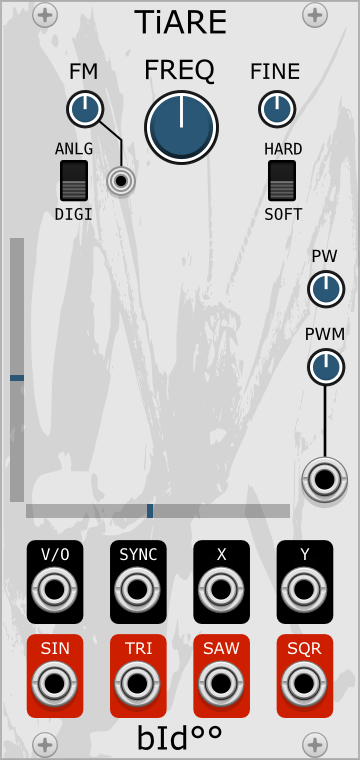
Oscillator · LFO · 12 HP
TiARE is a phase distortion oscillator. It has the four classic waves (sine, triangle, saw, square), but the speed at which each cycle is read can be bent: the phase goes faster in one part of the cycle and slower in the other. You set the bend point (X, Y) with the mouse, the two sliders or two CV inputs. In OSC mode it runs at twice the sample rate with band-limited jumps and a steep halfband filter, so it stays clean up to 20 kHz. It switches to LFO mode from the context menu.
- Patch SIN (or any wave output) to a mixer or VCV Audio.
- Patch a 1V/oct pitch into V/O, or tune with FREQ and FINE.
- Click and drag in the display: the curve bends and the waveform changes. The centre point is no distortion.
- Patch two LFOs (0-10 V) into X and Y to animate the bend.
- Phase distortion pad: VCV MIDI-CV V/OCT (polyphonic) into V/O, SAW or SIN through a VCA with an ADSR. Patch a slow, unipolar VCV LFO into X: the tone sweeps like a filter, without a filter.
- Envelope-shaped timbre: patch an envelope (0-10 V, for example BanCau OUT) into Y. Each note starts bright and settles back, as on Casio CZ-style synths.
- Sync sweep: patch another VCO into SYNC and play TiARE's pitch above it. Set the HARD/SOFT switch for hard or soft sync, and move X for more variations.
- Pulse width sweep: turn PWM up and patch a slow VCV LFO into the PW jack. The SQR output gets the moving, chorus-like tone of a PWM pad. Bend X and Y too for a less common square.
- Odd LFO shapes: right-click and choose Mode: LFO. Bend the curve to get a sine that rises fast and falls slowly, or a saw with a curved ramp, then use the outputs as modulation.
| Control | Range | Description |
|---|---|---|
| FREQ | about 11.6 Hz to 5.9 kHz (C4 = 261.6 Hz default) | Base pitch, ±54 semitones around C4. In LFO mode everything is 100 times slower (0.12 to 59 Hz). |
| FINE | ±3 semitones | Fine tuning, finer near the centre. |
| FM | 0-100 % | Amount of the FM input (exponential, 1V/oct at 100 %). Finer near zero. |
| ANLG / DIGI (engine mode) | DIGI (Digital) / ANLG (Analog) | Analog gives the slightly rounded shapes of VCV VCO-1's analog mode, and an AC-coupled square (not in LFO mode). Default ANLG. |
| HARD / SOFT (sync mode) | SOFT / HARD | Hard sync restarts the cycle; soft sync reverses the direction of the phase. Default HARD. |
| Left slider (Y) | 1-99 % (50 % default) | Phase distortion Y: the height of the bend point. |
| Bottom slider (X) | 1-99 % (50 % default) | Phase distortion X: the horizontal position of the bend point. |
| PW | 1-99 % (50 % default) | Pulse width of the square (SQR output). |
| PWM | 0-100 % (0 % default) | Amount of the PW input. At 100 %, 10 V moves the width across the whole range. |
| Input | Description |
|---|---|
| V/O | 1V/oct pitch, added to FREQ. Polyphonic: sets the number of voices. |
| FM (small port next to the FM knob) | Frequency modulation, scaled by the FM knob. Polyphonic. |
| SYNC | Syncs when the signal rises through 0 V. Polyphonic. |
| X | 0-10 V sets X from 1 to 99 %. When patched it replaces the slider. Polyphonic. |
| Y | 0-10 V sets Y from 1 to 99 %. When patched it replaces the slider. Polyphonic. |
| PW (jack under the PWM knob) | Pulse width modulation, scaled by PWM and added to PW. Polyphonic. |
| Output | Description |
|---|---|
| SIN | Sine, ±5 V. |
| TRI | Triangle, ±5 V. |
| SAW | Sawtooth, ±5 V. |
| SQR | Square, ±5 V. Its width is set by PW, PWM and the PW input. |
- The display draws the phase curve: two straight lines from the bottom-left corner to the bend point, then to the top-right corner. A straight diagonal (point in the centre) means no distortion. The point shown is the one of channel 1, CV included.
- Click or drag in the display to move the point: horizontal = X, vertical = Y. An axis whose CV input is patched is not changed by the mouse.
- The thin sliders along the left and bottom edges are the Y and X parameters. Like any knob they can be typed in (right-click), MIDI-mapped and automated.
- Mode: OSC / LFO: switches between audio range and LFO range (100 times slower). In LFO mode the waves are read at the sample rate without band-limiting, which costs less CPU.
- Polyphony: up to 16 voices, set by V/O. A mono FM, SYNC, X, Y or PW cable applies to all voices.
- Only the patched outputs are computed.
- Saved with the patch: the OSC / LFO mode, plus the knobs and sliders.