Repository navigation
FILTRE
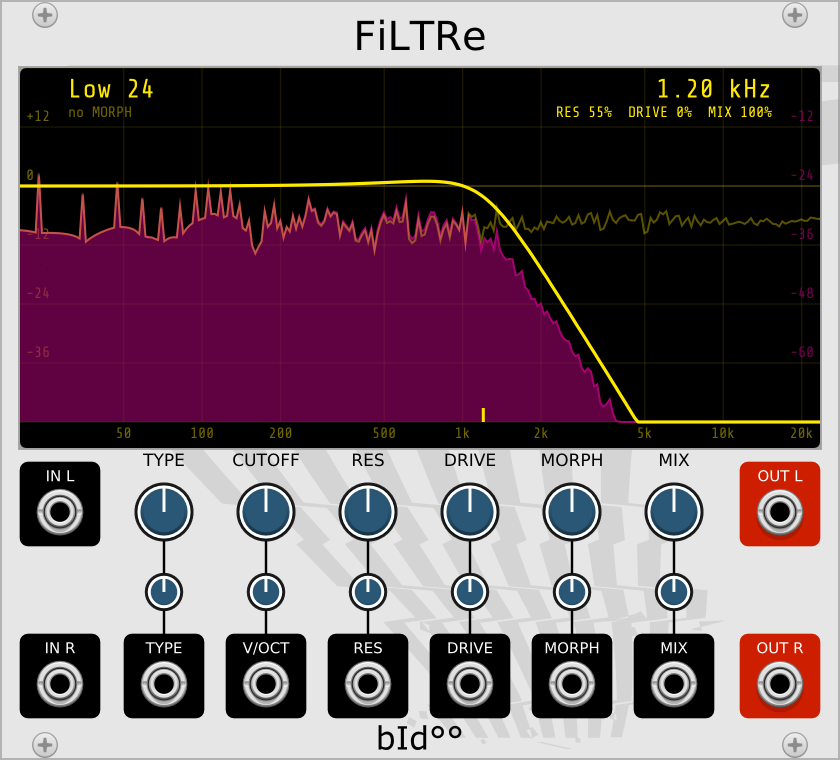
Filter · Polyphonic · Visual · 28 HP
FiLTRe plays all 71 filter types of the Potion synth, with the same code, so they sound the same: low, high and band-pass slopes, ladders, morphing and dual filters, combs, phasers, formants, shelves, and effects such as ring mod, downsample and reverb. Its screen shows the spectrum of the signal and the curve of the selected filter at its current settings, CV included. It is stereo and takes up to 16 voices.
- Patch an oscillator or a mix into IN L (R copies L when unpatched).
- Patch OUT L and OUT R to your mixer or Audio module.
- Turn CUTOFF. The yellow curve moves, and the pink spectrum of the output follows it.
- Raise RES for a resonant peak.
- Turn TYPE to walk through the types, or right-click TYPE or the screen to pick one by family.
- If the screen shows a MORPH line for the type, turn MORPH to hear what it does.
- Keyboard tracking: patch the same V/oct as your oscillator into V/OCT. The filter follows the notes. With a comb at high RES this tunes the comb to the note.
- Polyphonic filter: patch a polyphonic oscillator into IN L and a polyphonic envelope into V/OCT: every voice gets its own filter and envelope. The screen's curve is voice 1; the spectra are the sum of all voices.
- Vowels: choose Formant or Formant F and send a slow LFO into MORPH: the filter moves through A, E, I, O, U.
- Sequenced types: send a stepped CV into TYPE. Each step selects another type, with an 8 ms crossfade between them.
- Parallel blend: lower MIX to bring the dry signal back. The curve shows the result, so a comb at 50 % has shallower teeth.
- Audio-rate modulation: right-click the panel and set Controls and CV are read to every sample, then patch an oscillator into V/OCT.
- Factory presets: right-click > Preset > Factory presets: Warm ladder, Acid squelch, Vowels, Tuned comb (patch V/OCT) or Phaser blend.
Each column has a knob, an attenuverter under it and a CV jack under that.
| Control | Range | Description |
|---|---|---|
| TYPE | 71 types | The filter type, in the order of the table below. |
| CUTOFF | 20 Hz-20 kHz | Exponential. Stays under 0.45 x the sample rate. |
| RES | 0-100 % | Resonance. What it does depends on the type. |
| DRIVE | 0-100 % | Drive into a tanh before the filter (up to x9, level partly made up). Some types also use it inside their loop. |
| MORPH | 0-100 % | Depends on the type: see the table. The screen says what it does. The knob is faded when the type does not use it. |
| MIX | 0-100 % | Dry to filtered. |
| Attenuverters | -100..+100 % | Amount of each CV input, default +100 %. |
| Input | Description |
|---|---|
| IN L | Left audio, polyphonic. 5 V is the filter's full scale. |
| IN R | Right audio, polyphonic. When unpatched, it takes the L signal. |
| TYPE | Added to the knob: at 100 %, 1 V = 7 types, so 10 V covers them all. |
| V/OCT | Cutoff: at 100 %, 1 V/oct. |
| RES, DRIVE, MORPH, MIX | Added to the knob: at 100 %, 10 V = the full range. |
All CV inputs are polyphonic: each voice reads its own channel, and a mono CV drives all voices.
| Output | Description |
|---|---|
| OUT L | Left, polyphonic. |
| OUT R | Right, polyphonic. |
Outputs are softly limited above 8 V so they stay under 10 V. Peak and shelf types at high RES have a lot of gain and can reach that limit with a 5 V input.
| Family | Types | MORPH |
|---|---|---|
| Low-pass | Low 6, Low 12, Low 18, Low 24, Ladder 24 | not used |
| Diode 24 | Bass that the resonance takes away comes back | |
| OTA 24 | Poles: 4, 3, 2, 1 | |
| SK Low 12 | Bite: the resonance turns gritty | |
| Add Bass | Saturated bass added back, up to +12 dB | |
| Scream Low | Feedback, up to a screaming self-oscillation | |
| High-pass | High 6, High 12, High 18, High 24 | not used |
| SK High 12 | Bite | |
| Band and peak | Band 12, Band 24, Peak, Peak 24 | not used |
| Scream Band | Feedback, as Scream Low | |
| Notch, shelf and EQ | Notch 12, Notch 24 | not used |
| Band Reject | Width of the gap, 0.5 to 6 octaves | |
| Low Shelf, High Shelf, Band EQ | Gain, -24 dB through 0 (50 %) to +24 dB | |
| DJ Filter | Width of the flat zone (the cutoff's lower half closes a low-pass, its upper half opens a high-pass) | |
| Morphing | Morph 12, Morph 24 | Low, band, high, notch |
| L/P/H 12, L/P/H 24 | Low, peak, high | |
| L/N/H 12, L/N/H 24 | Low, notch, high | |
| B/P/N 12, B/P/N 24 | Band, peak, notch | |
| CMOS 12 | Low, band, high | |
| Dual | Dual L+H, L+B, L+P, L+N, H+B, H+P, H+N, B+P, P+P, P+N, N+N | Spread: the two filters move apart, up to two octaves each way |
| Comb and flanger | Comb +, Comb - | not used |
| Comb LP +, Comb LP - | Damp: the loop gets darker | |
| Comb HP +, Comb HP - | Thin: the loop loses its bass | |
| Comb BP +, Comb BP - | Focus: both close in on the cutoff | |
| Chord Comb | Four combs from unison to a major chord | |
| Dist Comb | Damp; DRIVE drives the loop | |
| Flanger | Feedback from positive through none (50 %) to negative | |
| Phaser | Phaser, Phaser 4 +/-, Phaser 8 +/-, Phaser 16 +/- | Spread of the stages around the cutoff, up to 4 octaves |
| Formant | Formant, Formant F | Vowel: A, E, I, O, U; the cutoff shifts the formants (1 kHz leaves them in place) |
| Effects | Diffuser | Density; the cutoff sets the length, RES feeds it back |
| Reverb | Damping; the cutoff sets the room size (lower is larger), RES the decay | |
| Downsample | From steps to straight lines; a sample and hold at twice the cutoff | |
| Ring Mod | Carrier from sine to square; the carrier is at the cutoff |
- The horizontal axis is frequency, log scale, from 20 Hz to about the top of the audio range.
- Pink, filled: the spectrum of the output. Dim line: the spectrum of the input, behind it. Both are band powers, so pink noise reads about flat and a sine reads its level (a little low under 200 Hz).
- White line: the curve of the selected filter, for voice 1 with its CV, and with MIX. Where one point of the screen holds more detail than it can draw (a comb's teeth), a pale band shows the lowest and highest values in it.
- Both share one vertical scale, 12 dB per grid line, so the output is the input moved by the curve. The left labels are the curve's gain (0 dB is the brighter line). The orange labels on the right are the spectra's level (0 dB is 5 V, at the top).
- A small mark on the bottom edge shows the cutoff.
- The top lines show the type, what MORPH does, the cutoff, RES, DRIVE and MIX.
- Right-click the screen for the types by family.
The curve is measured on a private copy of the filter, not computed from a formula, so it works the same way for all 71 types.
- Most types: the filter's response to a quiet impulse, which is its true curve.
- With DRIVE above 0, and for these types at any DRIVE: Ladder 24, Diode 24, OTA 24, SK Low 12, SK High 12, Add Bass, Scream Low, Scream Band, CMOS 12, Dist Comb, Comb LP/HP/BP, Chord Comb, Phaser (all), Diffuser. The curve is true for quiet signals. Loud signals bend it. The screen says curve: quiet signal, loud ones bend it.
- Downsample and Ring Mod move energy to other frequencies, so they have no true curve. The line shows the spectrum white noise comes out with. The screen says curve: white noise through it, this type moves frequencies.
- When a type self-oscillates (full RES on the ladders, Scream with MORPH up), the curve goes off the top at the cutoff. The filter rings on its own there.
- Type: the types by family.
- Controls and CV are read: every 16 samples (default, as in Potion), every 4 samples, or every sample for audio-rate modulation (more CPU).
- Polyphony: up to 16 voices; the count is the larger of IN L and IN R. With nothing patched out, only voice 1 runs, for the screen. With nothing patched in, the module stops once the tail has ended.
- CPU: one voice takes about 0.2 % of a core on average and about 0.8 % for the heaviest types (Phaser 16, Chord Comb), at 48 kHz.
- Bypass: Rack's bypass passes IN L to OUT L and IN R to OUT R.
- A type change crossfades over 8 ms. The new type starts from silence, so a reverb or comb tail does not carry over. A CV can change the type once per crossfade at most.
- Only the knob positions and the menu setting are saved.