Repository navigation
RICOCHET
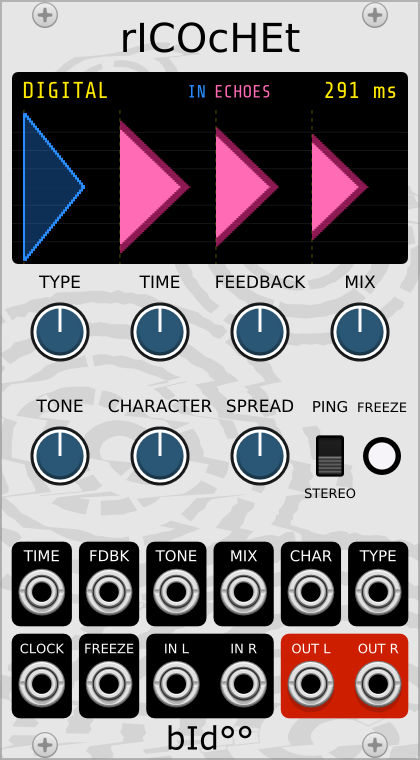
Delay · Effect · Stereo · 14 HP
rICOcHEt is a stereo delay with six characters: Digital, Tape, BBD, Lo-fi, Diffuse and Reverse. All six share the same controls, and you can switch between them while it plays. It models no particular machine: each type is written from general descriptions of how those machines work, and none has been compared with a real unit, so judge them by ear.
- Patch your sound to IN L (and IN R if it is stereo), and OUT L and OUT R to your mixer or Audio module.
- Turn TYPE to choose a character. The screen shows its name.
- Turn TIME and FEEDBACK for the rhythm and the number of repeats, and MIX for how much you hear.
- Turn CHARACTER to go from a clean version of the type to a worn one.
- To follow a tempo, patch a clock to CLOCK and set its pulses per beat in the right-click menu (4 for a 16th-note clock, 16 for tOCAnTe's 1/64, 24 for a MIDI clock): TIME then picks a note value, triplets (T) and dotted notes (.) included.
| Type | What you hear | CHARACTER | Turning TIME |
|---|---|---|---|
| Digital (the default) | Clean, exact repeats | From clean (0, the default) to an early rack unit: each repeat darker (down to 3.5 kHz), a lower rate with aliasing (down to 10 kHz) and fewer bits (down to 8), heard on a kick too | Crossfades, no pitch change |
| Tape | A gentle wobble; the colour comes with CHARACTER | From new tape (0: nearly clean, a 5 V kick keeps its click and its body) to worn tape: more drive and saturation, more wow and flutter, less top and low end, more hiss, dropouts | The pitch swoops |
| BBD | A bucket brigade: at 0 a new unit, bright and soft; long times get darker | Fewer stages: darker and dirtier, more drive, noise and clock whine | The pitch swoops, faster and rougher than Tape |
| Lo-fi | An old sampler: repeats fall apart into grit | Lower sample rate (32 to 4 kHz) and fewer bits (12 to 4) | Quick crossfade |
| Diffuse | Echoes melt into a cloud, close to a reverb | How blurred each repeat gets | Crossfades |
| Reverse | Every repeat plays backwards | The chance that a slice plays forwards. At 100 % it is a plain delay | The new length starts at the next slice |
- Self-oscillation: FEEDBACK reaches unity at about 87 %. Above that the repeats grow until the saturation or limiter of the type holds them. It stays under control, so you can ride it.
- Freeze: the button or the gate holds what is in the delay and stops listening to the input. The dry signal still passes. TIME still moves the read point: on Tape and BBD this bends the frozen loop.
- Short delays as a resonator: at a few milliseconds with high feedback, the delay rings like a comb filter. TIME CV is 1 V/oct, but Digital crossfades its time changes: use Tape or BBD to play it as a pitch.
- Ping-pong: the two inputs are summed and go to the left first, then the repeats alternate sides. In Stereo, each side keeps its own input.
| Control | Range | Description |
|---|---|---|
| TYPE | 6 positions | Digital, Tape, BBD, Lo-fi, Diffuse, Reverse. Changing type is a 40 ms crossfade. |
| TIME | 2 ms-8 s | Delay time, or a note value when CLOCK has a clock on it: 1/32, 1/16T, 1/16, 1/8T, 1/16., 1/8, 1/4T, 1/8., 1/4, 1/2T, 1/4., 1/2, 1/2., 1/1, 1/1., 2/1, 3/1, 4/1 (a beat is a quarter note). |
| FEEDBACK | 0-100 % | Amount of each repeat fed back. Loop gain 1 at about 87 %, 1.15 at 100 %. |
| MIX | 0-100 % | Dry to wet, keeping the power about constant. |
| TONE | -100..+100 % | Below the centre the repeats get darker (22 kHz down to 400 Hz), above it thinner: a high pass from 5 Hz up to 800 Hz that keeps the top of each repeat, so a kick's click comes back without its body. At the centre it does nothing. It acts on every repeat, so it adds up. |
| CHARACTER | 0-100 % | See the table of types. |
| SPREAD | -100..+100 % | One side up to 1.5 times longer than the other: the right to the right of the centre, the left to the left. |
| PING / STEREO | 2 positions | Ping-pong or stereo repeats. |
| FREEZE | on/off | Holds the loop. Lit when on. The screen shows FREEZE for the button or the gate. |
| Input | Description |
|---|---|
| TIME | Free: 1 V/oct, +1 V is half the time. With a clock: 10 V goes through the whole list of note values. |
| FDBK, MIX, CHAR | Added to the knob: 10 V = the full range. |
| TONE | Added to the knob: 5 V = the full range each way. |
| TYPE | Added to the knob: 10 V = all six types. |
| CLOCK | The delay time follows the clock's tempo: the period between pulses times the pulses per beat (right-click menu, 4 on a new module; a patch made before 2.7.9 loads with 1, its pulse being the beat, so it keeps its times). The time stays on a whole sample and moves only with a real tempo change. It needs two pulses to start, and if the clock stops it keeps the last period. Unplug it for the free time. |
| FREEZE | High holds the loop, as the button does. |
| IN L, IN R | Audio. IN R takes IN L when not connected. Polyphonic cables are summed. |
| Output | Description |
|---|---|
| OUT L, OUT R | Audio, softly limited above 8 V so they stay under 10 V. |
- The screen shows the output of the delay rolling by, newest on the right, the left side above the line and the right side below it, over about four repeats. It is in dB (48 dB from the centre line to the edge, faint lines at -12, -24 and -36 dB), so each repeat of a fading echo is as tall as the one before minus what FEEDBACK takes: the slope of the train shows the feedback. The input is drawn in blue behind, with a blue outline over everything, and the echoes in pink, each column its peak with its RMS (its loudness) as a brighter core: a sound and its repeats read side by side (the legend IN / ECHOES at the top). The dotted yellow lines mark the delay time back from now, one per repeat: the echoes of a sound fall on them.
- Timing: with Digital and a free time, repeats fall on the same sample every time. Measured at 44.1, 48 and 96 kHz through the module, every gap was within a third of a sample of the clock's period. Tape moves by its wow and flutter, about ±0.6 ms at the lowest CHARACTER.
- Repeat colour, one repeat at 200 ms and CHARACTER 40 %, at 10 kHz: Digital -3 dB, Tape -6 dB, BBD -9 dB, Diffuse -4 dB. At CHARACTER 0, Digital is flat within 0.05 dB. Tape and BBD thin the bass a little, about -2 and -3 dB at 50 Hz per repeat.
- Tails: below self-oscillation all six end in silence. Tape's hiss and BBD's noise follow the signal and fade away with it.
- Reverse plays each slice after it has been recorded, so the first echo comes one slice after the slice began, and slices line up with the clock when one is patched.
- CPU: about 0.15 to 0.4 % of a core at 48 kHz. Tape costs the most.
- Memory: about 12 MB per module at 48 kHz, 24 MB at 96 kHz, reserved when the module is added.
- Only the knob positions and the freeze button are saved, not what is in the delay.