Repository navigation
baR
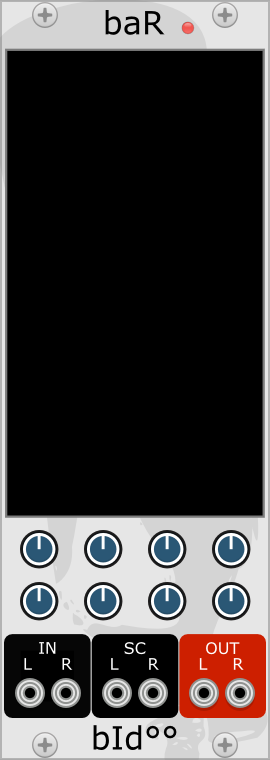
Dynamics · Effect · Compressor · Polyphonic · 9 HP
baR is a stereo peak compressor with soft knee, make-up gain, dry/wet mix, lookahead and a stereo sidechain. Both sides are linked: the louder side sets the gain for both. It is polyphonic: each channel has its own stereo-linked compressor. The display shows input and sidechain meters, the threshold, the gain change and the value of every knob. For a smaller one-jack version, see mINIBar.
- Patch a stereo signal into IN L and R (a mono signal into L only is copied to R).
- Patch OUT L and R to your mixer or Audio module.
- Raise the ratio (top row, second knob) to 4:1.
- Lower the threshold (top row, first knob) until the yellow bar on the right of the display starts to move down.
- Raise the make-up gain (bottom row, second knob) to bring the level back up.
- Glue a drum bus: send a drum mix into IN L/R, set ratio 2:1 to 4:1, attack around 20-30 ms so the transients pass, release 100-150 ms, and 2-3 dB of reduction. Add make-up gain to match the bypassed level (compare with the LED button).
- Sidechain ducking: patch a pad into IN, and the kick (or a gate shaped by an envelope) into SC L. Set a high ratio, a short attack and a release of 100-300 ms: the pad dips on each kick.
- Parallel compression: compress hard (ratio 10:1 or more, low threshold, make-up gain up) and turn the mix knob down to 30-50 % to blend the squashed signal with the dry one.
- Catch fast peaks: set the lookahead knob to 100 %: the audio is delayed by the attack time, so the gain is already down when a transient arrives. Mind the delay if you mix baR's output with an undelayed copy.
- Limit (peak catcher): turn the ratio all the way up to ∞:1, set some lookahead (100 % is a good start), a short attack and the mix at 100 %. No sample then goes above threshold + make-up gain, not even a single-sample click: the gain ramps down over the attack time (or over the lookahead, when shorter) and is fully down when the peak comes out of the delay. The ceiling holds on the sidechain's level when a sidechain is patched.
The knobs have no printed labels; the display shows each value under a short name.
| Control | Range | Description |
|---|---|---|
| LED button (top) | Off / On | Bypass. Fades the compression in or out over 5 ms. The LED is lit while bypassed. |
| Top row, knob 1 (Threshold, TdB) | -93.6..0 dB | Level above which the gain goes down. 0 dBFS = 5 V. |
| Top row, knob 2 (Ratio, R) | 1:1..∞:1 | Compression ratio. 1:1 does nothing. Just below the top the ratio is a little under 20:1; the very top of the knob is ∞:1, a limit: with lookahead, the output never goes above threshold + make-up gain. |
| Top row, knob 3 (Attack, A) | 1-100 ms | How fast the gain goes down. |
| Top row, knob 4 (Release, R) | 1-300 ms | How fast the gain comes back. |
| Bottom row, knob 1 (Knee, K) | 0-24 dB | Width of the soft knee around the threshold. |
| Bottom row, knob 2 (Make-up gain, GdB) | 0-60 dB | Gain added after compression. Glides over about 10 ms when it moves. |
| Bottom row, knob 3 (Mix, M) | 0-100 % | Dry/wet balance (parallel compression). Glides over about 10 ms when it moves. |
| Bottom row, knob 4 (Lookahead, L%) | 0-200 % of the attack | Delays the audio by this share of the attack time (up to 200 ms), so the compressor reacts before the sound arrives. At ∞:1, any lookahead above 0 holds the ceiling exactly. |
| Input | Description |
|---|---|
| IN L | Left audio, polyphonic: each channel gets its own compressor (L and R of a channel linked). |
| IN R | Right audio. Follows L when unpatched. The channel count is the larger of IN L's and IN R's; a mono cable drives every channel. |
| SC L | Sidechain left. When either SC input is patched, the sidechain drives the compressor instead of the audio. Channel by channel; a mono sidechain drives every channel. |
| SC R | Sidechain right. Follows SC L when unpatched. |
| Output | Description |
|---|---|
| OUT L | Left audio, compressed, with as many channels as the input. |
| OUT R | Right audio, compressed, with as many channels as the input. |
- Without sidechain, four meters from left to right: VU L (dark blue), RMS L, RMS R (light blue), VU R. On the RMS bars, an orange block shows the instantaneous peak above the RMS level and a red line shows the falling peak.
- With a sidechain patched, the bars are split in half: the sidechain meters sit next to the input meters.
- The white line with arrows is the threshold.
- The yellow bar at the right shows the gain change in dB: it grows down from the arrow with gain reduction and up with make-up gain.
- With a polyphonic input, the meters show the loudest channel and the yellow bar the deepest reduction.
- Under the meters: TdB (threshold), R (ratio), A/Rms (attack/release in ms), K (knee), GdB (make-up), M (dry/wet in %), L% (lookahead).
- Meters: RMS over about 10 ms, VU over about 340 ms, peak falling at 50 dB per second. The scale goes from -97 to 0 dBFS (5 V = 0 dBFS).
- Below ∞:1, a fast transient can still pass above the threshold: the attack is a smooth curve that is only about two thirds of the way down after the attack time, and a finite ratio lets part of the excess through. Use ∞:1 with lookahead when nothing may pass.
- The level detector follows peaks at once and falls back with the release time (at most 25 ms), so even a 1 ms release works and low notes do not make the gain follow the waveform.
- The output is soft-limited above 8 V (it never goes much above 10 V).
- The bypass state of the LED button is saved with the patch. Rack's own bypass (Ctrl+E) passes IN straight to OUT.
- When the LED bypass is on, the lookahead delay stays: the output keeps the same delay, so no audio is skipped or repeated when you switch the bypass.