Repository navigation
DIKTAT
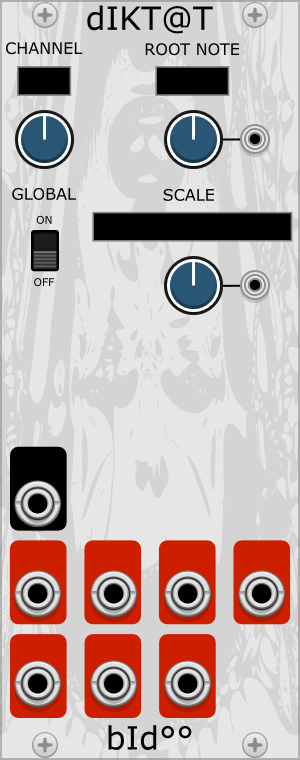
Quantizer · 10 HP
dIKT@T quantizes a 1V/oct pitch to a scale and builds a chord on top of it. It outputs the quantized note plus the third, fifth, seventh, ninth, eleventh and thirteenth, each taken from the chosen scale. It is polyphonic, and each channel can have its own root and scale. Use it to turn a random or sequenced CV into in-key melodies and chords.
- Patch a pitch CV (a sequencer, VCV Random, an LFO) into the input on the left (the black port under the switch).
- Set ROOT NOTE (for example C) and SCALE (for example Ionian).
- Patch the first red output (tonic) into the V/OCT of a VCO. The VCO now plays only notes of the scale.
- Patch more outputs (third, fifth, seventh) into more VCOs, or merge them with VCV Merge into one polyphonic VCO, to hear the chord.
- In-key random melody: VCV Random (or an S&H of noise) into the input, tonic into a VCO. Every random value snaps to the nearest scale note.
- Chords from one sequencer row: a mono sequencer into the input; merge the tonic, third, fifth and seventh outputs with VCV Merge into a 4-voice VCO and VCF. Each step plays a diatonic seventh chord built on its note.
- Chord changes by CV: a slow step CV (a sequencer or bordL) into the ROOT NOTE input transposes the key, so the same melody moves through keys. Patch a second CV into the SCALE input to change mode as well.
- Different scale per voice: set the GLOBAL switch to OFF, pick channel 1 with CHANNEL and set its root and scale, then pick channel 2 and set different ones. A 2-channel pitch input is then quantized to two different scales.
- Factory presets: right-click > Preset > Factory presets: C major, A minor, D Dorian, G Mixolydian (global) or Two voices C major and A minor (individual: channel 1 and channel 2).
| Control | Range | Description |
|---|---|---|
| CHANNEL | 1-16 | In Individual mode, chooses the channel whose root and scale the ROOT NOTE and SCALE knobs show and edit. In both modes it chooses the channel shown on the displays and ports. The display shows the number. |
| GLOBAL (mode) | OFF (Individual) / ON (Global) | ON: every channel uses one shared root and scale (the one stored for channel 1), and the knobs edit it whatever CHANNEL shows. OFF: each channel uses its own settings. Default OFF. |
| ROOT NOTE | No, C ... B | Root of the scale. Default C. No quantizes to the nearest semitone and gives no chord: all 7 outputs carry the same note. The display shows the root in use (CV included). |
| SCALE | No, Ionian ... Chromatic (46 scales) | Scale used for quantizing and for the chord notes. No means no quantizing: the input goes straight to all 7 outputs. Default Ionian. The display shows the scale in use (CV included). |
The scale list: No, Ionian, Dorian, Phrygian, Lydian, Mixolydian, Aeolian, Locrian, Ionian Min, Dorian b9, Lydian Aug, Lydian Dom, Mixoly. b6, Aeolian Dim, Super Loc., Aeolian nat7, Locrian nat6, Ionian Aug, Dorian #4, Phry. Dom, Lydian #9, Super Loc. bb7, Blues, Melodic Min, Pentatonic, Pentatonic m7, Pentatonic m6, Pentatonic M7, Whole tones, Sym 124, Sym 134, Diminished, Dom Dim, Augmented, Bebop Maj, Bebop Dom, Bebop Dorian, Bebop Melodic, Bebop Harmonic, Bebop Locrian, Persian, Hirojoshi, Arabian, Scottish, Turkish, Chromatic.
| Input | Description |
|---|---|
| Pitch (black port, bottom left) | 1V/oct pitch to quantize. Polyphonic: sets the number of channels of every output. |
| ROOT NOTE input | 0-10 V adds 0 to 11 semitones to the knob's root (1.1 semitone per volt). The result wraps round the octave: A plus 4 semitones gives C#. No effect when the root is No. Polyphonic (see Notes). |
| SCALE input | 0-10 V moves forward through the scale list from the knob's scale, up to the whole list at 10 V. Stops at the last scale (Chromatic). Polyphonic (see Notes). |
| Output | Description |
|---|---|
| Top row, left to right | Tonic (the quantized note), Third, Fifth, Seventh. |
| Bottom row, left to right | Ninth, Eleventh, Thirteenth. |
Each chord note is found by counting scale degrees from the quantized note: the third is 2 degrees up, the fifth 4, the seventh 6, and so on. In a 7-note scale these are the usual diatonic chord tones; in a pentatonic or 8-note scale they are "every other note" of that scale. All outputs are 1V/oct.
- The three small displays show the channel number, the root and the scale used by the selected channel, after CV.
- Each port shows the note name (for example C4) of its voltage on the selected channel, so you can read the chord directly on the panel.
- Polyphony: the pitch input sets the channel count. In Individual mode, the ROOT NOTE and SCALE inputs are read per channel, and a mono CV there applies to every channel. In Global mode the first channel of those inputs drives all channels.
- Every channel starts at root C and scale Ionian, the knob defaults. Initialize (right-click > Initialize) sets them all back.
- Quantized notes cover -4 V to +6 V. Input outside this range gives the lowest or highest note of the scale. Chord notes above the range are built an octave lower and raised back up, so they stay correct.
- When a scale is set, the chord is held until the input moves a quarter semitone (1/48 V) away from the voltage it was found for, or the root or scale changes. Noise on a note sitting between two scale notes does not make the outputs flip between them.
- Saved with the patch: the root and scale of all 16 channels, the selected channel and the mode.