Repository navigation
REI
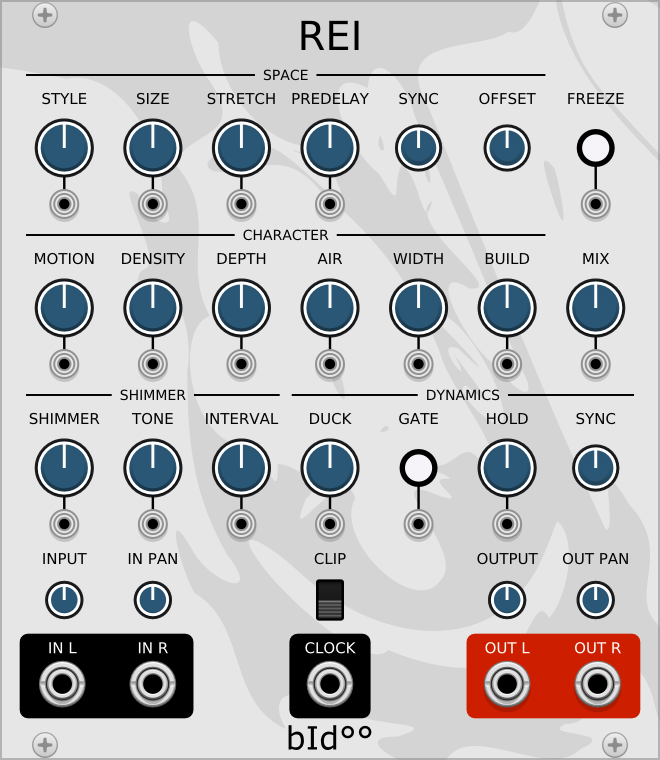
Reverb · Effect · 22 HP
REI is a stereo reverb with eight styles, a shimmer (pitched feedback), ducking, an auto gate and a freeze. It runs the Prism reverb from Bidoo's shared DSP library with the controls of Bidoo's Grotte reverb, grouped by theme: SPACE, CHARACTER, SHIMMER and DYNAMICS. Hall, Room, Chamber, Plate and Cloud run on a 16-line network with diffused early reflections, for smooth tails without metallic ringing. Every continuous control has its own CV input, the small jack under it. It has a MIX knob and input and output levels, so you can use it inline or on a send.
- Patch a signal into IN L (and IN R for stereo).
- Patch OUT L and R to your mixer or Audio module.
- Pick a STYLE (Hall by default), set SIZE and STRETCH for the length of the tail and MIX to taste (30 % by default).
- Turn SHIMMER up for a shimmer, and choose its interval with INTERVAL.
- Patch a clock into CLOCK to sync the predelay and the gate's hold to the tempo.
- Inline reverb: keep MIX between 20 and 40 %. Use WIDTH to narrow (below the middle) or widen (above it) the reverb only.
- Send reverb: turn MIX to 100 % (the dry signal is gone) and put REI on a send of VCV Mixer.
- Clear vocals or leads: turn DUCK up so the reverb dips while the input plays and blooms in the gaps.
- Gated drums: choose Hall or Plate, switch GATE on and set HOLD (or its SYNC to 1/8 or 1/4 with a clock): the tail closes shortly after each hit stops. Non-lin gives a gated sound on its own.
- Rhythmic predelay: patch a clock (one pulse per quarter note) into CLOCK and set the predelay's SYNC to 1/8 or 1/16; OFFSET pulls or pushes it from 50 to 200 % of that value.
- Shimmer pad: choose Hall or Cloud, SIZE and STRETCH high, SHIMMER around 30-60 % and INTERVAL on +OCT. TONE darkens the shimmer on each pass. Play slow chords: the tail climbs an octave each time round.
- Spacious attacks: turn BUILD up for sparse, distinct early reflections that thicken into the tail; DEPTH moves the source from close to far.
- Freeze a drone: press FREEZE (or send a trigger, for example from a VCV SEQ-3 gate) to hold the tail; new input is shut out while frozen. Press again to release.
- Frozen spring loop: choose Spring, play a short phrase, and press FREEZE. The last second of the spring tail repeats as a seamless loop. Play over it on the dry path, then release to let the reverb take new input again.
- Factory presets: right-click > Preset > Factory presets: Small room, Hall send, Shimmer pad, Wobbly spring or Gated drums.
| Control | Range | Description |
|---|---|---|
| STYLE | HALL, ROOM, CHAMBER, PLATE, SPRING, NON-LIN, REVERSE, CLOUD | The reverb algorithm. Default HALL. On a change the wet output fades out over 10 ms, the new style starts empty and fades in over 10 ms. |
| SIZE | 0-100 % | The size of the space: the lines' lengths, and the decay time that goes with them. Default 50 %. |
| STRETCH | 25-400 % | The decay time against the size's own: 100 % (the middle, default) is the size's time, 25 % a quarter of it, 400 % four times. On Non-lin and Reverse it sets the gate length. |
| PREDELAY | 0-300 ms | Time before the reverb starts (finer at the bottom of the knob). Default 10 ms. Not used while SYNC is on. |
| SYNC (predelay) | Off, 1/4, 1/8, 1/16, 1/32 | The predelay as a note value of the CLOCK (120 BPM without a clock). Default Off. |
| OFFSET | 50-200 % | Scales the synced predelay. Default 100 %. |
| FREEZE | Off / On | Holds the tail, on every style. |
| Control | Range | Description |
|---|---|---|
| MOTION | 0-100 % | The modulation of the tail: chorus in the tail, wobble on the spring. Default 30 %. |
| DENSITY | 0-100 % | Diffusion: sparse at 0, thick at 100 %. Default 50 % (the style as it is made). |
| DEPTH | 0-100 % | The early reflections, from close (louder and brighter) to far (quieter and darker). Default 30 %. |
| AIR | 0-100 % | The highs of the tail: 0 is dark, 100 % bright. Default 60 %. |
| WIDTH | 0-200 % | Stereo width of the reverb only: 0 mono, 100 % (the middle, default) as the style makes it, 200 % twice the side signal. |
| BUILD | 0-100 % | Build up: sparse, distinct early reflections that thicken into the tail. 0 (default) is the style as it is made. |
| MIX | 0-100 % | Dry and wet: the dry signal stays at full level up to 50 % and fades out above, the wet reaches full level at 50 %; 0 is dry only, 100 % wet only. Default 30 %. |
| Control | Range | Description |
|---|---|---|
| SHIMMER | 0-100 % | Amount of pitched feedback in the tail. Default 0. |
| TONE | 1-12 kHz | High cut of the shimmer loop, so each pass is darker than the one before. Default 2.7 kHz. |
| INTERVAL | -OCT, -5TH, +4TH, +5TH, +OCT, +OCT+5, +2OCT, +OCT/+5TH, +OCT/-OCT, +OCT/+2OCT | Interval of the shimmer. The last three stack two intervals. Default +OCT. |
| Control | Range | Description |
|---|---|---|
| DUCK | 0-30 dB | How far the reverb dips while the input plays (5 ms attack, 250 ms release). The knob is on a square curve: 1.2 dB at 20 %, 7.5 dB at 50 %, 30 dB at the top. Default 0. |
| GATE | Off / On | Auto gate: the tail stays open while the input plays, then for the HOLD time, then closes in 80 ms. The threshold follows the input's recent peak. Default Off. |
| HOLD | 10 ms - 2 s | How long the gate stays open after the input stops. Default 250 ms. Not used while its SYNC is on. |
| SYNC (gate) | Off, 2/1, 1/1, 1/2, 1/2., 1/2T, 1/4, 1/4., 1/4T, 1/8, 1/8., 1/8T, 1/16, 1/16., 1/16T, 1/32 | The hold as a note value of the CLOCK (120 BPM without a clock). Default Off. |
| Control | Range | Description |
|---|---|---|
| INPUT | -24 to +24 dB | Level of the input, into the reverb and on the dry path. Default 0 dB. |
| IN PAN | Left - right | Balance of the input. |
| CLIP | Soft / Hard | Soft: a soft limit that stays under 10 V. Hard: clip at ±10 V. |
| OUTPUT | -24 to +24 dB | Level of the output (dry plus wet). Default 0 dB. |
| OUT PAN | Left - right | Balance of the output. |
| Input | Description |
|---|---|
| CV jacks under the knobs | Added to their knob: 0-10 V = full range; STYLE and INTERVAL: 1 V per step. Every continuous control has one: STYLE, SIZE, STRETCH, PREDELAY, MOTION, DENSITY, DEPTH, AIR, WIDTH, BUILD, MIX, SHIMMER, TONE, INTERVAL, DUCK and HOLD. |
| FREEZE | Trigger: toggles the freeze. |
| GATE | Trigger: toggles the auto gate. |
| IN L | Left audio. A polyphonic cable is summed. |
| IN R | Right audio. Follows L when unpatched. A polyphonic cable is summed. |
| CLOCK | One pulse per quarter note, for the two SYNCs. Without a clock (or 4 s after its last pulse) they follow 120 BPM. |
| Output | Description |
|---|---|
| OUT L | Left: dry plus reverb. |
| OUT R | Right: dry plus reverb. |
- With SIZE in the middle and STRETCH at 100 %, Hall decays in about 2.5 s. Each style keeps its own range: Hall 0.8-14 s, Room 0.2-3 s, Chamber 0.4-6 s, Plate 0.4-9 s, Cloud 2-40 s, Spring 0.5-6 s. Non-lin gates from 0.08 to 0.6 s, Reverse from 0.1 to 0.8 s.
- On Hall, Room, Chamber, Plate and Cloud, FREEZE holds the reverb itself: the shimmer is off and new input does not enter the tail.
- On Spring, Non-lin and Reverse, FREEZE loops the last second of the wet output, with a 50 ms crossfade at the loop point, and shuts the input out. The loop fades in and out over 50 ms.
- The decay glides over about 100 ms when SIZE or STRETCH moves, so modulating them bends the tail instead of clicking.
- Since version 2.7.6 REI has these controls and 22 HP (it was 7 HP, with DECAY, DAMP, DRY, WET and menus for the algorithm, pre-delay and modulation). Patches made before open converted: DECAY becomes STRETCH, DAMP becomes AIR, DRY and WET become MIX, the algorithm, pre-delay and modulation become STYLE, PREDELAY and MOTION. They sound different: SIZE, DENSITY and DEPTH are new and the mix works another way.
- Patches made with the oldest REI (Bidoo 2.1.1 and older, before the Prism reverb) also open converted: the old ROOM SIZE becomes the decay, and the old PITCH SHIFT becomes the nearest shimmer interval.
- The reverb is processed in blocks of 32 samples: the wet signal is 32 samples late (0.7 ms at 48 kHz). The dry signal is not delayed.
- When the input and the tail have been silent for 1.5 s, or no output is patched, the reverb rests and costs almost no CPU.
- CV inputs are mono.
- The shimmer sounds the same at 44.1, 48, 96 and 192 kHz.
- Saved with the patch: every knob and switch. The freeze is not saved: a patch always opens with freeze off.