Repository navigation
BAFIS
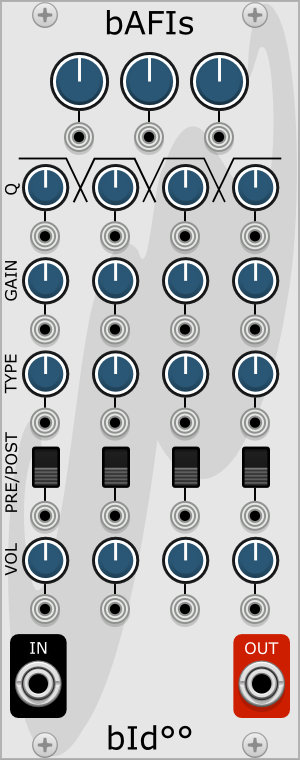
Effect · VCF · Distortion · 10 HP
bAFIs is a 4-band distortion. Three crossovers split the signal into four bands; each band has its own resonance, drive, distortion type (tanh, sine or digital clip), pre/post choice and volume, all under CV. Use it to distort the mids of a sound while keeping the bass clean, to fold only the highs, or as a resonant 4-band filter bank.
- Patch a sound into IN and OUT to your mixer or Audio module.
- Turn the four VOL knobs to 100 % (they start at 50 %, which lowers the overall level).
- Raise GAIN on one band (for example band 2, the low mids) to distort only that band.
- Change TYPE on that band to hear tanh, sine and digital clipping.
- Move the three top knobs to set where the bands split.
- Clean bass, dirty top: leave band 1 (lowest) at GAIN minimum, raise GAIN on bands 3 and 4 with TYPE tanh. The low end stays tight while the highs get crunchy.
- Wavefolder on one band: set TYPE to sin and PRE/POST to post on a band, then sweep GAIN (or patch a VCV LFO into its GAIN jack): the band folds over itself more and more.
- Filter-bank sculpting: keep all GAINs at minimum and use bAFIs as a 4-band EQ: VOL sets each band level and Q adds a resonant bump at the band's edges. With every Q at minimum and every VOL equal, the bands add up flat. Modulate the crossover jacks with a slow LFO for moving resonances.
- Rhythmic band switching: patch gates from a sequencer (for example the gate rows of VCV SEQ-3) into the VOL jacks of different bands, with the VOL knobs at 0 %: each gate opens one band.
- Pre vs post: in pre mode (default) the band is distorted then filtered, so the new harmonics outside the band are removed. Switch to post to distort after the filter and keep all the harmonics: brighter and harsher.
| Control | Range | Description |
|---|---|---|
| Top knobs 1-3 (crossover 1-3) | 22.6 Hz-16.4 kHz | The three split frequencies, defaults 200 Hz, 1 kHz, 5 kHz. Each crossover is kept at or above the one before it. |
| Q (band 1-4 resonance) | 10-100 % | Resonance at the band's edges (Q from 0.71 to 10). Default 10 %: no peak, and the bands add up flat. |
| GAIN (band 1-4 drive) | x1 to x10 | Drive into the band's distortion, default x1. At x1 the band is almost clean. Changes glide over 5 ms. |
| TYPE (band 1-4 distortion) | tanh / sin / digital | Distortion curve: tanh soft clipping, sine wavefolding, or digital hard clipping. A change dips the band for 5 ms, so it does not click. |
| PRE/POST (band 1-4) | Before the filter / After the filter | Down (default): distort, then filter the band. Up: filter the band, then distort. A change dips the band for 5 ms. |
| VOL (band 1-4 volume) | 0-100 % | Level of the band in the output mix, default 50 %. Changes glide over 5 ms. |
| Input | Description |
|---|---|
| IN | Audio, polyphonic. |
| Jacks under the top knobs (crossover 1-3 CV) | 1 V/oct, added to the knob. |
| Jack under each Q | Resonance CV: 10 V = +100 %. |
| Jack under each GAIN | Drive CV: +1 V adds 1 to the drive factor (9 V covers the full range). |
| Jack under each TYPE | Distortion type CV, replaces the knob when patched: 0-3.3 V tanh, 3.3-6.7 V sin, above 6.7 V digital. |
| Jack under each PRE/POST | Pre/post gate, replaces the switch when patched: 1 V and above = after the filter. |
| Jack under each VOL | Volume CV: 10 V = +100 %. |
| Output | Description |
|---|---|
| OUT | Sum of the four bands. Softly limited above 8 V so it stays under 10 V. |
- Bypass: Rack's bypass passes IN to OUT.
- Polyphony: up to 16 channels, as many as on IN. Every CV input is read per channel.
- Bands: Linkwitz-Riley crossovers (24 dB/oct). Band 1 is a low-pass at crossover 1; bands 2 and 3 are a high-pass at the previous crossover followed by a low-pass at the next; band 4 is a high-pass at crossover 3. The bands are phase-aligned so that they add up flat when every Q is at minimum. A band's Q raises the resonance only at its own edges.
- The input is scaled so that 5 V reaches full scale in the distortion: louder inputs distort more at the same GAIN. The tanh and digital curves are scaled so a 5 V input still comes out at about 5 V whatever the drive; the sin curve folds over at high drive, so its peak level can drop.
- The distortion runs oversampled (2x, with extra anti-aliasing on tanh and digital at high drive), so high drives stay clean of aliasing.