Repository navigation
rabBIT
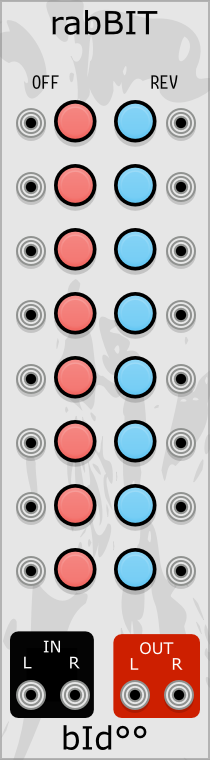
Effect · Distortion · 7 HP
rabBIT is a stereo bit crusher you play bit by bit. Each sample is turned into an 8-bit word (a sign bit and 7 level bits over ±5 V). The OFF column clears bits and the REV column flips them, then the word is turned back into a voltage. With no bit switched, the signal passes clean. Each bit can be toggled by a button or a trigger, so you can sequence the damage.
- Patch a signal into IN L (and IN R for stereo) and OUT L/R to your mixer. Turn your monitors down first: it can get very loud and harsh.
- Press the red OFF buttons from the top: bit 1 is the finest, so the top rows add grain and noise.
- Press a blue REV button to flip a bit.
- Press the bottom REV button (bit 8, the sign) to invert the polarity.
- Lo-fi drums: switch OFF bits 1 to 4 (the top four red buttons). The signal keeps its shape with only 8 levels per polarity.
- Sequenced destruction: patch gates from a sequencer (for example the gate rows of VCV SEQ-3) into the OFF and REV inputs. Each trigger toggles a bit, so the sound changes on every step.
- Random variations: right-click and choose Randomize: every OFF and REV switch is set at random. Do it on a loop until you find a texture you like.
- Rhythmic polarity flips: patch a clock into the bottom REV input (bit 8). Each pulse toggles the polarity of the signal, which clicks and chops sustained sounds in time.
| Control | Range | Description |
|---|---|---|
| OFF 1-8 (red buttons) | Off / On | Clears the bit (sets it to 0). Bit 1 is at the top (smallest step); bit 8, at the bottom, is the sign. The button lights while active. |
| REV 1-8 (blue buttons) | Off / On | Flips the bit. Lit while active. |
| Input | Description |
|---|---|
| OFF 1-8 (left column) | Trigger: toggles the OFF switch of that bit. |
| REV 1-8 (right column) | Trigger: toggles the REV switch of that bit. |
| IN L | Left audio, polyphonic. |
| IN R | Right audio, polyphonic. |
| Output | Description |
|---|---|
| OUT L | Left, crushed. Same channel count as IN L. |
| OUT R | Right, crushed. Same channel count as IN R. |
- With every switch off, the input passes clean: no steps, no clipping. As soon as one OFF or REV switch is on, the crushing fades in over 5 ms (and fades out the same way when the last one is turned off).
- While crushing, the signal is reduced to 127 steps per polarity over ±5 V (about 39 mV per step). Anything beyond ±5 V is clipped to ±5 V.
- Clearing a level bit pulls the signal towards 0 V. Clearing bit 8 makes negative halves positive (full-wave rectification); flipping it inverts the signal.
- When OFF and REV are both on for the same bit, OFF wins.
- The same switches apply to both sides and every channel. IN R does not follow IN L: patch both for stereo.
- The OFF and REV states are saved with the patch. Randomize sets them at random. Initialize turns them all off.
- Rack's bypass passes IN to OUT on each side.