Repository navigation
ZOUMAI Expander
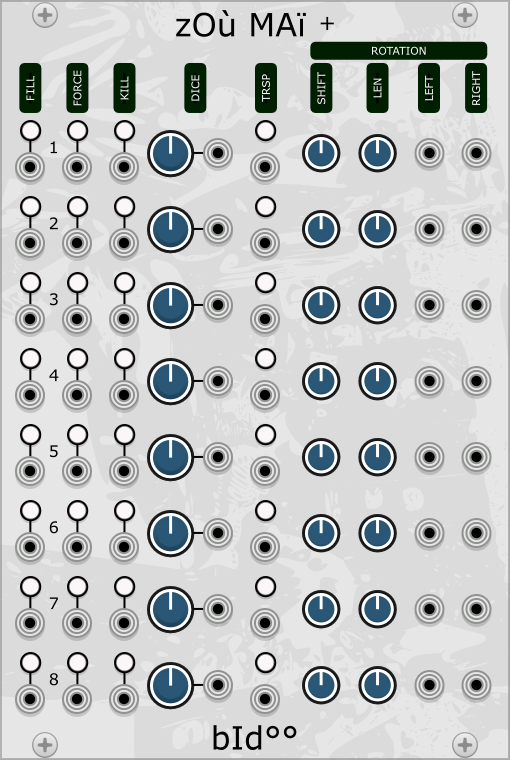
Sequencer · 17 HP
The zOù MAï Expander adds performance controls to each of the 8 tracks of ZOUMAI: fill, force and kill switches, a probability offset, a transposition input and step rotation. Place it directly to the right of zOù MAï; it does nothing on its own.
- Place the expander touching the right side of a zOù MAï (or use Add expander in zOù MAï's context menu).
- Write a pattern in zOù MAï with some conditional trigs (for example Prob. DICE with Val. 50, or FILL).
- Click FILL, FORCE or KILL on a track row and listen to its conditional trigs change.
- Patch a sequencer or MIDI-CV V/OCT into TRSP of a melodic track to transpose it.
- Per-track fills: patch a gate (a MIDI-CV gate, a button module, or a slow clock divider) into the FILL input of the drum track you want to fill. While it is high, that track plays its FILL trigs and skips its !FILL trigs, without touching the other tracks.
- Build-ups with DICE: turn the DICE knob of a hi-hat track down to -50 % at the start of a section and patch a slow rising ramp (VCV LFO saw, or an envelope) into the DICE input. Trigs with a DICE condition get denser as the CV rises.
- Key changes: patch a slow step sequencer (VCV SEQ3) into TRSP of the bass and lead tracks. Press the mode button to choose octaves (1 V/oct) or semitones (1 V per semitone). The transposition is added before zOù MAï's quantizer, so the notes stay in the track's scale.
- Evolving rhythms by rotation: set SHIFT to 1 and LEN to the track length, then patch a clock divider (for example every 4 bars) into LEFT. The track's trigs rotate one step left each time, writing a slowly changing pattern.
- Breakdowns: patch a gate into KILL on several tracks to silence their conditional trigs, and into FORCE to make every conditional trig play for a climax.
| Control | Range | Description |
|---|---|---|
| FILL 1-8 | on / off | Per-track fill. It is combined (OR) with zOù MAï's FILL. Green light = on. |
| FORCE 1-8 | on / off | Every active trig of the track plays, whatever its condition. Green light = on. |
| KILL 1-8 | on / off | Trigs with a condition stay silent. Plain trigs (DICE at 100) still play. Force wins over kill. Green light = on. |
| DICE 1-8 (dice offset) | -100..+100 % | Added to the Val. % of every DICE trig of the track. |
| TRSP 1-8 (transpose mode) | octaves (blue) / semitones (green) | Scale of the TRSP input: octaves = 1 V/oct, semitones = 1 V per semitone. |
| SHIFT 1-8 (rotation steps) | 1-64 | Number of steps a LEFT or RIGHT trigger rotates the track. |
| LEN 1-8 (rotation length) | 1-64 (default 16) | Number of steps, from step 1, that take part in the rotation. Set it to the track length to rotate the whole track. |
| Input | Description |
|---|---|
| FILL 1-8 | Gate: when patched, the input sets the fill state (high above 1 V, low under 0.1 V) and the button is ignored. |
| FORCE 1-8 | Gate for force, same rule. |
| KILL 1-8 | Gate for kill, same rule. |
| DICE 1-8 | Dice offset CV: -10..+10 V = -100..+100 %, added to the knob, total limited to ±100 %. |
| TRSP 1-8 | Transposition CV, added to the track's V/O before quantizing. 0 V when unpatched. |
| LEFT 1-8 | A trigger rotates the track's first LEN steps left by SHIFT steps. |
| RIGHT 1-8 | A trigger rotates them right by SHIFT steps. |
None. The expander sends everything to zOù MAï through the expander connection.
- Rotation edits the pattern: the trigs really move in zOù MAï's current pattern, and the result is saved with zOù MAï. Rotation works while stopped too.
- Per pattern: SHIFT and LEN are stored for each of zOù MAï's 16 patterns; the knobs follow when the pattern changes.
- Saved with the patch: the transpose modes and the SHIFT / LEN values of every pattern. The FILL, FORCE and KILL states are not saved.
- Initialize sets SHIFT to 1 and LEN to 16 on every pattern, turns FILL, FORCE and KILL off and sets the transpose modes to octaves.
- When the expander is removed, zOù MAï turns off every effect it applied.
- Works only with ZOUMAI, in both of its clock modes.