Repository navigation
dOSE
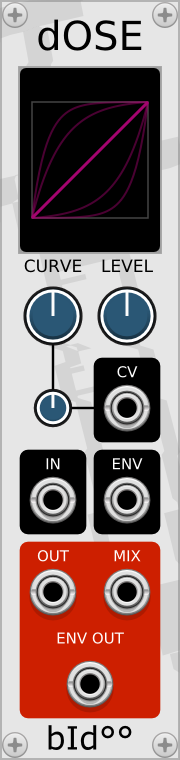
VCA · Polyphonic · 6 HP
dOSE is a polyphonic VCA. An envelope on ENV opens it, and CURVE bends how the envelope opens it: at 0 % the envelope is used as it is (linear), turned left it becomes exponential, so notes sound shorter and snappier, and turned right it becomes logarithmic, so notes sound longer. The shaped envelope also comes out on ENV OUT, so you can use the curve on any CV.
- Patch a voice (an oscillator or a filter) into IN. A polyphonic cable gives one VCA per channel.
- Patch an envelope into ENV, for example the output of a VCV ADSR driven by your gates.
- Patch OUT (or MIX for one mono signal) to your mixer.
- Play notes and turn CURVE: left for plucky, short notes, right for long, swelling ones. The screen shows the curve, and a yellow dot for each channel's envelope.
- Plucks from one envelope: give a polyphonic voice a short ADSR (attack 0, decay about 300 ms, sustain 0) on ENV. With CURVE at -100 % each note falls away fast, like a plucked string; at 0 % the same envelope sounds flat and long.
- Longer tails without touching the envelope: on a pad or a drone, turn CURVE to +50 % or more. The quiet end of each release is lifted, so notes hang on longer and the pad blends. Lower LEVEL if the notes get louder.
- Shape a CV too: patch an LFO or an envelope into ENV with nothing in IN, and use ENV OUT. It gives the same signal bent by CURVE (0..10 V), for example an exponential sweep for a filter cutoff.
- Curve per note: patch a polyphonic CV (velocity, or a random value per note) to the CV jack and turn the CV amount trimpot up. Each channel gets its own curve: soft notes long, hard notes short, or the other way round.
| Control | Range | Description |
|---|---|---|
| CURVE | -100 % to +100 % | 0 %: the envelope as it is (linear). Towards -100 %: exponential, low levels pushed down, so envelopes sound shorter and snappier (-60 dB at 1.7 V on ENV). Towards +100 %: the mirror of it, low levels lifted, so envelopes sound longer. A 10 V envelope always gives full gain, whatever the curve. |
| CV amount (trimpot) | -100 % to +100 % | How much the CV jack moves CURVE. Negative turns it the other way. |
| LEVEL | -inf to +6 dB | Output gain. 0 dB at 12 o'clock, +6 dB fully right. Smoothed over 5 ms, so turning it does not click. |
| Input | Description |
|---|---|
| IN | Audio, polyphonic: one VCA per channel. |
| ENV | Envelope, 0 V to 10 V = gain 0 to 1, clamped outside this range. A mono cable opens every channel; a polyphonic one opens each channel with its own envelope. Unplugged, the gain is 1, so dOSE is a plain amplifier set by LEVEL. |
| CV | Added to CURVE through the CV amount trimpot: with the trimpot fully right, ±5 V spans the knob's whole range. Mono for every channel, or polyphonic for one curve per channel. |
| Output | Description |
|---|---|
| OUT | Audio, with IN's channels. |
| MIX | The sum of all OUT channels, mono. |
| ENV OUT | The shaped envelope, 0 V to 10 V, before LEVEL. It has as many channels as ENV or IN, whichever has more. |
-
The curve is y = (e^(kx) - 1) / (e^k - 1), with x = ENV / 10 V and k = -8 × CURVE. At 0 % it is exactly y = x.
CURVE ENV 1 V ENV 2.5 V ENV 5 V -100 % -67.7 dB -53.4 dB -34.9 dB -50 % -40.8 dB -29.9 dB -18.5 dB 0 % -20.0 dB -12.0 dB -6.0 dB +50 % -9.5 dB -3.8 dB -1.1 dB +100 % -5.2 dB -1.3 dB -0.2 dB -
ENV is not smoothed, so fast envelopes and clicks stay as sharp as you patch them. Only the CURVE and LEVEL knobs are smoothed.
-
Polyphony works as on the VCV VCA: OUT takes its channels from IN.
-
Only the knob positions are saved.