Repository navigation
lIMbO
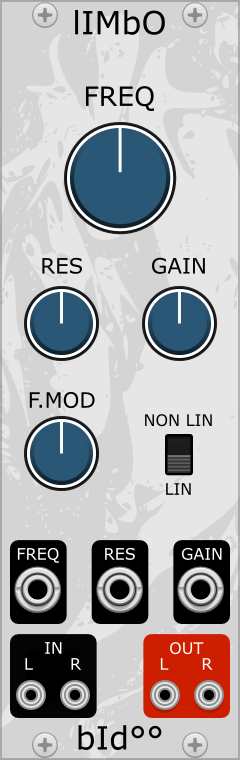
VCF · Effect · 8 HP
lIMbO is a stereo 4-pole (24 dB/oct) low-pass ladder filter, polyphonic. In LIN mode it is clean and GAIN is an output boost to make up for the level lost at high resonance. In NON LIN mode each of the four stages saturates (tanh) and GAIN drives that saturation.
- Patch an oscillator or a mix into IN L (R copies L when unpatched).
- Patch OUT L (and R) to your mixer or Audio module.
- Turn FREQ down until the sound gets darker.
- Raise RES for a resonant peak at the cutoff.
- Flip the switch to NON LIN and raise GAIN for a warmer, driven sound.
- Classic subtractive voice: VCV VCO saw into IN L, a VCV ADSR into the FREQ input, F.MOD to about +50 %, FREQ fairly low. Each gate opens the filter; F.MOD sets how far.
- Keyboard tracking: patch the same V/oct as your oscillator into the FREQ input and set F.MOD to 100 % (1 V/oct): the filter follows the notes, so the tone stays the same over the keyboard.
- Polyphonic filter: patch a polyphonic VCO into IN L and a polyphonic ADSR into the FREQ input: every voice gets its own filter and envelope.
- Drive a drum bus: put a stereo drum mix into IN L/R, switch to NON LIN, raise GAIN, and keep FREQ high so it only rounds off the top. Follow with baR to tame the peaks.
- Swept stereo filter: a slow VCV LFO into the FREQ input with F.MOD around 30-60 %, RES around 60 %, on a pad or a drone.
| Control | Range | Description |
|---|---|---|
| FREQ (cutoff) | 22.6 Hz-16.4 kHz | Cutoff frequency, exponential, default fully open. |
| RES (resonance) | 0-100 % | Feedback around the ladder. At 100 % the peak is strong but the filter does not self-oscillate. |
| GAIN (gain boost) | 0-100 % | LIN: output gain from x1 to x8 (0 to +18 dB). NON LIN: drive into the saturating stages; the output level is not boosted. In both modes the resonance stays where RES sets it. |
| F.MOD (cutoff CV amount) | -100..+100 % | Attenuverter for the FREQ input. 100 % = 1 V/oct. Default 0 %: the FREQ input does nothing until you turn it. |
| NON LIN / LIN (mode) | Linear / Saturated | LIN (down, default): clean filter. NON LIN (up): tanh saturation in each stage, oversampled 2x to keep aliasing down. |
| Input | Description |
|---|---|
| IN L | Left audio, polyphonic. |
| IN R | Right audio, polyphonic. When unpatched, it takes the L signal. |
| FREQ | Cutoff CV, scaled by F.MOD (100 % = 1 V/oct), polyphonic. |
| RES | Resonance CV, added to the knob: 5 V = +100 %. Polyphonic. |
| GAIN | Gain boost CV, added to the knob: 5 V = +100 %. Polyphonic. |
| Output | Description |
|---|---|
| OUT L | Filtered left signal. |
| OUT R | Filtered right signal. |
Outputs are softly limited above 8 V so they stay under 10 V.
- Polyphony: up to 16 channels; the channel count is the larger of IN L and IN R. The CV inputs are read per channel (a mono CV drives all channels).
- Bypass: Rack's bypass passes IN L to OUT L and IN R to OUT R.
- The cutoff, with CV, stays between 10 Hz and 0.45 x the sample rate.
- In NON LIN mode the saturation depends on the input level too: a 5 V signal drives it harder than a 1 V one.
- Nothing is saved besides the knob positions.