Repository navigation
BISTROT
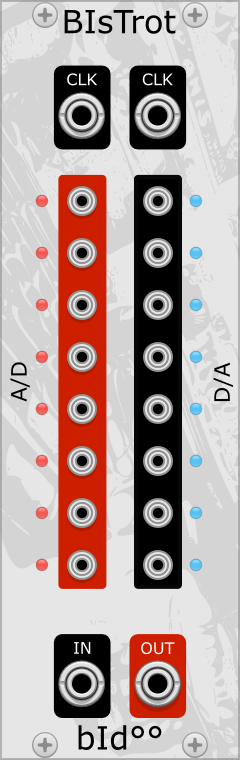
Effect · Distortion · 8 HP
BISTROT (BIsTrot on the panel) is an 8-bit converter you can patch into. The A/D side turns the input into 8 bits, each on its own gate output. The D/A side builds a voltage from 8 gate inputs. Between the two you can rewire, swap, mute or replace bits with any gate, and each side has its own sample clock for sample-rate reduction.
- Patch a signal into IN and OUT to your mixer. With nothing else patched, OUT is the input reduced to 8 bits.
- Patch a square wave (for example a VCV VCO square output at a few hundred Hz) into the left CLK: the input is now sampled at that rate.
- Patch one A/D output into a different D/A input to move a bit, for example the top A/D output into the fifth D/A input.
- Patch a gate or a clock into a D/A input to force that bit from outside.
- Sample-rate reduction: patch an audio-rate square (VCV VCO square output) into the left CLK and sweep the VCO pitch for classic aliasing.
- Bit swapping: cross-patch A/D outputs into other D/A inputs, for example reverse the order of the level bits. Unpatched D/A inputs keep the original bit.
- Bits as a sequencer source: use the A/D outputs as gates. Feed IN with a slow LFO or a random voltage and clock it with the left CLK: the eight outputs give eight related rhythms for drums.
- Gates to voltage: leave IN unpatched and drive the D/A inputs with gates from a sequencer or clock dividers: OUT becomes a stepped voltage (a simple 8-bit DAC) that you can quantize and use as a melody.
BISTROT has no knobs or buttons.
| Input | Description |
|---|---|
| CLK (left) | ADC clock. Each trigger samples IN. Unpatched: IN is sampled at every sample. Polyphonic: one clock per channel. |
| CLK (right) | DAC clock. Each trigger reads the D/A inputs and updates OUT. Unpatched: every sample. Polyphonic: one clock per channel. |
| D/A 1-8 (right column) | Bit inputs: high from 1 V. Bit 1 at the top, bit 8 (the sign) at the bottom. Unpatched: that bit follows the A/D side. Polyphonic. |
| IN | Audio, polyphonic. Full scale is ±5 V; beyond that it clips. |
| Output | Description |
|---|---|
| A/D 1-8 (left column) | The bits of the sampled input: 10 V when set, 0 V when clear. Bit 1 at the top, bit 8 (the sign) at the bottom. Polyphonic. |
| OUT | The voltage built from the D/A bits, ±5 V. Polyphonic. |
- The format is sign and magnitude: bits 1-7 give the level in 127 steps of about 39 mV, bit 8 makes it negative. With all level bits high, OUT is 5 V (or -5 V with bit 8).
- The channel count is the highest among IN and the D/A inputs.
- The red lights show the A/D bits, the blue lights the D/A bits, for the first channel only.
- Nothing is saved with the patch beyond the cables.
- rabBIT does the same conversion with buttons to clear or flip bits.