Repository navigation
dTrOY
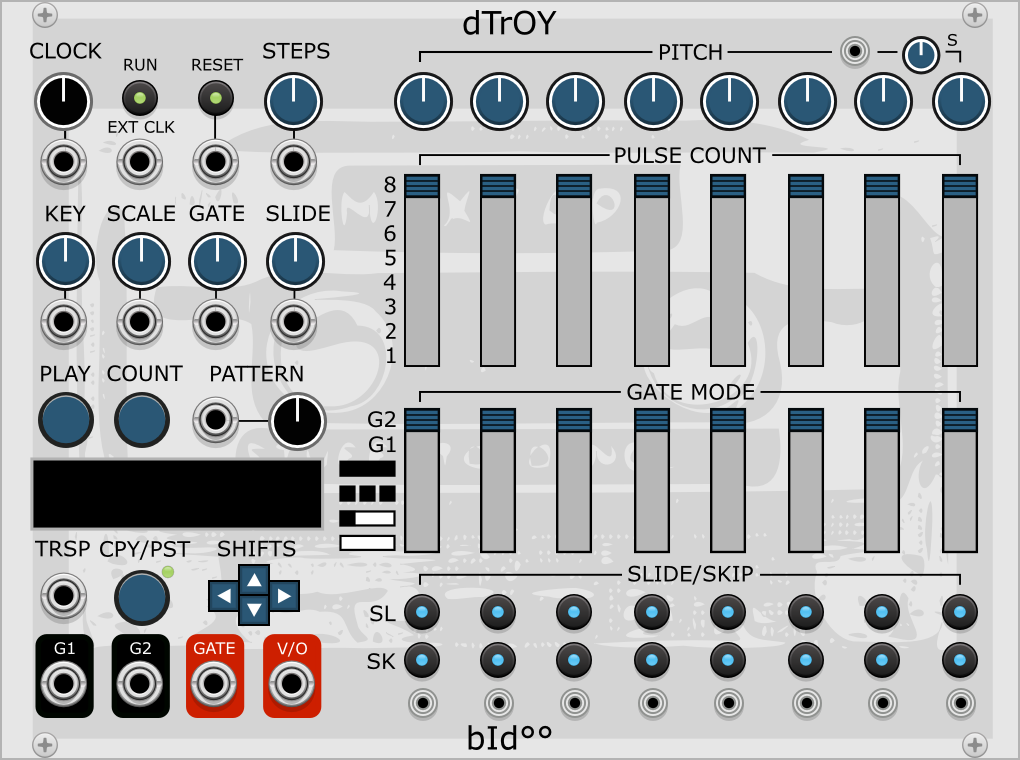
Sequencer · 34 HP
dTrOY is a single-voice pitch and gate sequencer in the spirit of the Intellijel Metropolis and RYK M185. It has 8 stages; each stage has a pitch, a number of pulses (how many clocks it lasts), a gate mode, a slide and a skip. Up to 16 steps play the 8 stages, in 5 play modes, with a scale quantizer and 16 patterns. Its sibling bordL adds per-stage probability, random pitch and an accent line.
- Patch V/O to the V/OCT input of an oscillator (for example VCV VCO) and GATE to an envelope (VCV ADSR) that drives a VCA.
- The internal clock runs at 120 BPM by default: you hear 8 steps, one per clock. Or patch a clock into EXT CLK.
- Turn the 8 PITCH knobs to set the notes. Pick a KEY and a SCALE to quantize them.
- Raise some PULSE COUNT sliders: that stage now lasts several clocks. Set its GATE MODE slider to choose how the gate fires during those clocks.
- Click SL on a stage to glide into it, SK to skip it.
- Metropolis-style bassline: set KEY and SCALE (for example a minor pentatonic), give a few stages 2-4 pulses with GATE MODE "Multiple" for ratchets, and set SL on one or two stages. Feed GATE into VCV ADSR and V/O into VCV VCO, then through VCV VCF.
- Long drones between notes: set GATE MODE to "Hold" on stages with many pulses. The gate stays open over the whole stage and closes at the gate length of the last pulse.
- Gate audio or another rhythm: patch a clock divider or a second sequencer into G1. Stages in "External gate 1" mode copy G1 to the GATE output for the whole stage, so you can mix rhythms from two sources. Audio works too, for stuttered sounds.
- Song mode with the PATTERN input: write variations in patterns 1-4, then patch a slow stepped CV (VCV SEQ3 CV row, or a stepped LFO) into the PATTERN input: 0-10 V selects patterns 1-16. The play position carries over, so the switch keeps the groove.
- Live transposition: patch a second sequencer or a MIDI-CV V/OCT into TRSP. It is added before the quantizer, so the line follows the transposition and stays in the scale.
| Control | Range | Description |
|---|---|---|
| CLOCK | 15-960 BPM (default 120) | Tempo of the internal clock. One clock = one pulse. Ignored when EXT CLK is patched. |
| RUN | button | Starts and stops the sequencer. The green light is on while it runs. |
| RESET | button | The next clock plays the first step. With the internal clock, the clock restarts at once and the first step plays now. |
| STEPS | 1-16 | Number of steps in steps count mode, or number of pulses in pulses count mode. Steps 9-16 play stages 1-8 again. |
| KEY (root note) | C..B | Root of the scale. |
| SCALE | No, Ionian ... Chromatic (46 entries) | Quantizer scale. "No" leaves the pitch unquantized. |
| GATE (gate length) | 10-100 % | Gate length as a fraction of one pulse. |
| SLIDE (slide curve) | 10-100 % | Shape of the glide on slide stages: 100 % is linear, lower values move faster at the start. The glide always lasts one pulse. |
| PLAY (play mode) | button | Cycles forward, backward, ping-pong, random, brownian (random neighbour). |
| COUNT (count mode) | button | Toggles steps / pulses count mode. |
| PATTERN (edited pattern) | 1-16 | Pattern shown and edited by the panel. It is also the played pattern when the PATTERN input is not patched. |
| S (pitch sensitivity) | 10-100 % | Scales the stage pitches before transposition and quantizing. Lower values squeeze the melody into a smaller range. |
| CPY/PST | button | Copy then paste a pattern (see Notes). The green light shows a copy is waiting. |
| SHIFTS ◄ ► | buttons | Rotate the 8 stages (pitch, pulses, gate mode, slide, skip) left or right. |
| SHIFTS ▲ ▼ | buttons | Transpose every stage pitch knob up or down by 1/12 V (one semitone at 100 % sensitivity). |
| PITCH 1-8 | -4..+6 V | Pitch of each stage, before sensitivity, transposition and quantizing. |
| PULSE COUNT 1-8 | 1-8 | Number of clocks each stage lasts. |
| GATE MODE 1-8 | Rest / Single / Multiple / Hold / G1 / G2 | Rest: no gate. Single: one gate on the first pulse. Multiple: one gate on every pulse. Hold: the gate stays open for the whole stage. G1, G2: the GATE output copies the G1 or G2 input for the whole stage. |
| SL 1-8 (slide) | button | Toggles slide on the stage: the pitch glides from the previous note during the first pulse. |
| SK 1-8 (skip) | button | Toggles skip: the stage is left out of the sequence. |
The SL and SK buttons, PLAY and COUNT are momentary buttons that flip the value stored in the edited pattern, so a MIDI-mapped button flips them too.
| Input | Description |
|---|---|
| CLOCK CV (under CLOCK) | Internal clock tempo, 1 V/oct, added to the knob (+1 V doubles the tempo). |
| EXT CLK | External clock. Each rising edge is one pulse. The gate length follows the measured clock period. |
| RESET (under RESET) | Same as the RESET button. A reset arriving up to 1 ms after an external clock counts for that clock. |
| STEPS CV | Adds 1 step (or pulse) per volt to STEPS, result 1-16. |
| KEY CV | 0-10 V adds 0-11 semitones to the root note. |
| SCALE CV | Adds one scale per volt to SCALE. |
| GATE CV | Adds to the gate length, 10 V = +100 %. |
| SLIDE CV | Adds to the slide curve, 10 V = +100 %. |
| PATTERN | Played pattern, 0.625 V per pattern: 0-10 V selects patterns 1-16. The panel still edits the PATTERN knob's pattern. |
| TRSP | Transposition, 1 V/oct, added after sensitivity and before the quantizer. |
| S CV (left of S) | Adds to the pitch sensitivity, 10 V = +100 %. |
| G1, G2 | External gates used by stages in G1 / G2 gate mode. Any signal passes, audio included. |
| Output | Description |
|---|---|
| GATE | Gate, 0 / 10 V (or the G1 / G2 signal in those modes). |
| V/O | Pitch, 1 V/oct. It holds the previous note through Rest stages. |
| 1-8 (bottom row) | Stage outputs: a 1 ms, 10 V trigger when the stage starts (or on every pulse, see the context menu). Skipped stages send nothing. |
- The display shows the play mode (►, ◄, ►◄, ►* random, ►? brownian), "steps:N" or "pulses:N", the root note and scale of the edited pattern, the edited pattern "Pn" and the played pattern, blinking (0.5 s on, 0.25 s off).
- The SL and SK lights show the slide and skip state of each stage; they flash (inverted) when the stage plays.
- Randomize pitches: random values on the 8 PITCH knobs (-4..+6 V).
- Randomize gates: random pulse counts (1-7) and gate modes (Rest to G2).
- Randomize slides & skips: about 20 % of stages get a slide, 15 % a skip, on the edited pattern.
- Stage outputs on every pulse: the stage outputs fire on every pulse of the stage instead of only its first.
- Count modes: in steps mode, the first STEPS steps play. In pulses mode, steps play until their pulses add up to STEPS; the last stage is shortened if needed and the rest is skipped. Skipped stages count no pulses.
- Play modes: ping-pong turns around on the first and last playing steps. Random picks any non-skipped step. Brownian moves one step forward or back at random.
- Patterns: 16 patterns. Everything on the panel except CLOCK, RUN and RESET is stored per pattern: steps, play and count modes, key, scale, gate, slide, sensitivity and the 8 stages. When the PATTERN input changes the played pattern, the play position carries over.
- Copy/paste: press CPY/PST on the source pattern (the light turns on), turn PATTERN to the target and press CPY/PST again. Pressing it twice on the same pattern cancels.
- Saved with the patch: all 16 patterns, the run state, the edited and played patterns and the stage-output option.
- Undo: Edit > Undo (Ctrl+Z) reverses paste, the SLIDE, SKIP, play mode and count mode buttons, transpose and rotate, and the Randomize lines of the menu, named in the menu. A knob on a pattern goes back on that pattern, even with another one selected. The pattern is put back within a few samples: the change goes through the audio thread, with no lock.
- Initialize resets all 16 patterns. Rack's Randomize randomizes the knobs (not the pattern selector) and also the slides and skips of the edited pattern.
- Not polyphonic: one voice, monophonic outputs.