Repository navigation
PRiSME
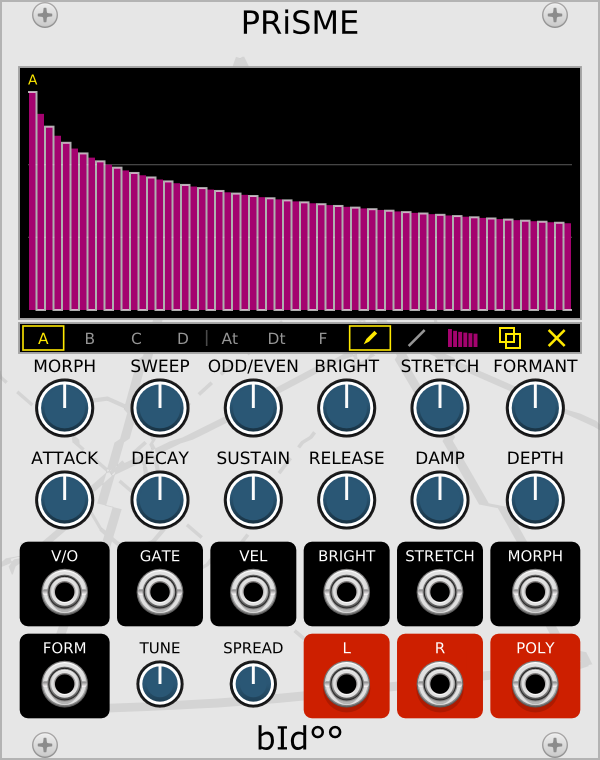
Synth voice · Oscillator · Polyphonic · 20 HP
PRiSME is an additive voice. Each note is built from 64 sine waves, its harmonics, and you draw their levels on the screen as bars. There are up to four spectra, A to D, to morph along, by hand, by velocity, or by themselves on every note. Each harmonic has its own envelope, with its own attack and decay times drawn on two more pages, so a note can start bright and lose its high harmonics one by one, as a plucked string does, let its high harmonics come in late, as a horn does, or, in loop mode, keep every harmonic rising and falling at its own pace for as long as the note is held. A formant filter, drawn over frequency, shapes the whole spectrum like a vowel and stays put as the notes move. Knobs then tilt the spectrum, hollow it out or stretch the harmonics into bell tones. Up to 16 notes play at once.
- Patch L to a mixer. With nothing else patched you hear one held note, a sawtooth at C4.
- Patch a polyphonic V/O and GATE (VCV MIDI-CV with its polyphony set to 4 or more, or a sequencer). Each channel is one note, with its own envelopes.
- Draw on the screen: left button paints the bars, right button erases them. The strip under the screen switches between the pages (A B C D, At, Dt, F) and has the tools.
- Turn MORPH to travel from A through B and C to D, DAMP to make the high harmonics die sooner, DECAY and SUSTAIN for the note's shape.
- A pluck that loses its brightness: SUSTAIN at 0, DECAY around 1.5 s, DAMP at 70 % or more. Every harmonic starts at once, and the higher it is the sooner it fades, so each note goes from bright to round. This is the factory preset Harp pluck.
- Morph timbres: draw a different spectrum on each page (or pick a shape), then sweep MORPH with an LFO or the MORPH CV (with SWEEP off). MORPH passes A, B, C and D in turn; right-click > Spectra in the morph keeps it to A-B or A-C. The bars are crossfaded in dB, so the move sounds even all the way.
- Soft and loud: right-click > Velocity moves MORPH. A soft note plays where MORPH is, a hard one further along the chain: draw a dull spectrum on A and a bright one on B, and the tone opens as you play harder, as an acoustic instrument does (Electric piano, Brass swell). Turn Velocity sets the level off to keep every note at the same level and let velocity change only the tone.
- A timbre that moves by itself on each note: turn up SWEEP. Each note starts where MORPH is and travels to the last spectrum in SWEEP's time (5 ms to 20 s), through every spectrum on the way: brass-like swells, slow pads that open up, evolutions through four spectra (Evolving shimmer). MORPH sets the starting timbre; once a note has arrived, it stays on the last spectrum until the next note.
- Harmonics that come in late: on the At page raise the bars of the high harmonics. They take up to 8 times ATTACK to rise, so the note starts round and brightens, as a horn's lips build up (Brass swell).
- Shimmer in a few harmonics: on the Dt page raise the bars of two or three harmonics. They take up to 8 times DECAY and RELEASE, so they ring on after the rest of the note.
- Living, evolving tones: right-click > Loop the harmonics' envelopes, SUSTAIN around 30 %, then draw uneven At and Dt pages (the random shape is a good start). Each harmonic rises, falls to SUSTAIN and rises again at its own pace, so the tone never stops moving while the note is held.
- Bells and metal: turn STRETCH right. The harmonics move apart from their exact multiples and the tone turns inharmonic. Use SUSTAIN at 0, a long DECAY, some DAMP, and a random Dt page so the partials ring for different times (Glass bells, Gong).
- Talking sounds: on the F page pick a vowel (the shape cell), turn DEPTH up, and move FORMANT or patch an LFO or a sequence into the FORM CV (1 V/octave) to move the vowel. The filter works at fixed frequencies, so it stays in place as the notes move, as a voice's vowels do. Right-click > Formant follows the envelope moves it up or down with each note's envelope, for wah-like attacks (Vowel pad, Choir aah).
- Wide stereo from one voice: turn SPREAD up and patch L and R. Odd harmonics go to the left, even ones to the right, and the fundamental stays in the middle.
- A, B, C and D show a spectrum: bar 1 is the fundamental, bar 64 the 64th harmonic. The height is the level in dB: a full bar is 0 dB, the grey lines are -20 and -40 dB, the bottom is -60 dB, and an empty bar is off. The spectrum before it in the chain (B for A) is drawn as a white outline over the bars. A spectrum left out of the morph says so, and its letter is darker in the strip.
- At (attack times) and Dt (decay times): a bar on the middle line plays at the knob's time (ATTACK, or DECAY and RELEASE); a bar above lasts longer (up to 8 times at the top), one below is shorter (down to 1/8). The grey lines mark 1/4, 1 and 4 times.
- F (formant filter): the gain the filter gives at each frequency, from 50 Hz on the left to 12.8 kHz on the right (grey lines at 100 Hz, 1 kHz and 10 kHz). The dark line across the bars is 0 dB; a full bar is +12 dB, an empty one -36 dB. While a note plays, a white line shows the curve where that note hears it (moved by FORMANT, its CV and the envelope), and pink ticks at the bottom show its harmonics.
- While notes play, yellow ticks on a spectrum page show what the newest note plays now, so you see each harmonic's envelope moving. The top right corner shows how many voices there are.
- Left button paints with the brush or draws with the line tool. Right button erases (on a time page, bars go back to the middle line; on F, to 0 dB). Shift + drag draws a straight line with the brush. The mouse wheel over the screen sets the brush width: 1, 2, 4, 8 or 16 bars. A wide brush paints a smooth hill.
- Every change can be undone and redone with Ctrl+Z and Ctrl+Shift+Z, or from Rack's Edit menu.
The strip under the screen, from left to right:
| Cell | What it does |
|---|---|
| A, B, C, D | The spectra. |
| At, Dt | The attack and decay times. |
| F | The formant filter. |
| Pencil | The brush. |
| Line | The line tool: drag from one point to another, the bars between follow a straight line. |
| Shapes | A menu of shapes for the page shown. On a spectrum: sawtooth (every harmonic at 1/k), square (odd harmonics at 1/k), triangle (odd harmonics at 1/k²), organ (a few stops), random. On a time page the same pictures are times: the sawtooth gives high harmonics that are quicker. On F: the vowels A, E, I, O and OU. |
| Copy | Copies the page shown to another spectrum, or a time page to the other one. |
| Clear | Empties the page (a time page back to the middle line, F back to 0 dB). |
| Control | Range | Description |
|---|---|---|
| MORPH | 0-100 % | Along the spectra: A at 0 %, D at 100 % (B at 33 % and C at 67 % with four). With SWEEP, where each note starts. |
| SWEEP | off, 5 ms to 20 s | Fully left: off. Otherwise each note travels from MORPH's position to the last spectrum in this time. |
| ODD/EVEN | -100 % to +100 % | Left: the even harmonics fade out (at -100 % only odd ones are left, a hollow, clarinet-like tone). Right: the odd ones fade out (at +100 % only even ones, an octave up). |
| BRIGHT | -6 to +6 dB/oct | Tilts the spectrum: right lifts the high harmonics, left lowers them. |
| STRETCH | -100 % to +100 % | Moves the harmonics off their multiples: harmonic k plays at k^(1 + 0.12 × STRETCH) times the fundamental. Right spreads them (bells, struck metal), left squeezes them. |
| FORMANT | ±3 octaves | Moves the curve drawn on F up or down. |
| ATTACK | 1 ms to 10 s | The time for a harmonic to rise to full level, times its bar on At. |
| DECAY | 5 ms to 20 s | The time for a harmonic to fall 60 dB towards SUSTAIN, times its bar on Dt, shorter for high harmonics with DAMP. |
| SUSTAIN | 0-100 % | The level the harmonics hold while the gate is high. At 100 % they do not decay. In loop mode, where they turn back up. |
| RELEASE | 5 ms to 20 s | The time to fall 60 dB after the gate ends, times each harmonic's bar on Dt, shorter for high harmonics with DAMP. |
| DAMP | 0-100 % | How much faster high harmonics decay and release: at 100 % harmonic k is k times faster than the fundamental, at 50 % √k times. |
| DEPTH | 0-100 % | How much the formant filter shapes the spectrum: at 0 % not at all, at 100 % fully (from +12 dB to -36 dB as drawn). |
| TUNE | ±24 semitones | Added to V/O. |
| SPREAD | 0-100 % | Odd harmonics to the left, even ones to the right; the fundamental stays in the middle. |
| Input | Description |
|---|---|
| V/O | 1 V/octave, polyphonic, C4 at 0 V. PRiSME plays as many notes as the widest of V/O and GATE. |
| GATE | Polyphonic gates: high above 1 V, low under 0.1 V. Unplugged, every voice is held, so PRiSME drones. A new gate on a note that still sounds carries on from where its harmonics are, without a click: each harmonic rises again from its level. |
| VEL | Velocity, 0 to 10 V: the level of each note, and MORPH if the menu says so. Unplugged, full level and no morph. |
| BRIGHT | Added to BRIGHT: ±5 V spans the knob's range. Polyphonic: each note its own. |
| STRETCH | Added to STRETCH: ±5 V spans the knob's range. Polyphonic. |
| MORPH | Added to MORPH: 10 V spans the knob's range. Polyphonic. |
| FORM | Moves the formant filter, 1 V/octave. Polyphonic. |
| Output | Description |
|---|---|
| L, R | Every note, summed. The sum is divided by the square root of the number of channels (4 channels: half), so chords keep a steady level; linear up to 8 V, then softly limited under 10 V. With R unplugged, L carries both sides. |
| POLY | Each note on its own channel, mono, before SPREAD. Use it to give each note its own filter or VCA. |
- Spectra in the morph: A to B, A to C or A to D (the default). The spectra left out stay drawn and can come back.
- Loop the harmonics' envelopes: once a harmonic has fallen to SUSTAIN it rises again, in its own attack time, and falls again in its own decay time, for as long as the gate is held.
- Velocity sets the level: on by default.
- Velocity moves MORPH: no, a quarter, half or all the way along the chain at full velocity (10 V).
- Formant follows the envelope: the formant filter moves up or down 1 or 2 octaves with each note's envelope (the fundamental's).
- Phases at note-on: Aligned starts every harmonic at the same phase, which gives the classic waveforms (a real sawtooth, a real square on a scope). Spread gives each harmonic its own fixed phase: the same tone, with lower peaks, useful with many loud harmonics.
- Page, Tool, Brush width, Shape on this page, Copy this page and Clear this page: the same as the strip and the mouse wheel.
- Every spectrum plays at the same loudness: a harmonic alone peaks at 3.3 V, a full sawtooth near 5 V. Drawing more bars changes the timbre, not the level. Use VEL, SUSTAIN or a VCA for the level.
- Band-limited: a harmonic fades out between 0.40 and 0.45 of the sample rate and is not played above it, so high notes never alias. High notes also cost less CPU.
- CPU: about 5 % of one core for 16 notes of 64 harmonics at 48 kHz (measured on the engine alone), less for higher notes or fewer harmonics. Voices that have finished cost nothing.
- Levels, pitches and envelopes are updated every 32 samples (and at once on a gate), then glided sample by sample, so knob moves and envelopes never step.
- The seven pages, the page shown, the tool, the brush width and the menu's settings are saved with the patch and with presets.
Right-click > Preset. Each one is a starting point: open its pages to see how it is drawn.
| Preset | What it shows |
|---|---|
| Harp pluck | No sustain, DAMP high: high harmonics die first |
| Drawbar organ | A few stops on A, more on B; full sustain |
| Glass bells | STRETCH, a sparse spectrum, a random decay page |
| Vowel pad | SWEEP from A to B under the vowel A on the formant page |
| Hollow sweep | Each note turns from sawtooth to square in 400 ms |
| Clarinet | Odd harmonics; B the brighter register for MORPH |
| Brass swell | A dull sawtooth opening into a bright one on every note; high harmonics late on the attack page; velocity opens it further |
| Electric piano | A bell cluster around the 7th and 14th harmonics that dies fast (decay page); harder notes ring brighter |
| Marimba | Partials 1, 4 and 10, the upper ones short |
| Tubular bell | The strike tone on the 2nd harmonic, STRETCH, a long hum |
| Choir aah | A soft sawtooth through the vowel A: pick another vowel on F |
| Sub bass | The fundamental and four harmonics, an octave down |
| Flute | Nearly a sine; B the overblown tone |
| Gong | Thirty stretched partials, each ringing for its own time |
| Strings | A sawtooth with a body formant, slow attack, wide |
| Evolving shimmer | Four spectra crossed in 3 s, every harmonic looping at its own pace, a vowel E opening with the envelope |