Repository navigation
Export Nodes SourceIOHairVMTNode
Builds a VMT for a hair material with an editable shader identifier (default Hair), base/detail/normal textures, surface flags and UV transforms.
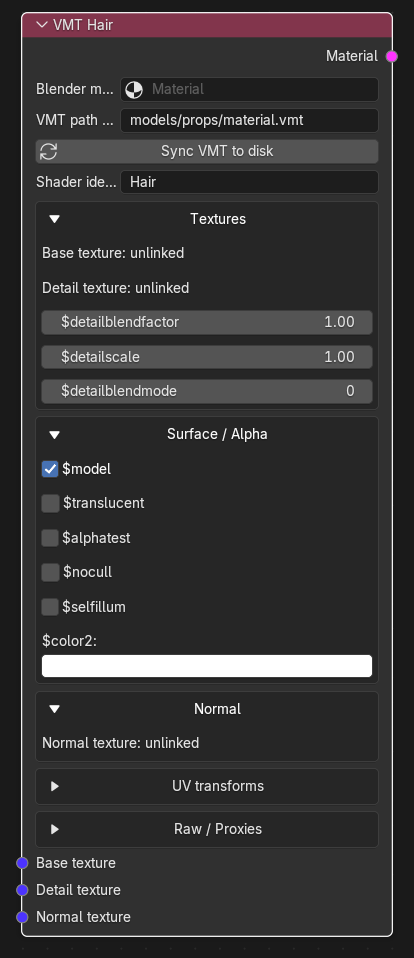
| Input | VMT parameter | Group | Purpose |
|---|---|---|---|
| Base texture | $basetexture |
Textures | Diffuse/albedo colour. Alpha is used by $translucent, $alphatest and, unless a mask is linked, by $selfillum. |
| Detail texture | $detail |
Textures | Secondary texture tiled over the base. Blended according to Detail blend mode, Detail blend factor and Detail scale. |
| Normal texture | $bumpmap |
Normal | Tangent-space normal map. Alpha can carry a specular/phong or envmap mask (see the PBR to Phong node). |
All inputs are VTF sockets (single link each, not multi-input) and are optional: an unconnected input simply omits its VMT parameter. Each one accepts the output of a VTF Output node. You can also drag a Texture socket straight onto one of these inputs; SourceIO then inserts a VTF Output node for you, named <vmt path without .vmt>_<suffix>.vtf (albedo for $basetexture, otherwise the parameter name without $) with Normal map (linear) enabled for $bumpmap/$normalmap. Any other link type is removed. At export, a linked input that does not resolve to a VTF recipe raises " must resolve to a VTF Output recipe".
| Output | Type | Description |
|---|---|---|
| Material | Material | The rendered VMT text plus every VTF it references. Connect it to the Materials multi-input of a Source 1 model output (many materials allowed), or to its Skin families input (SourceIO then inserts a Skin family node that lists this VMT's name). |
| Control | Meaning |
|---|---|
Blender material (mat) |
The Blender Material this VMT replaces. Required: the node raises "VMT requires a Blender Material binding" without it. Mesh slots that use this Blender Material are exported under this VMT's file name; a mesh slot whose Blender Material has no linked VMT node stops the export with "No linked VMT bound to ... slot". |
VMT path under materials (vmt_path) |
Output path of the .vmt, relative to the game's materials/ folder (default models/props/material.vmt). A leading materials/ and the .vmt extension are normalised; absolute paths, .., : and quotes are rejected. The file stem becomes the material name in the QC, and the folder is added to $cdmaterials automatically. |
| Sync VMT to disk (button) | Writes only this node's .vmt to the game root of every Source 1 model output the node feeds, without encoding textures (VTF paths are still referenced). Errors if the node is not connected to a model output. |
Shader identifier (shader_name) |
Shader name written as the VMT root block (default Hair). It is trimmed and must not be empty or contain quotes, braces or line breaks. Change it to the exact shader name your game or mod provides. |
Each group below is a collapsible box in the node. Textures, Surface / Alpha, Normal and Shader-specific start expanded, the rest start collapsed. Collapsing a group also hides that group's unlinked texture inputs, so open the group to see and connect them; linked inputs always stay visible.
Shows the link state of the texture inputs plus the detail controls:
| Control | Meaning |
|---|---|
$detailblendfactor |
Detail blend factor (default 1). Written only when it is not 1. |
$detailscale |
Detail texture scale (default 1). Written only when it is not 1. |
$detailblendmode |
Integer detail blend mode (default 0, the engine default). Written only when it is not 0; the meaning of each mode is defined by the Source engine. |
| Control | Meaning |
|---|---|
$model |
Written as "$model" "1" when enabled (default on). Required for materials used on models. |
$translucent |
Written as 1 when enabled. Alpha-blended transparency from the base texture alpha, so the base VTF needs an alpha-capable format (DXT5, RGBA8888, ...). |
$alphatest |
Written as 1 when enabled; pixels are cut out by alpha. |
$alphatestreference |
Only shown while $alphatest is on (0-1, default 0.5). Alpha cut-off, written as $alphatestreference. |
$nocull |
Written as 1 when enabled: draw both faces of every polygon. |
$selfillum |
Written as 1 when enabled: the surface glows independent of lighting. Uses the Self-illumination mask if linked, otherwise the base alpha (engine behaviour). |
$color2 |
RGB tint (0-1). Written as $color2 [r g b] only when it differs from white. |
Shows the link state of the normal-related texture inputs; it has no value controls.
One toggle per texture slot; when a toggle is on, scale, rotation and translation appear and the transform is written as center .5 .5 scale <sx> <sy> rotate <rotation> translate <tx> <ty> (the rotation value is written unchanged; VMT rotation is in degrees). Defaults: scale (1, 1), rotation 0, translation (0, 0).
| Toggle | Applies to |
|---|---|
$basetexturetransform |
Base texture |
$bumptransform |
Normal map |
$detailtexturetransform |
Detail texture |
| Control | Meaning |
|---|---|
Ordered raw VMT KV entries (raw_parameters) |
A Blender Text datablock whose content is KeyValues entries copied into the shader block verbatim and in order (duplicates and nested blocks are kept). Use it for any VMT parameter the node has no control for, e.g. "$surfaceprop" "metal". Parse errors abort the export; an entry that repeats a generated parameter (including a texture key of a linked input) is rejected as a conflict. |
Proxy KV entries (proxy_parameters) |
A Blender Text datablock holding entries for the Proxies block. Each entry must itself be a named KeyValues block (for example AnimatedTexture { ... }), otherwise the export fails with "Each Proxies entry must be a named KeyValues block". |
When a Source 1 model output builds the graph, this node produces one VMT: a "<shader>" block holding, in order, the texture parameters of linked inputs, then $model, $translucent, $alphatest, $nocull, $selfillum, $phong (those that are enabled), $alphatestreference, phong values, $envmap, $color2, the other typed parameters (detail, tint, UV transforms, shader-specific values), your raw entries and finally a Proxies block. The shader name is written in lower case. Parameters equal to their default are skipped so the file stays minimal. Every linked VTF is encoded by its VTF Output node and written to materials/<vtf path>.vtf next to the VMT under the model output's game root; two textures that map to the same path with different bytes, or two materials with the same VMT path and different text, abort the export.
Shader behaviour. Hair is a custom-shader template: it writes whatever shader identifier you type and the standard texture parameters, typically for a hair/anisotropic shader provided by a mod or a newer engine branch.
Texture and colour-space behaviour. No colour conversion by this node; VTF Outputs write pixels unchanged by default (no sRGB flag). Use a VTF Output with Normal map (linear) for the normal map.
- Set Shader identifier to the shader your target game provides (default
Hair). - Connect base, optional detail and normal textures; configure Surface / Alpha and UV transforms as needed.
- Choose the Blender material and VMT path, connect Material to the model output and export.
-
Hairis not a stock shader in every Source branch. The node does not check that the shader exists; a wrong identifier exports fine and fails in the engine. - Only the common typed controls are available (no Phong or Environment group); put shader-specific parameters in Raw / Proxies.
- The
$modelflag is written by default; turn it off only if your shader must not have it.