Repository navigation
Export Nodes SourceIOHeightToNormalNode
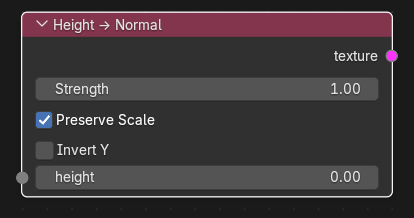
Generates a tangent-space normal map from a height (bump) channel using central differences.
| Input | Type | Description |
|---|---|---|
| height | Channel (single link) | Height field (0-1 floats, any size). Required (no constant). |
| Output | Type | Description |
|---|---|---|
| texture | Texture | RGBA normal map: RGB = encoded normal, alpha = 1. |
| Control | Meaning |
|---|---|
| Strength | Multiplier of the height slope (default 1; soft range 0-10). Higher = steeper bumps. |
| Preserve Scale | Default on. On: the slope vector (-dx * s, -dy * s, 1) is normalised to unit length (a regular normal map). Off: the un-normalised vector is encoded directly, so large slopes clip to 0/1. |
| Invert Y | Flips the green channel after encoding (default off). |
dx and dy are the central differences between the neighbouring pixels (half the difference of the previous and next pixel), wrapping at the image borders, so tileable textures stay seamless. With the Blender (bottom-up) row order this yields an OpenGL-style normal map (green = up). Source uses DirectX-style maps, so enable Invert Y (or use Normal Map Ops Flip Green) before exporting.
Texture operators are evaluated while the export graph is resolved (and by the Texture Preview node): upstream image sources are decoded to float arrays, the operator runs on whole images, and the result is passed on without being written anywhere. If an operator cannot produce a result (a required input is unlinked, sizes differ, wrong data type) the export stops with ": output is unavailable".
Image Source (height) -> Split Channels R -> Height -> Normal (Invert Y on) -> VTF Output (Normal map) -> VMT Normal texture.
To blend with a detail normal: Height -> Normal -> Blend Normals Detail.
- Wrap-around sampling creates a seam on non-tileable heightmaps.
- The height should be in the range of the original image: scaling the height with Math changes slope exactly like Strength.
- There is no 3x3 Sobel filter; very noisy height data produces noisy normals.