Repository navigation
Math Flocking
Birds, fish and chickens that copy their neighbours' headings move together; add noise and, past a threshold, they stop. The smallest model of that is Vicsek's (1995), and it is the engine of the Coop: every process is a chicken, every cgroup a flock, and the heading noise is driven by how erratic the process's CPU is and how stalled the machine is. This page states the Vicsek model precisely, places it among the other classic flocking models (Reynolds's boids, Couzin's zones, Toner and Tu's hydrodynamics), shows by simulation what its order parameter does at the sizes isotop uses, and says exactly where Coop and Reef depart from the textbook.
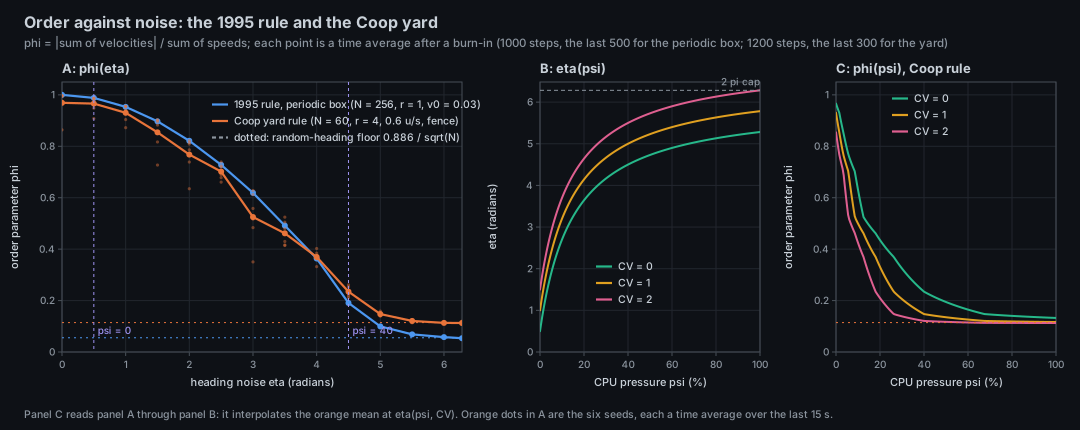
Panel A: $\varphi$ against $\eta$ for the 1995 rule on a periodic square (blue) and for the Coop yard's rule (orange). Panel B: the
noise coop/sim.rs assigns to a CPU pressure $\psi$ and CPU variation CV. Panel C: panel A read through panel B. Computed by
docs/figures/flocking-vicsek-order.py with the Python standard library; the yard series re-implements Yard::step
and follows the rule, not the Rust generator's bits.
The longer account lives in the repository: docs/theory/coop.md.
The pecking order. The earliest quantitative study of a group that orders itself is of hens. The Norwegian zoologist Thorleif Schjelderup-Ebbe described the dominance hierarchy of domestic fowl in his doctoral dissertation of 1921. Sources differ on whether his own word was Hackliste or Hackordnung; the English phrase "pecking order" is first recorded in a 1927 translation of a book by Friedrich Alverdes. Popular accounts have him keeping notebooks on his family's hens from the age of ten; the primary text was not checked for this page.
Boids. Craig Reynolds built his boids ("bird-oid objects") in 1986 and published "Flocks, herds and schools: a distributed behavioral model" at SIGGRAPH in 1987. Three local steering rules (separation, alignment, cohesion) were enough to make a computer flock look alive; the aim was animation, not measurement. The model was first used in the short Stanley and Stella in: Breaking the Ice (1987; one source says 1988) and, in modified form, for the bat swarms and penguin armies of Batman Returns (1992).
A phase transition. In 1995 Tamas Vicsek, Andras Czirok, Eshel Ben-Jacob, Inon Cohen and Ofer Shochet published a deliberately minimal model in Physical Review Letters: particles of fixed speed, each taking the mean heading of its neighbours plus noise. They reported a transition from disorder to collective motion as the noise fell. The result was surprising because the equilibrium XY model, which has the same alignment rule, cannot order in two dimensions (the Mermin-Wagner theorem). John Toner and Yuhai Tu explained in the same year, with a hydrodynamic theory, why moving particles escape the theorem. Later work on larger systems (Gregoire and Chate 2004; Chate and co-workers 2008) found that with angular noise the transition is in fact discontinuous, with travelling high-density bands near threshold: the continuous-looking transition of the small systems of the original paper is read as a finite-size effect.
Real birds. Couzin and co-workers (2002) gave agents concentric zones of repulsion, orientation and attraction and found swarm, torus and parallel-motion states. The StarFlag project reconstructed the three-dimensional positions of starlings over Rome, and Ballerini and co-workers (2008) concluded that each bird interacts with a fixed number of neighbours, about seven, rather than with all within a radius. Cavagna and co-workers (2010) measured scale-free correlations in the same flocks. The topological rule is why the Murmuration view aligns birds with their seven nearest neighbours.
The update is synchronous: every new heading is computed from the old state. The state of order is measured by
which is 1 when all particles move together and, for independent random headings, has expectation
The control parameters are the noise
The equilibrium XY model (spins on a lattice, aligning with neighbours) has the same alignment rule but, by the Mermin-Wagner theorem, no
long-range order in two dimensions at any non-zero temperature: thermal fluctuations of the Goldstone mode destroy it. The Vicsek flock does order in two dimensions. Toner and Tu (1995, 1998)
showed why with a hydrodynamic theory: the particles move, so the density and velocity fields are coupled by advection. In the form usually quoted, the velocity field
with a noise
- Boids (Reynolds, 1987) gave each simulated bird three steering rules applied to its neighbours: separation (steer away from crowding), alignment (steer towards the average heading), cohesion (steer towards the average position). It has inertia and individual forces rather than instant heading changes, and no noise term: the target was convincing animation.
- Couzin et al. (2002) put three concentric zones around each agent: repulsion (innermost), orientation, attraction (outermost). Varying the zone widths produces four collective states: a swarm, a torus (milling), dynamic parallel motion, highly parallel motion, with hysteresis between them.
- Metric versus topological interaction. Ballerini et al. (2008) found that starlings in large flocks keep interacting with a fixed number of nearest neighbours (about seven), whatever the distance, rather than with all neighbours within a radius. Cavagna et al. (2010) measured scale-free correlations in such flocks. The Murmuration view uses seven-neighbour alignment for that reason.
Foragers are the chickens that are not roosting, feeding, brooding, waiting, frozen, stuck or zombie (Role::Foraging). One step, FixedStep::new(H, MAX_STEPS = 10, MAX_GAP = 0.5), so the frame rate does not change the dynamics):
- Every chicken draws a kick once per step whatever it is doing,
rng.signed() * 0.5(uniform in $[-\tfrac12, \tfrac12)$), so the draws never depend on update order. A forager's new heading isatan2of the sum of unit headings of same-flock foragers withinNEIGHBOURHOOD = 4.0units (itself included), found through a spatial hash and summed in identity order, pluschicken.noise * draw: exactly the 1995 kick of width$\eta$ =noise. - Three extra terms are added to the vector sum before the angle is taken: a peer pull, for each socket peer
$k$ that is also foraging,$w,(\cos\theta_k + \tfrac12\hat{\mathbf u}_{ik})$ ; a home pull of$0.6\min((d - \text{range})/4, 1)$ towards the henhouse when the chicken is farther thanhome.rangefrom it; and a flee push of$1.5,(1 - d/6)$ away from every fox eye within 6 units. - All headings are applied together, then positions advance by
speed * halong the new heading. Speed is per chicken:$v = 0.6 + 3.4,c/(c + 25)$ units per second for CPU$c$ percent. - A Jacobi separation pass pushes overlapping bodies apart (a forager against a forager shares the overlap; against a planted or walking chicken it takes all of it), then
confinepushes foragers out of house footprints and reflects them off the fence.
The noise has three parts, summed and capped at a full turn:
with some average over 10 s, percent). A steady, unloaded machine (flocks_order_at_low_noise_and_dissolve_past_critical_noise (60 foragers:
Differences from the 1995 model, all visible in the figure. (a) The fence reflects rather than wraps. (b) Yard::order; the original port of tfpickard/chicken summed speed magnitudes and was always 1). (e) Flocks do not interact in the alignment rule, only through separation, so the yard is many independent flocks.
For the 1995 rule on a
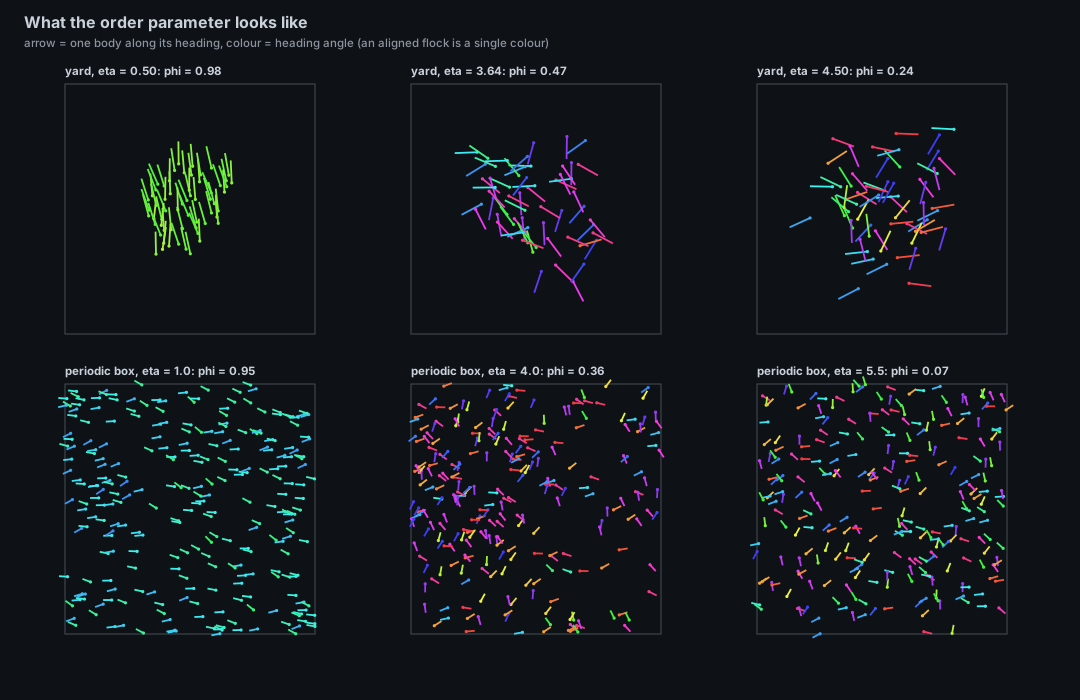
Top: the yard rule at $\eta = 0.5, 3.64, 4.5$ after 60 s; bottom: the periodic box at $\eta = 1, 4, 5.5$. Colour is heading angle, so an aligned flock is one colour. Script: docs/figures/flocking-snapshots.py.
Fish of one habitat form a school steered by three terms per frame: a pull towards the school's wandering target (0.4 times the offset), a separation push dt in Reef::draw), rather than a fixed clock, so the school's path depends on the frame rate.
The Murmuration view (Murmuration) uses the topological rule: one bird per thread, Flock stepped at a fixed 20 Hz (STEP = 0.05, through FixedStep), neighbours found with SpatialHash3::nearest. Alignment (ALIGNMENT = 0.30) pulls a bird's velocity towards the weighted mean velocity of its NEIGHBOURS = 7 nearest, with same-process neighbours counting double; cohesion (COHESION = 0.02) pulls it towards the centroid of its FAR_NEIGHBOURS = 21 nearest; separation (SEPARATION = 0.4 inside SEPARATION_RADIUS = 1.5) pushes close neighbours apart; a roost and a falcon complete the forces. The comments in the source record three failures of the prototype that bear on this page: a per-process centroid pull of 0.0012 or more splits the flock into balls (so FLOCK_PULL = 0.0006 pulls only the whole flock in); cohesion over only seven neighbours lets closed groups of eight split off as islands (hence 21); and a vertical damping of 0.22 flattens the flock into a pancake (VERTICAL_DAMPING = 0.10). The flock is thinned to BIRD_CAP = 8000 birds. Unlike Coop it has no order parameter in its legend.
-
Measured: which chickens belong to which flock (cgroup), their speed (CPU), their noise (CPU variation and system pressure), their pull (socket traffic or co-activity). Derived: the headings, which are the output of the dynamics and not data;
$\varphi$ is a derived order of that simulation. - A coherent flock means the noise inputs are low, not that the processes are doing the same thing: the headings are made up. The picture is an indicator of CPU stability (low CV) and low CPU pressure in disguise.
-
$\varphi$ in the legend is for the whole yard: with many flocks pointing in unrelated directions it is small even when each flock is perfectly ordered (the testchickens_align_only_with_their_own_flock: two flocks, each 0.98, yard under 0.2). The inspector gives the per-flock value. - With
$N$ foragers the floor is about$0.886/\sqrt N$ ; a flock of four can show$\varphi \approx 0.4$ by chance.
./target/release/isotop --demo --view coop --width 1600 --output /tmp/coop.png --renderer cpu
python3 docs/figures/flocking-vicsek-order.py      # about five minutes; deterministic
python3 docs/figures/flocking-snapshots.py
In a live coop (--view coop) select a chicken: the inspector line flock X: phi ... (N foraging) is the per-flock order.
-
src/coop/sim.rs:Yard::step,separate,confine,order,flock_orders,noise,speed,peer_weight;src/coop/roles.rs:variation; constantsNEIGHBOURHOOD,ETA_BASE,K_CV,K_PSI,PSI_KNEE,V_MIN,V_SPAN,SPEED_KNEE,FLEE,H. Tests:vicsek_step_does_not_depend_on_update_order,order_parameter_is_the_magnitude_of_the_summed_velocity,flocks_order_at_low_noise_and_dissolve_past_critical_noise,chickens_align_only_with_their_own_flock,flock_follows_the_same_path_at_ten_and_sixty_frames_per_second. -
src/simulation.rs:SpatialHash,Rng,FixedStep.src/reef.rs:Reef::school. - Figure scripts:
docs/figures/flock_sim_w6.py(both simulations),flocking-vicsek-order.py,flocking-snapshots.py.
-
Locate the crossover. Sweep
$N$ and$v_0 h/r$ for the yard rule and extract a Binder cumulant. At isotop's sizes is there any finite-size scaling to find? - Topological Coop. Replace the radius by the 7 nearest same-flock chickens. Does the crossover move?
- Vectorial noise. Add the noise to the vector sum and compare the two curves, after Chate et al. (2008).
- Reef with a radius. Give the school a neighbourhood and a noise term, and let the order parameter come out of the same legend line.
- Order as a measurement. Is there a quantity in the system (not the noise inputs) that the heading order could be made to measure? Currently it measures nothing about the processes beyond its inputs.
-
Rank without fights. Schjelderup-Ebbe's hens settled their order by early contests and kept it by memory; Coop queues chickens at a feeder by scheduling priority, which is settled by
nice(1)and kept by the kernel. Is a hierarchy that no one had to fight for still a pecking order?
- T. Vicsek, A. Czirok, E. Ben-Jacob, I. Cohen and O. Shochet, "Novel type of phase transition in a system of self-driven particles", Physical Review Letters 75 (1995), 1226-1229.
- G. Gregoire and H. Chate, "Onset of collective and cohesive motion", Physical Review Letters 92 (2004), 025702.
- H. Chate, F. Ginelli, G. Gregoire and F. Raynaud, "Collective motion of self-propelled particles interacting without cohesion", Physical Review E 77 (2008), 046113.
- F. Ginelli, "The physics of the Vicsek model", The European Physical Journal Special Topics 225 (2016), 2099-2117.
- J. Toner and Y. Tu, "Long-range order in a two-dimensional dynamical XY model: how birds fly together", Physical Review Letters 75 (1995), 4326-4329; and "Flocks, herds, and schools: a quantitative theory of flocking", Physical Review E 58 (1998), 4828-4858.
- C. W. Reynolds, "Flocks, herds and schools: a distributed behavioral model", Computer Graphics (SIGGRAPH '87) 21(4) (1987), 25-34.
- I. D. Couzin, J. Krause, R. James, G. D. Ruxton and N. R. Franks, "Collective memory and spatial sorting in animal groups", Journal of Theoretical Biology 218 (2002), 1-11.
- M. Ballerini et al., "Interaction ruling animal collective behavior depends on topological rather than metric distance: evidence from a field study", Proceedings of the National Academy of Sciences 105 (2008), 1232-1237.
- A. Cavagna et al., "Scale-free correlations in starling flocks", Proceedings of the National Academy of Sciences 107 (2010), 11865-11870.
- See also View Coop, View Reef, Murmuration, Math Spatial Hashing, Theory Simulation Toolkit.