Repository navigation
View Horizon
The OOM killer drawn as a Schwarzschild black hole: a round black shadow with a thin bright photon ring, an accretion disk whose far side is bent up over the top of the shadow and whose underside shows as a second arc below it, and processes riding circular orbits in the disk, ranked by oom_score, with the next victim on the innermost stable circular orbit and the processes the kernel never kills far out. When the kernel's OOM kill counter rises and a process vanishes, the victim leaves the ISCO, spirals in, stretches, reddens and dims, and freezes and fades short of the horizon instead of crossing it, as a distant observer would see it. The geometry is derived on Math Schwarzschild; this page says what the code draws, and what "memory pressure" can and cannot be in such a picture.
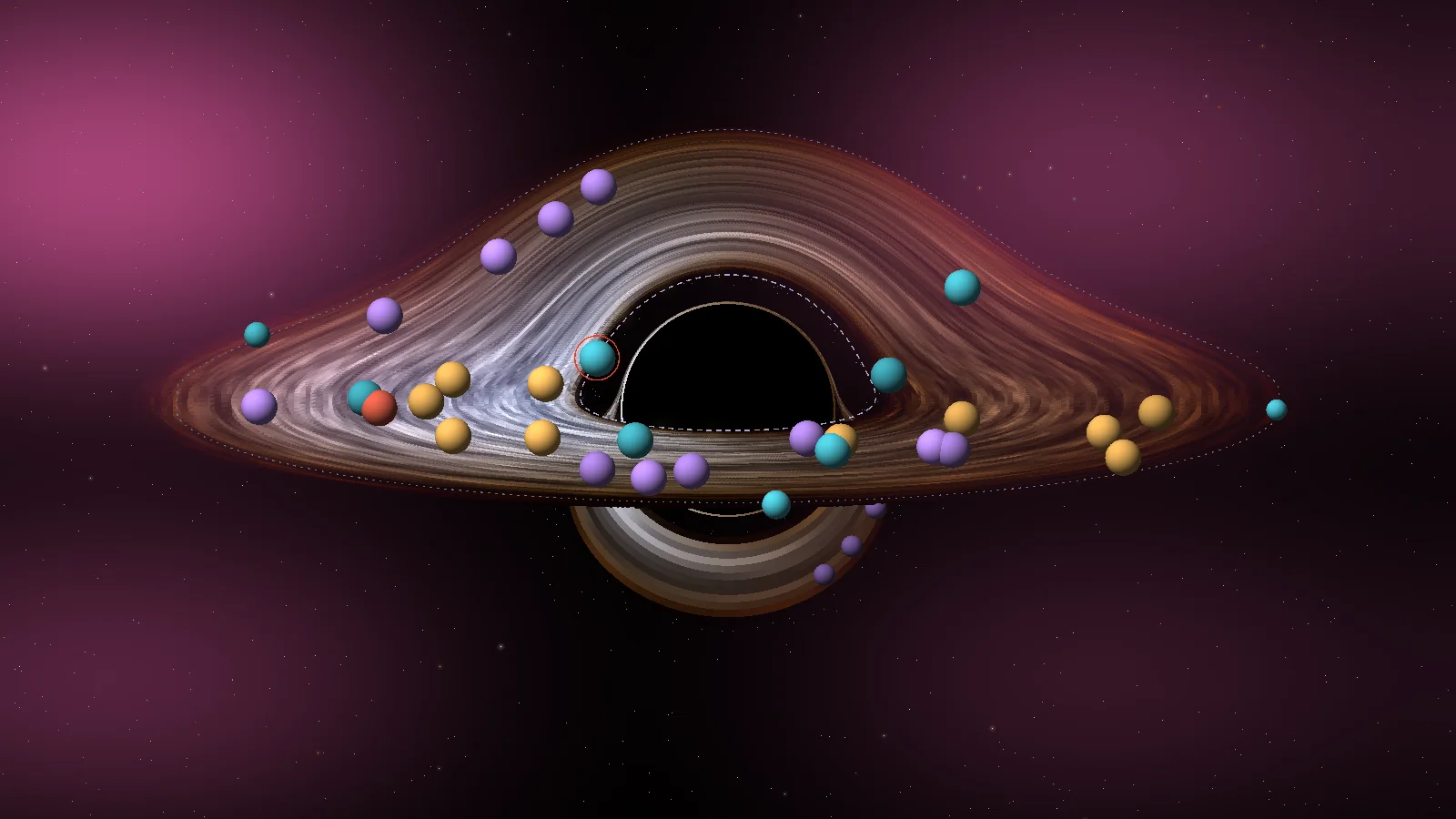
The README image of the view (docs/media/horizon.webp), rendered from the demo workload.
A Schwarzschild black hole is the simplest one: no spin, no charge, a horizon at
Why a black hole for the OOM killer. Linux can promise more memory than it has. When allocation fails and reclaim cannot help, the kernel's out-of-memory killer scores the processes with a badness heuristic (/proc/<pid>/oom_score, roughly each process's share of memory in thousandths, shifted by oom_score_adj) and kills one; a process with oom_score_adj of -1000 is exempt. The structure maps well: a ranking by how likely each process is to be consumed, an inner edge where the next victim sits, and an event from which nothing comes back. It is a metaphor, and the sections below say which parts carry data.
The longer account lives in the repository: docs/theory/horizon.md.
Dark stars. The idea that something could be too heavy for light to leave is older than relativity. In 1783 John Michell, and in 1796 Pierre-Simon Laplace, reasoned with Newtonian gravity and light as fast particles: enough mass packed into a small enough radius has an escape velocity above
Schwarzschild. Einstein published the field equations in November 1915. Within weeks Karl Schwarzschild, serving in the German army on the Russian front, found the exact solution for the space around a non-rotating mass and sent it to Einstein. He died of an autoimmune disease in May 1916. For decades the surface at
Collapse. In 1939 Robert Oppenheimer and Hartland Snyder computed the collapse of a pressureless cloud and found both pictures at once: the infalling matter reaches the centre in finite proper time, while a distant observer sees it slow and freeze at the horizon. That is the plunge this view draws. The phrase "black hole" was popularized by John Wheeler in a 1967 lecture, replacing "gravitationally completely collapsed object".
Disks. Matter falling into a compact object has angular momentum and settles into a disk. Shakura and Sunyaev (1973), Novikov and Thorne (1973) and Page and Thorne (1974) worked out what a thin relativistic disk radiates, and Cygnus X-1, a bright X-ray binary, became the first strong black-hole candidate in the early 1970s.
Pictures. In 1978 the French astrophysicist Jean-Pierre Luminet computed what a thin disk around a Schwarzschild hole looks like to a distant observer, on an IBM 7040 at the Paris-Meudon Observatory. The machine had no display, so he plotted the picture by hand with India ink, putting dots more densely where the numbers were brighter. It was published in 1979 and contains the crescent-and-ring structure this view reproduces. The Event Horizon Telescope imaged the shadow of M87* in 2019 and of Sagittarius A* in 2022.
The OOM killer. Each Linux process has an oom_score, higher meaning likelier to be chosen, and the administrator can bias it with oom_score_adj, from -1000 (never kill) to +1000. That interface arrived in Linux 2.6.36 (2010) in place of the older, coarser oom_adj, which was a power-of-two bit shift. The ranking this view draws is a policy that kernel developers chose and have revised.
Units are M below). The horizon is at
A massive particle in the Schwarzschild metric obeys
with conserved energy
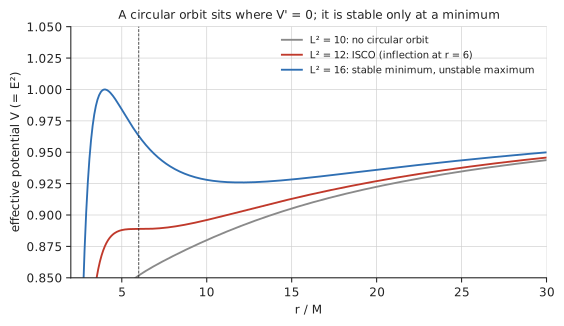
The effective potential for three angular momenta. For $L^{2} = 16$ there is a stable minimum and an unstable maximum; as $L^{2}$ falls to 12 they merge into the inflection at $r = 6$. From the repository's theory page.
Photons follow null geodesics. With
(Newtonian light would have no right-hand side and run straight). A photon reaching a distant observer with impact parameter lens::SHADOW_RADIUS): below it the photon crosses the horizon, above it the photon turns and escapes. The disk of
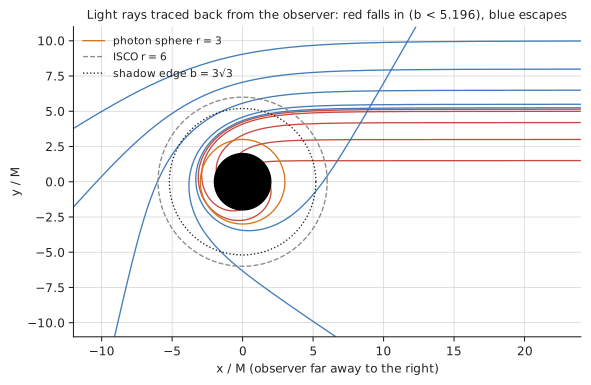
Photons traced back from a distant observer on the right (the same equation and Runge-Kutta step as lens::trace_photon): below $3\sqrt3$ they spiral into the horizon, above it they are bent and escape. From the repository's theory page.
For a thin disk in the Novikov-Thorne model the flux at radius lens::flux evaluates a closed form after Luminet (1979) derived from the Page-Thorne integral. Light from a patch at radius
where the first factor is gravitational redshift plus the transverse Doppler effect of the orbit, the second the line-of-sight Doppler shift, DISK_KELVIN, KELVIN_EXPONENT; the exponent widens the colour ramp and is stylised).
The coordinate-time angular velocity of a circular orbit is M_PER_SECOND), so a body on the ISCO goes round in 9.2 s and one at the outer edge of the ranked disk (
For a body leaving the ISCO the coordinate time PlungeTrack::seen_at): the displayed light falls by a factor of lens::PLUNGE_FLOOR = 2.0006 is the radius where the drawn image stops.
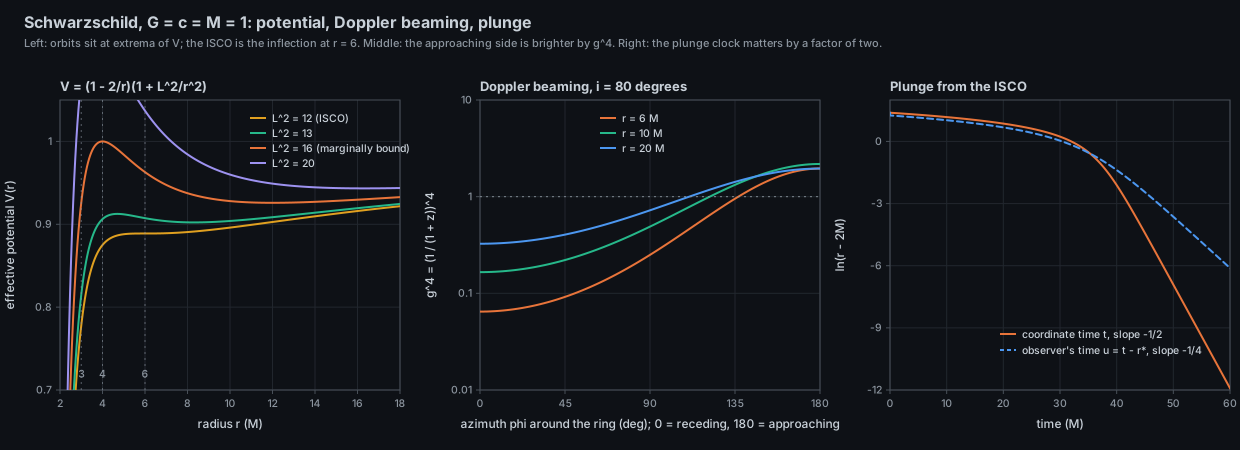
Left: $V = (1-2/r)(1+L^{2}/r^{2})$. Middle: relative intensity $g^{4}$ around a ring at $i = 80^{\circ}$ (no light bending). Right: the plunge from the ISCO ($L = 0.95,L_\mathrm{isco}$, kick 0.1): $\ln(r - 2M)$ falls with slope $-1/2$ in Schwarzschild time and $-1/4$ in the observer's retarded time. Script: docs/figures/horizon-potential-redshift-plunge.py.
| Visual element | Measured quantity (source) | Transform |
|---|---|---|
| Orbit radius of a process | rank by oom_score among processes that are not kernel threads or zombies, with a readable score (Source::Oom); ties by Identity
|
the top 28 ranks (RANKED) sit at SWAP_MARGIN); the radius eases with a 1.5 s time constant, at most 2 M/s |
| Unkillable band |
oom_score_adj of -1000 |
radius from the identity hash between 25.7 and 27.3 M (BAND), at most 12 drawn, labelled unkillable
|
| Orbital phase and speed | none: the true law, decoration |
Rng::for_identity
|
| Body size | Process.memory |
radius |
| Body colour | Process.kind |
palette::kind_color |
| Next victim's ring | rank 0 | a red ring of 28 hairline segments round the body, colour (235, 60, 30) |
| Disk brightness | memory pressure Snapshot.pressure[1] (10 s average) |
gain |
| Disk colour and brightness pattern | the physics of the metric |
blackbody::color at |
| OOM kill |
Snapshot.oom_kills (oom_kill in /proc/vmstat), else the sum of Unit.oom_kills over cgroups |
a rise of the counter claims the best-ranked ghost that vanished within GHOST_WINDOW (2.5 s) + BACKGROUND_PERIOD (2 s) + one sample interval |
| Plunge | the claimed kill | eases to the ISCO in 0.8 s, then follows PlungeTrack ( |
| Other exits | exit with no counter rise | the body fades where it stood over 1.2 s (FADE_SECONDS) |
| Inclination | the camera's pitch | 86 degrees at the lowest pitch, 80 at the default isometric pitch, 0 (face-on) at top-down, linear between |
| Disk texture, glares, 1,500 stars, the photon ring, the shadow, the dashed ISCO and band guides | none | decorative (the ISCO and band guides are positions of the true orbits, but carry no per-process data) |
Modules. src/horizon.rs holds Horizon (the ViewModule: Roster, the inclination map, drawing order, legend, popup lines); src/horizon/lens.rs is pure physics with no drawing (LensTable, Observer, flux, one_plus_z, disk_emission, angular_velocity, period, PlungeTrack, plunge_brightness); src/horizon/orbits.rs is the population without drawing (Ranking, Orbits, Ghost, rank_radius, band_radius); src/horizon/disk.rs cuts the disk, sky, shadow and ring into triangles. The registry row sets links: LinkRule::DrawnByView (no sockets are drawn), flash: false (the view draws its own exits, so the scene's expanding ring would say it twice), sources: Sources::of(&[Source::Oom, Source::OomKills]) (scores and the counter are read only while the view is shown), Backdrop::Void, demo options oom_and_memory_detail, kernel_counters and oom_cycle, and a headless warm-up that replays 8 s of demo samples. No keys, no digit. There is no plugin system: the view is compiled in.
Lensing is done on vertices, not pixels. LensTable::shared (built once, on first use, about a fifth of a second on every core in a release build) traces about 1,800 photon paths backwards from the observer by fourth-order Runge-Kutta on the orbit equation at RADII, from 2.0005 to 150) it records the sweep at which each photon crosses that radius, inbound and, for photons that turn, outbound; inverting that gives the impact parameter of the ray that joins a disk point at radius disk.rs then draws ordinary triangles between the images of mesh vertices, so the CPU and GPU rasterizers draw the same frame. The primary image agrees with Beloborodov's closed form (2002) to a few percent at
The disk. Facets of about 4 px (FACET_PIXELS), the secondary image at half the density (its sides longer by TRIANGLE_CAP); relensed only when the inclination or scale changes and recoloured every frame. The disk runs from the ISCO (DISK_INNER 6) to 30 M (DISK_OUTER) and is tapered to nothing over its last 10 M (disk_flux). Draw order, back to front: sky, secondary image, shadow (a fan of radius NONE), photon ring, primary image, the dashed guides, glares, the bodies. The photon ring is a drawn annulus from RING_OFFSET 0.07, RING_WIDTH 0.10, never thinner than 1.5 px), coloured and brightened by the Doppler and gravitational shift of matter at 7 M (so brighter and bluer on the approaching side), not a computed image of the photon sphere: the true ring is the infinite series of higher-order images, each narrower than the last by roughly
Rank, not value, sets the radius. orbits::Ranking orders processes by oom_score and rank_radius spaces the ranks, so the kernel's absolute scale does not matter and the radius is a chosen function, not a measurement. Two bodies at 6 M and 7.25 M may differ by one point or by hundreds.
A kill needs corroboration, and the victim is inferred. The counter says that a kill happened, never whose. A plunge starts when the counter rises and a process vanishes near it in time. The counter reaches the frame loop from the background thread, so the exit and the rise may land in different samples: Orbits::classify keeps vanished processes as fading ghosts and matches a rise before or after an exit within claim_window(); the best-ranked ghost in that window becomes the victim, so an unrelated exit close to a real kill can be the one shown plunging. A process that exits with no rise does not plunge. A restart of the counter cannot flood the ghosts: one sample adds at most 8 rises (MOST_RISES).
Camera. Pitch maps to inclination (inclination); camera rotation shifts the disk's azimuth; zoom sets pixels per
Demo kill cycle. DemoOptions::oom_cycle runs a 30 s cycle: worker-134 has score 950 and is the next victim, exits at 20 s into the cycle (the demo oom_kill counter rises then) and starts again at 26 s (DEMO_KILL_PERIOD, DEMO_KILL_AT, DEMO_RESPAWN_AT in src/model.rs).
Inspector and labels. The popup of a body shows oom_score N | oom_score_adj N, rank R of K (or unkillable: the kernel never picks it) and orbit r = X.XX M | period P M (S s). The five best ranks and one unkillable body are labelled; the tour visits bodies best-ranked first.
Legend. next victim NAME SCORE, then | oom_kill N (vmstat) or (cgroups) when a counter exists, with status::missing_note wording appended while it applies (no oom score: ranked by memory footprint, no oom kills: exits not classified or kills counted from cgroups, no memory pressure: disk at its base brightness, | N unranked), then | orbit radius = oom_score rank (ISCO 6M = next victim) | disk brightness = memory pressure | colour = Doppler + gravitational redshift | far orbit = oom_score_adj -1000 | i = 80 deg (the inclination in degrees).
Platforms. Linux: full. A process whose score cannot be read is excluded and counted as unranked. macOS has no oom_score: the sampler offers jetsam priorities only as root, and a score without an adjustment is not treated as a Linux score, so the roster is ranked by memory footprint, there is no unkillable band, and without a kill counter no exit is classified as a kill (all fade). The lensing, disk and pressure still work. This was read from the code; it was not run on a Mac.
-
Measured: the ranking by
oom_score, memory pressure, the existence and time of an OOM kill (to the counter's resolution), process memory and kind. - Derived from the metric, not measured: the shape of the disk, the shadow, the doubled images, the Doppler brightening and every colour in the disk. They are the correct pictures of an imagined disk and carry no information about the machine. The texture and glare are decorative.
- Radius is rank. A body at 6 M has the highest score, not a score of any particular size.
-
The victim is an inference. The ISCO process is the kernel's likeliest victim by its own heuristic; the real victim may differ (cgroup-level kills,
oom_score_adjchanged since,oom.group). When the counter rises and the best-ranked ghost plunges, the view asserts a match that the counter alone does not prove. - Freezing is the observer's view. The process stopped existing at once; the dimming time is not a property of the kill.
-
The ring is a drawing, the shadow is exact (radius
$b_c$ for a Schwarzschild hole). Nothing spins, so there is no frame dragging. - Brighter and bluer on the left. The matter on that side approaches (the disk turns counterclockwise as seen from above). The disk wraps over the top of the shadow even at 80 degrees inclination: that is the primary image of the far side, not a drawing error.
- Resolution. At most 28 ranked bodies (plus up to 12 in the band) are drawn.
Run here with the release binary (Linux, CPU renderer):
./target/release/isotop --demo --view horizon --time 12 --width 1600 --output /tmp/horizon.png --renderer cpu
./target/release/isotop --demo --view horizon --time 20.5 --width 1600 --output /tmp/plunge.png --renderer cpu
./target/release/isotop --demo --view horizon --width 1600 --renderer cpu --benchmark 30
Output of the first: Wrote /tmp/horizon.png (1600x900, 31 visible); the second wrote the same line for plunge.png (the frame is the plunge in progress; I did not inspect it frame by frame). The benchmark printed 30 frames | 1600x900 | 31 visible | 38.07 ms/frame | 26.3 renderer fps on cpu (excludes terminal transport), measured on a shared sandbox while other builds were running, so read it as an upper bound. Live: ./target/release/isotop --view horizon or Tab and the v picker (the sixteenth row, no digit). Not run: --renderer gpu, and any macOS run.
| Item | Path and symbol |
|---|---|
| The view |
src/horizon.rs: Horizon, inclination, roster, kill_counter, body_radius
|
| Physics |
src/horizon/lens.rs: LensTable, Observer, flux, disk_flux, one_plus_z, PlungeTrack, plunge_brightness, beloborodov_impact_parameter
|
| Population |
src/horizon/orbits.rs: Ranking, Orbits, Orbits::classify, rank_radius, band_radius
|
| Mesh |
src/horizon/disk.rs: Disk, Turbulence, SkyField, draw_shadow, draw_ring
|
| Registry row |
src/views.rs: REGISTRY row horizon
|
| Sources |
Source::Oom, Source::OomKills; platform/linux/memory.rs, platform/linux/counters.rs
|
| Repository theory page | docs/theory/horizon.md |
| Prototype (reference only) | docs/mockups/code/horizon.py |
-
A trap in the prototype. The Python prototype's
page_thornewrites the coefficient of the logarithm as$\sqrt3/3$ ; integrating the Page-Thorne expression directly gives$\sqrt3/2$ . With$\sqrt3/2$ the flux peaks near$9.55,M$ and is proportional to the integral; with$\sqrt3/3$ it peaks near$8.4,M$ and rises linearly from the ISCO instead of quadratically.lens::fluxuses$\sqrt3/2$ , pinned by a test against the integral. -
Departures from the roadmap design. The design specified a plunge clock without choosing; the code chose the observer's retarded time, so the light falls by
$e$ every$4,M$ . The design'sStage.own_exitsflag does not exist: the row'sflash: falsedoes that job. The design's unkillable band at golden-angle phases is a radius from an identity hash. -
Kerr. A spinning hole moves the ISCO from
$6M$ to$M$ (maximal, prograde) and shifts and flattens the shadow. A spin taken from, say, the hottest process's CPU would be arbitrary, which is exactly the problem. -
A real tidal stretch. The victim is stretched by a stylised streak; the geodesic-deviation stretch
$2GM\ell/r^{3}$ could set its length, so larger processes would stretch more. -
Hawking radiation. A black hole's temperature falls as
$1/M$ ; a hole that shrinks as it eats, with the memory freed by the kill as the analogue, is a different model. Nothing here does it. - Time to OOM. The trend of the pressure could predict the next kill and move the victim from the ISCO towards a marginally bound orbit as it rises.
-
Photon ring images. Draw the first higher-order image at its true
$b$ and width from the lens table instead of the annulus. - One kill, four renderings. This view draws an OOM kill as a plunge that never arrives; View Necropolis records it as a stone with a cause of death; View Coop sends a fox; View Cortex shows dust.
- J.-P. Luminet, "Image of a spherical black hole with thin accretion disk", Astronomy & Astrophysics 75, 228 (1979).
- D. N. Page and K. S. Thorne, "Disk-accretion onto a black hole. I. Time-averaged structure of accretion disk", The Astrophysical Journal 191, 499 (1974).
- A. M. Beloborodov, "Gravitational bending of light near compact objects", The Astrophysical Journal 566, L85 (2002).
- O. James, E. von Tunzelmann, P. Franklin and K. S. Thorne, "Gravitational lensing by spinning black holes in astrophysics, and in the movie Interstellar", Classical and Quantum Gravity 32, 065001 (2015).
- The Event Horizon Telescope Collaboration, "First M87 Event Horizon Telescope results. I. The shadow of the supermassive black hole", The Astrophysical Journal Letters 875, L1 (2019).
- C. W. Misner, K. S. Thorne and J. A. Wheeler, Gravitation, W. H. Freeman (1973).
- The Linux kernel documentation for
/proc(oom_score,oom_score_adj) and/proc/vmstat(oom_kill). - See also Math Schwarzschild, Theory Background Sampler and Demand.