Repository navigation
View Necropolis
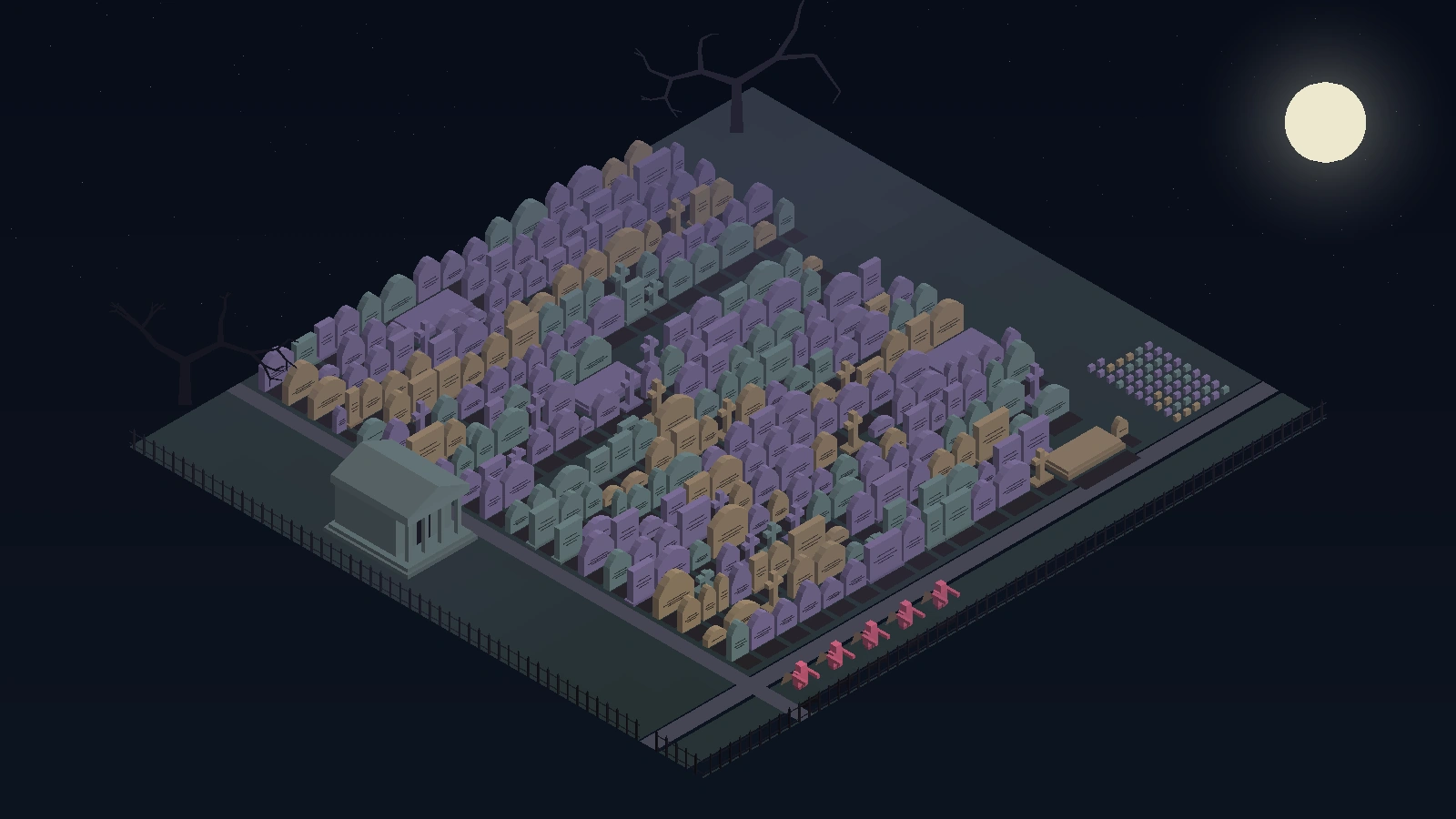
A moonlit cemetery of exited processes. Each death becomes a headstone in the row of its UTC minute, the newest row in front and the older ones receding into fog. A stone's height is the process's lifetime CPU time and its width the most memory it ever held; its tint is its kind; its epitaph (on hover or click) says how it died. Zombies stand in open pits in front, waiting to be reaped; a service whose processes are all gone gets a mausoleum; a ghost rises over a grave when a new process takes the buried pid; the fog thickens with memory pressure; and the moon is the real moon, its phase computed from the date. It is the view about what survives a process's death, and how little.
How a Unix process dies. A process ends with exit(status) or is killed by a signal; the kernel stores a 16-bit wait status (the low 7 bits are the signal that killed it, bit 7 says it dumped core, bits 8 to 15 are the exit code) and leaves a zombie, a table entry with nothing in it but that status, until the parent calls wait
(the parent reaps it). Between exit and reap the process is state Z. If the Linux OOM killer chose it, the signal is SIGKILL and the cgroup's oom_kill counter rises. Beyond the wait status, the kernel's accounting interface (taskstats) can deliver a record at exit with the process's elapsed time, CPU time, peak resident memory, I/O bytes, context switches and a flag
for "forked and never exec'd" (AFORK). The Linux process connector delivers fork, exec and exit events (with the status) as they happen; neither needs polling, though both need privilege, and on macOS only kqueue exec and exit events and sample diffing exist.
Why a graveyard. Process monitors show the living. The dead are the process table's negative space: every process that ever existed left a short record or nothing at all, and the rate of death, the mass deaths of a build job's children, the OOM kills and the services that stopped altogether are the machine's history. A cemetery has the right structure for it: a place for each death by when it happened, families together, a building for a whole dynasty, and the unmarked graves of those too short-lived to be recorded.
The longer account lives in the repository: docs/theory/necropolis.md.
Necropolis is Greek for "city of the dead", and the oldest were laid out as cities for the reason cities are: the dead were a community the living meant to stay in relation to.
The Valley of the Kings. For roughly five centuries of the New Kingdom (about 1539 to 1075 BCE) the pharaohs were buried in rock-cut tombs in a wadi on the west bank at Thebes, across the Nile from the living city. The move away from pyramids was a bet on concealment, and mostly lost: nearly every tomb was robbed in antiquity. Tutankhamun's, KV62, survived largely by accident, buried under rubble from later digging; Howard Carter's team found its steps in November 1922. KV5, the tomb of the sons of Ramesses II, was noted in 1825, but its extent (well over a hundred chambers) was established only by Kent Weeks's team from 1995.
Banditaccia, Cerveteri. An Etruscan city of the dead laid out as a city, with streets and squares, from the ninth century BCE to about the third. Many of its tumuli imitate the interior of a house, with carved beams, couches and hearths. The name does not refer to bandits; it is said to come from the bando, the lease under which landowners let ground to families for burials.
Pantalica, Sicily. A limestone plateau pierced by thousands of rock-cut chamber tombs, most from the thirteenth to the seventh century BCE. The traditional count is over 5,000; the most recent estimate is just under 4,000.
The Alyscamps, Arles. A Roman burial road that became a Christian pilgrimage cemetery, and which Van Gogh and Gauguin both painted in 1888. Cairo's City of the Dead (the Qarafa) is a necropolis people live in.
Brookwood, Surrey. London's churchyards were full and dangerous, so a private company laid out a vast cemetery 25 miles out in 1852 and ran the dead there by rail. The London Necropolis Railway ran its first funeral train in November 1854, from a private terminus near Waterloo, with coffins and mourners in separate classes of carriage. A German bomb destroyed the terminus and its rolling stock on the night of 16 April 1941, and the line never reopened. The cemetery still takes burials. Glasgow's Necropolis (1833) and Pere Lachaise in Paris (1804) belong to the same movement, the garden cemetery.
What these share is the design problem the view inherits: a place that has to index the dead (who, when, how, how big a life) so that someone can find one again.
A running process holds as many bits as it has resident memory: at most ExitRecord: a command name, a start time, elapsed time, CPU time, peak RSS, bytes read and written, two context-switch counts, the AFORK flag and a thread count, about 80 bytes. Everything the cemetery draws is a function of those few hundred bits and of the last observed name, kind, cgroup and parent.
The compression from the live image to the record is a factor of
The picture then compresses that again. The stone's height
A sampler that looks every
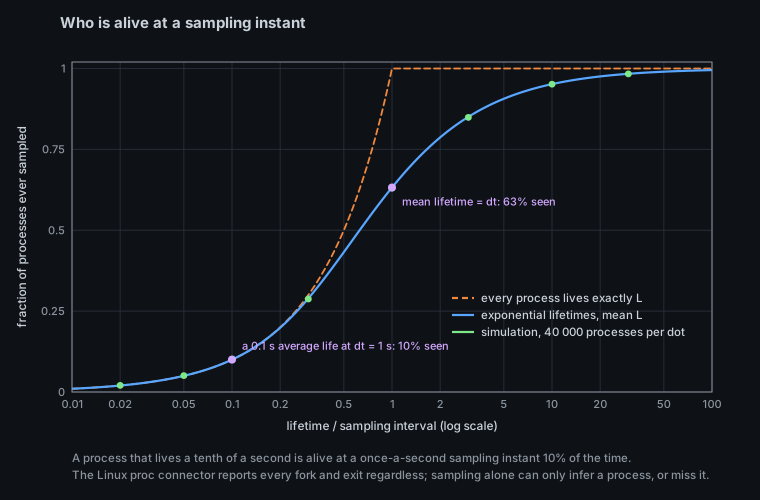
Probability that a process is ever sampled, against lifetime over sampling interval (figure from Theory Life Events).
Pids are allocated by a counter that wraps at pid_max (32 768 by default on many systems, larger on recent ones). A pid is reused only after the counter has gone round, so a ghost appears when a machine creates more than pid_max processes while the grave stands: at 1000 forks per second and a 32 768 limit, about once every 33 s. Identity in isotop is the pair (pid, start time), so the reused pid is a different
process, and the grave remembers the old one.
The moon is computed from the clock and, when the machine's place is known, from where it stands on the earth. lunar::Moon::at takes the Astronomical Almanac's low-precision series for the sun's and the moon's ecliptic longitude, the moon's ecliptic latitude and its horizontal parallax (six, four and four periodic terms), and from them:
-
The phase. With
$\psi$ the angle between the moon and the sun,$\cos\psi = \cos\beta,\cos(\lambda_\text{moon} - \lambda_\text{sun})$ , the lit fraction of the disc is$f = (1 - \cos\psi)/2$ and the moon is waxing when its longitude is east of the sun's. A new moon is when the longitudes meet, so$f$ at the instant is not quite 0 (up to$\beta^2/4 \approx 0.002$ ) and a full moon is not quite 1;Moon::phasenames the state ("new moon" below 1 % lit, "full moon" above 99 %, quarters within 2 % of half). -
The place in the sky. The sun's and moon's equatorial coordinates, the Greenwich sidereal time plus the east longitude for the hour angle
$H$ , then the altitude from$\sin h = \sin\varphi\sin\delta + \cos\varphi\cos\delta\cos H$ and the azimuth, taken from the north, from$\operatorname{atan2}(-\cos\delta\sin H,\ \sin\delta\cos\varphi - \cos\delta\sin\varphi\cos H)$ . The altitude is then made topocentric,$\operatorname{atan2}(\sin h - \sin\pi,\ \cos h)$ for the parallax$\pi$ (about 0.95 degrees, which moves the horizon crossing by nearly two moon-widths); refraction (half a degree at the horizon) is not put back. -
The tilt of the crescent. Meeus's position angle of the bright limb,
$\tan\chi = \cos\delta_\odot\sin(\alpha_\odot-\alpha),/,(\sin\delta_\odot\cos\delta - \cos\delta_\odot\sin\delta\cos(\alpha_\odot-\alpha))$ , less the parallactic angle$q$ ,$\tan q = \sin H / (\tan\varphi\cos\delta - \sin\delta\cos H)$ , is the angle of the limb from the direction of the zenith. That is why the same crescent is lit on the right and tilted down from a northern city and on the left and tilted up from a southern one.
Accuracy, computed. I compared Moon::at with PyEphem 4.2.1 (VSOP87 and ELP) at 300 random times between 2020 and 2030 at six places from Amsterdam to Reykjavik to Sydney. The altitude is within 0.26 degrees, the azimuth (above 5 degrees of altitude) within 0.6 and the lit fraction within 0.003. Six of the rows are in the test the_position_agrees_with_an_independent_ephemeris, and the phase is checked against the USNO's new, quarter and full moons of January 2024 and October 2026 in the_phase_matches_known_new_quarter_and_full_moons.
Why not the mean month. The view used to compute the phase as the age in the mean synodic month,
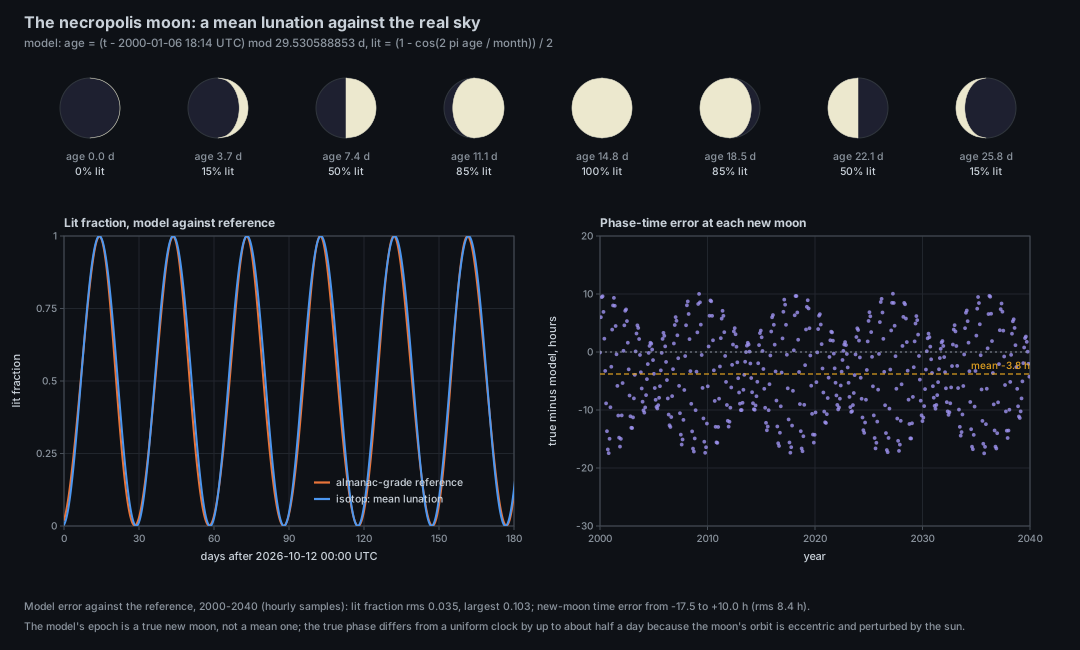
Script: docs/figures/necropolis-moon.py (the reference series are in the script; the check against known moons is described in its docstring).
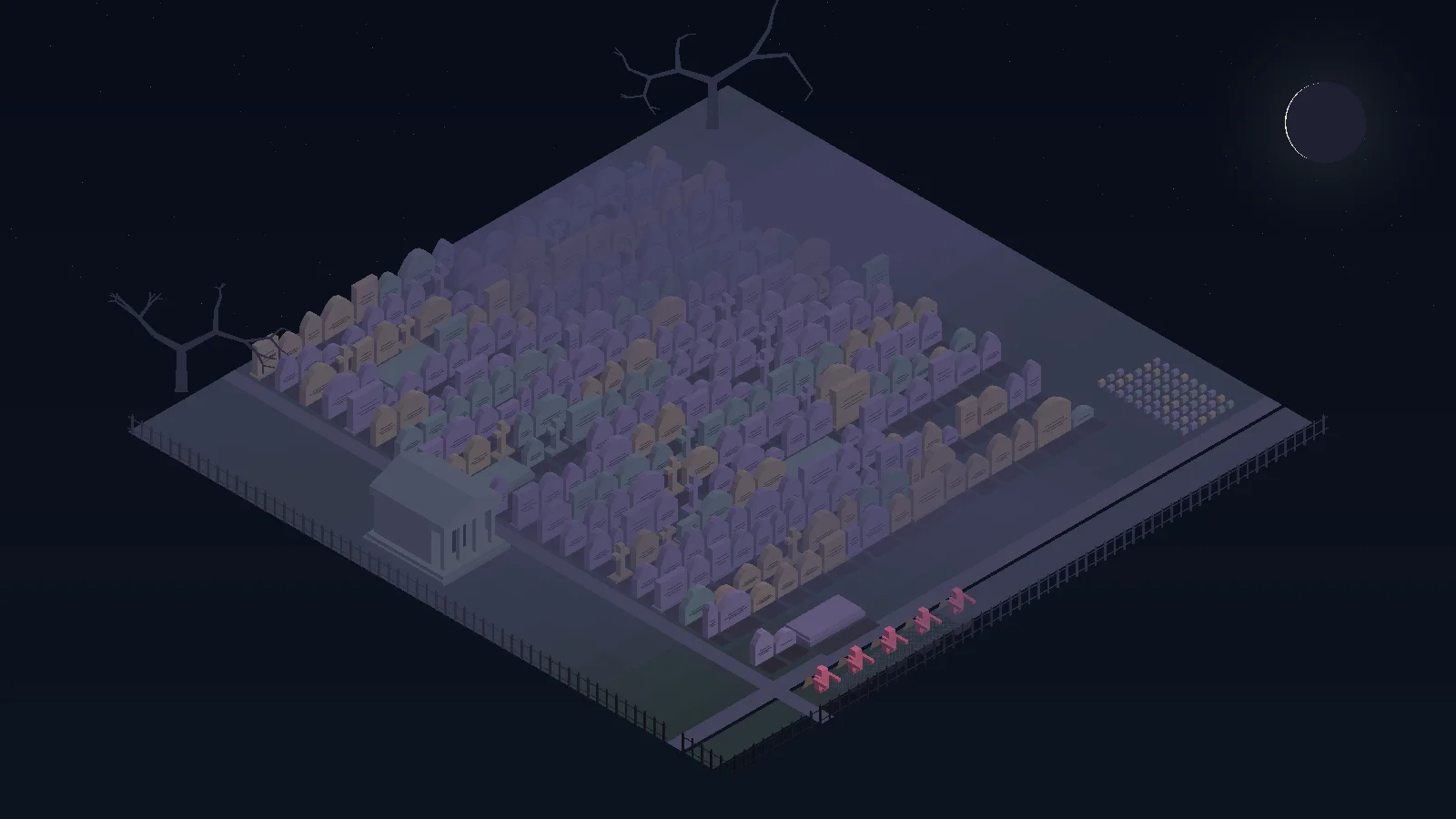
Where it is drawn. The camera looks down on the cemetery, which fills the frame, so there is no horizon to put a moon on; the sky is the strip along the top edge. The cemetery faces the equator (south for a northern place, north for a southern one, facing), where the sun and moon cross the sky. The moon's x is its azimuth relative to that, across SKY_WINDOW), so east is on the left facing south and on the right facing north, as it is from the ground. Its y is its altitude, from 11 % of the frame's height at the horizon to 1.5 moon radii from the top at the zenith (SKY_HORIZON, moon_center). Below the horizon, or outside the window, it is not drawn, and the legend says where it is (moon: waxing gibbous 82% lit, 32° up at 86°, , below the horizon, , out of view). The lit part of the disc is rotated so that it faces the sun by the limb angle above (a rotation, so the terminator's half-ellipse is unchanged). With no place known (no --home and no time zone entry) it keeps the old corner and is lit on the right while waxing. The demo's place is Amsterdam, and its clock (DEMO_EPOCH, 04:12 UTC on 2026-10-10) is 11.6 hours before a new moon, so the demo's moon is a "new moon 0% lit" under the horizon; use --time to bring it round (about 7.5 days later, --time 650800, it is about 41 % lit on the meridian, ten degrees up).
| Visual element | Measured source | Transform |
|---|---|---|
| Row | The UTC minute of the death (Snapshot::wall at the exit's time) |
One row per minute with deaths, 3.1 apart, newest in front; when a new minute opens a row the others ease back one spacing over 1.2 s. A row is two lines of 26 units, the second 1.5 behind, filled from the left; graves beyond both are counted on the row's label (+N); closed rows are frozen |
| Row label | The minute |
HH:MM UTC for the newest row, HH:MM for older ones |
| Stone height | Lifetime CPU: taskstats utime+stime, else the last sampled cpu_time
|
|
| Stone width | Peak memory: taskstats hiwater_rss, else the most any sample saw |
|
| Stone tint | Process kind | Slate (kernel), green granite (system), sandstone (session), lilac marble (containers) |
| Place in the row | Parent and child | In the open row a death whose parent or child is already buried there takes the slot after that family; only the graves after it move |
| Epitaph | Name, pid, lifetime, cause, kind, cgroup, parent |
name-pid; lived <lifetime> <cause>; kind | cgroup | parent name-pid. Lifetime from taskstats etime, else wall clock minus start |
| Cause | Wait status, OOM counter | The first rule that matches (below) |
| Mass grave | More than 8 deaths from one parent within 1 s | One slab 0.42 high and comm x N mass grave (parent-pid); counts as one grave |
| Zombie in an open pit | A live process in state Z | A pink figure in a pit before the newest row; a pit is kept for life; reaped, it sinks over 0.5 s and is buried |
| Mausoleum | A .service cgroup with no live process and at least 3 standing graves |
Its graves leave their rows (the gaps stay); it stands in the lot at the left end of the row of its last death; labelled unit (unit stopped, N graves); later graves join it |
| Unmarked marker | An exit of a process no sample listed | A marker 0.28 high in the corner field, the newest 120 drawn, all counted (N died between samples) |
| Ghost | A new process whose pid is that of a standing grave, with a different start | Five stacked glows rising 4 s and fading 2 s, labelled pid N reused; at most four at once; not pickable |
| Fog | Memory pressure (stall percentage, 10 s average) | Density |
| Sinking rows | Number of standing graves | Above 600 the oldest whole rows are dropped; from 450 the oldest row sinks by up to 1.5 and is fully fogged at 600 |
| Moon | The date (Snapshot::wall) and the home place (Snapshot::home) |
Lit fraction from the elongation, position from altitude and azimuth, tilt from the bright limb's angle to the zenith, all above |
Cause of death, first rule that matches (Death::of, with the OOM claim applied before it): SIGKILL (without core) while a cgroup's oom_kills rose in the same or the previous sample, "taken by the OOM killer", each rise claiming the largest victim by peak memory; a core dump, "dumped core"; another signal, "killed by SIGTERM" (Linux names, else "killed by signal N"); AFORK with exit 0, "forked, never exec'd"; a non-zero exit, "exited N"; exit 0,
"exited peacefully"; otherwise "died between samples".
Decorative: the fence and gate, gravel paths, grass, soil beds, the two bare oaks, the stars, the earthshine on the moon's dark side, the stone shapes (round, slab, gothic, cross, and an obelisk for some tall ones: drawn from the identity hash), the engraved lines, a zombie's sway, the fog's base density of 0.4, and the drifting of wisps.
flowchart LR
  A[Snapshot::life: fork, exec, exit] --> B[take_in: pending deaths by identity]
  C[Process list: name, kind, cgroup, parent, peak memory] --> B
  B -->|1 s later and one sample later| D{more than 8 from one parent in 1 s?}
  D -->|yes| E[mass grave]
  D -->|no| F{any sample ever listed it?}
  F -->|no| G[unmarked marker]
  F -->|yes| H[headstone: cause, OOM claim]
  E --> I[row of the death's UTC minute]
  H --> I
  I --> J[cap at 600, mausoleum for a stopped unit, ghost on pid reuse]
Intake. Necropolis::record runs on every sample (the view hook record), through take_in: OOM-kill credits from the cgroup counters (valid for the sample they rose in and the next); ghosts for new identities whose pid names a standing grave; a Seen record of each process's name, kind, cgroup, parent, peak memory and last CPU time;
then the exits of Snapshot::life (the merged stream of the proc connector, taskstats and sample diffing; see Theory Life Events), each once per identity (mourned); and zombies that vanished (reaped) buried as having died between samples if no event came. The row declares sources: LifeEvents, so the event thread runs only while the necropolis
is shown (deaths while another view is shown are not seen). warmup: a headless demo replays 600 s with before_start: true so the reference frame at 12 s shows ten rows; the demo (mortality: true) synthesises every cause, a burst, a stopped unit and a reused pid.
Burial. bury waits BURIAL_DELAY = 1 s and at least one sample (or 120 s, REMEMBER), so a mass grave and an OOM kill are known. Deaths with one parent within MASS_WINDOW = 1 s, more than MASS_THRESHOLD = 8 of them, become one mass grave; a death with no Seen record is an unmarked marker whose kind is guessed from its fork's parent;
the rest are headstones: dig fixes everything the grave shows (names, cause, sizes) at that moment and builds its stone once, in its own coordinates (stone(shape, width, height, color)), so a frame only moves, fogs and culls it. place puts it in the row of its UTC minute (minute = floor(wall / 60)): a new row if the minute is the newest, the open row beside its family if not, the end of a closed row otherwise;
next_slot lays it along the two lines.
Mausoleums and caps. entomb groups standing graves by cgroup (a .service leaf on Linux; any group where there are no cgroups) and, when no live process remains in it and three or more stand, moves them into a mausoleum at the left end of the row of the last death. cap drops the oldest whole rows (with their mausoleums and markers) while more than CAP = 600 graves stand; sinking_rows eases the two oldest into the fog from 75 % of the cap.
Fog and sky. Fog::new computes density from snapshot.pressure[1]; each face is blended towards the fog colour by its depth fraction. draw_sky places the stars and the moon from snapshot.wall (the system clock, or DEMO_EPOCH plus demo time) and snapshot.home: moon_over asks lunar::Moon::at for the phase and the sky, moon_center places the disc as above and draw_moon fills a dark disc and then a lit region bounded by the limb and a half-ellipse terminator of half-width
Picking and parity. Graves and mausoleums are pickable Things (kinds grave and mausoleum) with inspector Cards built on demand; zombies are the live process. Stones are triangles shaded by moonlight direction and culled when facing away; at most about 40 triangles per grave. The row sets links: DrawnByView, flash: false (a reaped zombie sinks instead), haze: false (fog stands for memory pressure) and
tour: false (the tour visits living processes, which this view does not draw). Epitaph text is sanitised like all process text (Theory Text Safety).
Degradation (the legend says so). Without taskstats (it needs CAP_NET_ADMIN): causes come from the proc connector's exit status, sizes from what the samples saw, lifetimes from start times (no exit records). Where only sample diffing works (an ordinary container): every cause is "died between samples" and there are no unmarked markers (no fork events). Without PSI the fog stays at its base density. On macOS only sample diffing and kqueue see deaths.
What I see in the demo render: a grey-violet plot seen from above at an isometric angle, about ten rows of headstones in lilac, sandstone and slate-green, in varied shapes (rounded, gothic arch, slab, small crosses) receding to the back where they disappear into pale violet fog; a pillared grey mausoleum at the left end of a middle row; a small field of tiny stones at the right (the unmarked markers); five pink figures in a line in front, standing in pits (the demo's
zombies); two bare oaks against a starry sky; and no moon: the demo's clock (DEMO_EPOCH, 04:12 UTC on 2026-10-10) is 11.6 hours before a new moon and Amsterdam's horizon, so the legend says moon: new moon 0% lit, below the horizon. At --time 650800 it is a waxing moon about 41 % lit, low in the south, lit on the right, behind the oak at the top of the frame.
- Measured: the cause (a wait status or an OOM counter), lifetime CPU and peak memory (taskstats or last sample), the kind and cgroup of the process as last seen, the minute of death, the count of deaths per minute, the number of zombies, memory pressure.
- Derived: the row and position (grouped by family), the choice of mass graves, the mausoleum (a unit with three or more graves and no survivors), the OOM attribution (a heuristic: a SIGKILL in a cgroup whose counter rose within one sample claims its largest victim), the ghost.
- Decorative: the shape and engraving of a stone, the oaks, the moon's shading and the strip of sky it travels in; the moon itself is the date and the place, good to a quarter of a degree and a fraction of a percent lit.
-
Heights and widths are logarithmic. Each extra unit of height means about 600 times more CPU time (
$10^{1/0.36}$ ), and each extra unit of width about 100 times more memory ($2^{1/0.15}$ ); a stone twice as tall as its neighbour is not twice as busy. - What the eye cannot tell: one-minute resolution of death times (and "newest in front" only at the row level), sub-second order inside a row, what a process did while alive, and any death while another view was shown.
- A "died between samples" grave is not an unknown process dying: it is a known process whose cause the source could not give; the unmarked marker is an unknown process.
./target/release/isotop --demo --view necropolis --width 1600 --output /tmp/necropolis.png --renderer cpu
./target/release/isotop --demo --view necropolis --time 300 --output /tmp/n300.png
./target/release/isotop --view necropolis     # live; leave it open: deaths are read only while it is shown
python3 docs/figures/necropolis-moon.py       # the moon figure
Hover or click a headstone for its epitaph; the legend line ends with moon: <phase> N% lit, the graves standing, mausoleums and deaths per minute.
-
src/necropolis.rs:Necropolis(record/take_in,bury,dig,dig_mass,place,entomb,cap,raise_ghost,draw,legend,card),Death(of,text),Grave,Row,Mausoleum,Marker,Ghost,Fog,stone,mausoleum,moon_over,moon_center,in_window,facing,where_is,draw_moon,lifetime_text,stone_height,stone_width; constantsROW_SPACING,CAP,MASS_THRESHOLD,BURIAL_DELAY,SKY_WINDOW,SKY_HORIZON,HORIZON,FOG_*;src/lunar.rs:Moon(at,phase),Sky,wrap_degrees. -
src/platform/mod.rs:Cause(of_status,signal_name),ExitRecord,LifeEvent,LifeKind,LifeSource;src/model.rs:Life(the merge),Snapshot::life,Snapshot::wall;src/platform/linux/events.rs: the proc connector and taskstats thread;src/platform/macos/events.rs: kqueue. -
src/layout.rs:Seats(pits);src/palette.rs:stone_color;src/views.rs: thenecropolisrow. - Tests:
exit_codes_and_flags_map_to_the_right_cause_of_death,a_sigkill_during_an_oom_kill_is_taken_by_the_oom_killer,many_deaths_from_one_parent_within_a_second_share_a_mass_grave,a_ghost_rises_when_a_new_process_reuses_a_buried_pid,the_cemetery_caps_at_six_hundred_graves_and_the_oldest_rows_sink_into_fog,a_service_whose_last_process_exits_gets_a_mausoleum,the_phase_matches_known_new_quarter_and_full_moons,the_position_agrees_with_an_independent_ephemeris,a_waxing_moon_is_lit_towards_the_sun_in_either_hemisphere,the_moon_crosses_the_sky_from_the_east_on_the_left_to_the_west_on_the_right,the_lit_limb_faces_the_way_the_observer_sees_the_sun. - Design:
docs/briefs/views-2026-10.md(section 6),docs/mockups/necropolis.jpg. Compile-time module; no plugin system.
- Refraction and a real horizon. Lift the moon by the half degree the air adds at the horizon, and give the sky a horizon by drawing the cemetery's own far fence line across it, so a low moon rises behind something instead of along a strip.
- The sun. The same module has the sun's position, so a day's sky is a few lines away: a dawn and dusk gradient, and the moon drawn in daylight as pale as it is. Whether a cemetery that is always at night is more or less true to the view is a taste question.
- Libration and the maria. The moon's face is a plain disc; its real face tilts and nods by up to 7 degrees, and the dark seas would say which way is up at a glance.
- Epitaph channel capacity. How many distinct epitaphs can a viewer tell apart by stone (height decile, width decile, tint, shape)? Is the stone a 6-bit or a 10-bit code?
- Lifetime distributions. Plot lifetime against CPU on a per-row Hertzsprung-style diagram; a machine's dead processes may fall on a main sequence.
-
Taskstats without privilege. Read
/proc/<pid>/statjust before death for processes with a known exit time to approximateetimewhen taskstats is not available. - Zombie ageing. Colour a pit by how long the zombie has waited.
- Degrees of death. Whether a process that is remembered only by its pid is more or less dead than one the kernel has also forgotten; the view buries both in the same minute.
- Linux manual pages
wait(2),signal(7),proc(5), and the kernel documentation of taskstats (Documentation/accounting/taskstats) and of the process connector (cn_proc). - The cgroup v2 documentation (
memory.events,oom_kill) and the OOM killer. - J. Meeus, Astronomical Algorithms (2nd ed., Willmann-Bell, 1998), chapter 49 on the phases of the moon; The Astronomical Almanac (US Naval Observatory and HM Nautical Almanac Office), the low-precision formulae for the sun and moon.
- C. E. Shannon, "A mathematical theory of communication", Bell System Technical Journal 27 (1948).
- C. D. Friedrich, Abbey among Oak Trees (1809-10), the mockup's stated look (
docs/briefs/views-2026-10.md). - Theory Life Events, Theory History, Theory Stable Layout, Theory Text Safety, Math Stellar Photometry.