Repository navigation
Theory Stable Layout
A process keeps its place. Its CPU can swing by an order of magnitude between two samples, its memory can double, and a tenth of the machine can exit and be replaced, and the pebble, house, grave or star that stood for it must not move. This page is about the machinery that makes that true: a golden-angle spiral that is a pure function of a slot number, a seat allocator that hands slots out for life, a disc allocator that reserves headroom so that growth rarely forces a move, and the test harness that fails any view that reshuffles. It also derives why the golden angle is the right angle for placement by sequential insertion, with numbers computed from the same arithmetic the code uses.
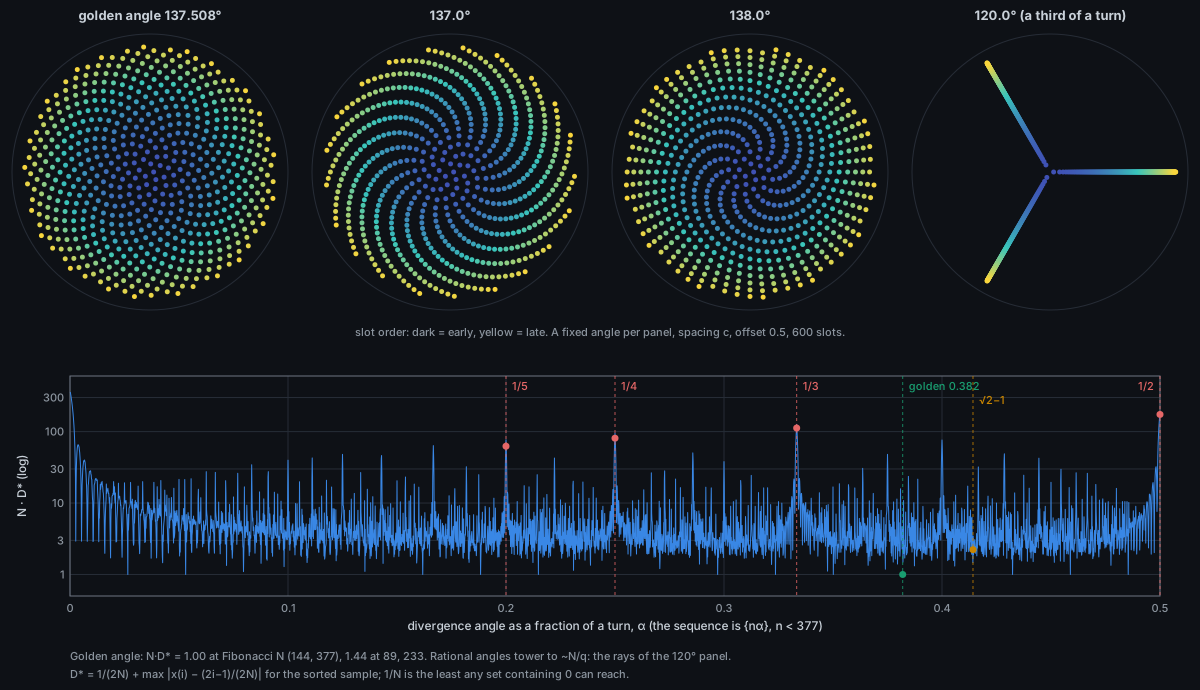
Top: 600 slots of layout::spiral at the golden angle, at 137.0 degrees, at 138.0 degrees and at 120
degrees (a third of a turn), dotted by arrival order. Bottom: the sequence discrepancy $N D^_N$ of the
angles
The arrangement of leaves, scales and florets was described long before it was explained. In 1837 the brothers Louis and Auguste Bravais (a botanist and a crystallographer) observed that successive organs around a stem are separated by about 137.5 degrees and tied the spiral counts to the Fibonacci sequence. The sequence itself comes from elsewhere: Leonardo of Pisa introduced it in the Liber abaci of 1202 as the answer to a problem about breeding rabbits, and no plant appears in the problem.
The mechanism came next. Hofmeister proposed in 1868 that a new primordium forms, one at a time, in the largest gap left at the growing tip; Schwendener's mechanical theory of 1878 put contact pressure between neighbours behind the same idea. Both state the rule that a new organ appears in the least crowded place; that doing so one at a time leads to the golden angle is what section 2 quantifies. Douady and Couder (1992) made that rule a laboratory experiment and a dynamical system: primordia that repel one another and appear at regular intervals settle on a divergence angle near 137.5 degrees, and on Fibonacci spiral counts, as the interval is shortened.
The formula isotop uses is Vogel's (1979): the
The wish that a changing picture should not rearrange itself has its own literature. Misue, Eades, Lai and Sugiyama (1995) named the viewer's model of where things are the mental map and asked layout algorithms to preserve it. isotop's variant is stronger than most graph-drawing practice: place is not adjusted to preserve the map, it is computed from nothing else.
This section is general; it is not specific to isotop.
A static picture is read once. A picture that is redrawn every second from data that changes every second is read continuously, and the reader's working memory is the thing that has to survive the redraw. Misue, Eades, Lai and Sugiyama called that working memory the mental map: the user's internalised model of where things are, and they argued that a dynamic layout should be adjusted so as to preserve it, even at the price of a worse static layout (Misue et al. 1995). Anything a user does with a process view depends on place being an identity:
- "the long thin thing at the left is the compiler" is a statement about a position;
- a selection, a hover tag, a tour stop or a search hit is found again by looking where it was;
- mouse input is cell-coarse (
target_nearsearches a radius), so a target that drifts by a few pixels between the aim and the click is a missed click; - the data itself is noise at the sampling rate: CPU is a smoothed rate recomputed every
--sample-ms, so a layout derived from CPU would twitch every second for no reason the viewer could use.
The design rule of isotop (AGENTS.md, Invariants: "Layouts are stable") is therefore that place is a
function of identity and history, never of the current measurements. Measurements drive height, size,
colour and motion; they must not drive position. The rest of this page is how that is achieved and how it is
checked.
There is a price. A layout that never moves anything must place a newcomer around the incumbents, so it cannot be as dense as one computed from scratch, and a body that outgrows its room must either overlap its neighbours or be moved once. Section 4 puts numbers on both costs.
This section is mathematics, independent of the code. The code is in section 3.
Place point
with a spacing
independent of
and no arrangement of that density can have a larger minimum distance. This is the yardstick for everything below.
The only freedom left is
If
Look at the angles alone: the
Adding point
| continued fraction |
|
|
|---|---|---|
|
|
|
|
|
|
||
|
|
(The golden entry reaches its limit to nine digits, float64; a stdlib script is in the figure source.) The golden
angle has every partial quotient equal to 1, the smallest possible, and that is exactly what keeps the
partition within a factor of
The same fact in the language of discrepancy: the star discrepancy $D^_N$ of ${n\alpha}$ is
$O(\log N/N)$ when the partial quotients are bounded, and in general $N D^_N$ is governed by the sum of the
partial quotients up to the scale
| golden | |||||
|---|---|---|---|---|---|
| 144 | 1.000 | 1.842 | 3.897 | 2.400 | 45.97 |
| 233 | 1.445 | 2.601 | 1.986 | 2.328 | 72.93 |
| 377 | 1.000 | 2.225 | 6.281 | 2.836 | 112.16 |
At
The gap statistics concern angles. Packing is about two-dimensional distances, and there is a short argument
that connects them. Take the pair
Put
So whenever the sequence has a
and the golden angle is the one angle for which the bound is essentially reached (all its
| angle | |||
|---|---|---|---|
| golden, 137.5078 deg | 0.381966 | 1.675 | 0.880 |
|
|
0.414214 | 1.490 | 0.782 |
| 0.718282 | 1.208 | 0.634 | |
| 137.3 deg | 0.381389 | 1.100 | 0.578 |
| 137.0 deg | 0.380556 | 1.048 | 0.550 |
| 137.6 deg | 0.382222 | 0.974 | 0.512 |
| 138.0 deg | 0.383333 | 0.964 | 0.506 |
| 0.141593 | 0.819 | 0.430 | |
| 120 deg | 0.333333 | 0.047 | 0.025 |
The golden angle measures 1.675 against the predicted 1.676. Every other angle in the table loses minimum
spacing relative to it: 11 percent for the silver angle, 28 percent for
The convergents of the golden angle are ratios of consecutive Fibonacci numbers (
layout::spiral(spacing, offset, slot, phase) -> (distance, angle) returns exactly Vogel's law:
with GOLDEN_ANGLE = 2.399_963 (f32 radians;
The property that makes stability possible is that a slot's position depends on nothing but the slot, the
spacing, the offset and the phase. Adding slot
layout::spin(name) -> f32 supplies the phase: the FNV-1a 32-bit hash of the name, its top 24 bits scaled to
Seats { taken: group -> (seat -> Identity), seats: Identity -> (group, seat) }
Seats::assign(members) takes the current members as (Identity, group) pairs and
- releases every seat whose holder left or changed group;
- gives each newcomer the lowest free seat of its group:
(0..=taken.len()).find(free), and one of$\texttt{len}+1$ candidates is always free by pigeonhole (hence theexpect); - visits newcomers in
Identityorder (pid, thenstart;IdentityderivesOrd), so the assignment does not depend onHashMapiteration order (see Determinism).
A member keeps its seat for life. A freed seat is reused by the next newcomer of that group, so the numbers
stay dense and span(group), one past the highest seat in use, bounds the spiral's radius. Seat numbers
carry no meaning beyond arrival order within a group; they are not ranks. The seat becomes a position as
spiral(spacing, offset, seat, spin(group)) in Cells (spiral(spacing, 1.0, ..)), Reef
(spiral(1.3, 0.5, ..) for fish, spiral(1.6, 0.5, ..) for crabs), Globe (spiral(0.9, 0.5, ..), and
GOLDEN_ANGLE directly), and Necropolis uses Seats for its zombie pits. Cortex seats its neurons with Seats
too. Ripple has its own copy of the same slot logic, with cluster.slots instead of Seats
(Ripple::scatter in src/views/ripple.rs), and the City has a third mechanism below.
Hidden processes keep their seats. Reef, Cells, Coop, Globe and Ripple reserve seats and places
for every sampled process, drawn or not (the comments in Ripple::scatter and in cells.rs, reef.rs,
coop/layout.rs and globe.rs say so), and the Orbit and Flow systems keep a hidden root's place in Galaxy::place
(src/views/systems.rs). Focusing a subtree or lowering --limit hides processes without freeing their seats, so
clearing the focus brings everything back where it was (Cores has the same test for its marbles). This is the same rule as stability under churn, one
level up: the view of the data (focus, limit) must not move anything either. The commits
"Keep hidden processes' Reef and Cells seats and places" (#106) and "Keep Ripple, Strata, Globe, Orbit, Flow
and Cores layouts when focus or --limit hides processes" (#105) established it.
layout::vacant(placed, radius) finds the first point on a golden-angle spiral out from the origin where a
disc of radius clears every placed (centre, radius) disc:
step = max(0.4 * radius, 1.0)
for k in 0.. :   c_k = spiral(step, 0, k, 0)      # origin outwards
    if for all placed (o, r):  |c_k - o| >= radius + r:  return c_k
It is a first-fit online algorithm. Termination is guaranteed because
Discs wraps it for named discs (cgroups, flocks). Discs::arrange(needs: [(name, radius)]):
-
keeps every placed disc whose current need is no larger than the radius it reserved
(
r <= reserved); a disc that shrank keeps its old reservation, so the reservation is a high-water mark; - drops discs that left, or that grew beyond their reservation;
- places the pending discs (new or dropped), largest first, ties by name, each at
vacant(other_discs, reserved)withreserved = radius * 1.15.
The 15 percent is the reservation: headroom bought at placement so that ordinary growth does not force a
move. Other stable placements use the same trick with their own constants: Ripple's clusters reserve
reach * 1.1 (plus POND_GAP) and grow their spacing by 1.15 when a pebble outgrows it; the Orbit and Flow
systems reserve need * HEADROOM with HEADROOM = 1.3 in src/views/systems.rs (the comment there says 30
percent holds what the view harness does to a system: memory by half to double, a tenth of its processes leaving
and as many arriving, and that a system which outgrows it is placed again). Cells reserves a Room per cell, and
its dish radius carries 5 percent (needed * 1.05). Discs::reach() is the radius around the origin that holds every disc, for fitting the camera.
City::place in src/views/city.rs is the third mechanism. A process gets a plot, a (district, slot) pair, from its
group's districts: the lowest free slot among the group's 16 (a 4 by 4 block, 4 world units apart), else a
new district. district_origin(index) enumerates the quadrant in square shells: with
 y
 3 | 15 14 13 12      shell 3 (indices 9..15) is filled before shell 4
 2 |  8  7  6 11
 1 |  3  2  5 10
 0 |  0  1  4  9
   +--------------- x
Index plots plus
occupancy are all the state the layout needs. (The test city_does_not_relocate_when_resources_or_population_change
in src/views/city.rs pins it.)
Two prices, computed with a faithful port of vacant (radii log-normal, float64). Density. The packing fraction reach:
| discs | arrival order | largest first (offline greedy) | arrival order, 1.15 reservation |
|---|---|---|---|
| 10 | 0.345 +- 0.080 | 0.462 +- 0.075 | 0.260 +- 0.062 |
| 30 | 0.406 +- 0.083 | 0.621 +- 0.055 | 0.309 +- 0.062 |
| 100 | 0.459 +- 0.066 | 0.703 +- 0.022 | 0.348 +- 0.050 |
Placing in arrival order rather than largest first costs a third of the density at 100 discs, and the
reservation takes a quarter more (Discs sorts only the pending set, which is the
only part of the order it is free to choose. For scale, the densest packing of equal discs in the plane is
Moves. A reservation is hysteresis. Model a disc's log-radius as a driftless random walk with per-sample
step --sample-ms 1000), mean of 60 seeded runs, steps Rng::normal:
| headroom |
area overhead |
moves per hour, |
moves per hour, |
|---|---|---|---|
| 1.05 | 1.10 | 29.3 | 41.7 |
1.15 (Discs) |
1.32 | 13.6 | 23.2 |
| 1.30 | 1.69 | 7.5 | 14.3 |
| 1.50 | 2.25 | 5.0 | 9.8 |
The ladder estimate HEADROOM against the harness's perturbation.
harness.rs (test-only) runs every registered view through the same six properties
(views::Property): Deterministic, NonEmpty, ValidPicks, ResourceChange, Churn, EmptyMachine.
The two stability properties are:
-
Resource change.
rescaled(snapshot)multiplies each process's CPU by$0.25\cdot16^{u}$ and its memory by$0.5\cdot4^{u}$ , with$u\in[0,1)$ drawn fromRng::for_identity(process.id, SALT): CPU is scaled log-uniformly in$[0.25,4]$ , memory in$[0.5,2]$ , each fixed by the process's identity. Cgroup totals are re-tallied. -
Churn.
churned(snapshot)removeslen/10leaf processes (not a parent, not a holder of a lock anybody waits for, chosen byhash_identityorder) and starts as many new ones, pids from 900000, as siblings of survivors in their group and cgroup, with a freshIdentity. Leaves only: an exiting parent re-parents its children, which is a change of structure, not of population.
A run is a headless --output run at the row's contract.time (12 s unless the view needs a fuller history;
a row names a later one where needed, as Ptolemy's 300 s), width 160, 192 demo processes, CPU rasterizer: the row's warm-up, a first frame, then 12
frames 0.25 s apart, with the changed sample arriving as the sample of time + 1 s. The steady run and the
changed run are compared frame for frame at the same times, so whatever moves by itself (orbits, walking
chickens) moves alike in both. For every process present in both, the distance in the ground plane,
contract.tolerance (1 world unit by default); height is
excluded because several views draw a measurement with it. Where creatures wander, the view supplies
anchors: ViewModule::anchors returns the places a body keeps to (Coop's seats and houses, Cores' lane
starts, Reef's school targets and crab seats), which Scene::anchors hands to the harness. A view with nothing to compare fails as Broken, and a panic is also Broken;
neither can be excused.
known_unstable records the debt of views that fail a property, each with its issue. It is empty on every
registered row. The six views that predate the harness (Orbit, Flow, Ripple, Cores, Cells, Reef) were listed
there with the issues #114 to
#119, and the change that moved every view onto
ViewModule (#143) fixed each layout and dropped the entries:
the Orbit and Flow systems got HEADROOM, Cells a reserved Room per cell, and Cores and Reef declare the
places that do not wander as anchors. All eighteen registered views pass all six properties; Matrix draws journal
lines, not processes (draws_processes: false on its row), and is exempt from the stability properties. The
harness reports a property that starts to pass on a listed row ("NowPasses": drop the entry and close the
issue), accepts no entry for a new view, and never excuses Broken. The listing mechanism is exercised only by
test rows in views::testing (SHUFFLED, whose second row lists a churn failure and a resource-change failure
it does not have), and the_harness_detects_a_view_that_reshuffles proves the test has teeth against a
deliberately rank-seated test view.
- What stability promises. Position is a function of identity and arrival history. It does not promise that position means anything: a seat number is arrival order, a spiral radius is not a ranking, and two processes close together are not related unless the view says so (Cells and Coop put a cgroup's members together by construction, which is information; the spiral inside the group is not).
- Holes. A freed seat stays empty until a newcomer of the same group arrives, so a long-running machine shows gaps that record exits. Absence of a thing is information here.
- Re-placement is visible. When a disc outgrows its reservation it jumps once. A jump in an otherwise still view is therefore a statement about growth, not about the process list.
-
Camera is separate. Stable world positions do not mean a stable screen: the camera fit follows
stage.bounds, and views whose content moves declare a fixed envelope so that the fit does not chase it. -
Not a proof of non-overlap.
vacantguarantees clearance at placement, for the reserved radius. A disc that grows within its reservation stays inside its own reserved disc by construction; a body drawn larger than the radius it asked for would overlap a neighbour, and that is a bug of the view.
# The same process stays where it is while the data changes under it (any view that passes the harness)
cargo test every_view_satisfies_the_view_contract -- --nocapture   # prints pass / exempt / known unstable per property
cargo test seats_survive_departures_and_discs_survive_small_growth
cargo test city_does_not_relocate_when_resources_or_population_change

# A visual: the city at two demo times, same plots
./target/release/isotop --demo --view city --time 12 --width 1200 --renderer cpu --output a.png
./target/release/isotop --demo --view city --time 40 --width 1200 --renderer cpu --output b.png
Regenerate the figure with python3 docs/figures/layout-vogel.py from the repository root.
-
src/layout.rs:GOLDEN_ANGLE,spiral,vacant,spin,Seats(assign,seat,span),Discs(arrange,reserved,reach), and the testlayout_spiral_places_the_same_points_as_beforethat pins their bits. -
src/views/city.rs:City::place,district_origin.src/views/systems.rs:Galaxy::place,HEADROOM(Orbit and Flow).src/views/ripple.rs:Ripple::scatter. -
src/cells.rs,src/reef.rs,src/coop/layout.rs,src/globe.rs,src/necropolis.rs,src/cortex.rs: the users ofSeatsandDiscs. -
src/harness.rs:rescaled,churned,Session,Runs,stayed,every_view_satisfies_the_view_contract. -
src/views.rs:Contract,Property,Unstable,ViewModule::anchors, the registry rows'known_unstable(empty today).
docs/VIEW_CONVENTIONS.md lists render::vacant and render::GOLDEN_ANGLE among the shared helpers "today";
in the code they live in layout.rs. The code wins.
-
Rank-free versus rank-aware seats. Ptolemy keeps its top ten processes on spheres whose ranks
shuffle while the spheres stay put (
wanderers_keep_their_spheres_while_ranks_shuffle_inside_the_top_ten). Is there a seating scheme that lets rank show without moving anything? -
Shrinking reservations.
Discsnever lowers a reservation. A slow decay (re-place a disc downwards when its need has stayed below half its reservation for a minute) would reclaim area at the price of one more move per episode. The model in section 3.5 predicts how often. - Offline compaction on demand. A key that re-packs everything largest-first would give the 0.70 density of the table in one deliberate reshuffle, with an animation. The mental-map literature suggests tweening between the two layouts.
- A discrepancy-optimal slot order. Seats are handed out lowest-first, which on the spiral fills from the centre. Filling by the order that minimises the largest empty circle at every prefix is a different problem (and the golden sequence is already near-optimal for it).
-
Higher dimensions. Arbor, a 3-D view, advances the azimuth of successive slots by the golden angle
(
src/arbor.rs). A 3-D analogue of the spiral for placing points in a volume has no single golden counterpart; the generalised golden ratio sequences of the Kronecker type (the "$R_d$ sequence") are a candidate (unverified; not in the tree). - Holes with names. A freed seat records an exit and nothing else. Necropolis records an exit with a stone, a minute and a cause. The two do not share a representation, and nobody has asked them to.
-
Two sequences compared. Replace
GOLDEN_ANGLEin a scratch build with the silver angle and render Cells: the table in section 2.4 predicts an 11 percent smaller minimum spacing.
- Vogel, H. 1979. "A better way to construct the sunflower head." Mathematical Biosciences 44: 179-189.
- Douady, S. and Couder, Y. 1992. "Phyllotaxis as a physical self-organized growth process." Physical Review Letters 68: 2098-2101.
- Prusinkiewicz, P. and Lindenmayer, A. 1990. The Algorithmic Beauty of Plants. Springer. (Chapter 4 on phyllotaxis.)
- Hurwitz, A. 1891. "Ueber die angenaeherte Darstellung der Irrationalzahlen durch rationale Brueche." Mathematische Annalen 39: 279-284.
- Sós, V. T. 1958. "On the distribution mod 1 of the sequence
$n\alpha$ ." Annales Universitatis Scientiarum Budapestinensis, Sectio Mathematica 1: 127-134. Swierczkowski, S. 1959. "On successive settings of an arc on the circumference of a circle." Fundamenta Mathematicae 46: 187-189. - Weyl, H. 1916. "Ueber die Gleichverteilung von Zahlen mod. Eins." Mathematische Annalen 77: 313-352.
- Kuipers, L. and Niederreiter, H. 1974. Uniform Distribution of Sequences. Wiley.
- Khinchin, A. Ya. 1964. Continued Fractions. University of Chicago Press.
- Misue, K., Eades, P., Lai, W. and Sugiyama, K. 1995. "Layout adjustment and the mental map." Journal of Visual Languages and Computing 6(2): 183-210.