Repository navigation
View Reef
Reef draws the machine as a coral reef under a sea sky. System services grow as coral colonies, one per cgroup, with a polyp on a stalk for every process; your session's applications swim in schools whose speed follows their CPU; containers are crabs scuttling on the sand; busy kernel threads drift as plankton. Size follows memory everywhere, a glow follows CPU, I/O rises as bubbles and zombies float belly-up. It is one of the most decorative views, and the page says so wherever it matters: almost nothing about where a creature is carries data.
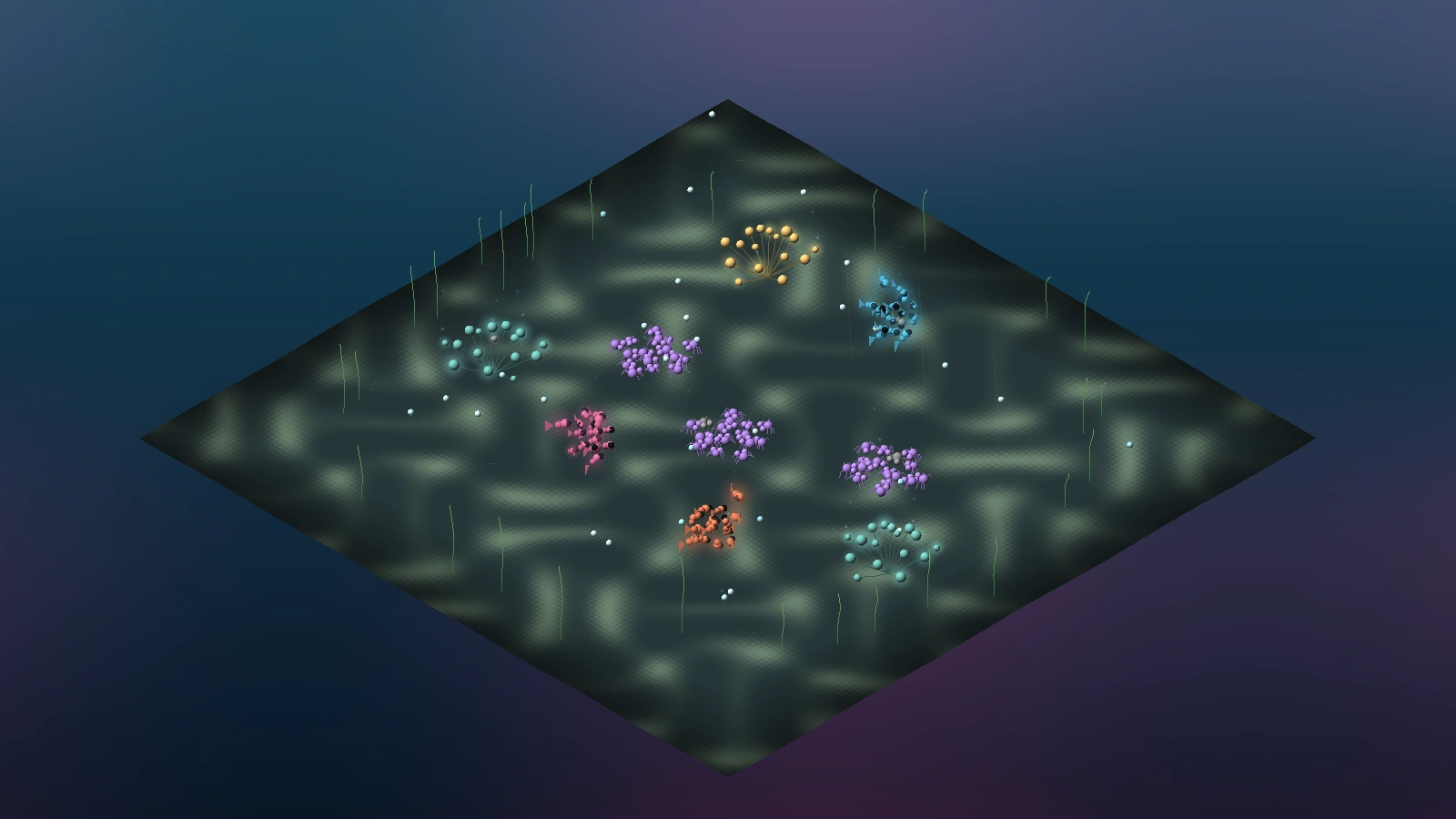
A coral colony is many small animals, the polyps, that share a skeleton of calcium carbonate and are linked by living tissue; most reef-building species also host symbiotic algae (zooxanthellae) that photosynthesise for them. A colony grows by budding new polyps and laying down skeleton, from millimetres to some centimetres a year depending on the species, and a reef is the accumulated, cemented skeleton of many generations. Darwin's 1842 classification of reefs as fringing, barrier or atoll followed from reading them as slowly rising structures built on slowly sinking land. The part of that picture that matters for a metaphor of processes is the colony: individuals who share a structure and a budget. A cgroup is the same kind of thing for processes, a node of the resource tree that a service's processes share, and the reef gives every system service one.
A school is fish that swim together, each adjusting to its neighbours. Reynolds (1987) showed that the look of flocks, herds and schools emerges from three local steering rules applied to every agent, which he called boids:
- separation, steer away from nearby mates so as not to crowd them;
- alignment, steer towards the mates' average heading;
- cohesion, steer towards the mates' average position.
Hunting and being hunted, the real reason fish school, are not modelled.
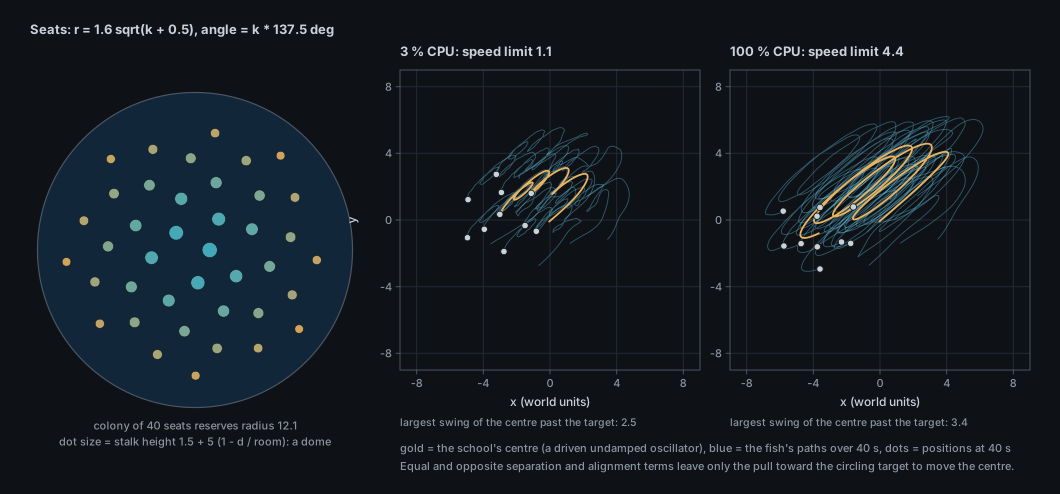
Phyllotaxis. Seeds in a sunflower head and scales on a pine cone sit on spirals. Vogel (1979) gave the simple
construction that reproduces a sunflower head: seed layout::spiral, to seat every member of a colony, school and gang.
Reefs as structures. A reef is built by animals but shaped by geology. Charles Darwin, who saw atolls on the Beagle voyage, argued in The Structure and Distribution of Coral Reefs (1842) that fringing reefs, barrier reefs and atolls are stages of one process: a reef grows upward around a volcanic island as the island slowly sinks, first fringing it, then standing off as a barrier, and at last ringing an empty lagoon. The idea was tested by drilling. The Royal Society's expedition to Funafuti (1896 to 1898) recovered more than 300 m of shallow-water reef material without reaching the volcanic base, which implied subsidence, though a contemporary reviewer argued it did not prove it for all atolls. Cores taken at Eniwetok Atoll in 1952, led by Harry Ladd, reached volcanic rock about 1,267 m below the sea surface under reef limestone, and were widely taken as the confirmation. Modern commentators say the result confirmed the volcano beneath the reef rather than every detail of Darwin's model.
The Great Barrier Reef. Europeans met it by accident: HMS Endeavour, under James Cook, ran aground on it in June 1770 and was refloated. It is the largest reef system on Earth, running about 2,300 km along the Queensland coast. Australia protected it with the Great Barrier Reef Marine Park Act of 1975, and it was inscribed on the UNESCO World Heritage List in 1981 (dates from memory, unverified here). The Great Barrier Reef Marine Park Authority counts mass bleaching on it in 1998 and in 2016, 2017, 2020, 2022 and 2024; the 2022 event was its sixth since 1998 and the first in a La Nina year, and the 2024 survey found some bleaching on 79 per cent of 1,080 reefs surveyed. Its count for 2002 is not confirmed here.
Bleaching. A coral under heat stress expels the symbiotic algae (zooxanthellae) that supply most of its energy and colour, and turns white; if the stress passes, the algae can return, and if it does not, the coral dies. NOAA's Coral Reef Watch describes the bleaching of 2023 to 2024 as the fourth global event on record. Sources differ on the labels and spans of the earlier three: 1998, 2010 and 2014 to 2017 are the usual ones, and some reports date the third to 2016.
Boids. The school rule is much younger than any of this: Craig Reynolds published boids in 1987. See Math Flocking.
Each fish carries a position
with
so an idle fish is limited to 0.8 units per second and a fish at 100 % to 4.4. Position advances by
Two properties follow directly.
-
The cohesion term is not cohesion in Reynolds's sense. It pulls each fish to the school's target, a point
that circles the school's home, not to the mates' centroid. Separation is a
$1/d$ repulsion inside a radius of$\sqrt 6 = 2.45$ units (the force has magnitude$1.5/d$ along the line between the pair). Alignment is to the mean velocity of the whole school, with no neighbourhood. -
The school's centre is an undamped oscillator. Separation forces are equal and opposite for each pair and alignment
terms sum to zero over the school, so the mean position
$X$ obeys$\ddot X = 0.4,(g - X)$ exactly, apart from the speed and height clamps: angular frequency$\sqrt{0.4} = 0.63$ rad/s, period 9.9 s, no damping. A school therefore swings back and forth through its target rather than settling on it; the clamp bounds the swing but does not damp it. (Explicit Euler integration adds a little energy, a factor of$\sqrt{1 + 0.4,\Delta t^2} \approx 1.002$ in amplitude per 0.1-s step, which the speed limit absorbs.) A run of the rule for ten fish, in the figure above, gives swings of the centre past the target of 2.5 units at 3 % CPU and 3.4 units at 100 % in 40 s, and a faster, wider school at higher CPU. That run is a replica of the rule written for this page, not the renderer.
The target itself is at $g(t) = \bigl(h_x + 0.4,\rho\cos(0.05,t + \phi),\ h_y + 0.4,\rho\sin(0.05,t + \phi),
5 + 2.5\sin(0.07,t + \phi)\bigr)$ with
Member Discs places at 1.15 times that. A polyp's stalk is
| Visual element | Measured quantity (platform source) | Transform |
|---|---|---|
| Habitat | Process kind and cgroup path (or process group): "{Kind:?} {path}"
|
One colony, school or gang per habitat; kernel threads have none |
| Coral colony | A system-kind cgroup (Kind::System) |
Palette of 5 chosen by a hash of the name |
| Polyp | A process in the colony | One sphere on a two-segment stalk from the colony's base |
| Polyp size | Process::memory |
mass_radius |
| Polyp glow |
Process::cpu above 1 % |
Radius |
| Polyp position | Seat (stable) | Vogel spiral, spacing 1.6; stalk height |
| School | A session cgroup (Kind::Session) |
Palette of 6 by hash |
| Fish | A process in the school | Two spheres, a tail wagging at |
| Fish length | Process::memory |
|
| Fish speed limit | Process::cpu |
|
| Fish glow |
Process::cpu above 5 % |
Strength |
| Fish position | None: the steering rule above | Decorative |
| Crab | A process in a container cgroup (Kind::Container) |
One per process, shell violet |
| Crab size | Process::memory |
|
| Crab pace | Process::cpu |
|
| Plankton | A kernel thread | Position from a hash of the pid plus slow drift ( |
| Bubbles |
Process::io_rate above 4096 B/s (storage bytes, read plus write; /proc/<pid>/io, proc_pid_rusage) |
|
| Zombie | Process state Z
|
Grey; a fish floats belly-up towards the surface at speed 0.3 |
| Seabed, caustics, kelp, light shafts, sky | none | Decorative |
Habitats and placement. Reef::draw in src/reef.rs builds a habitat for every sampled non-kernel process and
assigns Seats (a seat per process within its habitat) and Discs (a home per habitat). Both are reserved for every sampled
process, drawn or not: focusing a subtree or lowering --limit frees no seat and no home, and a hidden fish waits where
it swam and resumes from there, so clearing the focus puts everything back and the framing does not change. The camera
fit is a fixed square of half-width reach = max(homes.reach() + 6, 16) and height
Schools. Reef::school runs the rule above for the school's drawn members, from a Swimmer { position, velocity }
kept per Identity. A new fish hatches at the target plus a hash-derived offset (Reef's own clamp, stage.dt. Neighbour search is a plain double loop over the school (quadratic), which is fine at school sizes. No spatial hash is used here.
Corals and crabs are placed, not simulated: positions are functions of the seat and stage.time
(a
Seabed. A grid of between 60 and 160 quads per side, height
Stable layout. Fish swim at CPU-dependent speeds and crabs scuttle at CPU-dependent paces, so where they are drawn follows the CPU by design. The harness therefore holds them to what does stay put: Reef::anchors (compiled for tests) returns the target of a fish's school and a crab's seat on its container's home, and the coral polyps and plankton, which do not wander, are held where they are drawn. The reef row declares no known failures.
CPU and GPU. Spheres, lines, beams, facets and glows only; no new primitive. The row uses the Sea backdrop and a
four-second settle before a headless frame.
- Membership and size are the data; position and motion are not. Which colony, school or gang a creature belongs to is its cgroup and kind. How big it is is its memory. How it glows is its CPU. Where it is within the cluster, and where a fish is at an instant, is the seat or the steering rule: it says nothing.
- Speed is a limit, not a reading. A fast school is a busy one in the sense that its speed limit is high, but the fish are following a rule, not their processes' threads.
- Schools do not rest. An undamped oscillator never settles; even idle schools swim, slowly. A school that holds still is one with no drawn members or one paused.
- Bubbles are storage I/O only, written to or read from block devices; network and page-cache I/O raise none.
-
The reef has no memory of its own. Nothing grows or bleaches over time: a polyp's size is the process's memory now (eased), and
a service that ran hot yesterday leaves no skeleton. The only growth is the ease-in (
sprout) of a newborn. - The cluster layout is a stable arrangement, not a map. Colonies sit where the packer put them first and keep their place; the distance between two colonies means nothing.
-
A hidden creature is still there. Colonies keep room for hidden processes, so a tight
--limitleaves empty water.
./target/release/isotop --demo --view reef --width 1600 --output reef.png --renderer cpu
./target/release/isotop --demo --view reef --time 40 --output reef40.png
./target/release/isotop --view reef        # live; press 9 in a session
Headless PNGs simulate four seconds first so the fish have left their hatching point. Click a creature to inspect
its process; f focuses a subtree and the rest of the reef keeps its places. In the demo, a polyp's glow pulses with the process's demo CPU
and the schools are the demo's session cgroups.
-
src/reef.rs:Reef::draw,school,crab,polyp,draw_seabed,habitat; constantsDEPTH,CORALS,FISH,ZOMBIE. -
src/layout.rs:Seats,Discs,spiral,spin,GOLDEN_ANGLE,vacant. -
src/palette.rs:CONTAINER,tint;src/render.rs:mass_radius;src/simulation.rs:hash,sprout. -
src/views.rs: thereefrow (Backdrop::Sea, warm-upSETTLE); the legend isReef'sViewModule::legend. - Figure:
docs/figures/reef-school.py.
reef::Reef is a ViewModule built from its registry row; views are compile-time modules and there is no plugin system.
- Bleaching. Real corals expel their algae under thermal stress and turn white. Fade a colony towards white as its cgroup's memory or CPU pressure (the PSI figure Cells reads) rises, and let it recover.
- Accretion. Make a polyp's height the integral of its CPU time (calcification), so a long-lived busy service builds a tall reef and a short-lived one leaves nothing; that makes the reef a record rather than a snapshot.
-
Real cohesion. Replace the pull to the target with the pull to the school's centroid, or to the
$k$ nearest neighbours withSpatialHash3, and measure with a polarisation order parameter as Coop does for its flocks (Math: Flocking). The school would stop being a driven oscillator and would drift as a group. - Damping. Add a drag term and the school will settle on its target; the question is whether a still school reads as healthy or dead.
- Spawning events. Release a cloud of particles when a service forks many children at once. Mass spawning on the Great Barrier Reef is timed to the moon, a few nights after the full moon in late spring; the moon in Necropolis is computed from the date, and the Reef does not look at the sky. Whether it should is open.
- Open: what should the reef do with processes that are in two cgroups' worth of ancestry? Today the leaf cgroup is the habitat.
- C. W. Reynolds, "Flocks, herds and schools: A distributed behavioral model", Computer Graphics (SIGGRAPH '87 Proceedings) 21(4), 1987, pp. 25-34.
- H. Vogel, "A better way to construct the sunflower head", Mathematical Biosciences 44, 1979, pp. 179-189.
- C. Darwin, The Structure and Distribution of Coral Reefs, 1842.
- Related pages: Math: Flocking, Math: Spatial hashing, Theory: Stable layout, Theory: Determinism, View: Cells, View: Coop.