Repository navigation
Planned Anthill
Planned, not yet implemented. Specified in docs/briefs/views-2026-10.md and tracked in issue #47.
The anthill view is specified as sandy terrain on which every process is an ant nest, a mound with entrances sized by its memory. Open files are food piles, laid out on a stable map of the filesystem with regions for /usr, /home, /var and /tmp. Streams of ants run between nests and food: a crumb carried home is a read, a crumb carried out is a write; one ant walks for every K system calls, and the size of the crumb is the number of bytes per call. Pheromone glows along well-used routes and fades when they are abandoned, pipes and sockets are dashed tunnels between nests, and a picnic blanket stands for the terminal. This page is the biology of foraging and stigmergy, the optimisation algorithm that grew out of it, the exact meaning of the /proc/<pid>/io counters, and above all the line between what the view measures and what it infers, because the per-file attribution of I/O is the part of this view most easily over-read. Nothing here is implemented: isotop --list-views does not list anthill.
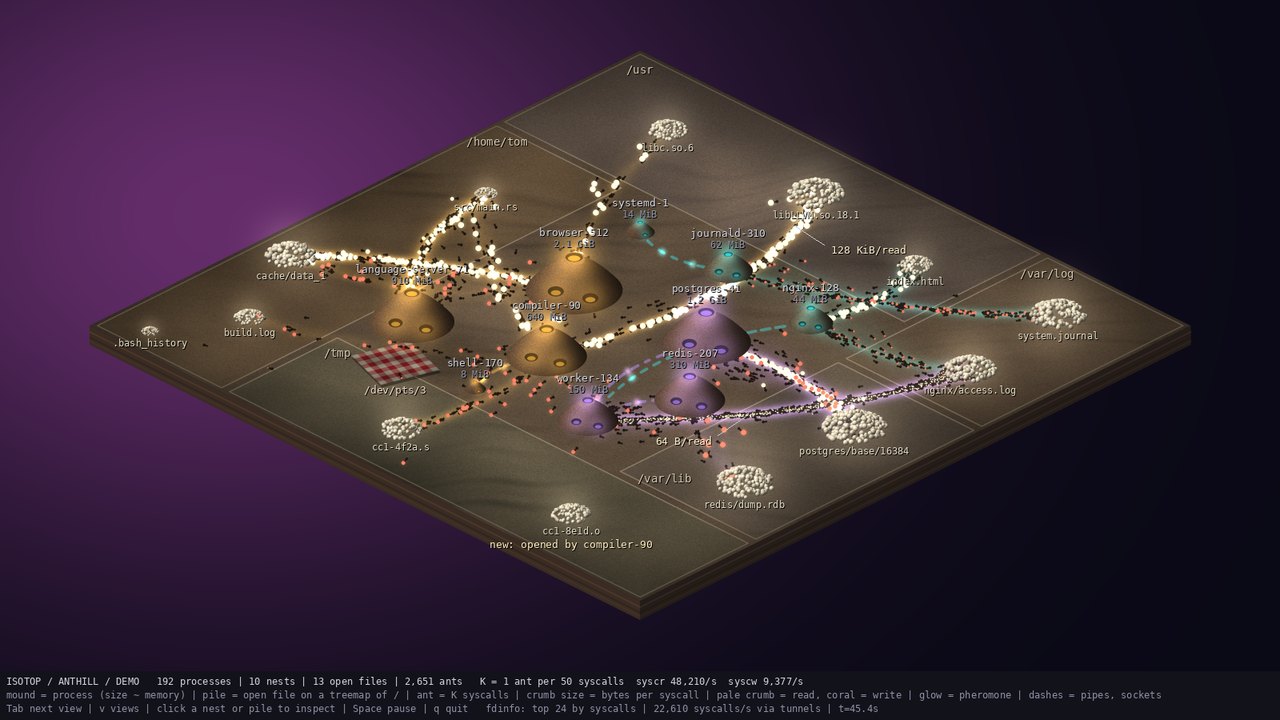
The reference mockup (docs/mockups/anthill.jpg), rendered in Python by docs/mockups/code/anthill.py from synthetic data. It is the visual target, not an isotop render.
An ant colony forages without a plan. A scout that finds food returns to the nest laying a chemical trail (a pheromone), and nest-mates that meet the trail follow it, and reinforce it on their own way home if they found food. Pheromone evaporates, so a trail that is no longer reinforced disappears. No ant knows the route, the distance or the colony's needs; the structure is stored in the environment, in the trail, and read by whoever walks past.
The French entomologist Pierre-Paul Grassé named this kind of coordination stigmergy (from the Greek stigma, a mark, and ergon, work) in 1959, studying how termites rebuild a damaged nest: the work done so far is itself the stimulus that directs the next worker's action, with no direct communication needed. Two decades later the Brussels group of Jean-Louis Deneubourg showed experimentally with Argentine ants that a colony offered two routes of unequal length to a food source converges, in most trials, on the shorter one (the double bridge; Goss et al. 1989, Deneubourg et al. 1990), a result that follows from nothing more than positive feedback and evaporation. Marco Dorigo turned the mechanism into an algorithm in the early 1990s (ant colony optimisation, ACO), and the family of methods is still used for routing and scheduling problems.
Why it is a good metaphor for system calls. A process that reads and writes files makes a stream of requests to the kernel from a fixed home (the process) to destinations (files, pipes, sockets) that persist across requests, in numbers that can be counted but not individually followed: the machine tells us how many calls and how many bytes, not which call went where at what moment. A colony is the same kind of object: individually invisible workers, a countable flow, persistent destinations. The view makes each ant stand for K calls, the destinations the files, and lets routes emerge. The routes themselves are decorative; the endpoints and the rates are data.
The system being modelled summarises the standard account. The details are less tidy than the summary.
Grassé's 1959 paper in Insectes Sociaux coined the word for termites, not ants: its subject is the rebuilding of the nest of Bellicositermes natalensis and Cubitermes after damage. Dorigo, Bonabeau and Theraulaz, who quote his definition, give it as the stimulation of workers by the performance they have achieved.
The chemistry of ant trails has its own line of work. E. O. Wilson's studies of the imported fire ant Solenopsis saevissima reported its trail substance in 1959, and his 1962 paper in Animal Behaviour 10, 137-147 treats the trail communication of its workers. In 1989 Goss, Aron, Deneubourg and Pasteels published the double-bridge result for the Argentine ant in Naturwissenschaften, and Deneubourg and colleagues followed in 1990. Marco Dorigo's doctoral thesis at the Politecnico di Milano (1992), Optimization, learning and natural algorithms, is where the first ant colony algorithm appears; the Ant System paper of Dorigo, Maniezzo and Colorni followed in 1996.
The algorithms took the ants' rule and none of their biology: the pheromone of ant colony optimisation is a number on an edge of a graph, and the pheromone of this view is a colour on a grid.
A minimal model of the double-bridge experiment (Deneubourg and colleagues): an ant arriving at the fork picks branch A with probability
where
- With two equal branches the colony nevertheless picks one: the early choices are random and then amplified, a symmetry-breaking bifurcation. Different colonies pick different branches (in a symmetric experiment about half choose each).
- With branches of unequal length the short branch accumulates pheromone first, because ants complete the round trip and deposit sooner, and the colony converges on it, in most but not in all colonies.
I simulated exactly this model (one ant per time unit, round trips 10 and 10, or 10 and 20, a branch marked only when an ant has finished the trip) with a fixed seed. Of 30 colonies on equal branches 16 ended mostly on branch A and 14 on B; with unequal branches 27 of 30 ended mostly on the short one (top panels below). Evaporation, left out of this minimal model, makes the long branch's marks fade and sharpens the convergence, and keeps the colony able to change its mind when the world changes, which is why isotop's pheromone decays.
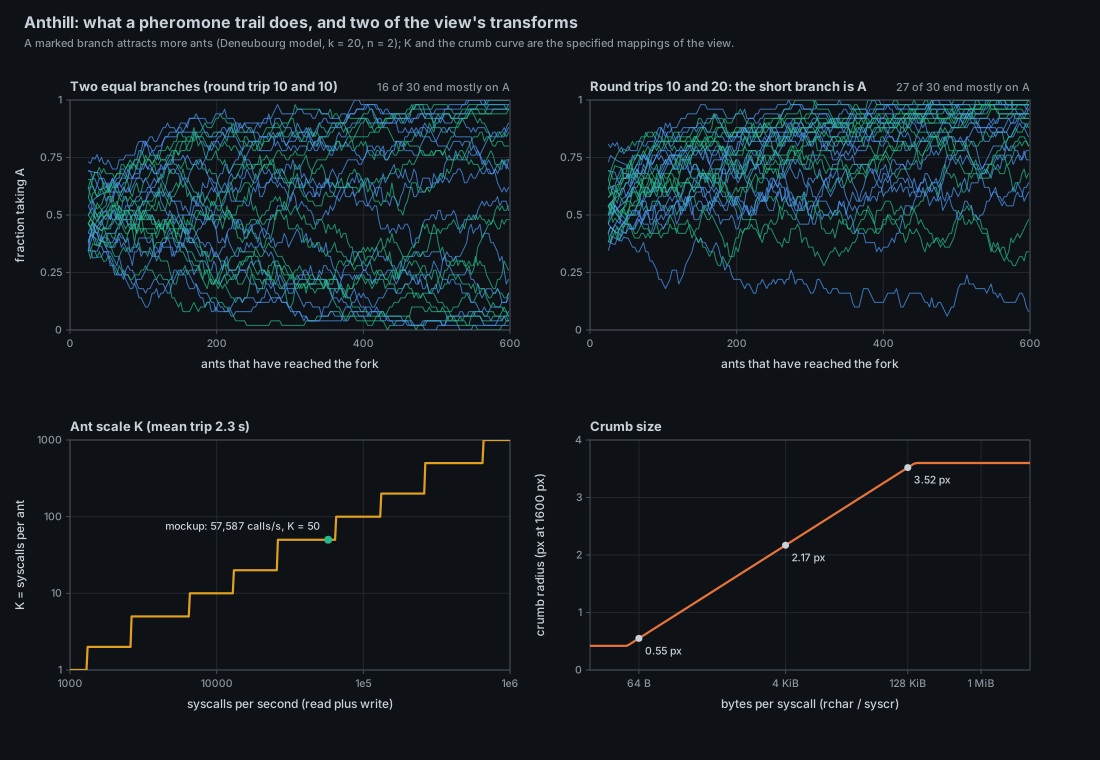
Top: the double-bridge model; thin lines are individual colonies. Bottom left: the specified ant scale K against the syscall rate. Bottom right: crumb radius against bytes per syscall. Script: docs/figures/anthill-stigmergy-crumbs.py.
In ACO (Dorigo, Maniezzo and Colorni 1996) artificial ants build tours on a graph; the probability that ant
and after every ant has finished its tour the pheromone is updated by evaporation and deposit,
with
Linux keeps seven I/O counters per process. Four of them are the view's raw material, and they are syscall-level, not device-level:
| Field | Meaning (after proc(5)) |
|---|---|
rchar |
bytes the process has passed to read(2) and similar calls, whether or not the data came from a disk (the page cache, a pipe, a socket and a terminal all count) |
wchar |
the same for write(2) and similar calls |
syscr |
the number of read-like system calls (read, pread, ...) |
syscw |
the number of write-like system calls |
read_bytes, write_bytes, cancelled_write_bytes
|
bytes the process caused to be fetched from or sent to the storage layer; the existing Process.read_rate and write_rate come from these |
From two successive readings, a rate for each follows, and the ratio Process.syscall_io: Option<SyscallIo> (reads, writes in calls per second; read_chars, write_chars in bytes per second), which is None until a second reading exists, after an exec or a counter that went backwards, when /proc/<pid>/io is unreadable, and always on macOS. P5 (issue #21) added it and it is on main.
The kernel does not say which file each read went to. What it exposes is, for each open file descriptor, a position: /proc/<pid>/fdinfo/<fd> has a pos: line with the current file offset and a flags: line with the open flags in octal. Building block B8 (issue #35) turns this into an estimate, with these binding rules:
- Key a descriptor by (
Identity, fd, device, inode, access mode). If any part of the key changes between two samples, the descriptor is new and gets no delta. - A positive
posadvance goes toreadif the file is openO_RDONLY, towrittenifO_WRONLY, and toeitherifO_RDWR: the split is never guessed. A negative advance (a rewind) attributes nothing. - If the attributed totals exceed the interval's
rcharandwchardeltas (anlseekjump can cause that), they are scaled down proportionally. - The unattributed remainder is the
rcharandwchardelta minus the attributed bytes, floored at 0. It contains everything that does not move an offset:preadandpwrite, memory-mapped I/O, asynchronous andio_uringI/O, and I/O to descriptors that were opened and closed between two samples; it also contains pipe, socket and terminal traffic, which have no meaningful offset.
Only the 24 busiest processes by syscall rate are scanned (IO_PROCESSES = 24), with caps of 256 regular files per process and 4,096 descriptors per pass; a pass is marked partial when a cap is hit. On macOS fi_offset plays the role of pos, there is no read/write syscall count, and the remainder is None.
| Quantity | Status | Basis |
|---|---|---|
| Calls per second, bytes per second, per process | measured (Linux) |
/proc/<pid>/io counter deltas: syscr, syscw, rchar, wchar
|
| Which regular files are open, their size, whether deleted | measured | the descriptor table and statx; unreadable for other users' processes without privilege |
| Bytes advanced in a file's offset over the interval | measured |
pos at two samples |
| Bytes read from or written to a given file | inferred | the pos advance, valid only for sequential I/O on a descriptor that stayed open across both samples; pread, mmap and io_uring are invisible to it |
Direction of an O_RDWR file |
not known | kept as either and never split |
| Number of calls that went to a given file | inferred | the view splits the process's call rate in proportion to attributed bytes, which assumes the call size is similar across its files |
| Bytes per call, per crumb | inferred (a mean) |
|
| Where unattributed bytes went | not known | drawn through the process's pipes and sockets if it has any (weighted by their traffic), to the terminal's blanket if it has a tty descriptor, otherwise counted and not drawn |
| The shape of each ant's route, pheromone strength, ant motion | decorative | the ant-colony rule; endpoints are data, routes are not |
| A file opened and closed between two samples | invisible | its key never appears in two successive samples; a background sample is taken about every 2 s |
| Visual element | Measured quantity (source) | Transform |
|---|---|---|
| Nest (mound) | a process | radius Process.memory; a paraboloid mesh of 24 segments (12 below 8 px radius); up to 4 entrances, one per distinct destination; placed by layout::vacant (the issue writes render::vacant) with a 1.15 times reservation, so a nest moves only when it outgrows it |
| Food pile | an open regular file in B8's FileFlow list |
one per file, capped at 256 by attributed bytes; radius thing_pick, kind "file", key from device and inode |
| Position of a pile | the file's path | a stable treemap of the directory tree: a square slab with a fixed pinwheel, a central clearing for the nests surrounded by /usr, /home, /var, /tmp and other; second-level directories take layout::Seats cells; each file at an FNV-hashed spot inside its cell |
| One ant | K system calls | the smallest K in the 1-2-5 sequence with |
| Direction of an ant | read versus write | a read ant goes nest to file and comes back with a crumb; a write ant carries a crumb out; either files send ants that carry a crumb both ways in the midpoint colour |
| Crumb size |
read_chars / reads or write_chars / writes
|
the crumb_px curve ([255,238,196], write crumbs coral [255,118,92]
|
| Ants per destination | attributed bytes | the process's reads and writes per second split across destinations in proportion to attributed bytes |
| Tunnel (dashed ribbon) | pipe, Unix and loopback TCP links (B2) |
Frame::ribbon with a dash moving with the flow at a speed proportional to |
| Blanket | a tty descriptor | up to 4, at fixed slots on the clearing's edge; reads from a tty are ants bringing back what you typed |
| Pheromone glow | the ants' own deposits | 3 channels (the nest's kind colour), 4 cells per world unit, at most 256 per side; deposit 1.0 while carrying and 0.45 otherwise; evaporation |
| Ant speed | none | 12 world units per second (the routes and speeds are decoration) |
| Sand ripples, pebble placement, blanket checks, slab sides | none | decorative |
Everything below is the specification of issue #47. None of it exists.
Module and registry. src/anthill.rs with Anthill: Default, registered as a row of views::REGISTRY, ViewInfo::new("anthill", "ANTHILL", Backdrop::Dusk, build) with build a views::Build closure, implementing ViewModule (draw(&mut self, &mut Stage, &[&Process], &Snapshot) -> usize); the scene builds the view from its row and owns its state. It would declare B8's source in the row's sources and warm up 10 s (warmup) before a headless --time frame. No view-local keys. There is no plugin system.
Dependencies. Status in the current source tree:
| Item | Provides | Status |
|---|---|---|
| P1 (#17), P2 (#18), S1 (#22), S2 (#23), S6 (#27) | registry, picker, parity check, FixedStep, source demand |
merged |
| P5 (#21) | Process.syscall_io |
merged |
| B9 (#36) |
Thing picks and Cards |
merged |
| B2 (#29) | pipe, Unix and loopback TCP links with traffic, for tunnels (Snapshot::unix_queues, Snapshot::pipes, Snapshot::link_traffic) |
merged |
| B8 (#35) |
IoDetail / FileFlow per-file attribution and tty counts |
not in the source tree |
| P3 (#19) | field primitive for the ground and the pheromone glow (src/render/field.rs) |
merged |
| S3 (#24) |
Frame::ribbon with Dash for the tunnels (src/render/strokes.rs) |
merged |
B8 is the one missing prerequisite, and it is the one that carries the per-file attribution.
Simulation. FixedStep::new(0.05, 10, 0.5) (20 Hz) with an interpolation alpha. The ants follow the prototype's Colony.step: steer toward a quadratic Bezier carrot with a hashed bend per flow, sense pheromone at plus and minus 0.5 rad, add noise of order
Layout (stable). A square slab with a fixed pinwheel; nests move only when they outgrow their 1.15 times reservation; the slab grows in 1.25 times steps only when the clearing overflows. stage.bounds is the slab's corners. Nests and piles keep their places when CPU, memory or the population change (a named test).
Rendering. The ground is one field (P3): static sand, region tint and the additive pheromone glow. Ants are two-triangle quads and are not pickable; nests are pickable by process index and piles and blankets by thing_pick. places labels the regions, the top 12 piles by traffic, and the top 2 crumb sizes (for example "128 KiB/read"). All file paths are untrusted text and pass through terminal::clean_text before display; the card of a pile shows the sanitized path, size, readers, writers and bytes per second.
Legend (specified): mound = process (size ~ memory) | pile = open file | ant = K syscalls (K = 50) | crumb = bytes per syscall | pale = read, coral = write | glow = pheromone | dashes = pipes, sockets, with fdinfo unreadable for N appended when processes cannot be read.
Demo. model::demo must provide every consumed field: consistent syscall counts and byte counts, about 24 files across the regions with pos deltas, one that opens and one that closes, a pipe, a Unix link, a loopback TCP link and one tty reader. The existing views' demo PNGs stay byte-identical.
Degradation.
- Linux: full. A process whose fdinfo is unreadable sends no ants and is counted in the legend.
- macOS: degraded but available. B8 attributes
fi_offsetadvances, butsyscall_ioisNone: an ant means K KiB moved, direction comes from the open flags, crumbs have a fixed size; the legend saysmacOS reports no read/write syscall counts: ant = K KiB moved, crumbs unsized. - Without B8 data at all: no ants are drawn, and
missing_notesays so. Never invented numbers.
Tests named by the issue include read_ants_go_to_the_files_whose_position_advanced, unattributed_bytes_travel_tunnels_or_the_blanket, k_keeps_ants_on_screen_near_three_thousand, k_steps_through_one_two_five_without_flicker, crumb_size_follows_bytes_per_syscall, file_paths_are_sanitized_before_display, pheromone_evaporates_with_its_time_constant, colony_follows_the_same_path_at_ten_and_sixty_frames_per_second, piles_and_nests_are_pickable_and_ants_are_not and missing_syscall_counts_switch_ants_to_bytes_and_say_so.
-
Rates are the machine's; routes are the colony's. How many ants leave a nest and how big their crumbs are follow
syscr,syscw,rcharandwchar. How an ant walks does not. Two runs with the same data show the same stream of ants but different paths. -
A pile with ants is a statement about file offsets. It says that a descriptor of that file advanced, and by about how many bytes, while its process was among the 24 busiest by syscall rate. It does not say the file was read by
read(2)rather thanpread(2)unless the offset moved, and a database doing positioned I/O on a large file shows no ants to that file: its bytes are in the unattributed remainder. - Ants are K calls, not events. One ant is K system calls of a flow; the legend gives K. A small K and many tiny crumbs is the signature of many small reads, a real and useful thing to see; but crumb size is a mean over the interval.
- Unattributed bytes are on purpose visible as such. Whatever the offsets cannot account for goes to tunnels or the blanket or is counted in the legend; it is never assigned to a file.
- Open and close are not seen if they are quick. A file opened and closed within one background period never appears. Short-lived processes are not seen at all by this view; see Theory-Life-Events for how exits are observed elsewhere.
- Layout encodes the path, not importance. A pile's position is a stable hash within its directory's cell; being close to a nest means nothing.
- Resolution limits. At most 256 piles, 4 entrances per nest, 3,750 ants. Processes outside the busiest 24 send no ants at all, however much they read.
None of these work yet: anthill is not registered.
# Once the view lands (issue #47).
./target/release/isotop --demo --view anthill --time 12 --width 1600 --output /tmp/anthill.png
./target/release/isotop --demo --view anthill --renderer cpu --width 1920 --benchmark 120
The quantities the view will draw can be read by hand on a Linux machine: cat /proc/<pid>/io, ls -l /proc/<pid>/fd and cat /proc/<pid>/fdinfo/<fd>. The figure regenerates from the repository root with python3 docs/figures/anthill-stigmergy-crumbs.py.
- Existing:
src/model.rs(Process.syscall_io,SyscallIo,Process.files,Snapshot.link_traffic,Snapshot.links),src/platform/linux/files.rs(classify,Bounds,FileScan: the open-file scan that B8 extends),src/platform/mod.rs(Source::SyscallIo,Source::OpenFiles),src/views.rs,src/simulation.rs(FixedStep,Rng::for_identity),src/layout.rs(Seats,vacant),src/render.rs(Thing,Card,Frame::thing_pick,label_name),src/terminal.rs(clean_text). - Also existing, which the design uses:
src/render/field.rs(P3),src/render/strokes.rs(S3:Frame::ribbon,Dash),Snapshot::unix_queuesandSnapshot::pipes(B2). - Planned:
src/anthill.rs, a registry row, and B8 (IoDetail,FileFlow). - Prototype, reference only:
docs/mockups/code/anthill.py(Colony.step,crumb_px,flow_rate, the treemapREGIONS).
- Ant colony optimisation as a layout. Let the ants minimise something real: for instance the total length of tunnels between nests that share sockets, and compare the emergent routes with the shortest paths. Does the colony find them (Goss et al. say yes for two routes)?
-
Memory-mapped I/O. Page faults of file-backed mappings (
major_faultsinProcess, already measured) are the missing channel: a process reading throughmmapmoves no offset. Major faults per second, attributed to a mapping through/proc/<pid>/mapsandsmaps, could be a third kind of ant. - Pheromone as a measurement. The decay constant of 2.2 s is a design choice. A pheromone whose evaporation matched the sampling period would make the glow read directly as "bytes in the last N seconds".
-
Latency. Ants could slow down when the process's wait channel (
wchan) says it is blocked in I/O, a thing the plumbing view considers for pipes. - Termites. The word stigmergy was coined for termites rebuilding a damaged nest. The isotop equivalent of a nest damaged and rebuilt is a service killed and restarted by its supervisor, and a view of that would show the work already done as the cue for the next worker, which is Grassé's definition.
-
Alarm pheromone. Real ants lay a different chemical when disturbed; a failed read (
EIO, areadon a deleted file) has no counter in/proc/<pid>/io, so this needs another source. -
A truth check. On a quiet machine, run a known program (
dd,cata file) and compare the view's attributed bytes with the file size and withrchar: the quickest test of the attribution rules.
- P.-P. Grassé, "La reconstruction du nid et les coordinations interindividuelles chez Bellicositermes natalensis et Cubitermes sp. La théorie de la stigmergie: essai d'interprétation du comportement des termites constructeurs", Insectes Sociaux 6, 41-83 (1959).
- S. Goss, S. Aron, J. L. Deneubourg, J. M. Pasteels, "Self-organized shortcuts in the Argentine ant", Naturwissenschaften 76, 579-581 (1989).
- J. L. Deneubourg, S. Aron, S. Goss, J. M. Pasteels, "The self-organizing exploratory pattern of the Argentine ant", Journal of Insect Behavior 3, 159-168 (1990).
- M. Dorigo, V. Maniezzo, A. Colorni, "Ant system: optimization by a colony of cooperating agents", IEEE Transactions on Systems, Man, and Cybernetics, Part B 26(1), 29-41 (1996).
- M. Dorigo, L. M. Gambardella, "Ant colony system: a cooperative learning approach to the traveling salesman problem", IEEE Transactions on Evolutionary Computation 1(1), 53-66 (1997).
- M. Dorigo, T. Stützle, Ant Colony Optimization, MIT Press (2004).
- The Linux manual page
proc(5):/proc/<pid>/ioand/proc/<pid>/fdinfo.