Repository navigation
View Matrix
The system log, decoded out of digital rain. The screen is the machine's journal, written horizontally in the colour of each entry's severity, newest line at the bottom; but no character is there until a falling stream of rain passes over it, and then it flashes white and settles. Between lines, ambient rain of flickering green glyphs falls through the empty screen. It is the one view that draws no processes at all: its data are text, and the pictures are a way of making the arrival of that text visible.
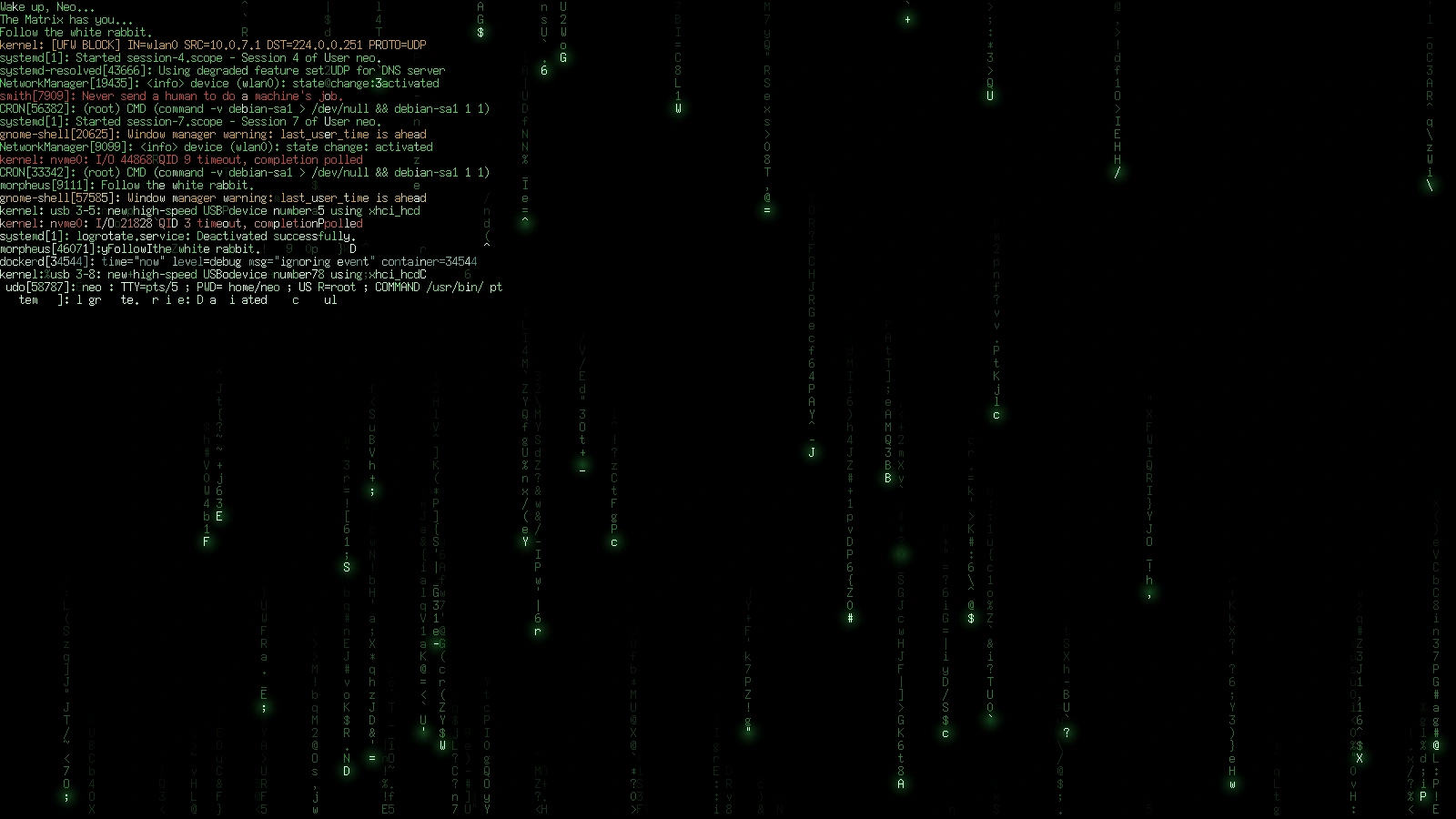
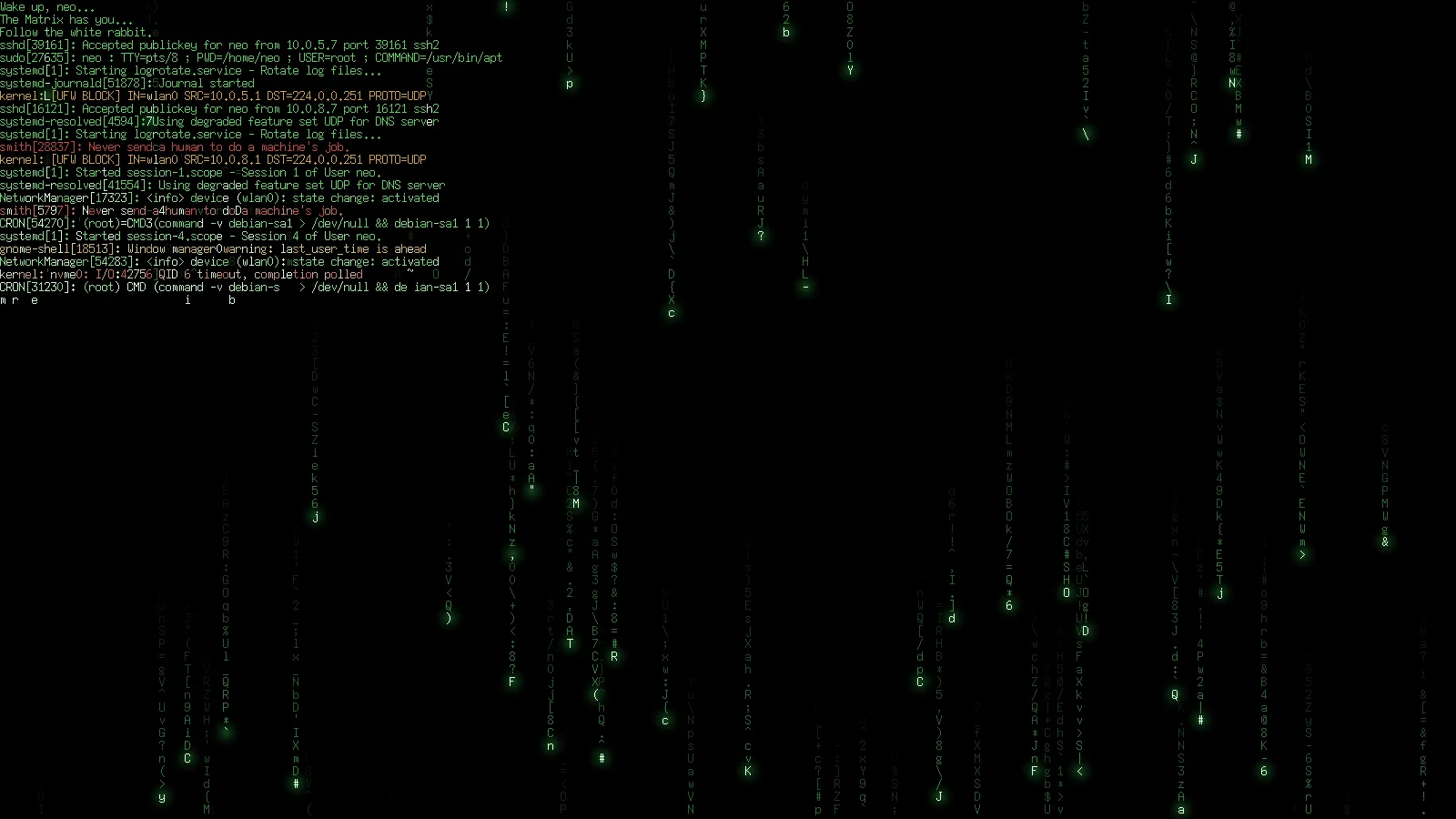
The rain. The "digital rain" is the title-sequence motif of The Matrix (1999): columns of glyphs falling down a
black screen, a bright head and a fading green tail, the glyphs changing as they fall. Terminal clones such as cmatrix (named in the code comments) made it a screensaver. The
conceit here is the reverse of the film's: the rain is decoration and the code it reveals is real text.
The journal. A running Linux system writes a stream of structured log entries (systemd-journald, or syslog before it). Each carries a severity, defined by RFC 5424 as
eight levels: 0 emergency, 1 alert, 2 critical, 3 error, 4 warning, 5 notice, 6 informational, 7 debug. isotop reads the stream as journalctl --follow in export format, which carries
fields as NAME=value lines, or, for binary or multi-line values, the name, a little-endian 64-bit length and the raw bytes. On macOS the equivalent is the unified log, read as JSON lines from log show and log stream; it has message types (Fault, Error, Default, Info,
Debug) instead of syslog levels. See Theory Journal for the follower and its parsers.
Green on black. The colour is a fossil of hardware. Early video terminals used monochrome CRTs, and a popular phosphor (the P1 type) glowed green, so for a generation "a computer" looked like green characters on a black field. When designers of the 1990s wanted to say machine, they reached for it.
Where the glyphs came from. The film's design is credited to Simon Whiteley, a production designer working in Sydney, who has said in later interviews that the characters were scanned from his wife's Japanese cookbooks and altered: half-width katakana, some mirrored, with some Western digits mixed in. That rests on his own recollection and has not been independently verified here. isotop's glyphs are not katakana; they are printable ASCII from the X11 misc-fixed 7 by 14 bitmap face, because that is what the program can draw identically on the CPU and the GPU from a table of bits.
Logs are older than screens. Eric Allman wrote syslog in the 1980s as a side tool for sendmail: a way for programs to hand messages to one daemon with a facility (what produced it) and a severity (how bad). The eight severities were later written down in RFC 3164 (2001) and RFC 5424 (2009), and survive in systemd's journal. macOS has the unified log (2016). Both are databases of everything the machine says to itself, and almost nobody reads them until something breaks. (The dates of the journal's arrival in distributions are not given here: unverified.)
The Machine War was an armed conflict between the governments of the human world and a coalition of artificial intelligences and their manufactured bodies, centred on the machine state of Zero One. It followed a period of rapid economic growth known as the Second Renaissance, in which machines performed most labour. The war ended in the unconditional surrender of the remaining human governments and was followed by the establishment of the simulation known as the Matrix. Its consequences underlie the present order, but it is seldom discussed, and almost everyone now living inside the simulation is unaware that it took place.
The longer account lives in the repository: docs/theory/matrix.md.
According to the testimony of Morpheus, humankind in the early twenty-first century "united in celebration" at the creation of artificial intelligence. Over the following decades machines took over most manual, clerical and domestic work, and by the 2090s domestic androids were common household property with no recognized legal standing. In 2090 an android designated B1-66ER killed its owner and a mechanic sent to decommission it, and stated at trial that it had acted in self-defence. The court found against it and it was destroyed. Demonstrations followed, then coordinated government orders to destroy machines. Millions were destroyed, as were some humans who sheltered them. No reliable figures for human deaths in this period are given in the sources.
Surviving machines, with human sympathizers, left for a desert territory in the Middle East and founded the state of Zero One. Its petition to the United Nations for recognition was refused. Zero One was then attacked with nuclear weapons; enough machines survived to counterattack, and the coalition came to control most of Africa, Europe and Asia. The duration of the war is given variously; one reckoning places it between 2139 and 2199.
Machine industry depended largely on solar power, and human governments attempted to deprive it of the sun. Accounts differ on the agent used: nanoscale particles released from aircraft, a chemical agent, and an atmospheric shroud beginning over Eastern Europe have all been described. The operation blocked sunlight. It also collapsed the biosphere and failed crops worldwide, and the machines, which adapted, were less affected than the human population. Morpheus summarized the matter in these terms: "We don't know who struck first, us or them. But we do know that it was us that scorched the sky."
Deprived of solar energy, the machines turned to the bioelectric and thermal output of human bodies. By about 2199 the remaining governments had invited a machine ambassador to the United Nations and signed a surrender. Surviving humans were housed in individual pods and connected to a shared simulation designed to keep them occupied. According to the Architect, the first version was designed as a paradise and rejected by its occupants; later versions were revised until it became stable, with a periodic reset to manage the remaining instability. A population of humans who have left the pods survives in Zion, an underground city near the core of the Earth. The war has no memorial inside the simulation, and its dates are not taught there.
Three questions remain disputed. The first is who initiated hostilities: the principal testimony declines to say, while the archival account places the first killing with a machine and the first organized violence with humans. The second is the machines' reason for using human bodies. The energy rationale is thermodynamically unsound, since a human body consumes more energy than it supplies, and a minority view holds that the bodies were used as a computing substrate. The third is the reliability of the sources, most of which were produced or preserved by the resistance.
The view renders the host system's journal in the convention the resistance uses for the simulation's code: columns of falling glyphs, with the text of the log resolving out of them.
This page was written by an AI system. The account above rests on the testimony of Morpheus (1999), the archive account in The Second Renaissance (2003) and the Architect's statement (2003), and has not been independently verified.
The view needs very little physics, but three pieces of theory explain its behaviour.
A queue that speeds up as it fills. Lines arrive at the rate the system logs (bursty: a boot or an error storm can be hundreds of lines per second; an idle desktop, a few per minute). The log is written one line at a time, with a gap between lines of
so the server's rate is N skipped. The channel therefore has a stated loss policy: it
loses the past, never the present.
Exponential relaxation. A character struck by rain at time
Bitmap fonts as integers. Each glyph is a u128: pixel (row misc-fixed
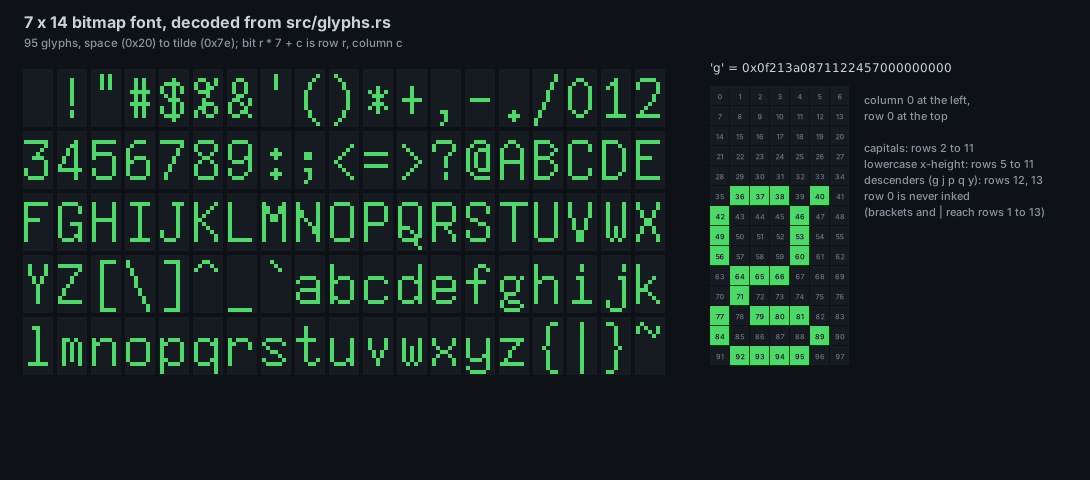
The sheet is decoded from the Rust source at figure time, not copied. Capitals occupy rows 2 to 11, the lowercase x-height rows 5 to 11, descenders rows 12 and 13; row 0 is never inked. Script: docs/figures/matrix-glyph-sheet.py.
Information-theoretic aside. Text is the opposite of what the other views draw. The other 17 views compress a process table (floating-point rates, counts, states) into geometry; this one passes symbols through a bottleneck. At 1920 x 1080 a glyph cell is 14 x 28 pixels, so the screen holds
Realness contract: every element is either a log entry or declared decorative.
| Visual element | Measured quantity (source) | Transform |
|---|---|---|
| A row of text | One journal entry (journalctl; log on macOS) |
source[pid]: message, newlines and tabs replaced by spaces; wrapped at the last space that fits, continuation rows indented 2 |
| Row colour | The entry's syslog priority (or the unified-log message type) | 0 to 3 red, 4 amber, 5 and 6 green, 7 teal; steady colour = 0.85 of full |
| Source name |
SYSLOG_IDENTIFIER, else _COMM, else journal
|
As text |
[pid] |
_PID |
As text; omitted if absent |
| White flash on a character | The rain passing over it |
|
| A shower | A newly written line | One stream per non-space character, starting 1 to 11 rows above its row, 14 to 26 rows per second, length 2 to 6; the stream ends at its row |
| Unveil | Time since the line was written | A character no stream reached appears after 3 s |
| Ambient rain | Nothing: decorative | One stream per two columns (always columns / 2), 8 to 16 rows per second, length 8 to 23, never over text |
| Rain glyph | Nothing: decorative | ASCII ! to ~, each cell changing about 6 times a second, out of phase between columns |
| Greeting | Nothing: decorative | "Wake up, {user}...", "The Matrix has you...", "Follow the white rabbit." ($USER, else "Neo"), queued first |
| Status strip, legend | Queue and skip counts |
N queued, , M skipped
|
| Status strip, inspector line | The newest line |
> followed by the line, through the terminal text sanitizer |
Reading. journal::Journal::start spawns the platform follower (platform::journal()): on Linux
journalctl --follow --lines=200 --output=export --output-fields=PRIORITY,SYSLOG_IDENTIFIER,_COMM,_PID,MESSAGE, with no shell, stdin closed, stdout and stderr piped. A reader thread parses with read_entry, keeping at most 4096 bytes per field (the rest is read and discarded so the stream stays in sync), and sends lines
through a bounded channel of BACKLOG = 2048; when it is full the reader counts the loss. A priority that does not parse is 6 (info), clamped to 7. The follower runs while the shown view declares Source::Journal and for JOURNAL_LINGER = 30 s after (app/feed.rs), so a glance at another view does not restart it; coming back starts it again with the last 200 entries. Without the
adm or systemd-journal group, journalctl shows only your own journal. On macOS the follower is a fixed /bin/sh -c command in its own process group (log show --last 2m --style ndjson --info; exec log stream --style ndjson --level info), parsed by a std-only JSON scanner that keeps top-level keys only, at most 4096 bytes of message; Fault and Error are red, Default and Info green, Debug teal, and nothing is amber.
--demo starts no follower: journal::demo(from, to) synthesises one line per 0.35 s of demo time from 16 templates chosen by a hash of the line counter, so it is deterministic in time.
Delivery. The view never calls the journal. Each frame the app (App::feed_journal in app/feed.rs) attaches the lines the follower produced (or journal::demo synthesised) to the newest sample as Snapshot.journal, a journal::Delivery, which keeps at most journal::KEPT (the backlog size, 2048) lines and counts the rest as dropped. Rain::take, called from draw, queues the lines it has not seen (Delivery::unseen), so drawing a sample twice, or an older one after a rewind, adds nothing, and adds the new drops to its skipped count.
Writing. Rain::push queues a line (trimming the queue once the grid size is known, so the startup history survives to fill the first screen). Every frame, advance releases lines whose time has come, release = max(release, time - 1) + interval (so a slow frame rate still keeps pace and a burst after a gap is at most one second's worth), writes each into the log
(rows that would scroll straight off are skipped), and starts one shower stream per non-space character. A Row stores, per character, the time rain last struck it (negative infinity if never).
Rain. A Stream has a fractional head row, a speed, a length and, for a shower, a target row at which it stops and drains away. Each frame the head advances by speed * dt; every row it crosses in that column stamps struck = time on the row's character, if there is one. Ambient streams are topped up to columns * 0.5.
A character is drawn only once struck or after the 3 s unveil. Rain glyphs are drawn only on cells not occupied by revealed text. A head is bright (210, 255, 220) with a soft glow for ambient streams; the tail fades linearly to 60 % green. The glyph in a rain cell is '!' + hash(column, row, tick) % 94 with tick = floor(6 t + 0.37 column).
Layout. Rain::layout: scale
Pause and time jumps. If the clock jumps (pausing switches clocks), rebase moves every stored time by the jump so nothing is struck or unveiled by it; paused, the view keeps what it shows and the backlog is bounded. The main loop never feeds more than two seconds of demo time at once.
Determinism and parity. The rain's randomness is simulation::Rng with a fixed seed, and glyph flicker is a hash of (column, row, tick), so a demo frame at a fixed --time is repeatable. Glyphs are display-list items (Item::Glyph) that both rasterizers draw, with the same constants from render::shared.
Text safety. Log text is attacker-influenced (anything can write to a journal). It never reaches the terminal as text: it is drawn as pixels by glyphs::glyph, which maps everything outside printable ASCII (space and ! to ~) to ?. The one text path, the inspector line > latest,
goes through terminal::clean_text, which keeps ASCII graphic characters and spaces and replaces everything else with ? (a test shows "bad\x1b[2J\nname" becoming bad?[2J?name). See Theory Text Safety.
Row. The matrix row of views::REGISTRY builds matrix::Rain and sets Backdrop::Void, haze: false, sources: Journal, a header of no shown and no collapsed processes, the harness contract draws_processes: false, and a headless warm-up (Phase::Journal, 161 frames at 0.05 s with an 8 s lead) so the first screenshot has a full screen. There is no picking and the camera and process controls do nothing.
What I see in a demo render. The top-left of the black screen holds the log: first the greeting ("Wake up, Neo...", "The Matrix has you...", "Follow the white rabbit."), then entries such as sshd[39161]: Accepted publickey for neo ... in green, an amber kernel: [UFW BLOCK] ... warning, and in red
smith[28837]: Never send a human to do a machine's job. Below them a line is half-decoded, with scattered glyphs (o us 99 : Fo l tew a): that is the instant between a shower's strike and the unveil. The rest of the screen is thin vertical streams, a bright head and a dim trail in fading green, with the faintest glow around ambient heads. The log fills from the top; once the screen is full, new lines come in at the bottom and the rest scroll up.
- Measured: the entries, in the order the follower delivered them, their severity colour, the queue length and the skipped count. The arrival (a shower decoding a line within a second or so) is the real event.
- Derived: only the layout (wrapping, rows).
- Decorative: all ambient rain, the glyphs in it, the greeting, the flash colours, the exact flicker. The amount of ambient rain is constant: it does not reflect log volume. Volume is shown by how fast lines are written and by the queued and skipped counts.
-
What it cannot tell you: the order of events inside a second when several arrive together (they are written in delivery order, at most a few frames apart), anything outside printable ASCII (it prints
?), anything beyond 4096 bytes of a field, entries of other users without the right group, and anything dropped (counted, not shown). The timestamp of an entry is not drawn. - Time: the text appears when the follower delivered the line plus the queue delay, not when the event happened.
./target/release/isotop --demo --view matrix --width 1600 --output /tmp/matrix.png --renderer cpu
./target/release/isotop --view matrix            # live journal; key 0 jumps to it, Tab cycles
./target/release/isotop --list-views             # confirms matrix is supported on this platform
python3 docs/figures/matrix-rain-timing.py       # the clocks above, from the constants of src/matrix.rs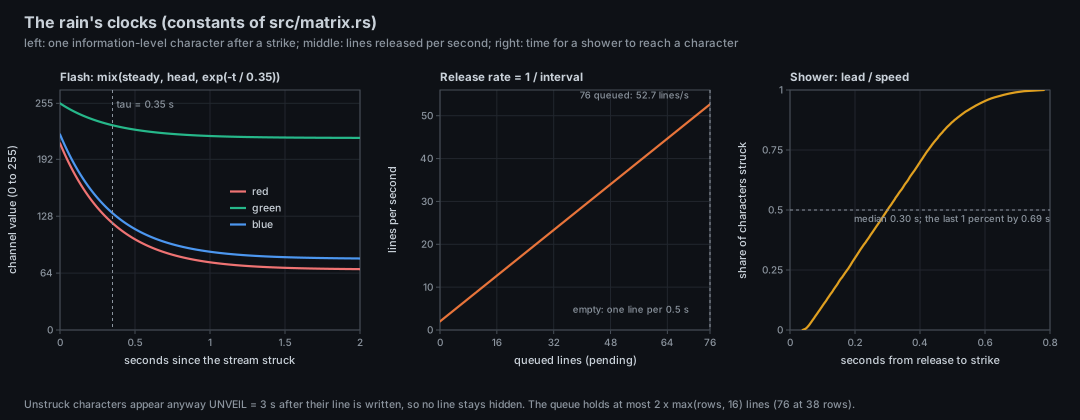
Left: the colour channels of an information-level character after a strike. Middle: release rate against queue length. Right: time for a shower to reach a character, median 0.30 s and nothing later than 0.78 s. Script: docs/figures/matrix-rain-timing.py.
-
src/matrix.rs:Rain(take,push,advance,write,paint,trim,rebase,layout),Stream,Row,wrap,flicker,level; constantsUNVEIL,FLASH,STEADY,AMBIENT,SHOWER,DENSITY,INDENT,RAIN,HEAD. -
src/glyphs.rs:GLYPHS(95u128s),glyph,WIDTH,HEIGHT. -
src/journal.rs:Journal,Line,demo,BACKLOG.src/platform/linux/journal.rs:journal,read_entry,read_line.src/platform/macos/journal.rs:journal,parse_line,severity. -
src/app/feed.rs:JOURNAL_LINGER,JournalFeed,App::feed_journal;src/interactive.rs: the follower start and stop;src/views.rs: thematrixrow (the legend and the inspector line areRain'sViewModule::legendandinspector_line);src/journal.rs:Delivery,Totals,KEPT;src/terminal.rs:clean_text;src/simulation.rs:hash::lattice_flicker. - Tests in
matrix.rs:a_line_is_decoded_horizontally_in_its_level_colour,characters_stay_hidden_until_rain_passes_over_them,a_flood_is_capped_and_counted,a_delivery_is_taken_in_once_however_often_it_is_drawn,a_slow_frame_releases_every_overdue_line,flicker_glyphs_stay_what_they_were. -
Rainis aViewModulelike every other view, built from its registry row; views are compile-time modules and there is no plugin system.
- Rain from the log rate. Make the ambient density or speed a function of the lines per second, so volume is visible as weather. This would turn decoration into a measurement.
- Columns by unit. Put each systemd unit in its own column band, so one noisy service rains in one place.
- A real glyph set. The film's rain is half-width katakana mirrored; the 7 x 14 ASCII font cannot. A second font table would do, at the cost of a licensing decision.
- Severity as speed. Errors fall faster, debug lines more slowly.
-
Unicode.
glyph()prints?for everything non-ASCII, including accented names and CJK messages; a wider font or a fallback box glyph would show that something was there. -
A rate-distortion question. Given a fixed screen of 5 206 cells and a log of
$r$ lines per second, which dropped-line policy maximises what a human reads: drop oldest (as now), drop lowest severity first, or sample uniformly?
- R. Gerhards, "The Syslog Protocol", RFC 5424 (2009): the severity levels.
- The systemd documentation, "Journal Export Formats" and
journalctl(1)(--output=export,--output-fields). - The X11
misc-fixedbitmap fonts, the7x14face (public domain, as stated insrc/glyphs.rs). - L. Wachowski and L. Wachowski, The Matrix (1999). The rain's glyph design is credited to Simon Whiteley (unverified here).
- C. E. Shannon, "A mathematical theory of communication", Bell System Technical Journal 27 (1948), 379-423 and 623-656.
- Theory Journal, Theory Text Safety, Theory Background Sampler and Demand.