Repository navigation
Theory History
A view that draws the past (Strata's ridges, Ptolemy's epicycles, the flashes of a birth) cannot wait a minute
for the past to accumulate when you switch to it. So isotop keeps one shared history of every process's CPU and
memory, recorded on every sample whichever view is shown, and lets views read windows of it. This page is that
structure: what a sample holds, the ring and its capacity, the four ways to read it (window, recent, series,
changes), how a headless run fills it, what it costs in memory, and a problem it has today with --sample-ms
(open issues #126 and
#127) that this page states as it is.
The ring buffer. A fixed-size buffer in which the newest entry overwrites the oldest is among the oldest data structures in computing; this page does not date it. The one that matters here is the round-robin database, RRDtool, which Tobias Oetiker presented at LISA '98 as the storage of the next Multi Router Traffic Grapher (MRTG) and released as version 1.0 on 16 July 1999. Its premise is the same as History's: monitoring data has a fixed horizon, so the store should have a fixed size and no cleanup. It differs in keeping several resolutions of the same series (consolidation) where History keeps one, at the sample interval, and gives up the oldest.
At the default interval the 240 samples of CAPACITY are four minutes, which is the length of a typical single.
In this project. On 2026-10-08 the scene began recording each sample whichever view was shown, so that Strata opened a minute deep ("Record strata history in every view"), and the ring then lived inside Strata. The shared History, with CAPACITY = 240, arrived on 2026-10-11 with the first module views (#123). The cause of issue #127, that 240 samples is a count and not a duration, is inherited: Strata's own ring held 240 samples before the shared history existed.
What it is for. The views that read it are the ones whose subject is time: Strata's ridges, Ptolemy's epicycles (a discrete Fourier transform needs a past before it has a spectrum) and Ptolemy's novae. Each is a different answer to the question RRDtool answered once: how much of the past is worth keeping, and at what resolution.
isotop has two things called history and they are unrelated:
App::history |
Scene::history (History, history.rs) |
|
|---|---|---|
| holds | whole Snapshots |
per-process (cpu, memory) readings |
| size |
--history, default 120 snapshots (2 to 3600) |
history::CAPACITY = 240 samples, fixed |
| purpose | pause, rewind and step: the app draws history[index]
|
views that need the recent past |
| read by | the main loop | views, through Stage::history
|
The rest of this page is the second. The first is a HistoryPlayer (app/player.rs) over a VecDeque<Snapshot>; while paused the main
loop stops sampling and the app draws an older snapshot from it, and the shared History ignores any snapshot that
is not newer than its newest, so rewinding cannot corrupt it.
pub struct Reading { pub cpu: f32, pub memory: u64 }
pub struct Sample  { pub elapsed: f64, pub sequence: u64, readings: Vec<(Identity, Reading)> }
A Sample is one snapshot reduced to what history wants: elapsed (seconds on the collector's monotonic clock,
Snapshot::elapsed), an absolute sequence number (how many samples were recorded before it; it keeps rising when
the ring turns over, so a view can number samples across windows), and the readings sorted by Identity.
Sorting buys binary search (Sample::reading) and a linear merge between two samples (below).
The doc comment says the readings are "the raw readings, not the scene's display smoothing". Be precise about raw:
Reading::cpu is Process::cpu, which in a live run has already been through the model's exponential filter
(time constant 1.5 s, Model and rates); it is raw only relative to the
extra visual easing the scene applies for drawing. In --demo there is no filter and the formula value is stored.
History is a VecDeque<Sample>, oldest first, with strictly increasing elapsed:
-
record(snapshot, time)appends a sample unless it is not newer than the newest (elapsednot strictly greater, orNaN): the scene and a replay may both offer the same snapshot, and a paused app re-offers old ones. Then it pops from the front whilelen > CAPACITY.timeis the scene time the sample arrived at, kept asarrived()so a view that scrolls can glide between samples instead of jumping. -
Scene::recordcalls it on every sample;Scene::rendercalls it again with the snapshot it is drawing, which is a no-op in a live run and the fill in a headless or test run that never callsrecord.
CAPACITY = 240 is a number of samples, not seconds. At the default one-second interval it is four minutes.
Every read is relative to an until, normally the shown snapshot's elapsed, so pause and rewind show the past they
were taken in.
| method | selects | cost |
|---|---|---|
window(until, seconds) |
samples with until − seconds ≤ elapsed ≤ until
|
two binary searches (partition_point) |
recent(until, count) |
the last count samples at or before until
|
one binary search |
series(id, until, count) |
for one process, its Reading in each of those count samples, None where absent |
count binary searches; currently unused outside tests |
changes(until, seconds) |
births and exits between consecutive samples in a window | a linear merge per adjacent pair |
newest(), arrived()
|
elapsed and scene time of the newest sample |
O(1) |
window is a duration; recent is a count. The first is how a view should ask: it is correct at any
--sample-ms. The second answers "the last N samples" and so means N seconds only at one-second sampling. The
project's own convention (docs/VIEW_CONVENTIONS.md) is to express time windows in seconds of snapshot.elapsed, not
as sample counts.
Because each sample is sorted by Identity, finding who appeared and who left between two consecutive samples is the
merge step of merge sort: walk both lists with a peekable iterator on each; if the old head is smaller, that identity
left; if the new head is smaller, it arrived; if equal, both advance. Each adjacent pair costs Change records the identity, the elapsed of the first sample it was in (a birth) or the first
it was missing from (an exit), whether it was born, and its first reading (a birth) or its last (an exit). The oldest
sample in the history has nothing before it, so it reports no births: a history that starts with a running machine
does not count the machine as newborn.
This is inference from snapshots, with the limit that implies: a process that lived and died inside one interval is
never seen, and nothing says why a process left. The exact and detailed alternative is
Snapshot::life, which exists only while a view demands it. Ptolemy flashes novae and fades from
changes; the Necropolis, whose subject is death, uses events.
-
Strata reads
window(now, 60.0): a 60-second window by elapsed time. -
Ptolemy reads
recent(until, SERIES)withSERIES = 60, a count, andchanges(until, 8.0)for its flashes. -
Tesseract does not use
History: it needs cumulative CPU seconds at a 0.25 s cadence for 180 s, so its ownWorldlinesrecorder keeps that (the conventions allow this when the data is not CPU percent and memory). - Coop keeps its own per-process CPU history for the flocks' variation.
A live run has its history by the time you press a key, because it has been recording. A headless render
(--output, --benchmark) has no past, so warm_up in headless.rs makes one:
-
replay_history(demo, headless runs only): record the demo samples of thehistory::SERIES= 60 whole seconds before--time(at = time − backforbackfrom 60 down to 1, skippingat < 0), each with the life events sinceat − 1. These go straight intoscene.history, not throughScene::record, so no view's own record hook sees them. A row that already fills history while it rasterizes (Phase::History, Strata) skips this. -
The row's own phases:
Phase::History { seconds }renders frames at one-second steps;Phase::Recordrecords one-second steps throughScene::record;Phase::Replayrecords at--sample-mssteps (seconds / sample_secondssamples);Phase::Playplays the seconds beforetimefor a view that builds its state insidedrawand does not record what it plays;Phase::SettleandPhase::Journalrender frames to settle motion.
The captured frame's own sample is then recorded by the first render. The tests pin the counts: a Coop render has 61
samples in window(75, 60) with the replay and 31 without.
Note the spacing: the history replay uses one-second steps whatever --sample-ms is, while a live run records at
--sample-ms. Hold that thought.
A reading is an Identity (16 bytes with alignment) and a Reading (16 bytes): 32 bytes per process per sample, plus
a small Sample header. At CAPACITY = 240:
--processes / processes live |
per sample | full ring |
|---|---|---|
| 192 (demo default) | 6 KB | 1.5 MB |
| 1 000 | 32 KB | 7.7 MB |
| 10 000 | 320 KB | 77 MB |
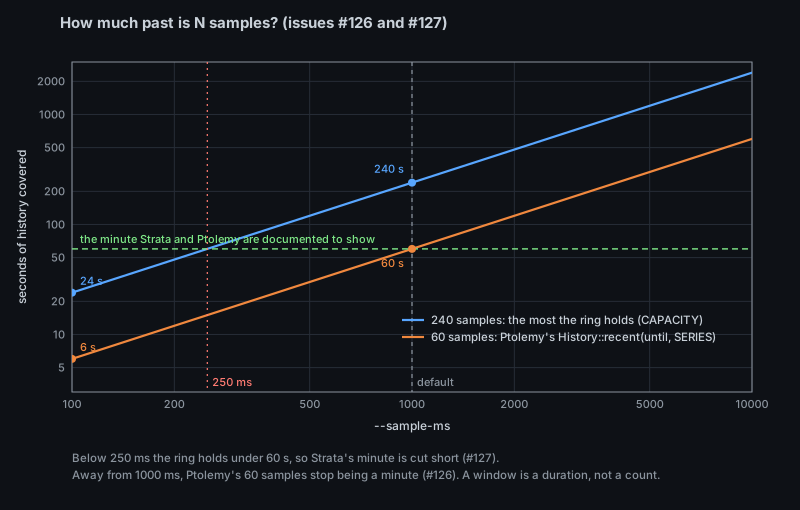
The ring and Ptolemy select by sample count; the promises made about them are in seconds. They agree only at the
default --sample-ms 1000.
-
#127 (retention). 240 samples is
$240\cdot\Delta t$ seconds. Below--sample-ms 250the ring holds fewer than 60 seconds, so Strata's 60-secondwindowis silently cut short: at 100 ms the ring covers 24 s. The issue notes this is not a regression (Strata's own ring held 240 samples before the shared history existed) and proposes sizing retention by elapsed time, at a memory cost it states (about 19 MB for 60 s at 100 ms with 1 000 processes, which matches the table above). -
#126 (selection). Ptolemy's
recent(until, 60)is the last 60 samples: a minute at one second, 6 s at 100 ms, ten minutes at 10 s. That changes which processes become planets and what the discrete Fourier transform sees, while the epicycle period assumes one minute. Because the headless replay is at one-second spacing, a live run and a headless run of Ptolemy disagree at any non-default--sample-ms. The proposed fix is to build the window bySample::elapsed(or resample to 60 points over the last 60 s).
Both were triaged as non-blocking: the default gives exactly the documented minute. Neither is fixed in the code described here.
- A ridge or planet is built from the last N readings of a filtered CPU figure, so it inherits the filter's delay (about 1.5 s) and the quantisation floor.
- An absent identity in a window means "not in that snapshot": it may not have existed, or may have been an unreadable process. History does not distinguish.
- A birth or exit from
changesis stamped with the sample that saw it, up to one interval after it happened. - Whatever a view shows about the past at a non-default
--sample-msshould be read with the two issues above in mind.
-
history.rs:History,Sample,Reading,Change,CAPACITY,SERIES. -
render.rs:Scene::record,Scene::render,Stage::history. -
headless.rs:warm_up,replay_history,run_phases;app/player.rs:HistoryPlayer,App::historyand--history. -
strata.rsandptolemy.rs: the readers;views.rs:Phase,Warmup,When. - Figure script:
docs/figures/history-window-vs-sample-ms.py.