Repository navigation
Theory Determinism
isotop makes one promise that most real-time graphics programs cannot make: isotop --demo --view city --time 12 --renderer cpu --width 480 --output a.png writes the same bytes every time, on every run, and a hash of those
bytes is checked into the repository. This page explains what that promise is made of: which inputs the frame
is a function of, how every source of randomness is seeded from a process's identity, how simulated time is
decoupled from frame time, what the golden hashes in tests/golden.txt do and do not certify, and what is
not deterministic in a live run and why that is correct. It also takes the information-theoretic view:
a 192-bit digest standing for a frame of 11.4 million bits.
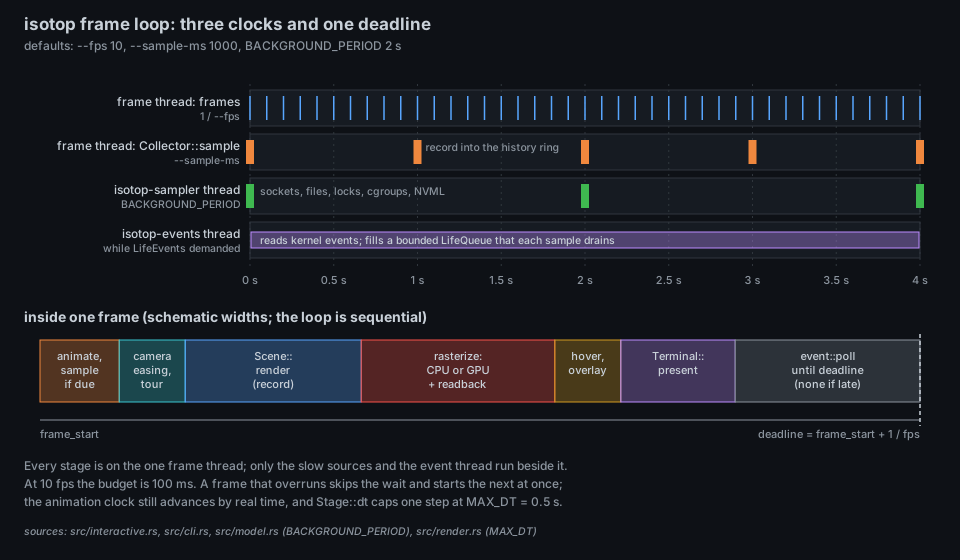
The three clocks of a live run (from Background sampler and Scene and display list). Determinism is the discipline of making the picture depend on the first two only through values that a headless run can reproduce.
The problem of making a machine produce numbers that look random, and produce the same ones again on request, is as old as the machines. John von Neumann proposed the middle-square method for the ENIAC's Monte Carlo calculations (sources date the proposal to 1946, and its public description to a conference in 1949): square an
Three lines of descent lead to the generators in simulation.rs. Marsaglia's xorshift generators (Journal of Statistical Software 8(14), 2003) use only shifts and exclusive-ors; Brent's note of 2004 showed that they are linear feedback shift register generators in disguise and inherit those generators' theory. Steele, Lea and Flood's SplitMix (OOPSLA 2014) was written to split a generator into independent streams and shipped in the JDK 8 as java.util.SplittableRandom; Steele and Vigna later reported detectable weaknesses in its output function, and its period is limited to
The hashes have a plainer past. The FNV hash grew out of reviewer comments that Glenn Fowler and Phong Vo sent to the IEEE POSIX P1003.2 committee in 1991; Landon Curt Noll improved the method during a ballot round, and the three names became its name. It is non-cryptographic by design, and has an IETF Internet-Draft; Noll's repository says it has since become RFC 9923 (unverified here).
The clock has its own tradition. Glenn Fiedler's "Fix Your Timestep!" on the Gaffer On Games site argues for integrating in fixed steps, carrying the remainder, and interpolating the drawn state between the last two; the reference list below dates it 2004, and one mirror of the article is dated 2006. Floating point is the last source of drift: IEEE 754 appeared in 1985 and was revised in 2008 and 2019, and none of them requires the transcendental functions to be correctly rounded, which is why the golden hashes are tied to one platform. Randomised hash-table order is a response to a different problem: Crosby and Wallach (USENIX Security 2003) showed that a predictable hash function lets an attacker degrade a hash table to a list, and the standard library's per-instance seeding is in that tradition.
docs/VIEW_CONVENTIONS.md ("The realness contract", "Simulation time", "Seeded randomness", "Demo
synthesis") states the determinism clauses of isotop's contract:
-
--demosynthesizes every field a view consumes, and--time T"makes a frame repeatable byte for byte". - "Simulations advance on wall-clock time, never per frame. All randomness is seeded from process identity
and
--time." - Per-process randomness is
simulation::Rng::for_identity(id, SALT)with oneSALTper view. Demo-wide randomness is "a pure function of--timeand indices". Stateless per-frame variation (flicker, jitter) is "a hash of a stable id and an event index, never a per-frame RNG advance". Gaussian draws useRng::normal. - "Two runs with the same
--timeproduce byte-identical PNGs." -
model::demo(time, count)stays byte-identical across changes; views that need more ask for it throughDemoOptionson their registry row.
The realness half of the contract (every element maps to a measured quantity or is declared decorative) and the determinism half are one statement seen from two sides. A picture is a function from measurements to pixels. If that function has hidden state (an unseeded generator, a per-frame accumulator, a hash-table iteration order) then some of the picture's information comes from nowhere, from no measurement: numbers are invented. Determinism is the testable form of "nothing is invented": every bit of decoration is a function of something the machine told isotop, usually a pid and a start time.
A headless frame is the value of this composition (headless::run, demo_snapshot, warm_up, App::render,
Frame::rasterize):
flowchart LR
    O["Options: --view --time --processes --width --sample-ms --limit"] --> D
    D["demo_snapshot(row, time - sample, time, count)<br/>= model::demo_with(time, count, row.demo)<br/>pure function"] --> W
    W["warm_up: replay_history + the row's Phases<br/>(History / Record / Replay / Play / Settle / Journal)<br/>replayed at fixed demo times"] --> R
    R["app.animation = options.time<br/>App::render -> Scene::render"] --> F
    F["Frame::rasterize (CPU)<br/>colour, pick, depth buffers"]
    S["Scene state: eased CPU/memory, births,<br/>layout (Seats, Discs), view modules"] --> R
    W --> S
Every arrow is a function of its inputs and of the earlier arrows. The demo workload is closed-form: for base
process model::demo_with,
memory Identity { pid: 1000 + i, start: i + 1 }. There is
no generator in it. (phase is computed in f32 from time as f32, which is the first place the precision of
the arithmetic enters the pixels.) Births and exits (DemoOptions::churn) and their causes (mortality)
do use Rng, seeded Rng::new(hash_identity(Identity { pid: family, start: epoch }, SALT)) with their own
salts, so that a death at demo time demo_life_over_split_intervals_equals_one_long_interval).
What the headless path adds to make a settled frame is bounded and itself deterministic: the warm-up phases of
a row replay demo samples at times computed from --time and --sample-ms (Phase::Replay samples at
time - back * step, Phase::Record at whole seconds before --time, Phase::Settle renders frames at
time - lead + index * step), so the state a view has when the real frame is drawn is a function of --time
alone.
Everything random is in src/simulation.rs;
a test (no_hand_rolled_hashes_outside_simulation) scans every other .rs file for the multiplier constants
and fails on a copy.
State is one u64. next_u64 adds the increment
This is the SplitMix64 generator of Steele, Lea and Flood (2014). The finaliser is a bijection on 64-bit words
with strong avalanche, so a counter advanced by unit() takes the top 24 bits, (next_u64() >> 40) as f32 / 16_777_216.0, which is in f32 has a 24-bit significand. normal() is the
Box-Muller transform, described on the toolkit page.
pub fn hash_identity(id: Identity, salt: u64) -> u64 {
    splitmix_finalizer(splitmix_finalizer(splitmix_finalizer(u64::from(id.pid)) ^ id.start) ^ salt)
}
and Rng::for_identity(id, salt) = Rng::new(hash_identity(id, salt)). Three properties are deliberate:
- Consecutive pids are unrelated (the finaliser avalanches), so process 1000 and 1001 do not look alike.
-
A reused pid differs from its predecessor because
Identitycarries the start time (field 22 of/proc/<pid>/stat, in clock ticks since boot) and it is mixed in. A test fixes both claims (hash_identity_separates_reused_pids_by_start_time). -
saltseparates independent uses of one process (drift versus colour versus phase). Salts in the tree are ASCII in hex: Necropolis0x6e65_6372_6f21, Ptolemy0x7074_6f6c_656d_7901and..02, Arbor0x6172_626f_7231, Murmuration0x6d75_726d_7572_6174, Cortex's five, Horizon's two, the demo's churn, signal, record and mortality salts, the harness's own.
The seed is a function of (pid, start, salt), and (pid, start) is something the machine measured. That is
why the decorative randomness of a view is not "invented": it is a deterministic, reproducible function of
measured identity. A hash of identity is stateless, so it is also independent of how many frames have been
drawn.
Older views seeded from the pid alone with small multiplicative hashes. hash::knuth(v) = v * 2654435761
(Knuth's multiplicative hash, the 32-bit golden-ratio prime; its good bits are the high ones, so callers shift
right, as kind_color does with >> 24), xxhash_prime2, knuth_xor_rotated_prime2, murmur_mix,
lattice_flicker, fnv1a_32. They are kept bit-exact because replacing one changes pixels, and pixels
are under golden hashes. The comment // pid only: kept for pixel stability, see A33 marks each site, and the
open issue #92 is the plan to retire them view by view with
the owner's approval, re-blessing the hashes each time. The one practical difference: the old hashes cannot
tell a pid from its reuse (hash_identity_separates_reused_pids_by_start_time asserts
hash::knuth(first.pid) == hash::knuth(reused.pid)).
XorShift32 is Marsaglia's 32-bit xorshift with shifts (13, 17, 5) (Marsaglia 2003): GOLDEN_RATIO_32 medium.rs) and draws from it for every emitter. A single shared
stream is history-dependent: what one particle gets depends on how many random numbers every other particle
consumed first, so the picture depends on frame rate, on population changes, and on the order in which a hash
map is iterated. That is the reason Flow is on the list in section 7.
The contract's "a hash of a stable id and an event index, never a per-frame RNG advance" is the
counter-based style of generator (Salmon et al. 2011: a random number is a pure function of a key and a
counter). The Matrix rain's glyph flicker is lattice_flicker(column, row, tick); the demo journal hashes a
line counter with golden_gamma_high; the Coop's fractions are unit_from(murmur_mix(seed)). Because the
function has no state, a frame can be drawn out of order, twice, or after a rewind and still show the same
glyph. A generator with a cursor cannot offer that.
| clock | type | who advances it | deterministic headless? |
|---|---|---|---|
demo time demo_time
|
f64 seconds |
--time (default 12.0); in a live --demo run origin.elapsed() at each sample |
yes: it is the argument |
App::animation |
f32 seconds |
headless: options.time, plus i / fps per frame in --benchmark; live: += elapsed each frame, standing still while paused |
yes headless |
Snapshot::elapsed |
f64 seconds |
the sampler; in demo, equals demo time | yes |
Snapshot::wall |
f64 Unix seconds |
live: the system clock; demo: DEMO_EPOCH + time, with DEMO_EPOCH = 1_791_605_520.0 (2026-10-10T04:12:00Z) |
yes |
A view never reads the system clock (it cannot tell a demo run from a live one); calendar-dependent visuals
(the Necropolis moon) read Snapshot::wall. The one exception is the Matrix greeting, which reads $USER
through login() in matrix.rs; in a test build login() returns nothing and the greeting falls back to
"Neo", so the golden test and the harness do not depend on the machine.
This is listed in #92.
A simulation that advances per frame changes with the frame rate; one that advances per wall-clock second does not. There are two sanctioned ways (derived in the toolkit page):
-
Stage::dt, computed once per frame byFrameClock::step(time, paused): 0 on the first frame, while paused and when time went back (a rewind or a headless replay); otherwisemin(time - last, MAX_DT)withMAX_DT = 0.5. Use it for anything that integrates a smooth ODE (eases, decays, drifts). -
FixedStep(FixedStep::new(step, max_steps, max_gap)), fedstage.time: whole steps of a fixed size, so the trajectory is independent of frame times. Coop usesFixedStep::new(0.05, 10, 0.5)(H,MAX_STEPS,MAX_GAP); Arbor, Murmuration and Cortex use it with their own constants.
The property tested is not "the same pixels" but "the same state after the same number of steps"
(fixed_steps_follow_the_same_path_at_ten_and_sixty_frames_per_second,
flock_follows_the_same_path_at_ten_and_sixty_frames_per_second, and the Tesseract's
the_orientation_eases_alike_at_ten_and_sixty_frames_per_second for exponential easing). Pause and rewind take
no steps.
Views that predate the contract do not all meet it. Verified in the tree, and tracked by #92 ("changes pixels, needs decision"):
| view | deviation | where |
|---|---|---|
| Flow |
dt clamped to 0.1 s (runs in slow motion below 10 fps); one shared XorShift32 seeded GOLDEN_RATIO_32
|
views/flow.rs ((time - flow.time).clamp(0.0, 0.1)), medium.rs
|
| Reef |
dt clamped to 0.1 s |
reef.rs |
| Cores |
dt clamped to 0.5 s |
cores.rs |
| Ripple | its own clock with CFL substeps | medium.rs |
| Orbit | galaxy continuity decided by a frame counter (self.frame + 1 == frames) |
views/systems.rs (Galaxy::revolve) |
| Matrix | reads $USER
|
matrix.rs (login) |
| pid-only seeding |
hash::knuth(pid) etc. at about a dozen sites |
palette.rs, reef.rs, coop/sim.rs, necropolis.rs, model.rs, render.rs, views/orbit.rs, views/ripple.rs, views/systems.rs
|
Below the clamp (10 fps for a 0.1 s clamp) these views run slower than real time rather than diverging, which
is the safe failure; they are deterministic in a headless run, where frames are generated at a fixed --fps.
Rust's HashMap is seeded per instance. A direct check on this machine, three maps built from the same ten
keys in one process, printed in key order:
[8, 3, 2, 4, 0, 5, 1, 7, 9, 6]
[1, 2, 3, 6, 0, 4, 7, 8, 5, 9]
[1, 7, 2, 8, 0, 3, 9, 5, 4, 6]
and a different set of three on the next run. Anything that iterates a map and lets the order reach the
output (a sum of floats, the order of overlapping translucent beams, the consumption of a shared random stream)
is nondeterministic. The tree's discipline is to sort: Seats::assign visits newcomers in Identity order,
Discs::arrange sorts pending discs by radius then name, model::top_n breaks ties by Identity, SpatialHash
sorts a cell's points by index, and the two sites that draw Snapshot::outside (Scene in render.rs and views/flow.rs) sort it by Identity.
Issue #108 is the case study: Flow rendered a different PNG on
every run (4 of 4) and Orbit two different PNGs across 12 runs (differing in two pixels by at most two levels)
because both iterated Snapshot::outside; the cause was found by sorting one site at a time. (The issue text
says the field became a BTreeMap; in the tree it is still a HashMap and the two consumers sort.) The
spatial hash for cells uses a fixed hasher (BuildHasherDefault<CellHasher>), not RandomState, so even its
internal order is reproducible.
The frame is built from f32 arithmetic with sin, cos, exp, powf and sqrt. IEEE 754 fixes + - * /
and sqrt exactly; the transcendentals are not correctly rounded by libm, and different libms (and different
architectures) differ in the last bit. A last-bit difference is a different pixel after a floor. That is why
the checked-in golden hashes are those of Linux on x86_64, and the comparison runs only there: "Elsewhere every
view still renders, which catches panics, and the comparison is skipped" (the doc comment of
every_view_matches_its_golden_hash). ISOTOP_GOLDEN_FILE=<path> compares against a local baseline on any
platform. Rust does not contract a*b+c into a fused multiply-add on its own, which keeps the CPU path
portable; the GPU path is checked for tolerance, not equality (see
GPU and parity).
| check | where | what it proves |
|---|---|---|
Property::Deterministic |
harness.rs |
for every registered view: two headless runs from the same inputs (the steady run and the rescaled run, before their change) draw the same colour bytes and the same picks |
every_view_renders_the_same_frame_twice |
headless.rs |
the golden render of every view, done twice in one process, gives equal hashes. Each render builds fresh HashMaps, each with its own hasher seed, so it is also a test of hash-order independence |
every_view_matches_its_golden_hash |
headless.rs, tests/golden.txt
|
the colour, pick and depth buffers of --demo --time 12 --renderer cpu --width 480 hash (FNV-1a 64) to the stored values (Linux x86_64 only) |
bless_mode_rewrites_the_golden_file |
headless.rs |
the bless mechanics, against a temp path |
| 10 versus 60 fps tests |
simulation.rs, coop/sim.rs, tesseract.rs
|
same state after the same number of steps, or the same eased angle |
tests/golden.txt has one line per view: name pixels picks depth, three 16-digit hex FNV-1a 64 values.
The depth buffer is hashed as f32::to_bits little-endian, the picks as u32 little-endian, the pixels as
raw RGB bytes. ISOTOP_BLESS=1 cargo test every_view_matches rewrites the file; a pull request that changes a
hash "says why in its description and carries the renders" (AGENTS.md).
The golden pixel hash is the FNV-1a 64 of the 388 800 RGB bytes of the 480 by 270 frame, which is exactly the
image --output writes. A PNG decoder is forty lines of standard library, so the checked-in value can be
reproduced by a program that shares no code with isotop:
import sys, zlib, struct

def fnv1a64(data):                      # offset basis 0xcbf29ce484222325, prime 0x100000001b3
    h = 0xcbf29ce484222325
    for b in data:
        h = ((h ^ b) * 0x100000001b3) & 0xFFFFFFFFFFFFFFFF
    return h

def read_png(path):                     # 8-bit RGB, non-interlaced, as isotop writes it
    d = open(path, 'rb').read(); pos = 8; idat = b''
    while pos < len(d):
        n, = struct.unpack('>I', d[pos:pos+4]); kind = d[pos+4:pos+8]; body = d[pos+8:pos+8+n]; pos += 12 + n
        if kind == b'IHDR': w, h = struct.unpack('>II', body[:8])
        elif kind == b'IDAT': idat += body
    raw = zlib.decompress(idat); stride = w * 3; out = bytearray(); prev = bytearray(stride); p = 0
    for _ in range(h):
        f = raw[p]; line = bytearray(raw[p+1:p+1+stride]); p += 1 + stride
        for i in range(stride):
            a = line[i-3] if i >= 3 else 0; b = prev[i]; c = prev[i-3] if i >= 3 else 0
            if f == 1: line[i] = (line[i] + a) & 255
            elif f == 2: line[i] = (line[i] + b) & 255
            elif f == 3: line[i] = (line[i] + ((a + b) >> 1)) & 255
            elif f == 4:
                pa, pb, pc = abs(b-c), abs(a-c), abs(a+b-2*c)
                line[i] = (line[i] + (a if pa <= pb and pa <= pc else b if pb <= pc else c)) & 255
        out += line; prev = line
    return bytes(out)

print('%016x' % fnv1a64(read_png(sys.argv[1])))
Run on this machine (Linux x86_64, the platform the golden file is blessed on), for each of the 18 views the golden file lists:
./target/release/isotop --demo --view $v --time 12 --renderer cpu --width 480 --output $v.pngAll eighteen decoded-PNG hashes equal the pixels column of tests/golden.txt, for example city ed3a2fc287f6ccc8 and coop 611d7af471cad992; a second run of the city produced a byte-identical file (cmp).
(Matrix greets $USER; it matched here, and the test build falls back to "Neo" to be machine-independent.) The picks and
depth hashes cannot be reproduced from the PNG, which carries colour only.
--time is a continuous input. Frames for the city at --time 12 and at three nearby times, 480 by 270:
--time |
differing pixels (of 129 600) | differing bytes | hash bits differing from --time 12 (of 64) |
|---|---|---|---|
| 12.001 | 2 843 (2.2 %) | 3 431 | 34 |
| 12.01 | 15 182 (11.7 %) | 21 587 | 35 |
| 13 | 118 066 (91.1 %) | 318 255 | 31 |
A millisecond of demo time moves 2 843 pixels (each of the city's windows and pulse lights is animated by the closed-form workload), and the hash is as different as it can be.
The frame's colour buffer is 388 800 bytes; the pick buffer is 480 x 270 x 4 = 518 400 bytes; the depth buffer another 518 400. Together 1 425 600 bytes, 11 404 800 bits, represented in the golden file by 3 x 64 = 192 bits: a ratio of 59 400 to 1. The frame is far less than 11.4 Mbit of information (the colour buffer deflates to 63 616 bytes for the city and 21 311 for the Matrix; the PNGs are 79 453 and 26 363 bytes), but it is still some five orders of magnitude more than the digest. What can 192 bits say?
-
Equality, not closeness. Treat the digest as a random function of the buffer. Then a different buffer
has the same digest with probability
$2^{-64}$ per hash ($5.4\times10^{-20}$ ), and all three agreeing by accident has probability$2^{-192}$ . The hash answers a one-bit question ("same or not?") with a vanishingly small false-accept rate, which is exactly what a regression test needs. It carries no information about how different: 3 431 bytes or 318 255 bytes differ and about half the hash bits flip either way (34, 35, 31 of 64 above, against 32 expected). A hash is a deliberately information-destroying map: the distance between two digests is meaningless. -
FNV-1a is not a random function, but its failure mode is benign here. Each step
$s\leftarrow(s\oplus b)\cdot p \pmod{2^{64}}$ with an odd prime$p=\texttt{0x100000001b3}$ is a bijection on states, for any byte$b$ . Hence two buffers that differ in exactly one byte always hash differently, whatever and wherever the difference. For two or more differing bytes, a collision requires the state differences to cancel, which for accidental changes happens with probability about$2^{-64}$ and for an adversary can be arranged (it is not cryptographic). The goldens guard against accident, not against attack. -
Avalanche is weak in the high bits for late changes. The multiplier is
$2^{40}+435$ , so a change in the last byte reaches only about the low 48 bits of the digest. For golden hashing this does not matter (the digest still differs by the bijection property); it matters for using FNV-1a as a pseudo-random function, which is why the code never does: all randomness goes through the splitmix64 finaliser. -
What it does not cover. (1) The terminal overlay: labels, popups and status lines are terminal text
drawn over the image by
terminal.rs, not part of theFrame. (2) The GPU path: the golden render is--renderer cpu; CPU/GPU agreement is a tolerance check (scripts/compare_png.py), not an equality. (3) Any other--time, size, population or--sample-ms. (4) Correctness: the hash certifies that this frame equals the blessed frame, not that the blessed frame is right. Only a person with the picture and the mapping table can do that, which is why a PR that moves a hash must carry the renders. (5) Behaviour over time: one frame cannot witness the 10 versus 60 fps invariance; that is tested on state.
For a live run the picture is a function of the measured data and of the time it was drawn. With the contract
met, the information in a frame is bounded by the information in (the snapshot, animation, the selection and
camera state), plus nothing: no generator draws from outside the process list. A seeded generator with a
64-bit seed adds at most 64 bits per (process, salt), and that seed is itself a function of (pid, start).
The decorative randomness of a frame is therefore not extra entropy; it is a re-encoding of identities
already measured. A violation of the contract would show up as bits in the frame that no table of mappings
accounts for.
-
Live data.
/procis a river; two live runs differ by the machine's state at the moment of the sample.--view city --output live.pngsamples twice, one--sample-msapart (it sleeps), so even the rates are of "now". This is the point of the tool. Record and replay (F4, open) is the design for making a live session reproducible. -
Scheduling. The background sampler, the journal follower and
isotop-eventsrun on their own threads; their results enter the frame loop only as whole values merged at the sample boundary. -
Frame pacing. Frame times in a live run are wall-clock and jitter. The animation clock is an
f32sum of per-frameelapsed, so its resolution degrades as the run ages: the spacing off32values near$t$ is$2^{\lfloor\log_2 t\rfloor-23}$ seconds: 1 ms from 2.3 hours, 7.8 ms from 18 hours, 0.0625 s from 6 days, 0.125 s from 12 days. AFixedStepof 0.05 s therefore sees time quantised coarser than its step past about six days, and a 0.1 s frame increment is lost entirely past 24 days (a derived limit, not an observed failure). -
The first live frame. A live run sets
scene.intro = true, so the first sample's processes get a birth time and grow in overGROW_SECONDS = 0.9; a headless run leaves births at negative infinity, so its frame is fully grown. Same code path, different declared initial condition. - The terminal. What the terminal does with the image is outside the program.
# byte-identical twice
./target/release/isotop --demo --view orbit --time 12 --renderer cpu --width 480 --output a.png
./target/release/isotop --demo --view orbit --time 12 --renderer cpu --width 480 --output b.png
cmp a.png b.png && echo identical

# the hash of the colour buffer, and the line to compare it with
python3 hash_png.py a.png        # the script above
grep '^orbit ' tests/golden.txt

# a view's stored vs fresh hashes, then bless after an intended change
cargo test every_view_matches
ISOTOP_BLESS=1 cargo test every_view_matches
ISOTOP_GOLDEN_FILE=/tmp/mine.txt ISOTOP_BLESS=1 cargo test every_view_matches   # local baseline, any platform
See Headless and reproducible renders for the full recipe.
-
src/simulation.rs:Rng,hash_identity,XorShift32,hash::*,FixedStep. -
src/headless.rs:run(the headless path),warm_up,replay_history,run_phases;src/main.rs:demo_snapshot; tests inheadless.rsevery_view_matches_its_golden_hash,every_view_renders_the_same_frame_twice,check_golden,golden_render. -
src/model.rs:demo_with,DEMO_EPOCH,demo_life,demo_events, the demo salts. -
src/render.rs:MAX_DT,FrameClock,Scene::ease,Stage::dt. -
src/harness.rs:Property::Deterministic. -
tests/golden.txt.
-
Seed-diffusion test. Measure the avalanche matrix of
hash_identityagainsthash::knuth: flip each of the 32 pid bits and count output bit flips.knuthshould show a triangular matrix (input bit$i$ only reaches output bits$\ge i$ ),hash_identitya flat 0.5. - Frame-rate-independence for everything. Finish #92: every simulation view with an fps-independence test.
-
A cryptographic golden. Replace FNV-1a with a vendored SHA-256 and the
$2^{-64}$ becomes a guarantee against adversarial change; the repository's "no new dependency" rule argues for the 40-line in-tree version. Is the extra assurance worth the eighteen longer lines ingolden.txt? -
Perceptual golden. Complement the equality hash with a tolerance metric (mean absolute difference, share
of pixels off by more than two levels, as
compare_png.pydoes for CPU/GPU) so a bless can say how much moved. -
A census of salts. Every salt in the tree is a word in ASCII, in hex, so that nobody has to remember
which number belongs to whom. The Necropolis salt reads
necro!, and the harness's readsharess. A new salt should say what it is. - Recording live sessions (F4) would turn the non-determinism of section 7 into data that can be replayed through exactly the path in section 2.
- Steele, G. L. Jr., Lea, D. and Flood, C. H. 2014. "Fast splittable pseudorandom number generators." OOPSLA 2014, ACM.
- Marsaglia, G. 2003. "Xorshift RNGs." Journal of Statistical Software 8(14).
- Salmon, J. K., Moraes, M. A., Dror, R. O. and Shaw, D. E. 2011. "Parallel random numbers: as easy as 1, 2, 3." Proceedings of SC11, ACM.
- Knuth, D. E. 1998. The Art of Computer Programming, vol. 3: Sorting and Searching, 2nd ed., section 6.4 (multiplicative hashing). Addison-Wesley.
- Fowler, G., Noll, L. C. and Vo, P. The FNV hash (FNV-1a, 32 and 64 bit); parameters as in the code.
- Fiedler, G. 2004. "Fix Your Timestep!" (Gaffer On Games).
- IEEE Std 754-2019. IEEE Standard for Floating-Point Arithmetic.