Repository navigation
Theory Overview
isotop is a closed loop with four stages: it samples the operating system, records what it saw as a list of screen-space drawing primitives, rasterizes that list into pixels on the CPU or the GPU, and hands the pixels to a terminal as a graphics image with the text drawn over it as ordinary terminal cells. Everything on this page is the whole machine at the scale of one frame loop; each stage has its own page, linked in the reading map. The rule that organises the whole project is the one in Philosophy: a view is only allowed to draw what the sampler measured.
This is the history of the project's architecture, taken from the repository's own log (git log; the first commit is dated 2026-10-07). The dates are commit dates; the order matters more than the pace.
-
2026-10-07. The first day has seven commits: an
Initial committhat holds only a licence and a.gitignore, then one commit of about 8,300 lines that already holdsmodel.rs,render.rs,gpu.rs,shaders.wgslandterminal.rs, one file for each stage of this page, then a pseudo-terminal smoke test, a README and an agent guide. - 2026-10-08. Strata, Cores, Cells, Globe and Reef are added together, then a Matrix view of the systemd journal. Strata's history ring is made to record in every view, the first appearance of the rule that a view's record hook runs whichever view is shown.
-
2026-10-09. Operating-system access moves behind a
platformmodule (47d34fa), and macOS support follows the same day: processes, CPUs, memory and sockets, the terminal probe, the unified-log follower for Matrix, and CI on both platforms. The boundary came first; the second platform made it real. -
2026-10-11. Three architecture batches land: golden hashes, CI, lints and the agent guide (#109); typed sources, sampler correctness and "unknown is not zero" (#113); and the view registry, the
Stagecontract, demo options,FixedStep, source demand, the view picker and the view harness (#120). From here a view is a row plus a module, and what a view needs from the operating system is declared, not assumed. Ptolemy, Tesseract and Necropolis are the first views written that way (#123). -
2026-10-12. Horizon, Murmuration and Cortex (#134), the field primitive, strokes and Arbor (#140), and then #143, "one view path": the eleven views that had been built into
Sceneare moved ontoViewModuleand theHookssplit is removed, so the registry has eighteen rows of one kind. The journal's lines stop being fetched by the Matrix view and travel on the snapshot (Snapshot.journal). That day alone has 117 of the 232 commits.
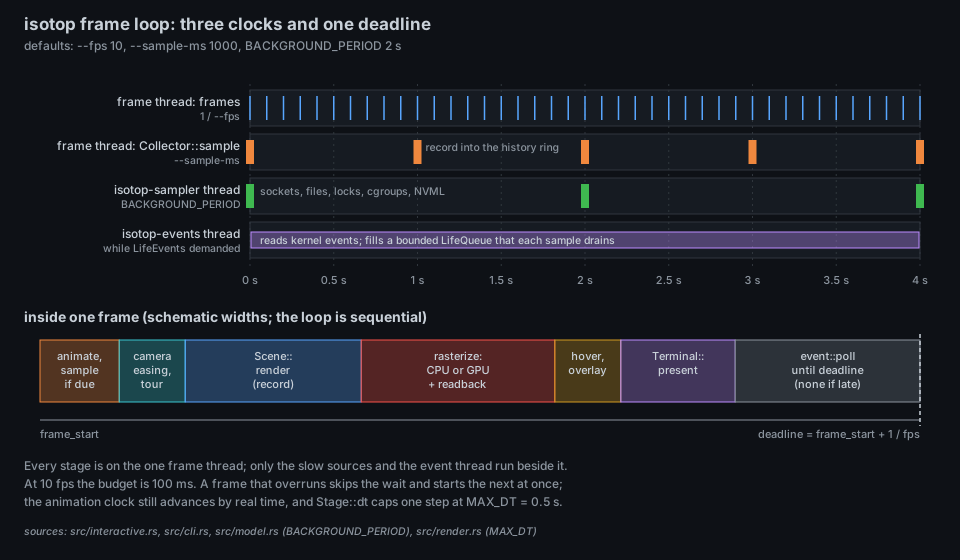
By default the frame loop of the section below runs at 10 frames a second and samples once a second, so each sample is drawn ten times and the frame thread asks the operating system nothing in between.
| Stage | Question it answers | Main types | Where |
|---|---|---|---|
| Sample | What does the kernel say right now? |
Collector, Snapshot, Process, Identity
|
model.rs, platform/
|
| Record | What should a frame contain, in screen space? |
Scene, Stage, Frame, Item
|
render.rs, view modules |
| Rasterize | Which pixel gets which colour, depth and pick? |
Frame::rasterize, Gpu::render
|
render.rs, gpu.rs, shaders.wgsl
|
| Present | How do pixels and text reach the screen? |
Terminal::present, Label, Popup
|
terminal.rs, interactive.rs
|
flowchart LR
    OS[("/proc, libproc, Mach,<br/>netlink, kqueue")]
    subgraph SAMPLE["1 Sample"]
      BG["isotop-sampler thread<br/>every 2 s: sockets, files,<br/>locks, cgroups, NVML"]
      EV["isotop-events thread<br/>only while LifeEvents is demanded"]
      COL["Collector::sample<br/>(frame thread, every --sample-ms)"]
    end
    HIST[("App.history<br/>ring of Snapshots<br/>--history, 120")]
    subgraph RECORD["2 Record"]
      SC["Scene::render<br/>view draws through Stage"]
      DL[["Frame.items<br/>display list"]]
    end
    subgraph RASTER["3 Rasterize"]
      CPU["Frame::rasterize<br/>(CPU)"]
      GPU["Gpu::render<br/>(wgpu) + readback"]
    end
    subgraph PRESENT["4 Present"]
      OV["App::overlay<br/>labels, popups, status text"]
      TERM["Terminal::present<br/>Kitty graphics + text"]
    end
    OS --> BG --> COL
    OS --> EV --> COL
    OS --> COL
    COL --> HIST --> SC --> DL
    DL --> CPU
    DL --> GPU
    CPU --> OV
    GPU --> OV
    OV --> TERM
    TERM -. "mouse, keys" .-> COL
Sample. Collector::sample reads /proc (Linux) or libproc and Mach (macOS) once per --sample-ms (default 1000, range 100 to 10000) and returns a Snapshot. It runs on the frame thread, because reading stat and io for a few hundred processes is cheap. Anything slower runs on the background thread isotop-sampler, which wakes every BACKGROUND_PERIOD (2 s) and whose results are merged in against the pids the cycle scanned; the optional sources only some views draw are read only while the shown view declares them (Demand). A second thread, isotop-events, exists only while a view demands Source::LifeEvents. The details are in Theory Sampling Linux, Theory Sampling macOS, Theory Background Sampler and Demand, Theory Model and Rates and Theory Life Events. The snapshot is pushed onto a ring (App.history, a HistoryPlayer; --history, default 120 snapshots) and, through Scene::record, into every view's record hook and the shared per-process history.
Record. Scene::render turns one snapshot plus a camera into a Frame: a sky description and a Vec<Item> of triangles, lines, sphere impostors, glows, beams, stars, glyphs and pick discs, in the order they must be painted. The scene persists between frames, so it can hold layout, easing and the simulated media. See Theory Scene and Display List and Theory Camera and Projection.
Rasterize. The same display list is drawn by Frame::rasterize (CPU) or by Gpu::render (wgpu: Vulkan, Metal or DX12). Both fill three images: colour, depth and a pick buffer that says which process or thing owns each pixel. They are required to agree; Theory Rasterization and Theory GPU and Parity say how, and how far they do. Hit-testing is in Theory Picking.
Present. The pixels leave as a Kitty graphics image, through POSIX shared memory when the terminal can read it and as zlib plus base64 otherwise; labels, the inspector popup and the status lines are terminal text. See Theory Terminal Graphics and Theory Text Safety.
AGENTS.md states the rule: dependencies mostly run one way, data first, then shared helpers, then the renderer and the views, then the two back ends, then main. The diagram is that rule with the exceptions the document lists; arrows point from the importing module to the imported one. A grep of use crate:: over src/ agrees with it for production code (the few imports of terminal from render and necropolis are in tests).
flowchart TD
    main["main.rs, cli.rs, interactive.rs,<br/>headless.rs, app/<br/>CLI, App, main loop,<br/>headless output"]
    harness["harness.rs<br/>(tests only)"]
    gpu["gpu.rs + shaders.wgsl"]
    terminal["terminal.rs"]
    picker["picker.rs"]
    subgraph RV["renderer and views (mutual)"]
      render["render.rs<br/>Camera, Frame, Scene, Stage"]
      shared["render/shared.rs<br/>constants shared with WGSL"]
      views["views.rs<br/>REGISTRY, ViewModule"]
      modules["view modules (all eighteen)<br/>views/city, orbit, ripple, flow, systems<br/>cells cores strata globe reef coop matrix<br/>ptolemy tesseract necropolis<br/>cortex horizon murmuration arbor"]
    end
    helpers["palette, geometry, medium,<br/>layout, simulation, history,<br/>stellar, status, glyphs"]
    subgraph DATA["data (mutual)"]
      model["model.rs<br/>Snapshot, Collector"]
      platform["platform/<br/>linux, macos"]
    end
    main --> gpu
    main --> terminal
    main --> picker
    main --> render
    main --> views
    main --> model
    harness -.-> main
    gpu --> render
    terminal --> render
    picker --> views
    render <--> views
    render --> modules
    modules --> render
    modules --> views
    render --> shared
    gpu --> shared
    render --> helpers
    modules --> helpers
    helpers --> model
    helpers --> render
    model <--> platform
The invariants that follow from this picture, all stated in AGENTS.md: nothing imports main; model and platform never import render, a view or terminal; gpu and terminal import only render; nothing outside platform/ reads /proc or /sys or spawns an operating-system tool (terminal I/O and local lookups are the exceptions). The renderer is therefore a pure function of a Snapshot, a Camera and a time, which is what makes the golden hashes of Theory Determinism possible.
Live::run in interactive.rs is one loop on one thread, each step of it a function (sample, follow_journal, render, present, input, finish). Per iteration, in this order:
-
elapsedis the time since the previous iteration began. Unless paused,app.animation += elapsed: the animation clock is wall time with the paused intervals removed. - If not paused and
last_sample.elapsed() >= --sample-ms, take a sample (collector.sample(), ordemo_snapshotunder--demo), callScene::record, push it onapp.history(dropping the oldest beyond--history). - Manage the journal follower: it runs while the shown view's demand contains
Source::Journaland forJOURNAL_LINGER(30 s) after. While it is demanded, the lines that arrived are attached to the newest sample asSnapshot.journal(ajournal::Delivery), where the Matrix view reads them. -
App::steer:CameraController::approach(smoothing(elapsed, 0.2)), thenupdate_tour. -
App::render:Scene::render, camera fitting if requested, thenFrame::rasterizeorGpu::render. If the GPU reports an error, the app drops the GPU and rasterizes on the CPU from then on. -
hover_over,overlay(labels and popups),Terminal::present. - Wait for input until
frame_start + 1/fps(--fps, default 10, range 1 to 60), handling every event that arrives; once past the deadline,poll(0)keeps draining queued input but never sleeps. - If the shown view's demand changed, tell the collector.
Three consequences follow, none of them obvious from a frame rate alone.
-
Frame rate is a ceiling, not a clock. A frame that takes longer than
1/fpsstarts the next at once; nothing is dropped and nothing is caught up. Animation advances by real time, so a slow machine sees the same motion at fewer frames per second. -
Stage::dtis the only step.Scenecomputes it once per frame throughFrameClock::step, whichever view is shown, and every new simulation steps by it:Situation Stage::dtfirst frame 0 paused 0 (the clock stays where it was) time went back (a rewind, a headless replay) 0, and the count restarts from this time otherwise time - last, at mostMAX_DT = 0.5sA fixed-step simulation (
FixedStep, see Theory Simulation Toolkit) is fed fromStage::timeinstead and never derives a step of its own. A view that predates the policy may keep a clamp of its own (Flow limits its particle step to 0.1 s) because changing it would change pixels. -
Easing is exponential and therefore frame-rate independent. The weight of one step over
dtseconds with time constant tau is1 - exp(-dt/tau), and two successive steps ofdt1anddt2compose to1 - exp(-(dt1+dt2)/tau), because(1-a1)(1-a2) = exp(-(dt1+dt2)/tau). The camera uses tau = 0.2 s; the scene eases CPU and memory towards each sample with tau = 0.3 s (Scene::ease), and clears the eased values if the gap between frames leaves0..=2s. The README's 1.5 s CPU smoothing is applied earlier, in the model (Theory Model and Rates).
--output file.png and --benchmark N run the same App::render without a terminal, on a 16:9 frame (--width, default 1920, so 1080 rows). --time (default 12) fixes the synthetic workload clock. warm_up first replays the shared history for --demo, then runs the shown view's warm-up phases from its registry row, so the captured frame is a settled one; the golden test calls the same function. Guide Headless and Reproducible Renders has the recipes.
App.history is a VecDeque<Snapshot> of at most --history samples. Space toggles paused and points history_index at the newest; [ steps back (pausing first if running) and ] forward while paused. While paused the scene is drawn from history[history_index] and at that snapshot's own elapsed (App::render_time), so a view that keeps its own records must not assume time only moves forward: this is why the conventions require windows in seconds of snapshot.elapsed and record hooks that deduplicate on snapshot.elapsed > last. Sampling and the animation clock stop while paused. Stage::dt is 0 throughout, so simulations hold still.
A view is one module plus one row of views::REGISTRY. There is no plugin system: views are compile-time modules, and the registry is a static slice.
- The module owns a state struct and implements
views::ViewModule:draw(&mut self, stage, processes, snapshot) -> usizeandlegend, plus defaulted hooksrecord(every sample, whichever view is shown),key,inspector_lineandcard. - A view reads only
Stage, the process slice and&Snapshot, and talks back only throughStageoutputs (positions,bounds,places,notes,tour,popup,callout). Whatever the platform could not measure issnapshot.missing. - The row (
ViewInfo) holds everything else that distinguishes the view: name and title,Backdrop,available, link rule, flash and haze switches, default pitch, tour participation, header override,faceandturnfor the globe,sources,demooptions, view-localkeys, headlesswarmupphases and a harnessContract.Scene,Appand the headless path read the row instead of naming a view. - Today the registry has eighteen rows, and every one is a
ViewModule. A row is built withViewInfo::new(name, title, backdrop, build), wherebuildis aviews::Build(fn() -> Box<dyn ViewModule>, usually a closure) that the scene calls to make and own the view's state.Scenekeeps only frame-wide state (the clock, easing, history, the selection); a view's own state lives in its module. City, Orbit, Ripple and Flow are insrc/views/(Orbit and Flow shareviews/systems.rs), and Matrix and Coop are module views like the rest. There are noHooksvariants and no per-view arms inScene. The first ten rows are never reordered because the digit keys pick them.
The shared test harness (harness.rs) runs every row against its Contract: the same inputs give the same pixels and picks, the demo shows processes with something to click, every pick names a process, no surviving process moves when CPU and memory change or when a tenth of the processes exit and as many start, and an empty machine draws. Guide Writing a View walks through adding a row; Theory Stable Layout explains the layout property.
Read the pages in the order of the pipeline, or jump to the stage you care about.
| Stage | Page | What it settles |
|---|---|---|
| Sample | Theory Sampling Linux |
/proc parsing, stat, io, pressure, cgroups; what each file costs and what can go wrong |
| Sample | Theory Sampling macOS | libproc, Mach, proc_pid_rusage, what macOS cannot report |
| Sample | Theory Background Sampler and Demand | the slow-source thread, Demand, Reads, stalls and health |
| Sample | Theory Model and Rates | counters to rates, smoothing, Option for unknown, top_n
|
| Sample | Theory Life Events | fork, exec and exit from the proc connector, taskstats and kqueue |
| Sample | Theory Journal | the log follower behind Matrix |
| Record | Theory History | the shared per-process ring that views read through Stage
|
| Record | Theory Stable Layout | why a process keeps its place; Seats, Discs, the golden-angle spiral |
| Record | Theory Scene and Display List | the primitives, Frame, Scene persistence, blending and ordering |
| Record | Theory Camera and Projection | the orthographic camera, its matrix, easing, fitting and the tour |
| Record | Theory Colour | palettes, tinting, why colours are what they are |
| Record | Theory Simulation Toolkit |
Rng, hashes, spatial hashes, FixedStep, easing, FFT |
| Rasterize | Theory Rasterization | the CPU rasterizer: edge functions, depth, cost |
| Rasterize | Theory GPU and Parity | the wgpu path, shared constants, readback, known divergences |
| Rasterize | Theory Picking | the pick buffer and cell-coarse hit-testing |
| Present | Theory Terminal Graphics | the Kitty protocol as used, the probe, restoration |
| Present | Theory Text Safety | why process text is untrusted and how it is cleaned |
| Cross-cutting | Theory Determinism | golden hashes, seeding, what makes two runs byte-identical |
For the views themselves start at Home and the Gallery; Glossary defines the terms used across pages.
| What | Where |
|---|---|
The main loop, Options, Layout, App, headless output, warm_up
|
src/interactive.rs: run; src/cli.rs: Options; src/headless.rs: run, warm_up; src/app/mod.rs: App::render; src/app/overlay.rs: App::overlay
|
Collector, Snapshot, BACKGROUND_PERIOD
|
src/model.rs |
Scene, Stage, FrameClock, MAX_DT, Frame, Item, Camera
|
src/render.rs |
The registry, ViewModule, ViewInfo, Contract
|
src/views.rs |
| The view harness | src/harness.rs |
| GPU back end and shader |
src/gpu.rs, src/shaders.wgsl
|
| Terminal back end | src/terminal.rs |
| The architecture rules |
AGENTS.md, docs/VIEW_CONVENTIONS.md
|
The figure comes from docs/figures/theory-frame-timeline.py; its segment widths in the lower panel are schematic, the loop has no fixed split.
- The project's own
AGENTS.md(pipeline, architecture, invariants) anddocs/VIEW_CONVENTIONS.md(view contract, performance budget). - J. D. Foley, A. van Dam, S. K. Feiner and J. F. Hughes, Computer Graphics: Principles and Practice, 2nd ed., Addison-Wesley, 1990.
- T. Akenine-Moller, E. Haines and N. Hoffman, Real-Time Rendering, 4th ed., CRC Press, 2018.