Repository navigation
Guide Headless and Reproducible Renders
isotop --demo --view orbit --time 12 --renderer cpu --output orbit.png writes the same file on every run, on every machine of one architecture, byte for byte. That property is not an accident of the demo being simple: it is held in place by a synthetic workload that is a pure function of time, by seeded randomness keyed to process identity, by a fixed pipeline from sample to pixels, and by a test that compares every view's frame with a stored hash on every change. This page walks the headless pipeline, says exactly what --time means, lists what makes a render reproducible and what silently breaks it, and shows how the golden test and CI render every view. Commands here were run on the build machine (Linux x86_64, no GPU) unless marked otherwise; see Guide: Recipes for task-sized uses.
Headless rendering is the old problem of running a program that draws without anything to draw on. Three lineages meet in this page: virtual displays, builds that give the same bytes twice, and tests that compare an output with a stored one.
Virtual displays. Xvfb, the X virtual framebuffer, is an X server that needs no display hardware or input devices and keeps its screen in virtual memory. Its manual page gives the original purpose as server testing. A 1997 FAQ from NOAA's Ferret group describes it as part of X11R6 and absent from earlier X releases; I did not find a precise release date, and a 2000 mailing-list recollection of X11R6.4 is the poster's own memory. Linux acquired generic framebuffer support in kernel 2.1.109 (1998), first to give machines without a text-mode display a console, then extended to PC hardware; its device nodes are /dev/fb0 and following. It has since been largely superseded by the Direct Rendering Manager. isotop does neither: its CPU rasterizer writes colour, depth and pick buffers in ordinary memory, so a PNG needs no server and no device.
Builds that agree with themselves. The Reproducible Builds project records that the idea was implemented for GNU tools in the early 1990s, and that the project itself learned this only in 2017. In Debian the idea came up in 2000 and again in 2007 without enthusiasm. Interest returned in 2011, when Bitcoin users needed assurance that a download had not been tampered with and the first versions of Gitian were written, and the Tor Browser began building with Gitian in 2013. Lunar (Jeremy Bobbio) organised a discussion at DebConf13 in July 2013; his first dpkg patches in August 2013 let hello build reproducibly, and the first mass rebuild, on 7 September 2013 by David Suarez, found 24% of 5,240 source packages reproducible. By January 2014 the figure was 67% of 6,887. Lunar died in November 2024; the project credits him with starting the effort and with the earliest status reports and many of its tools. Eelco Dolstra's Nix, whose store addresses a build by the hash of its inputs, belongs to this story, but I did not verify its dates here (unverified).
Golden images. Comparing output with a stored version has several names. Michael Feathers' characterization tests, in Working Effectively with Legacy Code (2004), pin what a system does rather than what it should do. "Golden master" borrows its name from record production, where the master is the disc from which copies are pressed. Snapshot testing in the style popularised by Jest, and approval testing, are the same move with a human reviewing the change. tests/golden.txt is this practice at its smallest: three 64-bit hashes per view instead of a stored image, so a change is detected but not shown, which is why the pull request must carry the renders.
The project's own record is short. The first commit is dated 2026-10-07, and the golden hashes arrived on 2026-10-11, four days later, in a commit that also brought continuous integration, lints and shared helpers.
A run is headless when it has --output or --benchmark (Options::headless). Headless runs never touch the terminal: preflight handles --list-views, --verbose and the view checks first, and run then builds the frame in memory.
| Flag | Effect in a headless run |
|---|---|
--output <PATH> |
Render one frame and write it as an 8-bit RGB PNG. Prints Wrote PATH (WxH, N visible)
|
--benchmark <N> |
Render one frame, then N more, timing the loop. Prints N frames | WxH | V visible | X ms/frame (record A + raster B) | Y renderer fps on R (excludes terminal transport), where A is the time to record the display list and B the time to rasterize it |
--width <W> |
Frame width in pixels, 160 to 2560, default 1920. The height is W * 9 / 16: headless frames are always 16:9 (Options::headless_height) |
--time <T> |
The synthetic time of the frame, in seconds, default 12. Negative values are refused (the argument parser rejects -1; run also rejects non-finite or negative values) |
--demo |
Use the synthetic workload. Without it, a headless run samples the real machine |
--processes <N> |
Number of synthetic processes, 1 to 10000, default 192 |
--limit <N> |
Most processes admitted into the scene, 1 to 10000, default 1024 |
--sample-ms <MS> |
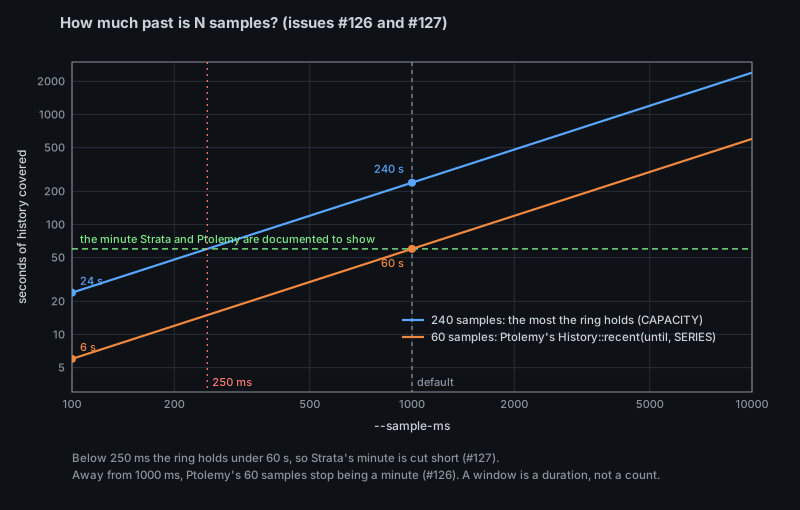
Sampling interval, 100 to 10000, default 1000. In headless demo runs it sets how far back the previous sample is and the cadence of warm-up replays |
--renderer cpu|gpu|auto |
Rasterizer. cpu is the reference; gpu fails with exit status 1 and a message if there is no hardware adapter; auto falls back to the CPU and the benchmark line says why |
--fps <N> |
In a benchmark, the spacing of the frames (frame i is drawn at --time plus i / fps) |
--view <NAME> |
The view to draw (default city; or the first of --views). An unsupported view makes a headless run exit 1 |
The PNG is the scene image only. Labels, popups, the inspector and the status strip are terminal text drawn over the image by terminal.rs; they are not in the file. (Matrix is the exception: its text is drawn into the frame as glyph items.) The camera is the row's default camera, fitted: a headless run has no way to move it, and --output of a view always shows the whole of what the view reports as its bounds.
The complete flag list, as isotop -h prints it, is at the end of this page.
flowchart TD
    A["Options::parse + preflight<br>view check, --list-views"] --> B["demo_snapshot(row, time - sample_s, time, processes)<br>or two live samples"]
    B --> C["App::new(view, snapshot)<br>switch(): fit = true, row pitch"]
    C --> D["warm_up"]
    D --> D1["replay_history<br>shared History, SERIES = 60 s before --time"]
    D --> D2["run_phases<br>the row's Warmup list, in slice order"]
    D1 --> E
    D2 --> E["app.animation = --time<br>App::render: Scene::render + fit + rasterize"]
    E --> F{"--benchmark?"}
    F -->|yes| G["N more frames at time + i/fps"]
    F -->|no| H
    G --> H["--output? frame.write_png"]
In order, from start in main.rs and headless::run:
-
The first sample. With
--demo,demo_snapshot(view.info(), time - sample_seconds, time, processes). The "time of the sample before" is one--sample-msback, because a view with churn needs the life events in between. Without--demo, the collector takes one sample, sleeps--sample-ms, and takes a second, because CPU use is a rate and needs two readings. -
The app.
App::newcallsswitch(view), which setsfitand the row'spitchon the camera goal. The firstApp::renderfits the camera toScene::bounds(or the positions) and draws again from the fitted camera. -
warm_up, described below: it makes the scene look the way a long-running session would at that moment. -
The captured frame.
app.animation = --time, thenApp::render:Scene::renderrecords the display list, the CPU (or GPU) rasterizes it. The golden test calls the samewarm_upandApp::render, so the hashes it checks are the PNGs' frames. -
Benchmark and PNG. A benchmark reuses the frame buffer and renders
Nmore frames at--time + i / --fps;--outputwrites the first frame's pixels.
--time T is the demo clock, in seconds. The synthetic workload is a pure function of it: model::demo_with(time, count, options) computes each process's CPU as ((sin(phase) * 0.5 + 0.5)^4 * scale + bonus with phase = 0.55 * time + 1.71 * index, its memory, state, I/O and so on, with no state and no randomness. It follows that:
- Two calls with the same
timegive the same snapshot, in any order, including negative times (the options are documented as "pure functions oftime, with no state"). -
Snapshot::elapsedistime, andSnapshot::wallismodel::DEMO_EPOCH + time, whereDEMO_EPOCHis 2026-10-10T04:12:00Z. Calendar-dependent drawing (the necropolis moon, the minute of a death) readswall, never the system clock, so it is repeatable too. - The animation clock is also
--timein a headless run. Anything that moves with scene time (the orbits, the globe's turn, the ripples) is therefore a function of--time: rendering at 12.0 and 12.2 gives two moments of one motion. This is how the recipe for an animated file works: render consecutive times and join the frames. - Interactively, demo time starts at 0 and follows the wall clock of the session;
--timeonly fixes headless runs. - The default reference time is 12. A view whose history window is not full at 12 seconds uses a later one: Ptolemy's planets need 30 samples and its reference renders use
--time 300; the harness takes the time from the row'scontract.time.
Verified: --time 12 twice produces files with the same MD5; --time 13 produces a different file.
model::demo(time, count) must stay byte-identical, because the pixels of every view that asks for nothing depend on it. A view that needs more asks on its registry row (ViewInfo::demo, a DemoOptions), and every demo snapshot taken while that view is shown follows it, whether it is the first sample, a warm-up replay or a live-looking one:
| Option | What it adds | Rows that ask |
|---|---|---|
churn |
Transient processes after the base population (families forking children that run 3 to 12 s and exit, with some killed by signals), pids reused with a new Identity::start, and the life events between two sample times (demo_life, demo_events) |
ptolemy, tesseract, necropolis, arbor |
exact_cpu_time |
cpu_time as the exact integral of the process's cpu (demo_cpu_seconds), and threads large enough that no single-threaded process exceeds one core |
tesseract |
observer |
Snapshot::observer, isotop itself: pid 999, below every demo pid, 40 +/- 10% CPU and 96 +/- 4 MiB |
ptolemy |
mortality |
With churn, cycles 3.5 times as long and tuned to bury about 40 processes a minute at 192: mass graves, an OOM victim, a stopped unit, pid reuse |
necropolis |
oom_and_memory_detail |
An Oom for every process (three System processes exempt) and a consistent Rollup for the 64 largest, one of them unreadable |
horizon |
kernel_counters |
Snapshot::interrupts, softirqs and oom_kills, pure functions of time |
horizon, murmuration |
oom_cycle |
An out-of-memory kill every 30 s of time, with the memory pressure that builds before it |
horizon |
threads |
The threads threads::demo_list synthesizes for every process |
murmuration, arbor |
thread_churn |
Thread pools that shed and regain threads between samples | arbor |
unreadable_parent |
One parent hidden in Snapshot::shadows, as another user's process would be |
arbor |
channels |
Snapshot::unix_queues and Snapshot::pipes
|
cortex |
The documentation of each field is on DemoOptions in model.rs; the rows that ask are in views::REGISTRY.
demo_snapshot (in main.rs) is the single entry point: it calls demo_with with row.demo, and for a churn row it fills Snapshot::life with demo_events(previous, time, ...) and, when the row demands Source::LifeEvents, the demo's source list. Nothing else may call demo_with for a view, or the headless frame and the interactive one would diverge.
A single --time 12 frame of Strata, with no history, would show an empty landscape. warm_up repairs that in two steps.
1. replay_history. For demo headless runs, it records the demo samples of the history::SERIES (60) whole seconds before --time straight into scene.history, skipping times before 0. It bypasses Scene::record, so no view's own record hook sees these samples. It is skipped when the row has a due Phase::History, which fills the history while it rasterizes. Views read the shared per-process history through Stage::history (see Theory: History), so Ptolemy, Strata and Tesseract have their past without a hook.
2. run_phases. For each Warmup of the shown row, in slice order, if due(warmup, options) holds. A Warmup is a Phase and a When.
When |
Runs in |
|---|---|
DemoOutput |
--demo with --output
|
Output |
--output, live or demo |
Headless |
--output or --benchmark, live or demo |
DemoHeadless |
--demo with --output or --benchmark
|
Phase |
What it does |
|---|---|
History { seconds } |
For each whole second back from seconds to 1 before time, makes that second's demo sample the whole history and rasterizes a frame; then leaves the history at the sample of time
|
Record { seconds } |
Feeds the demo samples of the seconds whole seconds before time to Scene::record (every view's record hook), skipping those before 0, without rasterizing |
Replay { seconds, before_start } |
The same, with the samples --sample-ms apart, as a live run takes them; with before_start, times before 0 are replayed too (the demo workload is defined there), so a view that keeps minutes is settled at 12 s |
Play { seconds, step } |
For a view that builds its state inside draw: at each --sample-ms back from seconds before time, makes that moment's demo sample the whole history and draws (without rasterizing) the frames step seconds apart up to the next sample. The played samples are not recorded, so a view that needs a record hook to settle uses Replay. Samples before time 0 are skipped |
Settle { frames, step, lead } |
Rasterizes frames frames step seconds apart, starting lead seconds before time
|
Journal { frames, step, lead } |
As Settle, in f64, first attaching the journal lines that arrived since the previous frame to the newest sample (Snapshot::journal, a journal::Delivery), where the Matrix view finds them |
The rows that exist today (from views::REGISTRY):
| View | Warm-up | Why |
|---|---|---|
| strata |
History { 60 }, DemoOutput
|
A full minute of ridges |
| ripple, flow, cores, reef |
SETTLE: Settle { frames: 80, step: 0.05, lead: 4.0 }, Output
|
Four seconds for the water, particles, marbles and creatures to settle |
| coop |
Record { 30 } (DemoOutput), then SETTLE
|
CPU variation over 30 samples and fox baselines, then the flocks |
| matrix |
Journal { 161, 0.05, 8.0 }, Headless
|
Eight seconds of rain |
| ptolemy | none | The shared history replay is all it needs; its planets need 30 samples, so use --time 300 (the row's contract.time) |
| tesseract |
Replay { 60, before_start: false }, DemoHeadless
|
A minute of worldlines at --sample-ms
|
| necropolis |
Replay { 600, before_start: true }, DemoHeadless
|
Ten minutes of deaths, so --time 12 shows ten rows |
| cortex |
Play { 12, 0.1 }, DemoHeadless
|
Twelve seconds as a live run drew them, so the raster is full at 12 s and the simulation has settled |
| horizon |
Replay { 8, before_start: false }, DemoHeadless
|
The view takes in each sample to see who vanished, replayed as a live run takes them |
| murmuration |
Play { 15, 0.05 }, DemoHeadless
|
Fifteen seconds of flight, a step at a time |
| arbor |
Play { 8, 0.05 }, DemoHeadless
|
Eight seconds of wind, blossoms and falling leaves |
| city, orbit, cells, globe | none | The row asks for no warm-up |
Two consequences worth knowing. First, SETTLE is When::Output, so --benchmark alone does not run it; the benchmark of ripple measures an unsettled scene unless you also pass --output. The rows that matrix and the views from tesseract on use Headless and DemoHeadless instead, so a benchmark measures a settled scene. Second, a Replay phase replays seconds / sample_seconds samples, so --sample-ms 250 makes the tesseract warm-up take four times as many samples and renders a different frame from the default (verified: the two files differ).
Reproducibility is a product of discipline in four places.
Inputs. A frame is determined by: the isotop binary, the view, --time, --width, --processes, --limit, --sample-ms, --demo, and --renderer. Nothing else: not the clock, not the current directory, not the environment, with one exception noted below.
Time. Simulations advance on the demo clock, never per frame; calendar data comes from Snapshot::wall; stage.dt is computed by the scene (zero on the first frame, while paused and on rewind, at most 0.5 s) and creature simulations step on a FixedStep fed from stage.time. See Theory: Determinism and Theory: Simulation Toolkit.
Randomness. Per-process randomness is simulation::Rng::for_identity(id, SALT), seeded from the pid and the start time through the splitmix64 finaliser, with one salt per view. Demo-wide randomness is a pure function of --time and indices. Stateless variation (flicker, jitter) is a hash of a stable id and an event index, never a per-frame generator that advances. No HashMap iteration order may reach the pixels: where a view draws from a map it sorts first (the links, for instance, are drawn from sorted keys because overlapping beams blend in drawing order).
Layout. A process keeps its place when CPU, memory or the population change (Theory: Stable Layout). The view harness checks it for every registered view.
What still varies:
-
The matrix greeting. Matrix draws
$USERinto the frame, so its PNG depends on the environment. Verified:USER=alicetwice gives identical files,USER=bobgives a different one. In test builds the name is fixed toNeo(matrix::loginreturns nothing undercfg(test)), which is why the golden test and the harness do not depend on the machine. -
The architecture.
sin,expandpowfare not guaranteed to round the same way across libm implementations and CPUs. The checked-in golden hashes are those of Linux on x86_64, and only that platform compares them. -
The rasterizer. The GPU path draws the same frame, but not the same bytes: hardware line rasterization and floating-point details differ from the CPU. Use
--renderer cpufor anything you intend to compare byte for byte, and the PNG comparison script (below) for CPU against GPU. See Theory: GPU and Parity. -
Live runs. Without
--demothe input is your machine. Two samples are taken, so a live Strata shows only its newest slice and the CPU smoothing has barely started.
every_view_matches_its_golden_hash (in headless.rs) renders every registered view the way isotop --demo --time 12 --renderer cpu --width 480 --output golden.png --view NAME does: Options::parse_from with those arguments, App::new with demo_snapshot, warm_up, app.animation = options.time, App::render. It hashes three buffers of the frame with FNV-1a 64: the colour bytes, the pick buffer and the depth buffer. tests/golden.txt stores one line per view:
# view pixels picks depth: FNV-1a 64 of `--demo --time 12 --renderer cpu --width 480`
city ed3a2fc287f6ccc8 59e9f029bd27c667 5ded0966b58b8ea6
- Each view renders on its own thread; the renders are shared with
every_view_renders_the_same_frame_twice, which renders every view a second time and requires equal hashes. - The comparison runs only on Linux x86_64 (
cfg!(all(target_os = "linux", target_arch = "x86_64"))). Elsewhere every view still renders, which catches panics. -
ISOTOP_BLESS=1 cargo test every_view_matchesrewritestests/golden.txt. A pull request that changes a hash says why in its description and carries the renders. - On another platform,
ISOTOP_GOLDEN_FILE=<path> ISOTOP_BLESS=1 cargo test every_view_matchesblesses a local baseline before a change, and running the test again withoutISOTOP_BLESScompares against it afterwards. Blessing the checked-in file from a non-x86_64 platform is refused. - A view in the file that is no longer a registry row fails as "no longer a view"; a registry row with no line fails as "no golden hash". A new view therefore cannot land without a hash.
The view harness (harness.rs) goes further. For every row it makes two runs from the same inputs and compares pixels and picks, then perturbs the sample after the first frame (CPU scaled by 0.25 to 4, memory by 0.5 to 2; a tenth of the processes exiting and as many starting) and requires every surviving process to stay within the row's tolerance. Its runs are headless runs: Session::start calls warm_up and App::render at the row's contract.time, at width 160 with 192 processes, on the CPU.
.github/workflows/ci.yml runs on Linux and macOS (macos-15, Apple Silicon):
-
Every view, headless. For each name
--list-viewsprints on the runner:isotop --demo --view NAME --renderer cpu --width 960 --time 12 --output NAME-OS.png. The PNGs are uploaded as artifacts. -
The live machine.
--view orbit --width 960 --output live-OS.pngand the same forcells, which exercise the collector's real readers (layout and permission errors the demo cannot show). On macOS, orbit is also rendered as root. -
CPU against GPU, macOS only. For every view, a CPU and a GPU render at the same arguments, compared by
scripts/compare_png.py; the job never blocks the build, and uploadsparity.txtand the PNGs. Linux CI has no hardware GPU, andGpu::newrefuses software adapters. -
The smoke test,
scripts/smoke_terminal.py, through a pseudo-terminal, once in demo mode over shared memory and once in live mode over inline zlib frames (verified here: both pass). -
The code report,
scripts/code_report.py --check, which keepsdocs/METRICS.mdand the README block in step with the tree.
# The reference render, twice, and proof that it is the same file.
./target/release/isotop --demo --view city --width 480 --time 12 --renderer cpu --output a.png
./target/release/isotop --demo --view city --width 480 --time 12 --renderer cpu --output b.png
cmp a.png b.png && echo identical

# A different moment.
./target/release/isotop --demo --view city --width 480 --time 13 --renderer cpu --output c.png
python3 scripts/compare_png.py a.png c.png      # mean 7.3395 | share 58.4360 % | max 242 | size 480x270

# Ptolemy needs a full window of history.
./target/release/isotop --demo --view ptolemy --time 300 --width 960 --renderer cpu --output ptolemy.png

# The cost of a frame (4-core build machine, CPU rasterizer, 960 px wide).
./target/release/isotop --demo --view city --width 960 --renderer cpu --benchmark 30
#   30 frames | 960x540 | 192 visible | 16.41 ms/frame | 60.9 renderer fps on cpu (excludes terminal transport)
./target/release/isotop --demo --view city --width 960 --renderer cpu --processes 1000 --benchmark 30
#   30 frames | 960x540 | 1000 visible | 20.26 ms/frame | 49.4 renderer fps on cpu (excludes terminal transport)
The exit statuses: 0 after a successful render; 1 when --view names a view this platform does not support in a headless run, when --views leaves no available view, when --renderer gpu finds no adapter, or when --time is not finite and nonnegative; 2 for a usage error (an unknown view name lists the valid names).
| Item | Symbol |
|---|---|
| Flags |
Options (cli.rs) |
| Startup checks |
preflight, Preflight
|
| The headless path |
run, Options::headless, Options::headless_height
|
| The demo entry point |
demo_snapshot; model::demo_with, DemoOptions, demo_life, demo_events, DEMO_EPOCH
|
| Warm-up |
warm_up, replay_history, run_phases, due; views::Warmup, Phase, When
|
| Row data |
views::REGISTRY, ViewInfo::{demo, warmup, contract}
|
| The golden test |
every_view_matches_its_golden_hash, golden_render, check_golden; tests/golden.txt
|
| The harness |
harness::Session, check, every_view_satisfies_the_view_contract
|
| PNG comparison | scripts/compare_png.py |
| CI | .github/workflows/ci.yml |
- Fix the camera. A headless run cannot rotate or tilt; a
--cameraflag (or reading the row's pitch and a rotation) would let a renderer produce the quarter-turn views directly. Today the only way is to edit the call. - Make a benchmark settle like a render.
SETTLEisWhen::Output; changing it toHeadlesswould make--benchmarkmeasure the settled scene for ripple, flow, cores, reef and coop, and would change their benchmark behaviour, which the view conventions say stays as it is. - Record animation natively. Rendering consecutive
--timevalues and joining the frames with ffmpeg works (see Guide: Recipes), but every frame pays the warm-up again. Issue 100 specifies the real thing, planned and not implemented:--record-media out.png --seconds Nwriting an APNG headlessly through the existingpngcrate, advancing simulation time at the export frame rate so that two exports at the same--timeare byte-identical. Until it lands, there is no such flag. - Make Matrix reproducible across machines by default, not only in the tests: the greeting could come from a flag or be omitted under
--demo.
As printed by isotop -h (version 0.1.0); isotop --help prints the same flags with each help text on its own lines. The two lists of view names are the registry's, in Tab order.
Usage: isotop [OPTIONS]

Options:
      --demo                   Use a deterministic synthetic workload instead of /proc
      --view <VIEW>            Initial visualization (city, or the first of --views) [possible values: city, orbit, ripple, flow, cores, cells, strata, globe, reef, matrix, coop, ptolemy, tesseract, necropolis, cortex, horizon, murmuration, arbor]
      --views <VIEWS>          The views Tab and Shift+Tab cycle, as a comma-separated list such as reef,city: a name repeated or not supported on this platform is dropped. Without it, every supported view [possible values: city, orbit, ripple, flow, cores, cells, strata, globe, reef, matrix, coop, ptolemy, tesseract, necropolis, cortex, horizon, murmuration, arbor]
      --list-views             Print the views this platform supports, one per line, and exit
      --verbose                Print startup notes to stderr, such as each view this platform does not support
      --processes <PROCESSES>  Number of synthetic processes [default: 192]
      --limit <LIMIT>          Maximum processes admitted into a scene [default: 1024]
      --width <WIDTH>          Maximum internal rendering width (height follows terminal aspect ratio) [default: 1920]
      --fps <FPS>              Target animation frame rate [default: 10]
      --sample-ms <SAMPLE_MS>  Process sampling interval in milliseconds [default: 1000]
      --history <HISTORY>      Number of snapshots retained for pause/rewind [default: 120]
      --tour <TOUR>            Seconds without input before the guided tour starts (0 disables it) [default: 20]
      --output <OUTPUT>        Render a single PNG and exit (no terminal required)
      --time <TIME>            Synthetic time for PNG output and benchmark [default: 12]
      --benchmark <BENCHMARK>  Render this many frames headlessly and report renderer performance
      --force-graphics         Bypass the terminal graphics capability query
      --direct                 Send frames inline (zlib + base64) even when the terminal can read shared memory
      --renderer <RENDERER>    Rasterizer: the GPU when one is available, falling back to the CPU [default: auto] [possible values: auto, gpu, cpu]
      --gpu-power <GPU_POWER>  Which GPU to prefer on machines with more than one [default: high] [possible values: low, high]
      --duration <DURATION>    Exit after this many seconds and report end-to-end presentation throughput
      --geoip <GEOIP>          City-level GeoIP database (MaxMind format, such as DB-IP Lite or GeoLite2 City) for the globe; found in ~/.local/share/isotop and /usr/share/GeoIP when not given
      --home <HOME>            This machine's location as LAT,LON for the globe; defaults to the system time zone's city
  -h, --help                   Print help (see more with '--help')
  -V, --version                Print version
Ranges enforced by the parser: --processes and --limit 1 to 10000, --width 160 to 2560, --fps 1 to 60, --sample-ms 100 to 10000, --history 2 to 3600, --tour 0 to 3600, --benchmark 1 to 10000. --view and --views accept the registry names: city, orbit, ripple, flow, cores, cells, strata, globe, reef, matrix, coop, ptolemy, tesseract, necropolis, cortex, horizon, murmuration, arbor.