Repository navigation
View Ptolemy
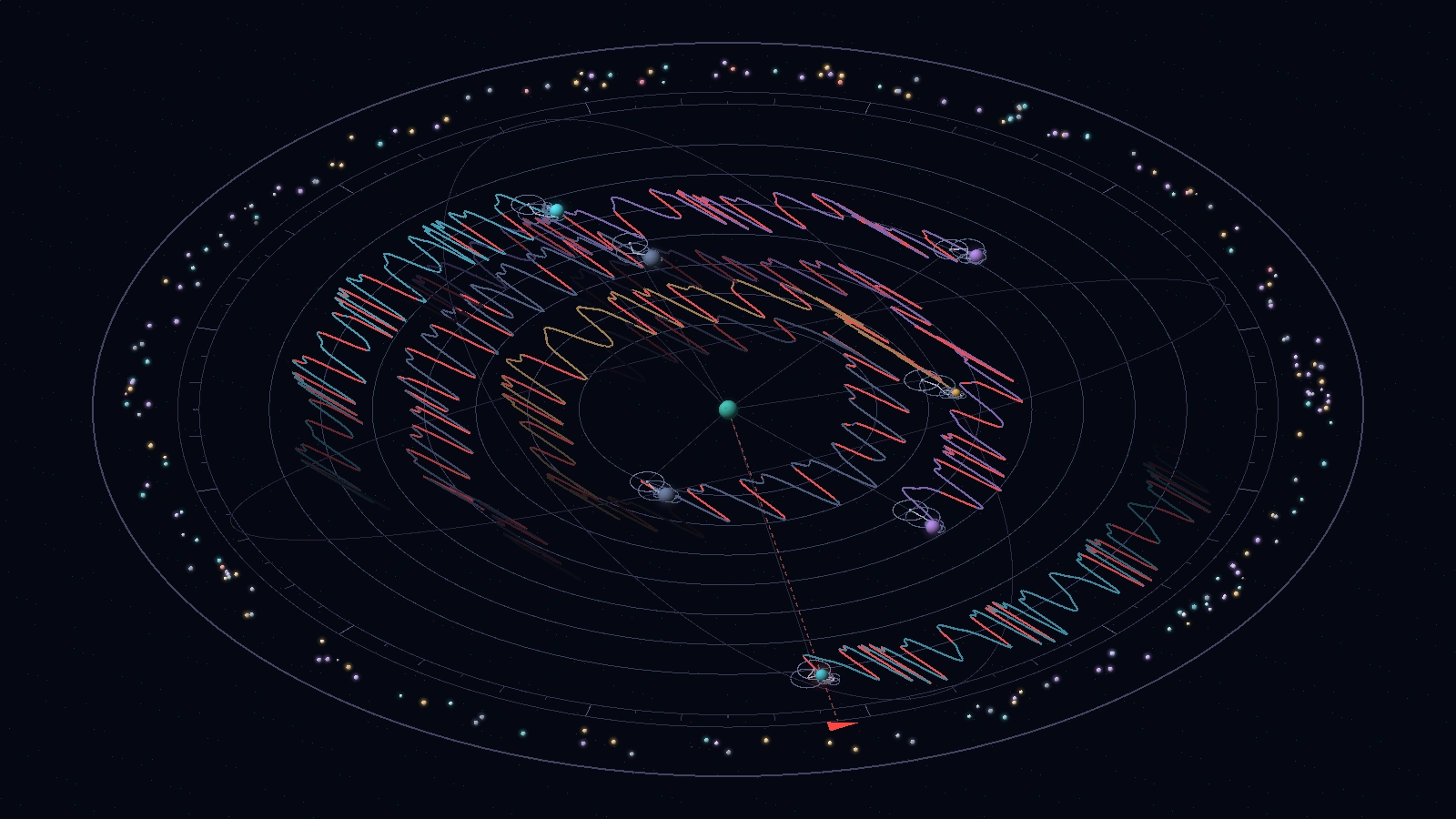
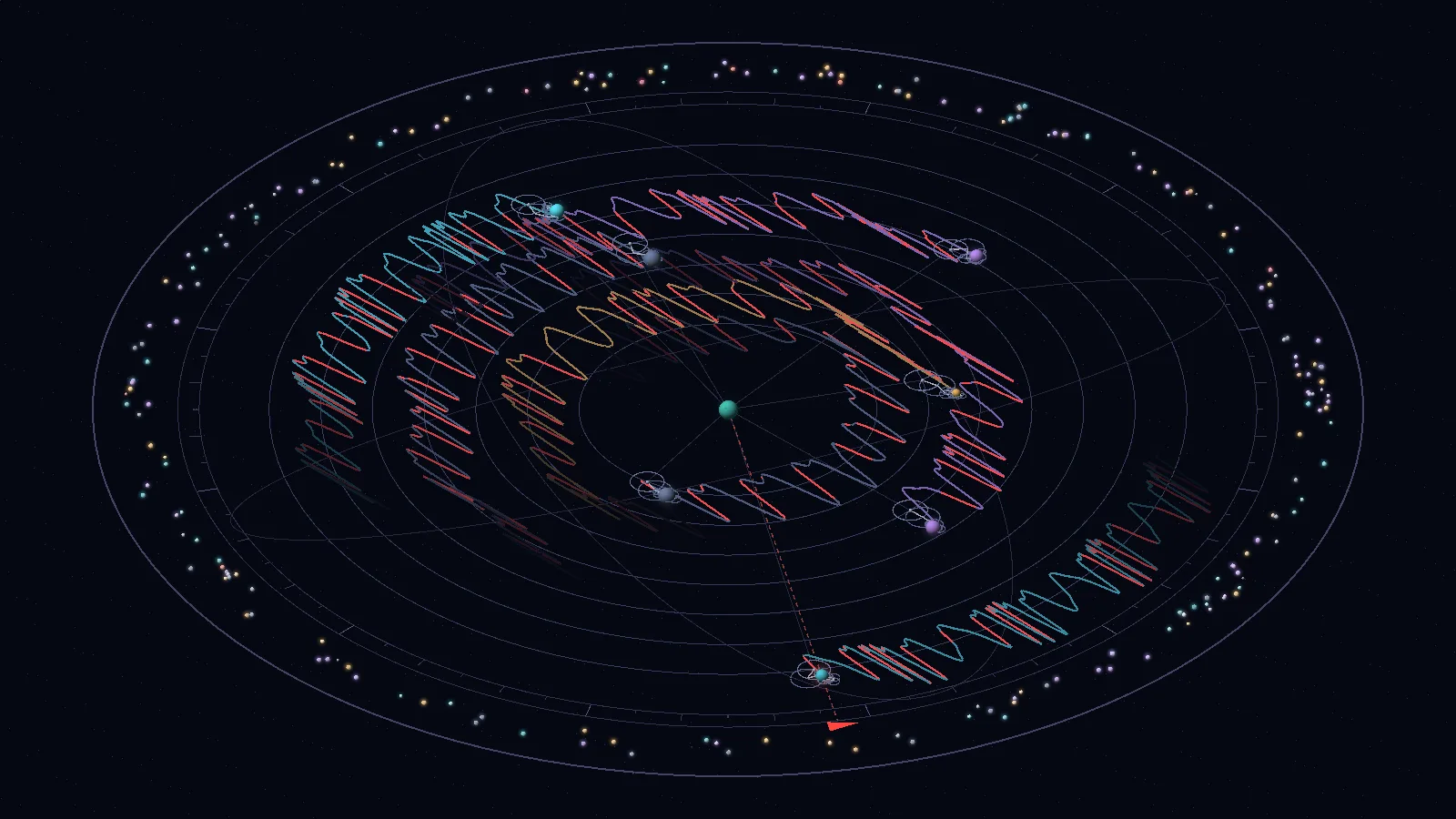
isotop becomes the Earth at the centre of a geocentric cosmos. The seven processes whose CPU and memory varied most over the last minute are the planets, each carried on a deferent circle and a chain of twelve epicycles that is the discrete Fourier transform of that minute, replaying it once a minute; every other process is a fixed star on an outer ring, as bright as its memory. Where a planet's apparent longitude seen from Earth runs backwards, its trail turns red and the status line says so. It is the most mathematical of the eighteen views: the picture is, to rounding, a theorem about Fourier series dressed as second-century astronomy.
Ptolemaic astronomy (the Almagest, about 150 CE) predicts the positions of the Sun, Moon and five naked-eye planets as seen from a fixed Earth. A planet rides an epicycle, a small circle whose centre travels on a larger circle, the deferent; seen from Earth the planet slows, stops, runs backwards against the stars (retrograde motion), stops again and resumes. The geometry is derived on Math Fourier Epicycles: retrograde motion exists exactly when the epicycle's tip speed exceeds the deferent's speed. Ptolemy's refinements (eccentric deferents and the equant, a point about which the epicycle's centre turns uniformly) make the model predictive; isotop uses none of them. Its spheres are the traditional order of the seven wanderers, Moon, Mercury, Venus, Sun, Mars, Jupiter, Saturn, from the centre outwards, and the outermost sphere carries the fixed stars.
Why it is a good metaphor for process data: a process's resource use is a closed-ish trajectory in a plane (CPU against memory) with a slow trend and several fast cycles. A sum of rotating vectors is the natural way to describe cycles; a planet is a process, and a process in retrograde is one whose short-period swings outrun its long-period drift.
The longer account lives in the repository: docs/theory/ptolemy.md.
Spheres and circles. Greek astronomy inherited a demand, usually attributed to Plato's circle: explain the wandering of the planets by uniform circular motion. Eudoxus answered with nested rotating spheres in the fourth century BCE. Apollonius of Perga (around 200 BCE) is credited with the deferent and epicycle, and Hipparchus (second century BCE) with fitting them to observation and discovering the precession of the equinoxes.
Ptolemy. Claudius Ptolemy's Mathematical Syntaxis, known by its Arabic-derived title, the Almagest (around 150 CE), is the completed system: tables for every planet built from deferents, epicycles and the equant, an off-centre point about which the epicycle's centre moves at uniform angular speed. The equant broke the letter of uniform circular motion and troubled astronomers for well over a thousand years.
Repair and replacement. Nasir al-Din al-Tusi (1247) devised a pair of circles that turns circular motion into motion along a line, the Tusi couple, and Ibn al-Shatir of Damascus (fourteenth century) built models without the equant. Copernicus (1543) moved the Sun to the centre but kept epicycles, and his lunar model is closely related to Ibn al-Shatir's; how much he knew of the earlier work is debated. Kepler's ellipses (1609) replaced the circles.
Fourier. In 1822 Joseph Fourier, studying heat, showed that essentially any periodic function is a sum of sines and cosines; in complex form, that is the epicycle theorem used here. Gauss had found a fast algorithm for the discrete transform around 1805, working on asteroid orbits, but did not publish it. It appeared in his collected works in 1866, in Latin, and Cooley and Tukey rediscovered it independently in 1965. N. R. Hanson (1960) argued that epicyclic astronomy, as a method, can approximate any path, which is part of why it lasted.
The mathematics (phasors, the DFT, Parseval's optimal truncation, Gibbs ringing, the sliding-window correction and the
retrograde criterion
a uniform deferent of radius
| Visual element | Measured quantity (source) | Transform |
|---|---|---|
| Earth, centre | isotop's own process (Snapshot::observer; in --demo a synthetic pid 999) |
Labelled isotop (pid N) and X cores | Y MiB (CPU / 100, memory in MiB); clickable when isotop is among the drawn processes |
| Planet | The seven drawn processes with the highest variance score over their last 60 samples of the shared history (history.rs) |
Score = variance of CPU in cores + variance of memory in doublings (log2 MiB, floored at 1 MiB). Needs at least 30 samples and a score above 0; isotop itself is excluded. An incumbent keeps its sphere while it ranks tenth or better |
| Sphere (which circle) | Mean CPU over the window | When the membership changes the seven are sorted busiest innermost: Moon, Mercury, Venus, Sun, Mars, Jupiter, Saturn at 0.245, 0.33, 0.415, 0.5, 0.585, 0.67, 0.755 of the sky radius (40 units); a planet that changes sphere eases there over 1.5 s |
| Deferent period | Sphere radius | 1200 s x (r / r_Saturn)^1.5; starting angle from the identity hash (decorative) |
| Epicycle chain | CPU in cores + i x memory in doublings, mean removed, 60 samples | Direct 60-point DFT, the 12 largest terms without the mean, largest first from the deferent point; the tip is the planet. Samples before a process's first are held at its first reading |
| Chain length | Sum of coefficient magnitudes | One global gain, soft-limited so the radii sum to |
| Planet size | Memory | 0.34 + 0.105 log2(max(memory / 64 MiB, 1)) units, at most 1.2 |
| Planet colour | Kind and state |
palette::kind_color, as in the other views |
| Trail | The chain and deferent as they stand now | Positions over the last min(240 s, 0.8 x deferent period) on a 0.25 s grid; the oldest 45 % fades |
| Red trail, red glow, dashed sight line, marker on the ecliptic scale | Retrograde: |
Exact analytic derivative of the deferent plus the chain; sight line from Earth to the ecliptic scale |
| Fixed star | Every other drawn process | Angle and radius (0.935 + 0.06 u) x 40 from the identity hash, on a ring that turns once in 60 s |
| Star brightness | Memory (RSS; the physical footprint on macOS) |
|
| Nova | A process that appeared since the sample before (within 8 s) | Brightens 4 magnitudes in 0.3 s, then decays with e-folding time 2 s, over 6 s |
| Fade | A process that exited | Dims out over 1.5 s at its seat on the ring |
| Legend lead | Samples in the window; planets in retrograde |
the heavens are still forming: N of 30 samples, then X is in retrograde / X and Y are in retrograde
|
Decorative: the armillary rings (outer sphere, two ecliptic hoops, two tilted hoops), the ecliptic degree scale and its labels, the faint spokes from Earth to each deferent point, the dot on the deferent, the colours of the epicycle circles and the chain arm, Earth's continents, the starting angle on the deferent, the names of the spheres (they stand in for a ranking by mean CPU, not for real distances), and the turning of the star ring.
Selection and hysteresis. Ptolemy::observe runs once per new sample. It takes the last SERIES = 60 samples of the
shared history at or before the shown snapshot (so pause and rewind show the past they were taken in), scores every drawn
process with measure() (at least FORMING = 30 readings; the variance of CPU in cores plus the variance of memory in
doublings), and ranks candidates by score, ties by identity. Existing planets that still rank within KEEP_RANK = 10
keep their sphere; empty spheres are filled with the best candidates that were not planets before. Only when the
membership changes are the seven re-sorted by mean CPU; otherwise they stay in their spheres however the ranks shuffle.
The test wanderers_keep_their_spheres_while_ranks_shuffle_inside_the_top_ten fixes this.
The chain. signal() builds the complex series, epicycles() the twelve largest terms with the phase correction of the sliding
window, scaled() applies the gain. A new planet starts with its terms at their targets; an existing one retargets, easing every
coefficient to the new target with a smoothstep over the measured interval between samples (clamped to 0.1 to 10 s), starting
at the instant the sample arrived (history.arrived()) so the easing does not depend on the frame rate. Deferents are Deferent values that
integrate the angle across a re-sort so it stays continuous.
Replay and trail. The chain replays the window once per REPLAY = 60 s of scene time at any --sample-ms. The trail is recomputed every frame
from the current coefficients and deferent: it is where the planet would have gone with the epicycles it has now, not a recording. The code steps
rotors back by one grid step per point so a trail costs one complex multiply per term per point.
Stars, novae, fades. star_seat places each non-planet process on the ring from a hashed angle and radius. Births and exits come from History::changes over the last
FLASH_WINDOW = 8 s, so a new process flares as a nova (stellar::flash(Flash::Nova, age)) and an exited one fades (Flash::Fade), even in a headless frame. A process that was a planet when it exited does not fade on the ring.
(The supernova timeline in stellar.rs, for exits above 1 GiB, exists but this view does not use it.)
Drawing and parity. Strokes (trails, hoops, chains, sight lines) are drawn as pairs of triangles by stroke(), not as hardware lines, so the CPU and GPU rasterizers fill them alike;
depth offsets (BEHIND_RINGS, BEHIND_TRAILS, TRAIL_BAND per sphere, BEHIND_CHAINS) separate the many flat strokes that all lie on the ground plane so neither backend breaks a tie. The row has haze: false (trail colours are
pre-blended against the plain space sky), flash: false (stars flash their own novae) and its harness reference time is 300 s, because the window fills only after a minute.
Picking and stability. Planets and stars are pickable spheres; the harness checks the seats (a star's seat depends on the identity only; Earth's is the centre), not the planets, whose membership is a measurement. The tour visits planets by variance score.
Degradation. Ptolemy reads only per-process CPU and memory and isotop's own row, so it has no optional source to lose. If isotop's own process is not read, Earth has no figures and is labelled isotop.
On macOS the picture is otherwise the same, with memory as the physical footprint.
What I see in the repository's renders. At the default --time 12 the heavens are empty: Earth, the ring of sphere
and degree marks, the tilted armillary hoops and a ring of small coloured stars, and the status line says the heavens are
still forming. At --time 300 (a full window) seven coloured spheres sit on seven concentric circles around the
teal Earth, each trailing a long coloured line whose red stretches make it look like a saw-blade; the colours are the
kind colours (teal, slate, purple, gold). Faint small circles hang about each planet: the epicycles. One planet has a dashed red line to Earth and a red wedge on the outer degree scale: it is in retrograde now.
- Measured and derived. The chain's shape is the minute of CPU and memory, to the truncation error in Math Fourier Epicycles. The red stretches are an exact criterion on that chain. The size of a planet is memory. Which sphere a planet is on is its rank by mean CPU among the seven wanderers at the moment the membership last changed.
- Not history. The tip is not the process's current state. It is the replay of the minute (current to within the last one or two samples' easing), at a position in the replay that is a function of the clock; the trail is hypothetical. Two planets in retrograde at once are not synchronised with anything real.
- The wrap. Each minute the tip snaps from the last sample back to the first. For a process whose memory climbs through the whole window this is a visible jump, with Gibbs ringing beside it.
- Handedness. Counter-clockwise epicycles mean memory lags CPU by a quarter period, clockwise that it leads.
- Saw-teeth. Real planets in the Ptolemaic model loop a few times per synodic cycle because the deferent is nearly as fast as the epicycle. Here epicycle terms turn 1 to 30 times a minute and the deferents 0.05 to 0.27 times, so the epicycles are 4 to 600 times faster in turns and loops are small, frequent and everywhere. The picture is therefore not a quantitative claim about the process.
- Invisible. Anything shorter than one sample, anything longer than the window, the 47 smaller Fourier terms, and every process below the variance of the seventh planet (they are stars; a quiet process's brightness is only its memory).
- Stars are not positioned by data. Angle and radius come from the identity hash; only brightness (memory) and the flare (birth) mean something.
./target/release/isotop --demo --view ptolemy --time 300 --width 1600 --output /tmp/ptolemy.png --renderer cpu
./target/release/isotop --demo --view ptolemy --time 12  --width 1600 --output /tmp/forming.png   # the heavens still forming
./target/release/isotop --view ptolemy            # live; v opens the picker, Tab cycles, click a planet for its sphere and epicycle count
Renders are repeatable: the demo is deterministic in --time, and the trail is a function of the clock, not a recording.
-
src/ptolemy.rs:Ptolemy(theViewModule),observe,measure,signal,epicycles,scaled,Deferent,Planet,retrograde,star_seat,draw_planet_paths,draw_armillary,stroke; constantsSKY,RADII,SPHERES,KEEP_RANK,FORMING,TERMS,GAIN,REACH,OUTER_PERIOD,REPLAY,RESORT,EASE,TRAIL_*,STAR_RING,STAR_TURN,FLASH_WINDOW. -
src/simulation.rs:Complex,dft,smoothstep;src/history.rs:History::recent,History::changes,SERIES;src/stellar.rs:magnitude,spread,flash,Frame::star. -
src/views.rs: theptolemyregistry row (Backdrop::Space,haze: false,flash: false, demo optionschurnandobserver, harnesstime: 300). - Tests:
dft_reconstruction_equals_the_samples_at_integer_times,a_planet_whose_epicycle_outruns_its_deferent_is_in_retrograde_and_a_slow_one_is_not,wanderers_keep_their_spheres_while_ranks_shuffle_inside_the_top_ten,a_wanderer_leaves_its_sphere_when_it_drops_out_of_the_top_ten_or_exits. - Design source:
docs/briefs/views-2026-10.md(section 1,ptolemy) anddocs/mockups/ptolemy.jpg. There is no plugin system: this is a compile-time module and oneREGISTRYrow.
- Real periods. Replace the Kepler-law deferent with one whose period is the process's own dominant period (the largest term of the spectrum): the planet would complete a deferent revolution once per cycle of its main behaviour.
- Equant and eccentric. Add Ptolemy's equant to the deferent and compare retrograde statistics. Does the bisected eccentricity make the loops more regular?
- Hann-windowed minute. Remove the wrap discontinuity (see the Gibbs figure on the Math page) and see whether planets' tips then pass through the newest sample.
- Colour by handedness. Draw clockwise and counter-clockwise epicycles differently.
- A planet's second chain. A second DFT of the memory alone, drawn as a small moon on the CPU epicycle: separates the two physical signals that the single complex chain entangles.
- Open: is the variance score the right "most varied" measure? It adds a variance in cores to a variance in doublings, two incommensurable units; a normalised version would rank differently.
- G. J. Toomer (transl.), Ptolemy's Almagest (London: Duckworth, 1984).
- O. Neugebauer, A History of Ancient Mathematical Astronomy (Springer, 1975).
- N. R. Hanson, "The mathematical power of epicyclical astronomy", Isis 51 (1960), 150-158.
- J. Ferguson, Astronomy Explained upon Sir Isaac Newton's Principles (London, 1756), the plates of apparent planetary paths that the mockup follows (named in
docs/briefs/views-2026-10.md). - Math Fourier Epicycles, Math Stellar Photometry, Theory History, Theory Determinism.