Repository navigation
Math Schwarzschild
The Schwarzschild metric is the exact vacuum solution of Einstein's equations outside a spherical, non-rotating mass, and nearly everything the Horizon view draws can be derived from it in a few lines: the radii 2M, 3M and 4M and 6M, the Kepler-exact orbital frequency, the bending and capture of light, the redshift of orbiting gas, the freezing of an infalling body, the tidal stretching, even the temperature of Hawking radiation. This page derives those results, checks the important ones numerically with the Python standard library, and separates what the theory says from what the view does with it. It has no view of its own: it is the mathematics page behind Horizon, and it is independent of isotop. Throughout,
The longer account lives in the repository: docs/theory/horizon.md.
Dark stars. The idea that something could be too heavy for light to leave is older than relativity. John Michell (1783) and Pierre-Simon Laplace (1796) reasoned with Newtonian gravity and light as fast particles: enough mass inside a small enough radius gives an escape speed above
Schwarzschild. Einstein published the field equations in November 1915. Karl Schwarzschild, an astronomer serving in the German army on the Eastern Front, sent him the exact solution for the space outside a non-rotating mass in a letter dated 22 December 1915; Einstein replied on 9 January 1916 and presented the paper to the Prussian Academy, and the solution appeared in the Academy's Sitzungsberichte in 1916. A second paper, on the interior of a uniform sphere, followed within weeks. Schwarzschild was invalided home with the autoimmune disease pemphigus and died at Potsdam on 11 May 1916, aged 42. His surname is German for "black shield". Nothing follows from this.
What the radius means. For decades the surface at
Disks and pictures. Shakura and Sunyaev (1973), Novikov and Thorne (1973) and Page and Thorne (1974) worked out what a thin relativistic disk radiates. In 1978 Jean-Pierre Luminet computed the appearance of such a disk around a Schwarzschild hole on an IBM 7040 at the Paris-Meudon Observatory and, the machine having no display, drew the result by hand in India ink; it was published in 1979. The Event Horizon Telescope imaged the shadow of M87* in 2019 and of Sagittarius A* in 2022. Hawking (1975) showed that the hole radiates, with the temperature of the last section, and Bekenstein (1973) had given it an entropy.
In Schwarzschild coordinates
Free particles and light follow geodesics. The metric does not depend on
Writing
Differentiating once more gives the orbit equation
For
Circular orbits sit at extrema of
Circular orbits therefore exist only for
which is positive, a stable minimum, if and only if
The angular frequency of a circular orbit with respect to coordinate time follows from
identical to Kepler's third law, exactly and not just in the weak-field limit, in the units of the distant observer's clock. The proper time of the orbiting body runs slower: orbits::M_PER_SECOND), an ISCO orbit takes 9.2 s.
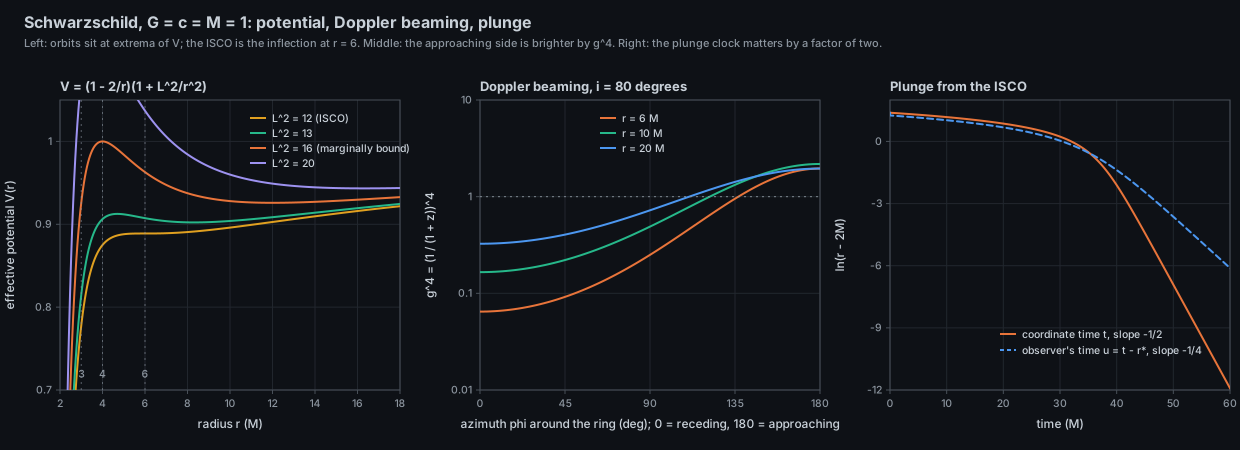
Left: the effective potential for $L^2 = 12, 13, 16, 20$; the $L^2 = 16$ curve peaks at exactly $E = 1$ at $r = 4$. Middle: relative intensity $g^4$ around a ring of gas at inclination 80 degrees. Right: the plunge; see below. Script: docs/figures/horizon-potential-redshift-plunge.py.
For
A circular photon orbit needs
The orbit is unstable: a small perturbation obeys
Deflection. The total sweep of a scattered ray is
The leading term,
Each additional
I integrated the orbit equation
| numerical |
with the cubic term | |||
|---|---|---|---|---|
| 6 | 1.7194 | 0.6667 | 0.9939 | 1.1914 (the series has stopped converging usefully) |
| 10 | 0.5904 | 0.4000 | 0.5178 | 0.5605 |
| 20 | 0.2361 | 0.2000 | 0.2295 | 0.2348 |
| 40 | 0.1081 | 0.1000 | 0.1074 | 0.1080 |
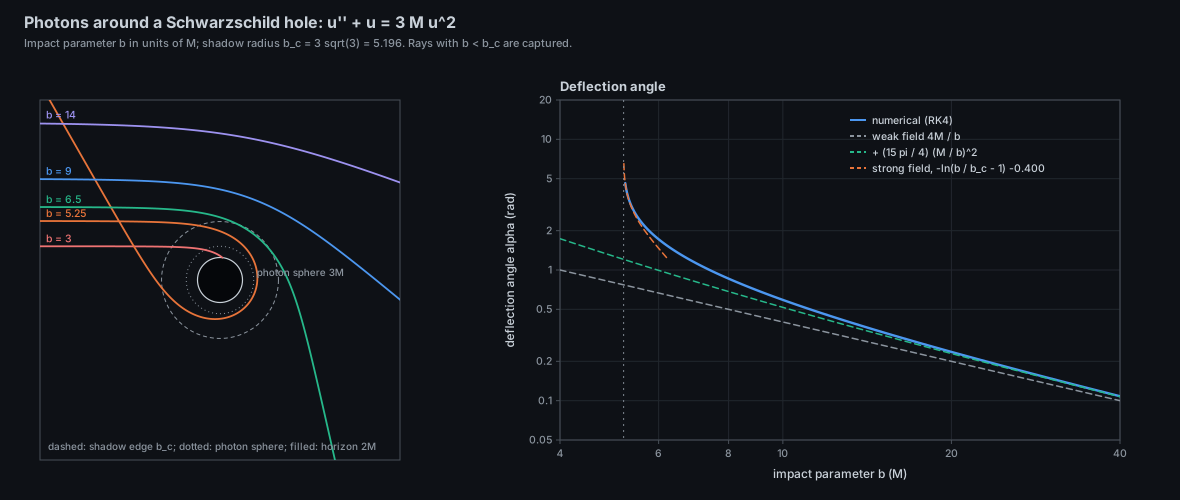
Left: rays from the left with $b = 3$ (captured), 5.25 (just outside the shadow: it winds almost once around and comes back), 6.5, 9, 14. Right: the numerical deflection, the weak-field series (dashed) and the strong-field logarithm (dashed orange). Script: docs/figures/schwarzschild-light-bending.py; deterministic and instantaneous to run.
A renderer can lens a scene without tracing rays through every pixel. Put the observer at infinity and the hole at the origin. A point at radius
where
A static emitter at radius
The first factor combines the gravitational redshift and the transverse Doppler effect; the second is the longitudinal Doppler term, and
For a body falling radially from rest at infinity,
- the body is seen to slow, redden and dim without bound, and never to cross the horizon: its image freezes, exponentially fast, with an e-folding time of
$4M$ of the observer's time for the redshift and for$r - 2M$ ; - in proper time the body crosses without incident and reaches the singularity after a finite time: for a radial fall from rest at the horizon the proper time to
$r = 0$ is exactly$\pi M$ (for one solar mass 15 microseconds; for$4\times10^6$ solar masses about 62 seconds).
I verified the exponents numerically by integrating a plunge from the ISCO (
Geodesic deviation gives the relative acceleration of two nearby freely falling particles. For a body in radial free fall, in its own frame, the tidal tensor is diagonal: stretching along the radial direction at
which falls as
For a thin disk in steady state the Page-Thorne (1974) flux in the Schwarzschild case follows from conservation of mass, energy and angular momentum and the zero-torque condition at the ISCO. In units
Here
(differentiate to check: the derivative of the right side is $1/(2\sqrt r) - 3/(2\sqrt r (r-3))$) giving
I checked this numerically against the integral form: the ratio of the two is constant (1.5, from the factor I left out of the numerical integrand) at docs/mockups/code/horizon.py, page_thorne, has) is not proportional to the integral (the ratio drifts from 0.29 at
A black hole radiates as a black body of temperature
This is a quantum result and cannot be derived from the classical metric alone, but its form follows from a short argument. Continue to Euclidean time
The Horizon view uses units in which oom_score ranks the orbits, memory pressure (memory some avg10, snapshot.pressure[1]) sets the brightness of the disk (a gain from 0.45 at no pressure to 1.35 at 100 %), and an OOM kill triggers a plunge. The honest physical content is therefore these:
-
Brightness is accretion rate. The disk's luminosity is
$\eta\dot M c^2$ , so tying brightness to a pressure is tying it to a rate at which something is being consumed, which is a sound reading. It does not say how much has been consumed. -
Rank is not mass. The orbit radius is a rank of
oom_score, a monotone function; the metric's radii$6M$ to$30M$ are chosen, and the physical radius of any process is not a measurement. - The horizon is a one-way surface, not a measurement. What the picture claims by freezing a killed process at the horizon is an epistemic statement: the observer sees the last sample of the process, and nothing newer. That is true of isotop whichever view is shown.
The Horizon view implements part of this page; the rest is theory that the view does not use (tides, Hawking temperature, the full proper-time infall).
-
src/horizon/lens.rs:LensTable(the photon table of section "Lensing a scene by its vertices": 360 radii by 721 sweeps, traced with RK4 atPHOTON_STEP = 0.002),trace_photon,beloborodov_impact_parameter,flux(the closed form derived above, with the coefficient$\sqrt3/2$ ) anddisk_flux,angular_velocityandperiod,one_plus_z,disk_emission,PlungeTrackandplunge_brightness; constantsHORIZON,ISCO,SHADOW_RADIUS,DISK_OUTER,PLUNGE_FLOOR. -
src/horizon/orbits.rs:rank_radius,band_radius,M_PER_SECOND,Orbits;src/horizon.rs: the view itself;src/horizon/disk.rs: the lensed disk, shadow and photon ring as triangles. - The Python prototype, reference only, is
docs/mockups/code/horizon.py(LensTable,beloborodov_b,page_thorne,one_plus_z,plunge_track); itspage_thornecarries the wrong coefficient discussed under "The accretion disk flux", andlens::fluxdocuments the correction. Figure scripts on this page:docs/figures/schwarzschild-light-bending.pyanddocs/figures/horizon-potential-redshift-plunge.py.
- K. Schwarzschild, "Über das Gravitationsfeld eines Massenpunktes nach der Einsteinschen Theorie", Sitzungsberichte der Königlich Preussischen Akademie der Wissenschaften (1916), 189-196.
- M. D. Kruskal, "Maximal extension of Schwarzschild metric", Physical Review 119, 1743 (1960).
- C. W. Misner, K. S. Thorne, J. A. Wheeler, Gravitation, W. H. Freeman (1973).
- R. M. Wald, General Relativity, University of Chicago Press (1984).
- S. Chandrasekhar, The Mathematical Theory of Black Holes, Oxford University Press (1983).
- C. Darwin, "The gravity field of a particle", Proceedings of the Royal Society A 249, 180 (1959).
- V. Bozza, "Gravitational lensing in the strong field limit", Physical Review D 66, 103001 (2002).
- A. M. Beloborodov, "Gravitational bending of light near compact objects", The Astrophysical Journal 566, L85 (2002).
- J.-P. Luminet, "Image of a spherical black hole with thin accretion disk", Astronomy & Astrophysics 75, 228 (1979).
- D. N. Page, K. S. Thorne, "Disk-accretion onto a black hole. I. Time-averaged structure of accretion disk", The Astrophysical Journal 191, 499 (1974).
- O. James, E. von Tunzelmann, P. Franklin, K. S. Thorne, "Gravitational lensing by spinning black holes in astrophysics, and in the movie Interstellar", Classical and Quantum Gravity 32, 065001 (2015).
- S. W. Hawking, "Particle creation by black holes", Communications in Mathematical Physics 43, 199-220 (1975).
- J. D. Bekenstein, "Black holes and entropy", Physical Review D 7, 2333 (1973).
- F. W. Dyson, A. S. Eddington, C. Davidson, "A determination of the deflection of light by the Sun's gravitational field, from observations made at the total eclipse of May 29, 1919", Philosophical Transactions of the Royal Society A 220, 291 (1920).
- The Event Horizon Telescope Collaboration, "First M87 Event Horizon Telescope results. I. The shadow of the supermassive black hole", The Astrophysical Journal Letters 875, L1 (2019).