Repository navigation
Theory Life Events
A sampler sees who is alive at the instant it looks. Births, deaths and execs are things that happen between
looks. isotop has two ways to learn about them: the kernel's own notifications (the Linux proc connector and
taskstats, macOS kqueue) and sample diffing, comparing this sample's population with the last one's. The
first is exact and detailed but needs the kernel's cooperation and sometimes a privilege; the second always works
and misses what lived and died between two samples. Life in model.rs merges both into one ordered list,
Snapshot::life, in which each exit appears once and is never revised. This page explains the kernel
mechanisms, the byte layout isotop decodes, the merge, the queue between the event thread and the frame loop, the
privilege rules, and (found while writing it) one edge where the "once" has a time limit.
Accounting for exits. Unix process accounting (acct) writes a record when a process ends. (General background; I have not cited a source for dates.) The mechanisms this page reads are the Linux and BSD descendants of that idea, and they differ in how much they say.
-
The proc connector is a netlink interface that multicasts fork, exec and exit. It took shape in 2005, when Matt Helsley proposed merging separate fork and exit connector patches into one connector that also reported exec and id changes; the connector's own history dates the "Process Events Connector" commit to 2005-11-07. Later additions were a tracer event and a comm-change event (2011). Until Linux 6.6 listening needed
CAP_NET_ADMIN; isotop's source comment says it does not from 6.6 on, and the sections below say it will not ask. -
Taskstats is the per-task accounting struct delivered over generic netlink at exit. Its documentation in the kernel is bound up with delay accounting, which measures time spent waiting for CPU, block I/O and swap-in; the record isotop decodes is the same structure with
TASKSTATS_VERSION14 in current headers, and "new versions only append fields". Taskstats always needsCAP_NET_ADMIN. -
kqueue came from FreeBSD 4.1 in July 2000 (Jonathan Lemon, described at USENIX 2001) and reached macOS later. Its
EVFILT_PROCfilter watches one pid at a time for exec and exit, which is why section 2 differs from section 1 in kind and not only in detail.
Why sample diffing is not enough is a problem older than any of these: a process that lives for less than the interval between looks is invisible to a poller. Section "Why events at all" gives the probability; the connector, taskstats and kqueue are three answers to it.
In this project. Event sources arrived on 2026-10-11 with the Necropolis (#123), the one view that demands Source::LifeEvents. The guard against a second exit for one process, in necropolis.rs, is a map called mourned.
Take sampling instants
A shell command, a compiler child or a sh helper that lives a tenth of a second is on the books at a once-a-second
instant 10 % of the time; if its mean life equals
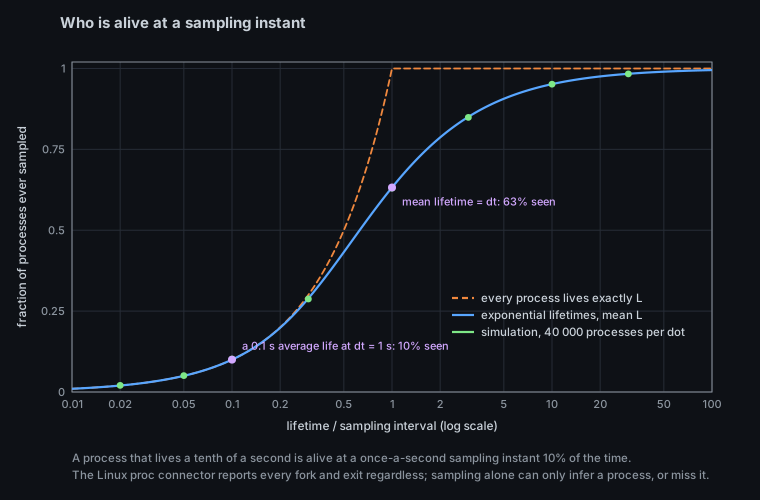
This is the Nyquist problem for point events. Sample diffing cannot recover what it never saw; the proc connector
reports every fork and exit as it happens. A view that tells a story of births and deaths (the
Necropolis, whose whole subject is the dead) needs them. Views that draw only the population
(everything else) use sample-to-sample arrivals (History has changes) and need no events.
Both mechanisms are netlink sockets: datagrams between the kernel and a process, addressed by a protocol number and, for multicast, a group.
The process events connector (NETLINK_CONNECTOR, index CN_IDX_PROC = 1, value CN_VAL_PROC = 1) multicasts a
message from inside the kernel's fork, exec and exit paths. A listener subscribes by sending
PROC_CN_MCAST_LISTEN. Events are per task (thread), so a thread creation is also a "fork"; isotop reports
processes, so it ignores thread events (pid != tgid). The message, as include/uapi/linux/cn_proc.h lays it out and
as Decoder::connector reads it (kernel byte order):
| offset in datagram | size | field |
|---|---|---|
| 0 | 16 |
nlmsghdr (length, type NLMSG_DONE, flags, sequence, port) |
| 16 | 20 |
cn_msg: idx, val, seq, ack, len, flags |
| 36 | 4 |
proc_event.what: PROC_EVENT_FORK 0x1, PROC_EVENT_EXEC 0x2, PROC_EVENT_EXIT 0x80000000, PROC_EVENT_NONE 0 (acknowledgement) |
| 40 | 4 | cpu |
| 44 | 8 |
timestamp in nanoseconds, CLOCK_MONOTONIC
|
| 52 | 4 each |
event_data, as words: fork = parent pid, parent tgid, child pid, child tgid; exec = pid, tgid; exit = pid, tgid, exit_code, exit_signal, parent pid, parent tgid |
The exit code is a wait status: the low 7 bits are the terminating signal (0 for a normal exit), bit 7 says a core
was dumped, and bits 8 to 15 are the exit status. Cause::of_status is exactly the WIFEXITED/WIFSIGNALED
decoding: Code(n), or Signal { number, core }. The connector is a push interface: it carries no cpu time, no
memory, and no command line.
Taskstats (generic netlink, the TASKSTATS family whose numeric id is looked up at start through the control
family GENL_ID_CTRL) is the kernel's per-task accounting struct delivered at exit. A listener registers for a CPU
mask (TASKSTATS_CMD_ATTR_REGISTER_CPUMASK, here "all possible CPUs", read from /sys/devices/system/cpu/possible)
and receives the record of every task that exits on those CPUs: one record per thread, and for the last thread
of a process an extra aggregate. The record carries what the connector lacks: command name (ac_comm), start
(ac_btime/ac_btime64), run time (ac_etime, µs), user and system CPU time (µs), peak resident memory
(hiwater_rss, KiB), storage bytes read and written, voluntary and involuntary context switches, the AFORK flag
(forked, never exec'd), and the exit code. isotop decodes it by byte offset from taskstats.h as of Linux 6.8
(TASKSTATS_VERSION 14), where "new versions only append fields", checking the version word before using later
fields:
| field | offset | notes |
|---|---|---|
version |
0 | selects the layout |
ac_exitcode |
4 | same wait status |
ac_flag |
8 |
AFORK 0x01, AGROUP 0x20 (version 12 and later: last thread of the group) |
ac_comm |
80, 32 bytes | NUL-terminated |
ac_pid |
128 | the thread id |
ac_btime / ac_btime64
|
136 / 344 | seconds since the epoch; the 64-bit form from version 10 |
ac_etime, ac_utime, ac_stime
|
144, 152, 160 | microseconds |
hiwater_rss |
200 | KiB |
read_bytes, write_bytes
|
248, 256 | |
nvcsw, nivcsw
|
272, 280 | context switches |
ac_tgid |
368 | version 12 and later |
Decoder::record_message sums the thread records of a process into one ExitRecord (CPU, I/O and switch counts
add; hiwater_rss and etime take the maximum; btime the minimum), takes the command and AFORK from the
leader's own record, and emits it when the last thread's record arrives (the AGROUP flag where the version has
it; before it, the aggregate message or the leader's record with no known thread left). Which thread belongs to
which process, before ac_tgid existed, comes from the connector's thread forks.
Netlink families can mark an operation as administrative; the kernel then requires CAP_NET_ADMIN before it will honour it. Taskstats' registration is such an operation, always. The proc connector
required it too; isotop's source and README state that it needs no privilege from Linux 6.6 on (not re-verified
against kernel history for this page). Both only work for a process in the initial PID and user namespaces
(initial_namespaces checks the /proc/self/ns/pid and user links against the fixed inode numbers
pid:[4026531836] and user:[4026531837]); inside a container only sample diffing remains.
open_events is written never to escalate: it opens each source once, takes what the process may open as it is,
and returns None with no thread if neither opens. An unprivileged run gets the connector on a new kernel and
sample diffing otherwise; you can choose to grant the binary the capability (setcap cap_net_admin+ep), and
isotop will use it, but it will not ask, sudo itself, or retry.
open_connector binds the socket to the multicast group, sends PROC_CN_MCAST_LISTEN with a nonce (its own pid) in the
ack slot and waits (up to 256 messages, with a 200 ms receive timeout) for the kernel's acknowledgement, a
PROC_EVENT_NONE message whose ack field is nonce+1 and whose first data word is 0 (success). Outside the initial
namespaces the request is ignored and no acknowledgement ever comes, so the socket is dropped. The receive buffer is
requested at 4 MiB (SO_RCVBUF; the kernel caps it at rmem_max), because a burst of forks outruns the default.
open_taskstats asks the control family for the TASKSTATS id, then registers with NLM_F_ACK and waits for
error code 0.
isotop-events polls both sockets with a 200 ms timeout, so it notices within 200 ms that nobody holds the queue
any more and exits, closing its sockets. It reads with MSG_DONTWAIT in a loop until the socket is empty; an
ENOBUFS from recv means the kernel dropped messages because the socket's buffer was full, and is counted
(LifeQueue::overrun).
macOS has no connector and no taskstats. kqueue with EVFILT_PROC can watch one pid at a time, any process of
the same user, child or not, for NOTE_EXEC and NOTE_EXIT. isotop-events therefore watches every pid in the
latest sample (the collector shares the pid → Identity map; each loop it registers new ones with EV_ADD | EV_CLEAR
and forgets those that left the sample) and stamps each event with monotonic_ns() when it receives it. Consequences:
- No fork events. A fork names no child here, so births come from sample diffing, at the time of the sample that saw them.
-
No exit status or record.
NOTE_EXITSTATUSis reported for children only, so every kqueue exit hasCause::Unknown. - Only the sampled are watched. A process that lives and dies between two samples was never in a sample and was never watched, so kqueue cannot see it. (On Linux the connector can.)
- Other users' processes are refused by the kernel and are simply not watched.
- The exec itself is exact: a macOS process also carries a pid version that changes on every exec (macOS sampling), which sample diffing uses as a backstop.
The event thread produces Observed { at, source, what }: at in nanoseconds of CLOCK_MONOTONIC, the kernel's
timestamp where the source gives one (the connector) and the receive time otherwise; what is Fork, Exec, Exit
or Record (a taskstats record). The collector turns them into LifeEvents: at in seconds of
Snapshot::elapsed (seconds_since(origin_ns, at), where the collector captured CLOCK_MONOTONIC at its
construction), a kind, the source, and an estimated flag.
Naming a process. An observation carries a pid; the model needs an Identity. Life::merge names it from, in
order: a start the source gave (the connector reads /proc/<pid>/stat for the parent and child at the time of the
event); the previous sample's population plus forks reported this interval; this sample. If the pid is in none of
those the event is estimated: a forked child already gone before its stat could be read gets the start its
fork's timestamp implies, converted by the Clock into ticks since boot (monotonic time plus the suspended time,
times USER_HZ), and a process nothing names gets start 0. An estimated identity never matches a sampled process,
so an estimated event can never be joined to a wrong one.
Life keeps, between samples, reported (what has been emitted, by kind and Identity, with its time),
exits (connector exits waiting for their taskstats record), records (taskstats records waiting for their
exit) and forked (forks of the last interval, so a following exit can name the child). Per sample:
-
Walk the observations in arrival order.
- A fork names parent and child, remembers the child, and is emitted.
- An exec is emitted.
- An exit is dropped if that identity already exited or waits; else, when the source is the connector and
taskstats is active, it is held in
exitsfor its record; else emitted at once. - A record is attached to the exit holding it if there is one; else, if the connector is active, held in
records; else (taskstats alone) emitted as an exit with the record's own cause. A record whose begin time is more than one second off the identity it would name belongs to another process and is dropped.
-
Expire. After
RECORD_WAIT = 0.5 s(of event time) whichever half is still alone is emitted alone.attachmerges a held exit with its record: the event keeps the connector's exact time and cause and gains the record, and is re-labelled a taskstats event (the most detailed source). -
Diff, but only if the previous sample was also taken under demand (so the first sample reports nothing):
- a process in this sample and not the last, with no fork reported for it: a birth, at this sample's time,
source
Diff, parent taken from this sample (or the last if the parent is gone); - a process in both whose exec marker changed and that no event reported: an exec. On macOS the marker is the pid version; on Linux it is the process name, and only while the proc connector is not active (the connector reports every exec, so a rename is then not an exec);
- a process in the last sample and not this one, and not claimed (reported, or waiting in
exitsorrecords): an exit,Cause::Unknown, sourceDiff, at this sample's time.
- a process in this sample and not the last, with no fork reported for it: a birth, at this sample's time,
source
-
Prune
reportedof entries older thanLIFE_MEMORY = 10 s, and sort the sample's events byat.
Preference when two sources saw an exit: taskstats (cause, time, record) over the connector (cause, time) over kqueue (time) over diff (existence). The tests pin the cases: connector and diff report one exit; taskstats and connector one exit with the record at the connector's time; an exit that came before its record waits and is delivered later while diffing leaves it alone; a late record after the exit was reported alone is dropped; a connector exit that happened after the scan of the sample that still lists the process is not repeated by the next sample's diff.
One exit per Identity, never revised is enforced by reported: a second exit for the same identity is
discarded, and a reported event is never edited (attachment happens before reporting, while the exit is held for
at most half a second). It is what lets a consumer treat Snapshot::life as an append-only log.
There is a limit, found by reading merge and confirmed with a probe test (a scratch copy of the repository, not
committed): the guarantee is bounded by LIFE_MEMORY. A zombie (a process that has exited and not been reaped)
stays in /proc and in every sample as state Z. The connector reports its exit when it becomes a zombie; if its
parent reaps it more than 10 s later, the entry in reported has been pruned, the process is in the last sample and
not this one and is not claimed, and diffing emits a second exit for it, Cause::Unknown, source Diff, at the
reaping sample. In the probe an exit reported at 1.5 s for a process still listed at 2 s to 19 s produced
Exit { cause: Unknown, source: Diff } at 20 s, while the same reaping within 8 s produced nothing. By the same reasoning a sampling interval over ten seconds (the maximum --sample-ms is 10000, and frame rounding adds a little) can open the
same window; that case was not probed. Consumers that need exactly-once guard it themselves: the Necropolis keeps its own
mourned set and ignores a repeated exit. A reported-set that outlives the longest zombie, or diffing that skips
processes that were already Z, would close it; it is a boundary of the current design, not a measurement of how
often it occurs.
The event thread and the frame loop share a LifeQueue: a mutex around a Vec<Observed> and a dropped count.
-
LifeQueue::CAPACITY = 4096.pushappends while the vector is shorter; otherwise it drops the new observation and incrementsdropped(saturating). The earliest 4096 are kept (a test checks this). -
overrunalso incrementsdropped, for an observation lost before it reached the queue (the kernel had more for the socket than its buffer held,ENOBUFS). -
drainreturns everything queued in arrival order and the count dropped since the last drain, resetting both. The collector calls it once per sample and exposes the count asSnapshot::life_dropped.
"Dropped" therefore means an event the stream lost, not a process that did not exist. What it costs depends on the
loss: a lost exit is later found by diffing as an exit with Cause::Unknown (existence kept, detail lost); a lost
fork becomes a birth at sample time; a lost exec is lost, on Linux, unless the process was renamed. The queue is
sized for bursts (a build forking thousands of processes in a second) between samples a second apart; a larger
--sample-ms makes overflow more likely.
Events are read only while a view demands them (Source::LifeEvents; today the Necropolis). On the first sample
under demand Life::start opens the sources once (tried prevents retries until the demand ends). While demanded
Snapshot::sources lists LifeEvents, SampleDiff and the mechanisms that opened, and Snapshot::missing lists
ForkEvents when the proc connector is not delivering and ExitRecords when taskstats is not. When the demand ends,
Life::default() replaces the state, dropping the queue, which ends the thread within 200 ms and closes the
sockets. Deaths while another view is shown are therefore not recorded. The demand itself is described in
the background sampler.
--demo runs no thread: demo_events computes the events from the churn schedule and the snapshot carries them
directly (Model and rates); under the Necropolis's mortality option one
exit in ten is delivered as a diff event with no cause, to exercise that path.
- An exit with a signal, a status and a record came from the connector and taskstats; "died between samples" is diffing and means only that the process was gone, not why, and not when within the interval.
- A fork or exit with an exact time is a kernel timestamp (Linux) or the instant isotop's thread was woken (macOS kqueue); a diff event is stamped with the sample's time, up to one interval late.
- Absence of an event proves nothing about a process that lives and dies inside one interval on macOS, or when the queue overflowed.
- An estimated identity is a guess named as such, and is never drawn as a known process.
-
platform/linux/events.rs:open_events,open_connector,open_taskstats,Decoder,parse_record,Clock,fieldoffsets. -
platform/macos/events.rs: thekqueuethread. -
platform/mod.rs:LifeEvent,LifeKind,LifeSource,Cause,ExitRecord,Observed,Observation,LifeQueue. -
model.rs:Life(merge,expire,diff),attach,RECORD_WAIT,LIFE_MEMORY,Collector::sample(the demand and drain),demo_events. -
necropolis.rs: the consumer.
- Linux kernel documentation:
Documentation/driver-api/connector.rst(the connector) andDocumentation/accounting/taskstats.rst(taskstats and its delivery); the uapi headerscn_proc.h,connector.h,genetlink.h,taskstats.h. -
netlink(7),capabilities(7),namespaces(7)andwait(2)(the status macros). -
kqueue(2)in the macOS and BSD manuals.